
 100% FREE ACCESS
7th Standard CBSE Syllabus & Materials
7th Standard CBSE
CBSE 7th Social Science Theme E - Understanding Market - New Sample Question Papers Study Material - QB365 Set A
NEW7th Standard CBSE
CBSE 7th Social Science Theme E - From Barter to Money - New Sample Question Papers Study Material - QB365 Set A
NEW7th Standard CBSE
CBSE 7th Social Science Theme D - The Constitution of India- An Introduction - New Sample Question Papers Study Material - QB365 Set A
NEW7th Standard CBSE
CBSE 7th Social Science Theme D - From the Rulers to the Ruled : Types of Governments - New Sample Question Papers Study Material - QB365 Set A
NEW7th Standard CBSE
CBSE 7th Social Science Theme B - The Age of Reorganisation - New Sample Question Papers Study Material - QB365 Set A
NEW7th Standard CBSE
CBSE 7th Social Science Theme B - The Rise of Empires - New Sample Question Papers Study Material - QB365 Set A

Published on: 23/09/2019
Nutrition in Plants
Download CBSE Class 7th Standard CBSE Science question papers, sample papers, important questions, and previous year solved papers in PDF format. Get free study materials, NCERT solutions, and exam preparation resources for Class 7th Standard CBSE Science
Questions + Answers key
Take MCQ Science Test
1.
Vivek went to visit his grandfather in village where he saw that his grandfather's field of wheat is infected with fungus but no one is aware of this. Vivek told him that he should use an antifungal agent in his fields to stop this infection?
(a) What is fungus?
(b) Can fungus only cause disease or can it be helpful also?
(c) What values are shown by Vivek?
2.
2. (a) Draw a diagram of a pitcher plant to show the following parts:
(i) Pitcher
(ii) Lid
(b) What is the mode of nutrition of this plant?
(c) Is it an autotroph or partial heterotroph?
3.
Pooja is worried about her new shoes which she wore on special occassions that they were spoiled by fungus during rainy seasion. Is she right to worry, if yes, then tell why does fungi suddenly appears during the rainy season?
4.
Nitrogen is an essential nutrient for plants growth. But farmers who cultivate pulses as crops like green gram, bengal gram, black gram, etc., do not apply nitrogenous fertilisers during cultivation. Why?
5.
(a) Draw a schematic diagram showing photosynthesis.
(b) What are the products of photosynthesis?
(c) Name the gases utilized and liberated in photosynthesis.
(d) Can all plants do photosynthesis?
6.
Wild animals like tiger, wolf, lion and leopard do not eat plants. Does this mean that they can survive without plants? Can you provide a suitable explanation?
7.
Harish went to visit his grandfather in village where he saw that his grandfather's field of wheat are infected with fungus but no one is aware of this. Harish rushed to his grandfather's side and told him that the field have been infected with fungi. He should use an antifungal agent in his fields to stop this infection.
(a) What is fungus?
(b) Can fungus only cause diseases or can it be helpful also?
(c) What values are shown by Harish?
8.
Describe the process by which plants prepare their food using different raw materials.
1.
(a) Fungus are non-green plants that grow on dead and decaying matter for their food.
(b) Fungus are also useful as it can cure different type of infections.
(c) Vivek is sincere, curious and knowledge with a keen sense of applying it where necessary.
2.
(a)
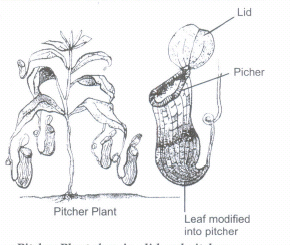
Fig. : Pitcher Plant showing lid and pitcher
(b) Autotrophic and Heterotrophic both.
(c) Partial heterotroph.
3.
Yes, the fungi reproduces by spores which are generally present in the air and grow on any article that are left in hot and humid weather for a long time. During rainy season they land on wet and warm things and begin to germinate and grow.
4.
Roots of pulses (leguminous plants) have a symbiotic association with a bacterium called Rhizobium. This bacteria convert gaseous nitrogen of air into water soluble nitrogen compounds and give them to the leguminous plants for their growth. Hence, farmers need not use nitrogenous tertilisers.
5.
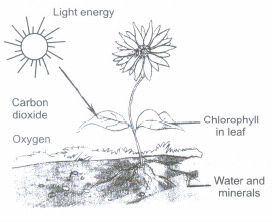
(b) Carbohydrates and oxygen.
(c) Liberated-oxygen, Utilised-carbon dioxide.
(d) All plants cannot do photosynthesis, only green plants can do photosynthesis.
6.
Animals like tiger, wolf, lion and leopard are carnivores and do not eat plants. They hunt and eat herbivorous animals like deer, gaur, bison, zebra, giraffe, etc., which are dependent on plants for food.
If there are no plants, herbivorous animals will not survive and ultimately animals like tiger, wolf, lion and leopard will have nothing to eat.
7.
(a) Fungus are saprophytic organisms usually present as spores in atmosphere which can germinate on any substrate in optimal conditions.
(b) Fungus are also useful in that they produce many antibiotics which can cure different types of infections like penicillin.
(c) Harish is sincere, curious and knowledgeable with a keen sense of applying it where necessary.
8.
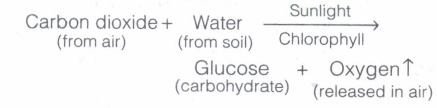
The process by which green plants can prepare their own food is called photosynthesis. Green plants possess chlorophyll in their leaf and utilises carbon dioxide (from air) water, minerals (from soil, through root) as raw material and sunlight as source of energy and convert light energy into chemical energy. The food thus synthesied is in the form of starch (carbohydrate). The overall reaction for photosynthesis can be given as follows:

7th Standard CBSE Syllabus & Materials
7th Standard CBSE
CBSE 7th Social Science Theme B - New Beginnings : Cities and States - New Sample Question Papers Study Material - QB365 Set A
NEW7th Standard CBSE
CBSE 7th Social Science Theme A - Climates of India - New Sample Question Papers Study Material - QB365 Set A
NEW7th Standard CBSE
CBSE 7th Social Science Theme A - Geographical Diversity of India - New Sample Question Papers Study Material - QB365 Set A
NEW7th Standard CBSE
CBSE 7th Science Earth, Moon and the Sun - New Sample Question Papers Study Material - QB365 Set A



CBSE 7th Standard CBSE Subjects
CBSE Standards




