
 100% FREE ACCESS
7th Standard CBSE Syllabus & Materials
7th Standard CBSE
CBSE 7th Social Science Theme E - Understanding Market - New Sample Question Papers Study Material - QB365 Set A
NEW7th Standard CBSE
CBSE 7th Social Science Theme E - From Barter to Money - New Sample Question Papers Study Material - QB365 Set A
NEW7th Standard CBSE
CBSE 7th Social Science Theme D - The Constitution of India- An Introduction - New Sample Question Papers Study Material - QB365 Set A
NEW7th Standard CBSE
CBSE 7th Social Science Theme D - From the Rulers to the Ruled : Types of Governments - New Sample Question Papers Study Material - QB365 Set A
NEW7th Standard CBSE
CBSE 7th Social Science Theme B - The Age of Reorganisation - New Sample Question Papers Study Material - QB365 Set A
NEW7th Standard CBSE
CBSE 7th Social Science Theme B - The Rise of Empires - New Sample Question Papers Study Material - QB365 Set A

Published on: 09/09/2019
Air
Download CBSE Class 7th Standard CBSE Social Science question papers, sample papers, important questions, and previous year solved papers in PDF format. Get free study materials, NCERT solutions, and exam preparation resources for Class 7th Standard CBSE Social Science
Questions + Answers key
Take MCQ Social Science Test
1.
Why do astronauts wear special protective suits when they go to the Moon?
2.
Briefly discuss about the distribution of air pressure in atmosphere.
3.
How do bacteria help plants in using nitrogen?
4.
Briefly explain the composition of the atmosphere.
5.
What is air pressure?
6.
When the air is heated it becomes
Heavier
Lighter
Colder
Warmer
7.
Excess of CO2 is responsible for
Global warming
Global cooling
Both (a) and (b)
None of these
8.
This layer helps in radio transmission.
troposphere
stratosphere
thermosphere
mesosphere
9.
Which one does not happen when air is heated?
It expands
It becomes lighter
It goes up
It comes down
10.
Which of the following gases protects us from harmful Sun rays?
Carbon dioxide
Nitrogen
Ozone
11.
Make a weather calendar for one week. Use pictures or symbols to show different types of weather. You can use more than one symbol in a day, if the weather changes. For example, the sun comes out when rain stops. An example is given below:
12.
Observe the following picture and answer the questions that follow
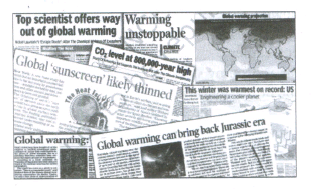
1.Is global warming a serious issue in today's world?
2.In the above newspaper cutting, state one reason for global warming.
3. What is according to you, a way out of global warming
13.
Discuss the different layers of the atmosphere
14.
_____________influences the distribution of temperature.
15.
The upper most layer of atmosphere is known as_____________.
16.
All the weather phenomena occur in_______________.
17.
___________released in the atmosphere creates greenhouse effect.
18.
Plants need_________________ for their survival.
19.
Our Earth receives only 2 in 2000000000 parts of the Sun's energy.
20.
Heavy air rises up and creates a high pressure area.
21.
Local winds blow only during a particular period of the day or year in a small area.
22.
The air always moves from low pressure areas to high pressure areas.
23.
Climate can change from day to day.
24.
How will you define humidity?
25.
What is hot and dry wind of Northern plains of India called?
26.
How does air move?
27.
Where can we find highest air pressure?
28.
There is no air pressure on the Moon. Why?
1.
Astronauts have to wear special protective space suits filled with air when they go to the Moon. If they did not wear these space suits, the counter-pressure exerted by the body of the astronauts would make the blood vessels burst. The astronauts would bleed.
2.
The air pressure is highest at sea level and decreases with height. In areas where temperature is high, the air gets heated and rises. This creates a low pressure area
In areas having lower temperature, the air is cold. It is therefore heavy. Heavy air sinks and creates a high pressure area. The air always moves from high pressure areas to low pressure areas.
3.
Nitrogen is very important for plant's survival. They cannot take nitrogen directly from the air. Bacteria that live in the soil and roots of some plants take nitrogen from the air and change its form, so that plants can use it
4.
Atmosphere consists of mainly nitrogen (78%), oxygen (21 %), argon (0.93%), carbon dioxide (0.03%) and other gases like helium, ozone and hydrogen (0.04%).
5.
The pressure exerted by the weight of air on the Earth's surface is called air pressure.
6.
(b)
Lighter
7.
8.
(a)
troposphere
9.
(d)
It comes down
10.
(c)
Ozone
11.
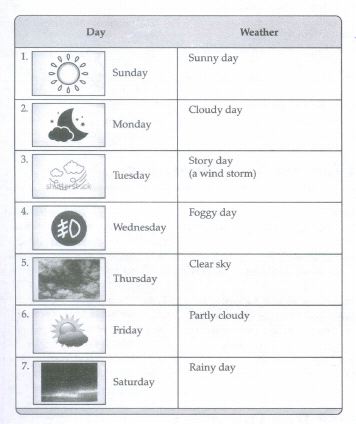
12.
1.Yes, global warming is a serious issues of contemporary world. Due to global warming, temperature on Earth is increasing. If it is not controlled, a day will come when all ice caps will melt and everything will get submerged into water.
2.Overburning of fuels like coal and oil causes the greenhouse effect.
3.Using bio-fuel and tree plantation make ways out of global warming.
13.
The atmosphere is divided into five layers starting from the Earth's surface
(i) Troposphere Its average height is 13 km. The air we breathe exists here. Almost all the weather phenomena like rainfall, fog and hailstorm occur in this layer.
(ii) Stratosphere It lies above the troposphere which extends up to a height of 50 km. This layer is almost free from clouds and associated weather phenomenon, making conditions most ideal for flying aeroplanes. It contains a layer of ozone gas.
(iii) Mesosphere It lies above the stratosphere. It extends up to the height of 80 km. Meteorites burn up in this layer on entering from the space.
(iv) Thermosphere In thermosphere, temperature rises very rapidly with increasing height. Ionosphere is a part of this layer. It extends between 80-400 km. This layer helps in radio transmission. In fact, radio waves transmitted from the Earth are reflected back to the Earth by this layer.
(v) Exosphere This uppermost layer. This layer has very thin air. Light gases like helium and hydrogen float into the space from here.
14.
()
Insolation.
15.
()
Exosphere
16.
()
Troposphere
17.
()
Carbon dioxide
18.
()
nitrogen
19.
(b)
20.
(b)
21.
(a)
22.
(b)
23.
(b)
24.
()
Humidity is the amount of water vapour in the air.
25.
()
The hot and dry wind of Northern plains of India is called l00.
26.
()
The air always moves from high pressure areas to low pressure areas.
27.
()
The air pressure is highest at sea level.
28.
()
There is no air on the Moon and hence, no air pressure on the Moon.

7th Standard CBSE Syllabus & Materials
7th Standard CBSE
CBSE 7th Social Science Theme B - New Beginnings : Cities and States - New Sample Question Papers Study Material - QB365 Set A
NEW7th Standard CBSE
CBSE 7th Social Science Theme A - Climates of India - New Sample Question Papers Study Material - QB365 Set A
NEW7th Standard CBSE
CBSE 7th Social Science Theme A - Geographical Diversity of India - New Sample Question Papers Study Material - QB365 Set A
NEW7th Standard CBSE
CBSE 7th Science Earth, Moon and the Sun - New Sample Question Papers Study Material - QB365 Set A



CBSE 7th Standard CBSE Subjects
CBSE Standards




