
 100% FREE ACCESS
7th Standard CBSE Syllabus & Materials
7th Standard CBSE
CBSE 7th Social Science Theme E - Understanding Market - New Sample Question Papers Study Material - QB365 Set A
NEW7th Standard CBSE
CBSE 7th Social Science Theme E - From Barter to Money - New Sample Question Papers Study Material - QB365 Set A
NEW7th Standard CBSE
CBSE 7th Social Science Theme D - The Constitution of India- An Introduction - New Sample Question Papers Study Material - QB365 Set A
NEW7th Standard CBSE
CBSE 7th Social Science Theme D - From the Rulers to the Ruled : Types of Governments - New Sample Question Papers Study Material - QB365 Set A
NEW7th Standard CBSE
CBSE 7th Social Science Theme B - The Age of Reorganisation - New Sample Question Papers Study Material - QB365 Set A
NEW7th Standard CBSE
CBSE 7th Social Science Theme B - The Rise of Empires - New Sample Question Papers Study Material - QB365 Set A

Published on: 17/10/2019
GEO - Our Changing Earth
Download CBSE Class 7th Standard CBSE Social Science question papers, sample papers, important questions, and previous year solved papers in PDF format. Get free study materials, NCERT solutions, and exam preparation resources for Class 7th Standard CBSE Social Science
Questions + Answers key
Take MCQ Social Science Test
1.
Briefly describe the journey of a river forming waterfalls and flood plains.
2.
Solve the crossword puzzle with the help of given clues.
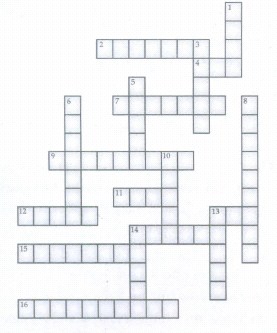
ACROSS
2. Loop like bend of a river.
4. Solid form of water.
7. Moving mass of ice.
9. Sudden descent of water in the bed of a river.
11. Natural cavity on weak rocks formed by action of waves.
12. Embankment on a river that keeps it in its channel.
13. Large body of sea water.
14. Dry area where sand dunes are found.
15. Small hill of sand caused by the action of the wind.
16. Flat plain formed by river deposits during time of flood.
DOWN
1. Rise and fall of water caused by friction of wind on water surface.
3. Flow of water in channel.
5. Steep perpendicular face of rock along sea coast.
6. Debris of boulder and coarse material carried by glacier.
8. Crescent shaped lake formed by meandering river.
10.Fine sand deposited by action of the wind.
13. Isolated mass of rising steep rock near a coastline.
14. Alluvial tracts of land formed by river deposits at the mouth of river.
3.
The 'Earthquake-A case study' given in the form of headlines that appeared in the newspapers after the quake. Arrange the events in the right sequence of their happening.
4.
Write an account on earthquake preparedness.
5.
How sea waves gives rise to coastal landforms?
6.
Discuss the erosional work of river.
7.
Write a note on the work of Sea waves.
8.
Draw a labelled diagram of a volcano.
1.
(i) When the river enters the plain it twists, turns and forms large bends. These bends are known as meanders.
(ii) Due to continuous erosion and deposition along the sides of the meander, the ends of the meander loop comes closer and closer. In due course of the meander loop cuts off from the river and forms a cut-off lake. It is called an ox-bow lake. At times the river overflows its banks. This leads to the flooding of the neighbouring areas. The flood water. deposits layers of fine soil and other materials, called sediments, along its banks. This leads to the formation of a flat fertile land called a flood plain.
(iii) The raised banks are called levees.
(iv) As the river approaches the sea, the speed of the running water decreases. The river begins to break up in number of streams.
2.
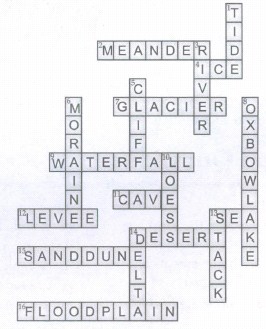
3.
Earthquake- A case study
(i) Earthquake hits Bhuj: A massive earthquake measuring (6.9 on Richter scale hilts Bhuj Town on 26th January 2001.
(ii) School worst affected: At least 971 students and 31 teachers are feared to have lost their lives following the collapse of school buildings
(iii) Bhuj relief effort blighted: Three days after the quake, concern rose about food, blankets; and medical supplies not reaching everyone.
(iv) Destruction of Bhuj: Phone lines, water pipelines and power stations transmissions lines were knocked out.
(v) Fire in the city: Hundreds of fires started as charcoal, cookers overturned
(vi) Emergency declared in quake zone: The president declares a state of emergency.
(vii) CM's appeal to the Centre: Gujarat Chief Minister appeals for financial help. The Chief Minister of Gujarat has launched an appeal for the Centre to deal with the disaster.
4.
Earthquakes cannot be predicted but their impact can be minimised by the preparedness beforehand. Earthquake preparedness also deals with where to take shelter during an earthquake.
It is stated in the following points
(i) Safe Spot Under a kitchen counter, table or desk, against an inside corner or wall.
(ii) Stay Away from Fireplaces, areas around chimneys, windows that shatter including mirrors and picture frames.
(iii) Be Prepared Spread awareness amongst your friends and family members and face any disaster confidently.
5.
i) Sea waves continuously strike at the rocks. Thus, cracks develop. Over time they become larger and wider. Thus, hollow like caves are formed on the rocks. They are called sea caves. As these cavities become bigger and bigger only the roof of the caves remain, thus forming sea arches.
ii) Further, erosion breaks the roof and only walls are left. These walls like features are called stacks. The steep rocky coast rising almost vertically above sea water is called sea cliff. The sea waves deposit sediments along the shores forming beaches.
6.
The following points explain the work of river
(i) When the river tumbles at steep angle over very hard rocks or down a steep valley side it forms a waterfall.
(ii) As the river enters the plain, it twists and turns forming large bends known as meanders.
(iii) With the continuous erosion and deposition along the sides of the meander, the ends of the meander loop come very closer. Over time, the meander loop cuts-off from the river and forms an ox-bow lake.
(iv) At times the river overflows its banks deposited layers of fine soil and other material called sediments along its banks, and formed a flat-fertile floodplain.
(v) The raised banks are called levees.
(vi) As the river approaches the sea, its speed slows down and it forms a number of streams called distributaries.
(vii) The river then begins to deposit its load. Each distributary having its own mouth deposit its load of sediments and forms a delta.
7.
Work of Sea Waves:
(i) Erosion and deposition of the sea wave forms coastal landform.
(ii) They are called sea caves. As cavities become bigger and bigger only the roof of the caves remain. This leads to formation of Sea arches.
(iii) Continuous erosion breaks the roof and only walls are left. These walls like features are called stacks.
(iv) The steep rocky coast rising almost vertically above Sea water is called sea cliff.
(v) The sea waves deposit sediments along the shores. This lead to the formation of Sea beaches.
8.
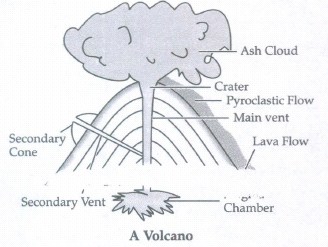

7th Standard CBSE Syllabus & Materials
7th Standard CBSE
CBSE 7th Social Science Theme B - New Beginnings : Cities and States - New Sample Question Papers Study Material - QB365 Set A
NEW7th Standard CBSE
CBSE 7th Social Science Theme A - Climates of India - New Sample Question Papers Study Material - QB365 Set A
NEW7th Standard CBSE
CBSE 7th Social Science Theme A - Geographical Diversity of India - New Sample Question Papers Study Material - QB365 Set A
NEW7th Standard CBSE
CBSE 7th Science Earth, Moon and the Sun - New Sample Question Papers Study Material - QB365 Set A



CBSE 7th Standard CBSE Subjects
CBSE Standards




