
 100% FREE ACCESS
7th Standard CBSE Syllabus & Materials
7th Standard CBSE
CBSE 7th Social Science Theme E - Understanding Market - New Sample Question Papers Study Material - QB365 Set A
NEW7th Standard CBSE
CBSE 7th Social Science Theme E - From Barter to Money - New Sample Question Papers Study Material - QB365 Set A
NEW7th Standard CBSE
CBSE 7th Social Science Theme D - The Constitution of India- An Introduction - New Sample Question Papers Study Material - QB365 Set A
NEW7th Standard CBSE
CBSE 7th Social Science Theme D - From the Rulers to the Ruled : Types of Governments - New Sample Question Papers Study Material - QB365 Set A
NEW7th Standard CBSE
CBSE 7th Social Science Theme B - The Age of Reorganisation - New Sample Question Papers Study Material - QB365 Set A
NEW7th Standard CBSE
CBSE 7th Social Science Theme B - The Rise of Empires - New Sample Question Papers Study Material - QB365 Set A

Published on: 26/09/2019
HIS - Rulers And Buildings
Download CBSE Class 7th Standard CBSE Social Science question papers, sample papers, important questions, and previous year solved papers in PDF format. Get free study materials, NCERT solutions, and exam preparation resources for Class 7th Standard CBSE Social Science
Questions + Answers key
Take MCQ Social Science Test
1.
Why king's destroyed temples of others?
2.
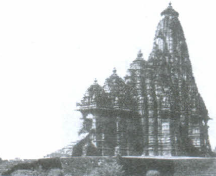
Look at the following figure. How could that building be constructed faster today?
3.
Observe the picture carefully and answer the questions that follow:
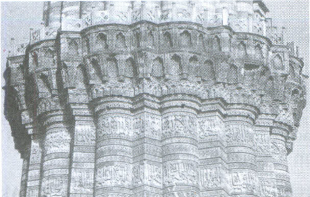
(a) Name the monument whose section is shown in the picture.
(b) Who constructed the monument and when?
(c) What are your observations about the architecture of the monument?
4.
Observe the picture carefully and answer the questions that follow:
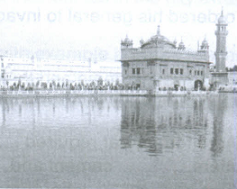
(a) Suggest the other name of the Golden Temple. What does it mean?
(b) Write a short note on the history of the Golden Temple.
5.
Observe the given pictures and answer the question that follows.
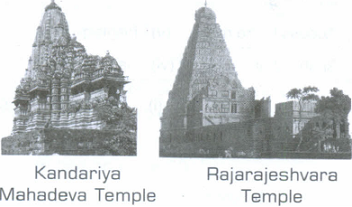
What differences do you notice between the Shikharas of the two temples? Can you make out that the Shikhara of the Rajarajeshvara temple is twice as high as that of the Kandariya Mahadeva?
6.
What was the importance of the royal temples?
7.
Write an account of the regional influence on art.
8.
How was Mughal architecture influenced by regional art?
1.
Kings built temples to demonstrate their devotion to God and their power and wealth. It is not surprising that whenever they attacked one another's kingdoms, they often targeted these temples.
The early 9th century Pandyan king Shrimara Shrivallabha invaded Sri Lanka and defeated Sena I. According to a Buddhist monk and chronicler Dhamma Kitti, " he removed all the valuables" ... The statue of the Buddha made entirely of gold in various monasteries were all seized.
Similarly in the early 11th century, the Chola king Rajendra I built a Shiva temple in his capital and filled it with prized statues seized from defeated rulers.
Sultan Mahmud also destroyed Somnath temple, he there by tried to win credit as a great hero of Islam. In middle ages, most of the rulers displayed their political might and military success by attacking and looting the places of worship of defeated rulers.
2.
The buildings shown in the figure were usually constructed as a matter of pride in old days. It was very difficult to construct them but were made by skillful masons, architects and labourers. The construction took a very long time and a number of labourers to get constructed. But now as technologies have advanced, we have many facilities, equipments, tools which can construct huge buildings very easily and in no time.
3.
(a) The section of monument shown in the picture is of the first balcony of the Qutb Minar.
(b) The first floor of the Qutb Minar was constructed by Qutbuddin Aybak, around 1199 AD and the rest by IItumish around 1229. Firoz Shah Tughluq constructed the fifth and last story.
(c) The following observations regarding the architecture of the monument can be made:
(i) The minar is made of red sandstone with intricate carvings and verses from the Quran.
(ii) All the stories are surrounded by a projected balcony encircling the Minar and supported by stone-brackets, which are decorated with honeycomb design, more conspicuously in the first floor.
(iii) The surface of the minor is curved and angular.
(iv) There are inscriptions all around the tower and these are in Arabic.
(v) It is a great masterpiece of Mughal architecture. This most visited monument in India has now become a World Heritage site.
4.
(a) The Golden Temple is also referred to as the Harmandar Sahib. The Harmandar Sahib literally means the Temple of God. It is the holiest Sikh Gurudwara located in the city of Amritsar, Punjab.
(b) In 1578 CE, Guru Ram Das excavated a tank, which subsequently became known as Amritsar (Pool of the Nectar of Immortality). This holy tank is fed by the Ravi River. The Harmandar Sahib was designed by the fifth guru, Guru Arjan. Guru Arjan completed the Adi Granth, (Guru Granth Sahib) and installed it in the gurudwara. Inside the gurudwara, there are many shrines to past Sikh gurus, saints, and martyrs.
The gurudwara is open to all persons, regardless of their religion, colour, creed or sex. Over 100000 people visit the holy shrine daily for worship. The Harmandar Sahib runs one of the largest free kitchens in the world, serving 100000 people on average daily. Most Sikhs visit Amritsar and the Golden Temple at least once during their lifetime.
5.
Rajarajeshvara temple It had the tallest Shikhara among all of the temples of that time. It has a top of about 90 tonnes. It is a Shiva temple. The quadrangular sanctum has a two-tiered pyramidal roof; in front of the sanctum is the namaskara mandapam. The main Shikhara is the tallest under which the deity of the temple is kept.
Kandariya Mahadeva The Shikhara of this temple is homogeneous. But with time, secondary shikharas, smaller and narrower, were plated on the sides of the main Shikhara. They are heterogeneous shikharas. Some tertiary Sikharas sometimes exist near the ends of the side or in the corners. Under the main Shikhara, the main deity is situated.
6.
The Massive temples were constructed by the kings. In a temple made by Rajarajadeva, worship of one God Rajarajeshvaram honoured another- Rajarajadeva,
The other lesser known deities were the gods and goddesses of the allies and subordinates of the ruler. The temples were the miniature model of the world rules by the king and his allies. As they worshipped the deities together in the temple, it seemed as if the rule of the gods is present on Earth.
7.
Regional influence on Art :
(i) Along with increase in construction activity between the eighth and eighteenth century, there was a significant sharing of ideas across regions.
(ii) The traditions of one region were adopted by the other. In Vrindavan, near Mathura, temples were constructed in architectural style, similar to the Mughal palaces in Fatehpur Sikri. Vijayanagara's architecture was influenced by the Sultanate of Bijapur and Golconda. For example, their elephant stables.
(iii) Mughal rulers were specifically skilled in adapting regional architectural styles in the construction of their own buildings
In Bengal, the local rulers had developed a roof that was designed to resemble a thatched hut.
The Mughals liked this "Bangla dome" to such extent, that they widely used it in architecture.
The impact of other regions was also evident.
In Akbar's capital at Fatehpur Sikri, many of the buildings have the impact of the architectural styles of Gujarat and Malwa.
8.
The creation of large empires that brought different regions under their rule helped in the cross fertilization of artistic forms and architectural styles. Mughal rulers were skilled in adapting regional architectural styles in the construction of their own buildings. For example, in Bengal, rulers had developed a roof that was designed to resemble a thatched hut.
The Mughals liked this "Bangla dome" so much that they used it in their architecture.
In Akbar's capital at Fatehpur Sikri many of the buildings bear the impact of the architectural styles of Gujarat and Malwa.
The authority of the Mughal rulers waned in the eighteenth century; the architectural styles developed under their patronage were constantly used and adapted by other rulers whenever they tried to establish their own kingdoms.

7th Standard CBSE Syllabus & Materials
7th Standard CBSE
CBSE 7th Social Science Theme B - New Beginnings : Cities and States - New Sample Question Papers Study Material - QB365 Set A
NEW7th Standard CBSE
CBSE 7th Social Science Theme A - Climates of India - New Sample Question Papers Study Material - QB365 Set A
NEW7th Standard CBSE
CBSE 7th Social Science Theme A - Geographical Diversity of India - New Sample Question Papers Study Material - QB365 Set A
NEW7th Standard CBSE
CBSE 7th Science Earth, Moon and the Sun - New Sample Question Papers Study Material - QB365 Set A



CBSE 7th Standard CBSE Subjects
CBSE Standards




