
 100% FREE ACCESS
7th Standard CBSE Syllabus & Materials
7th Standard CBSE
CBSE 7th Social Science Theme E - Understanding Market - New Sample Question Papers Study Material - QB365 Set A
NEW7th Standard CBSE
CBSE 7th Social Science Theme E - From Barter to Money - New Sample Question Papers Study Material - QB365 Set A
NEW7th Standard CBSE
CBSE 7th Social Science Theme D - The Constitution of India- An Introduction - New Sample Question Papers Study Material - QB365 Set A
NEW7th Standard CBSE
CBSE 7th Social Science Theme D - From the Rulers to the Ruled : Types of Governments - New Sample Question Papers Study Material - QB365 Set A
NEW7th Standard CBSE
CBSE 7th Social Science Theme B - The Age of Reorganisation - New Sample Question Papers Study Material - QB365 Set A
NEW7th Standard CBSE
CBSE 7th Social Science Theme B - The Rise of Empires - New Sample Question Papers Study Material - QB365 Set A

Published on: 24/09/2019
HIS - The Creation of an Empire the Mughal Dynasty
Download CBSE Class 7th Standard CBSE Social Science question papers, sample papers, important questions, and previous year solved papers in PDF format. Get free study materials, NCERT solutions, and exam preparation resources for Class 7th Standard CBSE Social Science
Questions + Answers key
Take MCQ Social Science Test
1.
What were the main features of Sulh-i-Kul?
2.
How Babur became the ruler of Delhi?
3.
How important was the income from land revenue to the stability of the Mughal Empire?
4.
What were the relationships between the Mansabdar and the Jagir?
5.
Write a note on Akbar Nama and Ain-i Akbari.
6.
How did Aurangzeb expand his empire?
7.
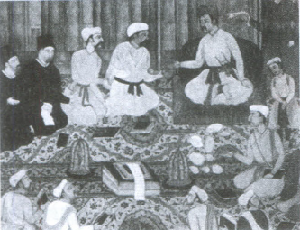
Can you identify the Jesuit priests in the given below picture?
8.
Write a note on Akbar's administrative policies?
9.
Give an account of the Mughal relations with other rulers? How Shivaji reacted against Aurangzeb?
10.
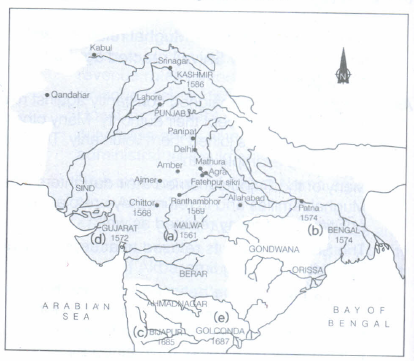
On the map of India, mark the following areas of military campaigns under Akbar and Aurangzeb.
(a) Malwa (1561)
(b) Bengal (1574)
(c) Bijapur (1685)
(d) Gujarat (1572)
(e) Golconda (1687)
1.
The idea of Sulh-i-Kul was introduced by Akbar, the Great. It meant universal peace. Its main features were
(i) This idea was based on the idea of tolerance which did not discriminate between people of different religions in his realm.
(ii) This idea focussed on a system of ethics which included honesty, justice, and peace. These values were universally applicable.
2.
Babur succeeded to the throne of Ferghana in 1494 at the tender age of 12 years. Unfortunately, he had to leave his ancestral throne due to the invasion of the Uzbegs, a Mongol group. He wandered for several years. Then, in 1504, he seized Kabul. In 1526, he defeated the Sultan of Delhi, Ibrahim Lodhi, at the battle of Panipat. Thus, he captured Delhi, where he laid the foundation of the Mughal Empire
3.
Mughal Empire was dependent on land revenue. Without the revenue, nothing could be carried on. The king could not pay the salary to his soldiers. Neither could he do any of the welfare work. The administrative expenditure was so vast that it could be met with the help of revenue. Hence, revenue was important to hold each of the Subas under the Empire.
4.
Mansabdars were the patrons who joined Mughal Services. They received their salaries as revenue assignments. This was called Jagir. Mansabdars did not actually reside in or administer their Jagir.
They only had rights to the revenue of their assignments. The revenue collected for them by their servants, while the mansabdars themselves served in some other part of the country.
5.
Akbar Nama and Ain-i Akbari
(i) Akbar ordered one of his close friends and courtiers, Abul Fazl, to write a history of his reign.
(ii) Abul Fazl wrote a three-volume history of Akbar's reign titled 'Akbar Nama'.
(a) The first volume depicted Akbar's ancestors.
(b) The second volume recorded the events of Akbar's reign.
(c) The third volume is the 'Ain-i Akbari'.
• It deals with Akbar's administration, household, army, the revenues and geography of his empire.
• It also gives details about the traditions and culture of the people living in India.
• The most interesting aspect about the Ain-i Akbari is its rich statistical details about things like crops, yields, prices, wages, and revenues.
6.
(i) In the north-east, the Ahoms were defeated in 1663.
(a) They rebelled again in the 1680s.
(b) Campaigns in the north-west against the Yusufzai and the Sikhs became temporarily successful.
(c) Mughal intervention in the succession and internal politics of the Rathor Rajputs of Marwar gave rise to their rebellion.
(d) Campaigns against the Maratha chieftain Shiva ji, were initially successful. But Aurangzeb insulted Shiva ji, who escaped from Agra, declared himself an independent king and resumed his campaign against the Mughals.
(e) Prince Akbar rebelled against Aurangzeb and received support from the Marathas and the Deccan Sultanates.
(f) He finally fled to Safavid Iran.
(ii) After Akbar's rebellion, Aurangzeb sent armies against the Deccan Sultanates.
(a) Bijapur was annexed in 1685 and Golconda in 1687.
(b) From 1698, Aurangzeb personally managed campaigns in the Deccan against the Marathas who started guerrilla warfare.
(c) Aurangzeb also had to face the rebellion in North India of the Sikhs, Jats, and Satnamis, in the north-east of the Ahoms and in the Deccan of the Marathas.
7.
The two men in the black dress with black cap are the Jesuit priests; At the time of Akbar Jesuits like Fr. Rudolf Acquaviva, Fr. Antony Monserrate and Francis Henriques and many others came to India.
The Society of Jesus is a Christian male religious congregation of the Catholic Church. The members of this society are called the Jesuits. Jesuits work in education, intellectual research, and cultural pursuits. They also promote social justice. They are sometimes referred to as 'God's soldiers.
The headquarter of the above society, its assembly or council is in Rome. These Jesuit priests came on a regular basis to discuss their religion in the Ibadat Khana of Akbar's palace with Akbar and other notable religions priests.
8.
Abul Fazl, in his book Akbar Nama, specially in the third volume named Ain-i-Akbari gave a detailed description of Akbar's administration.
In the book, Abul Fazl explained that the empire was divided into provinces known as Subas, governed by a Subedar. The Subedar carried out both political and military functions.
Each provinces also had a financial officer or Diwan. For the maintenance of peace and order in the province, the Subedar was supported by several officers, like Military Paymaster (Bakhshi) Minister-in-charge of Religious and Charitable Patronage (Sadr). Military Commanders (Faujdars) and the town Police Commander (Kotwal). Akbar's nobles commanded huge armies and had access to large amounts of revenue.
Akbar did not want to discriminate people of different religions, so he gave utmost importance to the idea of tolerance. He accepted the concept of universal peace or Sulh-i-Kul.
9.
Mughal rulers campaigned constantly against rulers who refused to accept their authority. Many other rulers like Rajputs joined them voluntarily. The Rajputs are a good example of this.
Many of the Rajputs married their daughters into Mughal families and in return they are placed in key positions. But many resisted as well.
The Sisodiya Rajputs refused to accept Mughal authority for a long time.
The careful balance between defeating but not humiliating their opponent kings and chieftains enabled the Mughals to expand their kingdoms. But this attitude was not maintained by all the emperors.
Aurangzeb insulted Shivaji when he came to Agra to accept Mughal authority. The consequence of this insult was that Shivaji declared himself an independent king and resumed his rivalry against the Mughals.
10.

7th Standard CBSE Syllabus & Materials
7th Standard CBSE
CBSE 7th Social Science Theme B - New Beginnings : Cities and States - New Sample Question Papers Study Material - QB365 Set A
NEW7th Standard CBSE
CBSE 7th Social Science Theme A - Climates of India - New Sample Question Papers Study Material - QB365 Set A
NEW7th Standard CBSE
CBSE 7th Social Science Theme A - Geographical Diversity of India - New Sample Question Papers Study Material - QB365 Set A
NEW7th Standard CBSE
CBSE 7th Science Earth, Moon and the Sun - New Sample Question Papers Study Material - QB365 Set A



CBSE 7th Standard CBSE Subjects
CBSE Standards




