
 100% FREE ACCESS
7th Standard CBSE Syllabus & Materials
7th Standard CBSE
CBSE 7th Social Science Theme E - Understanding Market - New Sample Question Papers Study Material - QB365 Set A
NEW7th Standard CBSE
CBSE 7th Social Science Theme E - From Barter to Money - New Sample Question Papers Study Material - QB365 Set A
NEW7th Standard CBSE
CBSE 7th Social Science Theme D - The Constitution of India- An Introduction - New Sample Question Papers Study Material - QB365 Set A
NEW7th Standard CBSE
CBSE 7th Social Science Theme D - From the Rulers to the Ruled : Types of Governments - New Sample Question Papers Study Material - QB365 Set A
NEW7th Standard CBSE
CBSE 7th Social Science Theme B - The Age of Reorganisation - New Sample Question Papers Study Material - QB365 Set A
NEW7th Standard CBSE
CBSE 7th Social Science Theme B - The Rise of Empires - New Sample Question Papers Study Material - QB365 Set A

Published on: 24/09/2019
HIS - The Delhi Sultans
Download CBSE Class 7th Standard CBSE Social Science question papers, sample papers, important questions, and previous year solved papers in PDF format. Get free study materials, NCERT solutions, and exam preparation resources for Class 7th Standard CBSE Social Science
Questions + Answers key
Take MCQ Social Science Test
1.
Which types of taxes were there during Delhi Sultanate? Which right of local chieftain was canceled during Khalji empire?
2.
How did the chieftains arrange for their defence?
3.
Who was Raziyya? Why was she not accepted as a Sultan inspite of being talented?
4.
What Minhaj-i-Siraj thought about Raziyya?
5.
Why was Muhammad-bin-Iughluq known as "Man of ideas but a failure as an administrator"?
6.
What were the administrative measures taken by Alauddin Khalji to check the prices and supply of goods for his large standing army?
7.
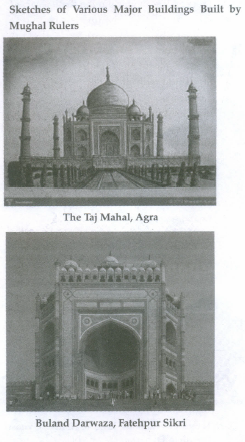
Find out whether there are any buildings built by the Delhi Sultans in your area. Are there any other buildings in your area that were built between the twelfth and fifteenth centuries? Describe some of these buildings and draw sketches of them.
8.
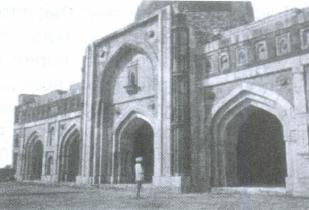
Compare figures 1, 2, 3 and 4. What similarities and differences do you notice amongst the mosques?
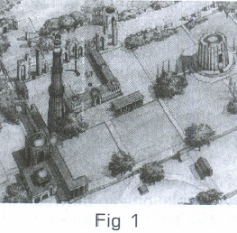
Quwwat aI-Islam mosque and minaret, built during the last decade of the 12th century. This was the congregational mosque of the first city built by the Delhi Sultans described in the chronicles as Delhi-i-Kuhna (the old city). The mosque was enlarged by IItutmish and Alauddin Khalji. The minar was built by two Sultans. Qutbuddin Aybak and IItutmish.
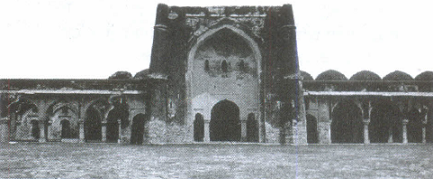
Begumpuri mosque built in the reign of Muhammad Tughluq was the main mosque of Jahanpanah the 'Sanctuary of the World' his new capital in Delhi.
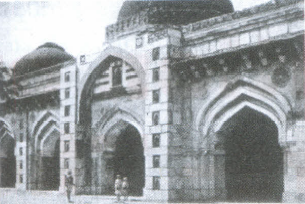
Moth ki Masjid, built in the reign of Sikandar Lodi by his minister.
9.
What is called a masjid? Explain the contribution of Delhi Sultans in building different masjids.
10.
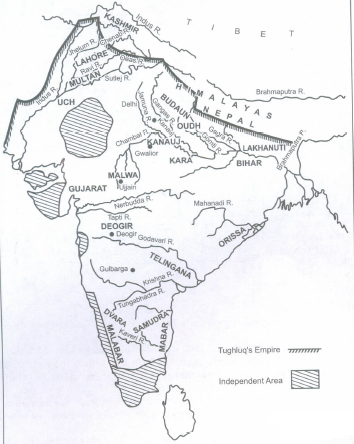
On an outline map of India, identify the provinces of Delhi Sultanate during Muhammad Tughlaq's reign and write their names near their locations
1.
There were three kinds of taxes during Delhi Sultanate. These were
(i) Tax on cultivation (known as kharaj) which was about 50 percent of the peasant's produce.
(ii) Tax on the cattle
(iii) Tax on houses
At the time of Alauddin Khalji, the state brought the assessment and collection of land revenue under its own control. Thus, the rights of the local chieftains to levy taxes were cancelled and they were forced to pay taxes.
2.
The chieftains fortified themselves in long mountains in rocky, uneven and rugged places as well as in bamboo groves. In India, the bamboo is big and it was strong. Even fire could not affect it because its groups were intertwined making them very strong. They kept everything necessary for life such as cattle, crops, water, etc inside the forests. Thus, they were safe and only powerful armies could subdue them.
3.
Raziyya became Sultan of Delhi Sultanate in 1236. According to Minhaj-i-Siraj, she was more able and qualified than all tier brothers. Many including the nobles did not feel comfortable to share things with her. Those were the days when women were not allowed to enjoy independent identity. This led to her removal in 1240.
4.
Minhaj-i-Siraj thought that the Raziyya Sultan's rule went against the ideal social order created by God, in which women were supposed to be subordinate to men. Although he recognised that she was more able and qualified than all her brothers. But Siraj was not comfortable at having a queen as ruler. Thus, he suggested that in the register of God's creation, since her account did not fall under the column of men, it was not possible for her to gain from all of her excellent qualities.
5.
Muhammad bin Tughluq was a learned man, a philosopher and student of science and math. His ideas about "token currency" and "central capital" were good but failed miserably as administrative measures:
After he defeated Mongol Army, he planned to raise large army to attack on Transoxiana. But his campaign into Kashmir was a disaster. He had to disband his large army as well as his plans to conquer Mongols.
He asked residents of Dehli-i-Kuhna to vacate the city for his soldiers and move to new capital Daulatabad in the south. It resulted in another failure and resentment among the citizens.
To feed his army, he levied additional taxes which coincided with famine in the area. It led to widespread rebellion in Ganga-Yamuna belt.
To control prices, he introduced a 'token currency'. People did not trust these new coins but they outsmarted the king and paid the taxes in new currency. This cheap currency could also be counterfeited easily. Finally, the 'token currency' had to be recalled.
6.
Alauddin Khalji executed the following administrative measures:
(i) He constructed a new garrison town known as Siri for his soldiers.
(ii) He fixed 50 per cent of the peasant's yield for the Ganga Yamuna lands.
(iii)The soldiers were paid salaries instead of iqtas. The soldiers would buy their supplies from merchants in Delhi.
(iv) The prices of the goods in Delhi were regulated. Merchants were asked to sell at prescribed rates.
(v) Prices were carefully surveyed by officers, and merchants who did not sell at the prescribed rates were punished.
7.
There are very few buildings in our area made by Delhi Sultans. One is [ama 'Masjid in Shaikhon Ka Mohalla at Fatehpur Sikri. Another one is also a mosque in Mohalla Sheikh Chutwa. This mosque was built by Alauddin Khilji. There is also a tomb of Makkdum Shah. Other buildings made by Delhi Sultans in our area were destroyed by Mughal rulers and they made their forts on the remains of these buildings.
The [ama Masjid has three ways, each terminated by an ogival mehrab. The central one is more deeply carved than the others, contains a perforated stone screen with a stylish eight petalled lotus and enclosed within an ogee. The blank spaces are filled by rosettes, above all the Kalirna is inscribed in naksh lettering and on either side, Quranic verses.
8.
The mosques in Fig. 2, 3 and 4 show an evolution in the architectural tradition that culminates in Shah Jahan's mosque in Delhi. In Fig. 1 the earlier mosque is shown which is plain and rough. Only a centre hall mosque is there. Thereafter, in fig. 2, the mosque had many supporting masjids in the left and right side of the main hall.
Fig. 3 Moth ki Masjid, showed many soft skills, craftwork carved on the pillars, walls, Arabic calligraphy. The facade was decorated with Arabic calligraphy and vegetal motifs in the fig. 3 and 4. Craftsmen used corbelled arches, a technique commonly used in India. Different types of red sandstone marble were used to create such monuments. These all spoke highly about the art and culture that flourished during the Delhi Sultanate.
9.
A mosque is called a masjid in Arabic, literally, it is a place where a Muslim prostrates in reverence to Allah. In a congregational mosque, Muslim read their prayers. Members of the congregation choose the most respected, learned male as their leader or Imam for the rituals of prayer-Imam delivers the sermon (Khutba) during Friday prayer.
The Delhi Sultans build several mosques in cities all over the subcontinent.
They wanted to claim themselves as protectors of Islam and Muslims. Mosques also helped to create the senses of a community of believers who shared a common code of conduct and belief.
Quwwat al-islam was built by Qutbuddin Aybak and IItutmish. Muhammad Tughluq constructed Begumpuri mosque. Moth ki Masjid built by a minister of Sikandar Lodi, Mosque of Jamali Kamali was also built in the late 1520s.
10.

7th Standard CBSE Syllabus & Materials
7th Standard CBSE
CBSE 7th Social Science Theme B - New Beginnings : Cities and States - New Sample Question Papers Study Material - QB365 Set A
NEW7th Standard CBSE
CBSE 7th Social Science Theme A - Climates of India - New Sample Question Papers Study Material - QB365 Set A
NEW7th Standard CBSE
CBSE 7th Social Science Theme A - Geographical Diversity of India - New Sample Question Papers Study Material - QB365 Set A
NEW7th Standard CBSE
CBSE 7th Science Earth, Moon and the Sun - New Sample Question Papers Study Material - QB365 Set A



CBSE 7th Standard CBSE Subjects
CBSE Standards




