
 100% FREE ACCESS
7th Standard CBSE Syllabus & Materials
7th Standard CBSE
CBSE 7th Social Science Theme E - Understanding Market - New Sample Question Papers Study Material - QB365 Set A
NEW7th Standard CBSE
CBSE 7th Social Science Theme E - From Barter to Money - New Sample Question Papers Study Material - QB365 Set A
NEW7th Standard CBSE
CBSE 7th Social Science Theme D - The Constitution of India- An Introduction - New Sample Question Papers Study Material - QB365 Set A
NEW7th Standard CBSE
CBSE 7th Social Science Theme D - From the Rulers to the Ruled : Types of Governments - New Sample Question Papers Study Material - QB365 Set A
NEW7th Standard CBSE
CBSE 7th Social Science Theme B - The Age of Reorganisation - New Sample Question Papers Study Material - QB365 Set A
NEW7th Standard CBSE
CBSE 7th Social Science Theme B - The Rise of Empires - New Sample Question Papers Study Material - QB365 Set A

Published on: 03/10/2019
HIS - The Making of Regional Cultures
Download CBSE Class 7th Standard CBSE Social Science question papers, sample papers, important questions, and previous year solved papers in PDF format. Get free study materials, NCERT solutions, and exam preparation resources for Class 7th Standard CBSE Social Science
Questions + Answers key
Take MCQ Social Science Test
1.
Observe the question given below and answer the questions that follow
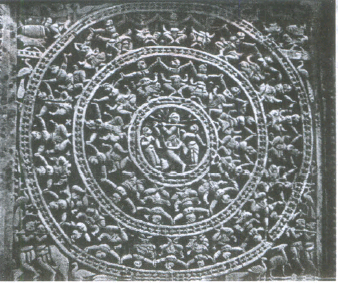
(a) What is depicted in the picture?
(b) In which temple can this picture be found?
2.
Write elaborately on the Miniature paintings in the Himalayan foothills.
3.
Describe the development of temples in Bengal.
4.
How did regional cultures grow around religious traditions?
5.
Describe about the Kathak, a popular dance form of North India.
6.
What do you know about Rajput tradition of heroism? Write in brief.
1.
(a) In the given picture Lord Krishna is depicted with gopis.
(b) This picture can be found in Shyama raga temple of Vishnupur.
2.
Miniatures are painted in brilliant colours and has an important place in historical informations.
(i) A region that attracted miniature paintings was the Himalayan foothills around the modern day state of Himachal Pradesh.
(ii) By the late 17th century, the Himalayan region had developed a bold and intense style of miniature painting called basohli.
(iii) Due to the invasion of Nadir Shah the artists migrated to the hills where they found patrons and thus developed Kangra school of painting in the mid 1Sth century.
(iv) Following the Vaishnavite traditions it used soft colours including cool blues and greens, and a lyrical treatment of themes distinguished Kangra painting from other paintings.
(v) Miniature paintings were carefully preserved in palaces.
3.
Thefollowing points explain the development of temples in the Bengal region
(i) The temples and various other religious structures were often built by individuals or groups who were becoming powerful to demonstrate their power and proclaim their piety as well.
(ii) Many of the modest brick and terracotta temples in Bengal were built with the support of several 'low' social groups, like Kolu (oil pressers) and the Kansari (bell metal workers).
(iii) When local deities, gained the recognition of the Brahmanas, their images began to be honoured in temples.
(iv) The temples began to copy the double roofed or four roofed thatche huts.
(v) Temples were built on raised square platforms. For example, Dakshineshwar Kali Temple. Outer walls were decorated with paintings, ornamental tiles or terrocotta tablets. Vishnupur in the Bankura district of West Bengal has a remarkable set of temples decorated with terracotta reliefs.
4.
Each region is associated with distinctive kinds of foods, clothes, poetry, dance, music and paintings. Social attributes contributed to the growth of regional cultures. Religious traditions became the centre of the growth of regional cultures.
The best example of this process is the cult of Jagannatha (a name for Vishnu) at Puri, Orissa. Anantavarman, decided to construct a temple. for Purushottama Jagannatha at Puri. In 1230, king Anangabhima III dedicated his kingdom to the deity. He proclaimed himself as the 'Deputy' of the God. With the temple gaining importance as a centre of pilgrimage, its authority in social and political matters also increased.
Those rulers who conquered Orissa, like the Mughals, the Marathas and the English East India Company, attempted to gpin control over the temple. They felt that this would make their rule acceptable to local people.
5.
The term Kathak is derived from 'katha', a word used in Sanskrit and other languages for story. The Kathaks were originally a caste of story-tellers in temples of North India, who beautified their performances with gestures and songs.
Kathak began evolving into a distinct mode of dance in the fifteenth and sixteenth centuries with the spread of the bhakti movement.
Kathak was performed in the Mughal court. Here it acquired its present features and developed into a form of dance with a distinctive style. Afterwards, it developed in two traditions or gharanas : one in the courts of Rajasthan (Iaipur) and the other in Lucknow.
Kathak grew into a major art form, under the patronage of Wajid Ali Shah, the last Nawab of Awadh. By the third quarter of the nineteenth century it was firmly entrenched as a dance form not only in these two regions, but also in adjoining areas of present-day Punjab, Haryana, Jammu and Kashmir, Bihar and Madhya Pradesh.
British administrators disfavoured Kathak. However, it survived and continued to be performed by courtesans, and was recognised as one of six "classical" forms of dance in the country after independence.
6.
Rajputs are closely associated with the culture of Rajasthan.
These cultural traditions were closely linked with the ideals and aspirations of rulers. Rajasthan was ruled by various Rajput families. The name of the Prithviraj is worth mentioned, because he was one of the ablest Rajput ruler.
These rulers cherished the ideal of the hero who fought valiantly, often choosing death on the battlefield rather than face defeat.
Stories about Rajput heroes were recorded in poems and songs, which were recited by specially trained minstrels. These preserved the memories of heroes and were expected to inspire others to follow their example.
Ordinary people were also attracted by these stories which often depicted dramatic situations, and a range of strong emotions -loyalty, friendship, love, valour, and anger.

7th Standard CBSE Syllabus & Materials
7th Standard CBSE
CBSE 7th Social Science Theme B - New Beginnings : Cities and States - New Sample Question Papers Study Material - QB365 Set A
NEW7th Standard CBSE
CBSE 7th Social Science Theme A - Climates of India - New Sample Question Papers Study Material - QB365 Set A
NEW7th Standard CBSE
CBSE 7th Social Science Theme A - Geographical Diversity of India - New Sample Question Papers Study Material - QB365 Set A
NEW7th Standard CBSE
CBSE 7th Science Earth, Moon and the Sun - New Sample Question Papers Study Material - QB365 Set A



CBSE 7th Standard CBSE Subjects
CBSE Standards




