
 100% FREE ACCESS
7th Standard CBSE Syllabus & Materials
7th Standard CBSE
CBSE 7th Social Science Theme E - Understanding Market - New Sample Question Papers Study Material - QB365 Set A
NEW7th Standard CBSE
CBSE 7th Social Science Theme E - From Barter to Money - New Sample Question Papers Study Material - QB365 Set A
NEW7th Standard CBSE
CBSE 7th Social Science Theme D - The Constitution of India- An Introduction - New Sample Question Papers Study Material - QB365 Set A
NEW7th Standard CBSE
CBSE 7th Social Science Theme D - From the Rulers to the Ruled : Types of Governments - New Sample Question Papers Study Material - QB365 Set A
NEW7th Standard CBSE
CBSE 7th Social Science Theme B - The Age of Reorganisation - New Sample Question Papers Study Material - QB365 Set A
NEW7th Standard CBSE
CBSE 7th Social Science Theme B - The Rise of Empires - New Sample Question Papers Study Material - QB365 Set A

Published on: 30/07/2019
The Creation of an Empire the Mughal Dynasty
Download CBSE Class 7th Standard CBSE Social Science question papers, sample papers, important questions, and previous year solved papers in PDF format. Get free study materials, NCERT solutions, and exam preparation resources for Class 7th Standard CBSE Social Science
Questions + Answers key
Take MCQ Social Science Test
1.
Describe the Mughal traditions of succession.
2.
How did the Mughals become successful in ruling the subcontinent?
3.
Aurangzeb insulted Shivaji when he declared himself an independent king and resumed campaigns against the British. What was the consequence of it?
4.
Analyse the Mughal relations with other rulers, especially the Rajputs.
5.
Peasants were vital for the economy of the Mughal Empire. Do you think that they are as important today? Has the gap in the income between the rich and the poor in India changed a great deal from the period of the Mughals?
6.
Aurangzeb insulted:
Maharana Pratap
Sher Shah
Ranjit Singh
Shivaji
7.
In which year, Humayun recaptured Delhi?
1552
1553
1554
1555
8.
Ranthambhor was seized during the reign of
Humayun
Akbar
Jahangir
Shah Jahan
9.
The Sisodiya capital of Chittor was seized in the year
1565
1568
1570
1562
10.
Orchha was seized during the reign of
Aurangzeb
Shah Jahan
Akbar
Humayun
11.
What was zabt?
12.
How Prince Khurram is better known as in the Indian History?
13.
Who is a mansabdar?
14.
Who fought Guerrilla warfare?
15.
Why the rulers of the middle ages faced difficulties to rule the Indian subcontinent?
16.
Write a note on Akbar Nama and Ain-i Akbari.
17.
Write a note on Akbar's administrative policies?
18.
_____________was the revenue minister of Akbar.
19.
The regent of Akbar was ________
20.
The Red Fort at Delhi was the residence of ____________ Emperors.
21.
Many Rajputs married their daughters into Mughal families in order to get ____________
22.
Humayun recaptured Delhi in 1555 with the help of __________
23.
Town Police Commanders were known as Kotwals.
24.
Akbar was the regent of Bairam Khan
25.
Babur was defeated at Chausa
26.
Military Commanders were also known as Faujdars.
27.
Military paymasters were known by the name Bakhshi.
28.
Shahjahan
29.
Akbar Nama
30.
Akbar
31.
Humayun
32.
Babur
33.
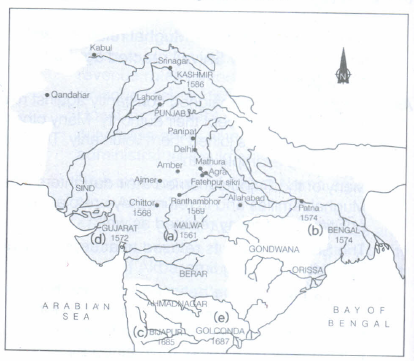
On the map of India, mark the following areas of military campaigns under Akbar and Aurangzeb.
(a) Malwa (1561)
(b) Bengal (1574)
(c) Bijapur (1685)
(d) Gujarat (1572)
(e) Golconda (1687)
1.
Mughal Traditions of Succession:
(i) The Mughals did not believe in the rule of primogeniture (inheritance).
(ii) Instead, they followed the Mughal and Timurid custom of coparcenary inheritance. It is a division of the inheritance amongst all the sons.
(iii) Mughal princess rebelled against their fathers, overthrew them and captured power.
2.
(i) Contrary to their predecessors, the Mughals created an empire and ruled over it for a long period of time.
(ii) From the later half of the sixteenth century, they expanded their kingdom from Agra and Delhi up to the seventeenth century.
(iii) They controlled nearly the entire subcontinent.
(iv) They imposed structure of administration and idea of governance.
(v) They outlasted their rule, leaving a political legacy that succeeding rulers of the subcontinent could not ignore.
3.
Shivaji went to Agra to accept the Mughal authority. But after being insulted by Auranqzeb, Shivaji resumed his campaigns against the Mughals. Prince Akbar rebelled against Aurangzeb and received support from the Marathas and the Deccan Sultanate. He finally fled to Safavid, Iran. From 1698, Aurangzeb personally managed campaigns in the Deccan against the Marathas who started Guerrilla warfare which was difficult to suppress.
4.
The Mughal rulers constantly campaigned against rulers who were not ready to accept their authority. Gradually, when the Mughals became powerful, many other rulers joined them willingly.
Many Rajputs offered their daughters into Mughal families in order to gain high positions or offices. The Sisodiya Rajputs refused to accept Mughal authority for a long time. Mughals never humiliated their opponents, even though they got defeated by them. This quality enabled them to extend their influence.
5.
Agriculture plays a vital role in Indian economy. Peasants are important today as they were during the Mughal Empire. They pay land revenue to the government which is used in various policies, grants, subsidies, projects. During the Mughal rule, all were virtually agriculturists. No other source of income was different from that of agriculture. So, the income gap between rich and poor was not so much as is today. Now, people find more income based jobs other than agriculture. Still, peasants are important today as more than 55 percent of the population of our country is agriculturists. Agriculture and allied sectors like forestry and fisheries accounted for 13.7 percent of the GDP.
6.
(d)
Shivaji
7.
(d)
1555
8.
(b)
Akbar
9.
(b)
1568
10.
(b)
Shah Jahan
11.
()
It was the revenue collected on the basis of schedule of revenue rates for individual crops.
12.
()
Prince Khurram is better known as Emperor Shahjahan in the Indian History
13.
()
Mansabdar refers to an individual who holds a mansab i.e. a position or rank in Mughal administration.
14.
()
The Marathas started Guerrilla warfare against the Mughals.
15.
()
It was because people of diverse backgrounds and cultures lived in the Indian subcontinent
16.
Akbar Nama and Ain-i Akbari
(i) Akbar ordered one of his close friends and courtiers, Abul Fazl, to write a history of his reign.
(ii) Abul Fazl wrote a three-volume history of Akbar's reign titled 'Akbar Nama'.
(a) The first volume depicted Akbar's ancestors.
(b) The second volume recorded the events of Akbar's reign.
(c) The third volume is the 'Ain-i Akbari'.
• It deals with Akbar's administration, household, army, the revenues and geography of his empire.
• It also gives details about the traditions and culture of the people living in India.
• The most interesting aspect about the Ain-i Akbari is its rich statistical details about things like crops, yields, prices, wages, and revenues.
17.
Abul Fazl, in his book Akbar Nama, specially in the third volume named Ain-i-Akbari gave a detailed description of Akbar's administration.
In the book, Abul Fazl explained that the empire was divided into provinces known as Subas, governed by a Subedar. The Subedar carried out both political and military functions.
Each provinces also had a financial officer or Diwan. For the maintenance of peace and order in the province, the Subedar was supported by several officers, like Military Paymaster (Bakhshi) Minister-in-charge of Religious and Charitable Patronage (Sadr). Military Commanders (Faujdars) and the town Police Commander (Kotwal). Akbar's nobles commanded huge armies and had access to large amounts of revenue.
Akbar did not want to discriminate people of different religions, so he gave utmost importance to the idea of tolerance. He accepted the concept of universal peace or Sulh-i-Kul.
18.
()
Todar Mal
19.
()
Bairam Khan
20.
()
Mughal
21.
()
high positions
22.
()
Safavid Shah
23.
(a)
24.
(b)
25.
(b)
26.
(a)
27.
(a)
28.
()
Prince Khurram
29.
()
Abul Fazl
30.
()
His half-brother Mirza Hakim
31.
()
SherKhan defeated him
32.
()
Defeated Ibrahim Lodi
33.

7th Standard CBSE Syllabus & Materials
7th Standard CBSE
CBSE 7th Social Science Theme B - New Beginnings : Cities and States - New Sample Question Papers Study Material - QB365 Set A
NEW7th Standard CBSE
CBSE 7th Social Science Theme A - Climates of India - New Sample Question Papers Study Material - QB365 Set A
NEW7th Standard CBSE
CBSE 7th Social Science Theme A - Geographical Diversity of India - New Sample Question Papers Study Material - QB365 Set A
NEW7th Standard CBSE
CBSE 7th Science Earth, Moon and the Sun - New Sample Question Papers Study Material - QB365 Set A



CBSE 7th Standard CBSE Subjects
CBSE Standards




