
 100% FREE ACCESS
7th Standard CBSE Syllabus & Materials
7th Standard CBSE
CBSE 7th Social Science Theme E - Understanding Market - New Sample Question Papers Study Material - QB365 Set A
NEW7th Standard CBSE
CBSE 7th Social Science Theme E - From Barter to Money - New Sample Question Papers Study Material - QB365 Set A
NEW7th Standard CBSE
CBSE 7th Social Science Theme D - The Constitution of India- An Introduction - New Sample Question Papers Study Material - QB365 Set A
NEW7th Standard CBSE
CBSE 7th Social Science Theme D - From the Rulers to the Ruled : Types of Governments - New Sample Question Papers Study Material - QB365 Set A
NEW7th Standard CBSE
CBSE 7th Social Science Theme B - The Age of Reorganisation - New Sample Question Papers Study Material - QB365 Set A
NEW7th Standard CBSE
CBSE 7th Social Science Theme B - The Rise of Empires - New Sample Question Papers Study Material - QB365 Set A

Published on: 27/07/2018
Based on the current academic syllabus, some of the important questions are prepared from the chapter Fractions and Decimals.
Teachers can prepared question paper with answer key within five minutes. Please Click Here for subscribe.
Download CBSE Class 7th Standard CBSE Mathematics question papers, sample papers, important questions, and previous year solved papers in PDF format. Get free study materials, NCERT solutions, and exam preparation resources for Class 7th Standard CBSE Mathematics
Questions + Answers key
Take MCQ Mathematics Test
1.
Multiply and reduce to lowest form (if possible).\(\frac{1}{3}\times \frac{15}{8}\)
2.
Fill in these boxes \(\frac{1}{5}\times \frac{1}{7}=\boxed {}=\boxed {}\)
3.
Multiply and express as a mixed fraction.\(3\frac{2}{5}\times 8\)
4.
Multiply and reduce to lowest form and convert into a mixed fraction.\(15\times \frac{3}{5}\)
5.
Multiply and reduce to lowest form and convert into a mixed fraction.\( \frac{5}{2}\times6\)
6.
Simplify \(\frac{4}{9}-\frac{4}{11}+\frac{1}{2}\)
7.
Solve \(\frac{7}{10}+\frac{2}{5}+\frac{3}{2}\)
8.
Solve \(\frac{3}{5}+\frac{2}{7}\)
9.
What should be subtracted from \(\frac{21}{32}\) to get \(\frac{9}{16}\)?
10.
What should be added to 4\(\frac{1}{5}\) to get \(6\frac{2}{5}\)?
11.
Ritu ate \(\frac{3}{5}\) part of an apple and the remaining apple was eaten by her brother Somu. How much part of the apple did Somu eat? Who had the larger share?By how much?
12.
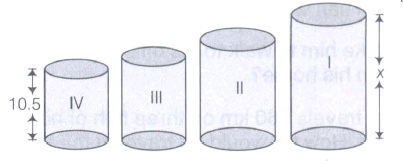
There are four containers that are arranged in the ascending order of their heights. If the height of the smallest container given in the figure is expressed as \(\frac{7}{25}x=10.5\)cm.Find the height of the largest container.
13.
Which of the drawings (a) to (d) show
(i)\(2\times \frac{1}{5}\)(ii)\(2\times \frac{1}{2}\) (iii) \(3\times \frac{2}{3}\) (iv) \(3\times \frac{1}{4}\)
a)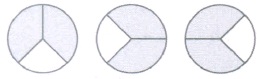 b)
b) 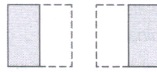
c)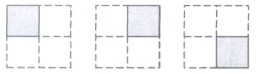 d)
d) 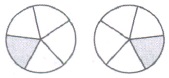
14.
To divide a decimal number by 1000, we have the decimal point in the number to the left by three places.
15.
1 is the only number which has its own reciprocal.
16.
\(\frac{5}{12}\)part of what amount will be equal to 3\(\frac{3}{4}\) part of Rs 100?
Rs 900
Rs 940
Rs 875
Rs 925
17.
Which of the following represents \(\frac{1}{3}\)of\(\frac{1}{6}\)?
\(\frac{1}{3}+\frac{1}{6}\)
\(\frac{1}{3}-\frac{1}{6}\)
\(\frac{1}{3}\times \frac{1}{6}\)
\(\frac{1}{3}\div \frac{1}{6}\)
18.
The product of \(\frac{11}{13}\) and 4 is
\(3 \frac{5}{13}\)
\(5\frac{3}{13}\)
\(13\frac{5}{5}\)
\(13\frac{5}{3}\)
19.
\(\frac{2}{5}\times 5\frac{1}{5}\) is equaI to
\(\frac{26}{25}\)
\(\frac{52}{25}\)
\(\frac{2}{5}\)
6
20.
The picture interprets
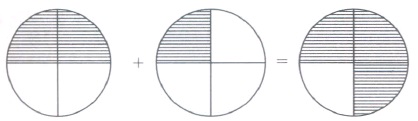
\(\frac{1}{3} \div 4\)
\(3\times \frac{1}{4}\)
\(\frac{3}{4}\times 4\)
\(3\div\frac{1}{3}\)
21.
\(\frac{4}{5} \div 4\)is equal to ________
22.
The lowest form of the product \(2\frac{3}{7}\times \frac{7}{9}\) is _________
23.
\(\frac{3}{4}\)of 27 is __________
1.
We have, \(\frac{1}{3} \times \frac{15}{8}=\frac{1\times 15}{3\times 8}=\frac{15}{24}=\frac{5}{8}\) [dividing numerator and denominator by 3]
2.
The complete boxes are shown below:
\(\frac{1}{5}\times \frac{1}{7}=\boxed {\frac{1\times 1}{5\times 7}}=\boxed {\frac{1}{35}}\)
3.
Mixed fraction = 27\(\frac{1}{5}\)
4.
We have, \(15\times \frac{3}{5}=\frac{15\times 3}{5}=\frac{45}{5}=\frac{9}{1}=9\)
This is the required lowest form.
5.
We have,\( \frac{5}{2}\times6=\frac{5\times 6}{2}=\frac{30}{2}=\frac{15}{1}=15\)
This is the required lowest form.
6.
\(\frac{115}{198}\)
7.
We have, \(\frac{7}{10}+\frac{2}{5}+\frac{3}{2}\)
\(\therefore \frac{7}{10}+\frac{2}{5}+\frac{3}{2}=\frac{7+4+15}{10}\)
=\(\frac{26}{10}=\frac{13}{5}\)
[dividing numerator and denominator by 2]
8.
We have, \(\frac{3}{5}+\frac{2}{7}\)
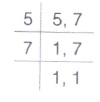
LCM of 5 and 7 = 5X7 = 35
∴ \(\frac{3}{5}+\frac{2}{7}=\frac{3\times 7+2\times 5}{35}\)
=\(\frac{21+10}{35}=\frac{31}{35}\)
9.
\(\frac{3}{32}\)
10.
\(\frac{11}{5}\)
11.
Let an apple be 1 part. Rim ate \(\frac{3}{5}\)part of an apple.
Now, remaining part=1-\(\frac{3}{5}\)=\(\frac{1}{1}-\frac{3}{5}=\frac{1\times 5-3\times 1}{5}\)
=\(\frac{5-3}{5}=\frac{2}{5}\)
So, Somu ate 2/5 part of an apple.
∵ 3>2 [numerators of fractions]
∴ \(\frac{3}{5}\)>\(\frac{2}{5}\)
i.e. Riru had larger share.
Now, d'ifference between theeilr shares=\(\frac{3}{5}\)-\(\frac{2}{5}\)=\(\frac{3-2}{5}=\frac{1}{5}\)
Hence, Ritu had the larger share which is \(\frac{1}{5}\) more than Sornu's share.
12.
Given figure is expressed as \( \frac{7}{25}x=10.5\)
From the figure (I), the height of the largest container is x.
So, if we find the value of x, then we find the height of the container (largest).
\(⇒ \frac{7}{25}x=10.5\)
x=\(\frac{10.5}{1}\times \frac{25}{7}=\frac{10.5\times 25}{7}=\frac{262.5}{7}=37.5 cm\)
Hence, height of the container is 37.5. cm
13.
(i)We have, \(2\times \frac{1}{5}= \frac{2}{5} or \frac{1}{5}+ \frac{1}{5}\)
It shows that, out of 5 parts of two figures, one part is shaded, which is shown in figure (d),
(ii) WQe have, \(2\times \frac{1}{2}= \frac{2}{2} or \frac{1}{2}+ \frac{1}{2}\)
It shows that, out of 2 parts of two figures, one part is shaded, which is shown in figure (b),
(iii) We have, \(3\times \frac{2}{3}= \frac{6}{3} or \frac{2}{3}+ \frac{2}{3}+\frac{2}{3}\)
It shows that, out of 3 parts of three figures, 2 parts are shaded, which is shown in figure (a),
(iv) We have, \(3\times \frac{1}{4}= \frac{3}{4} or \frac{1}{4}+ \frac{1}{4}+\frac{1}{4}\)
It shows that, out of 4 parts of three figures, 1 part is shaded, which is shown in figure (c),
14.
(a)
15.
(a)
16.
(a)
Rs 900
17.
(c)
\(\frac{1}{3}\times \frac{1}{6}\)
18.
(a)
\(3 \frac{5}{13}\)
19.
(b)
\(\frac{52}{25}\)
20.
(b)
\(3\times \frac{1}{4}\)
21.
()
\(\frac{1}{5}\)
22.
()
\(1 \frac{8}{9}\)
23.
()
20\(\frac{1}{4}\)

7th Standard CBSE Syllabus & Materials
7th Standard CBSE
CBSE 7th Social Science Theme B - New Beginnings : Cities and States - New Sample Question Papers Study Material - QB365 Set A
NEW7th Standard CBSE
CBSE 7th Social Science Theme A - Climates of India - New Sample Question Papers Study Material - QB365 Set A
NEW7th Standard CBSE
CBSE 7th Social Science Theme A - Geographical Diversity of India - New Sample Question Papers Study Material - QB365 Set A
NEW7th Standard CBSE
CBSE 7th Science Earth, Moon and the Sun - New Sample Question Papers Study Material - QB365 Set A



CBSE 7th Standard CBSE Subjects
CBSE Standards




