
 100% FREE ACCESS
7th Standard CBSE Syllabus & Materials
7th Standard CBSE
CBSE 7th Social Science Theme E - Understanding Market - New Sample Question Papers Study Material - QB365 Set A
NEW7th Standard CBSE
CBSE 7th Social Science Theme E - From Barter to Money - New Sample Question Papers Study Material - QB365 Set A
NEW7th Standard CBSE
CBSE 7th Social Science Theme D - The Constitution of India- An Introduction - New Sample Question Papers Study Material - QB365 Set A
NEW7th Standard CBSE
CBSE 7th Social Science Theme D - From the Rulers to the Ruled : Types of Governments - New Sample Question Papers Study Material - QB365 Set A
NEW7th Standard CBSE
CBSE 7th Social Science Theme B - The Age of Reorganisation - New Sample Question Papers Study Material - QB365 Set A
NEW7th Standard CBSE
CBSE 7th Social Science Theme B - The Rise of Empires - New Sample Question Papers Study Material - QB365 Set A

Published on: 05/12/2018
CBSE Class 7 is a crucial grade in your secondary school education. So learning with effective preparation is a must. Our study materials for CBSE Class 7 follow the latest CBSE syllabus and are prepared by subject experts who have much experience in the academic industry. In this question paper, the questions are cover from the 7th Science chapter Water: A Precious Resource. Questions are prepared as per NCERT guidelines by the help of expert teachers.
By referring to our solutions, students get a clear understanding of each concept in detail. Students who have referred to our solutions have seen a significant increase in overall marks and ease in understanding the subjects. Our study materials are not only used by students but also by educational institutes in India.
In this post, we are providing you with the most important questions of Science exam from the chapter Water: A Precious Resource. You should know answers to these questions in all likelihood to score good marks in Class 7 Science exam.
The latest sample papers have been designed as per the latest blueprints, syllabus and examination trends. Sample papers should be practiced in examination condition at home or school and also show it to your teachers for checking or compare with the answers provided.
Download CBSE Class 7th Standard CBSE Science question papers, sample papers, important questions, and previous year solved papers in PDF format. Get free study materials, NCERT solutions, and exam preparation resources for Class 7th Standard CBSE Science
Questions + Answers key
Take MCQ Science Test
1.
Water found above the water table is called groundwater.
2.
Rapid growth of industries is one of the cause for water shortage.
3.
Rain is the ultimate source of water.
4.
A list of jumbled words are given here. Write the correct form of each word.
(a) Washferret
(b) Charrege
(c) Quifera
(d) Wosn.
5.
What do you mean by rainwater harvesting?
6.
What is drip irrigation?
7.
If wells dug to get groundwater, then it dry up after sometime, what initiative should be taken to get water from it again?
8.
The earth looks blue from space. Explain why?
9.
Sea water is unfit for drinking because it contains ________ salts.
10.
Sea water is in ________ taste.
11.
The rainwater and from other sources such as rivers and ponds seep through the__________ and fills the empty spaces and cracks deep below the ground. The process of seeping of water into the ground is called_____________
12.
On which of the following day is World Water Day observed?
22 March
14 November
2 October
21 December
13.
Which of the following are not the liquid forms of water?
(i) Snow
(ii) Lake water
(iii) Water vapour
(iv) Ice
Choose the correct combination from the options below:
(i), (iv) and (v)
(i) and (ii)
(ii) and (iii)
(iv) only
14.
Seas and oceans are full of water on earth. However, a very small percentage of water present on earth is available for us. This percentage is roughly:
0.006%
0.06%
0.6%
6%
15.
Which of the following inhibits the seepage of rainwater into ground?
A pukka floor
Playground
Grass lawn
Forest land
16.
A man digging the ground near a waterbody found that the soil was moist. As he kept digging deeper and deeper he reached a level, where all the spaces between particles of soil and gaps between rocks were filled with water. The upper limit of this layer is called
water level
water table
groundwater
water limit
17.
'Every Drop Counts' is a slogan related to
counting of drops of any liquid
counting of water drops
importance of water
importance of counting
18.
While watching news channel on television, Ajay comes to know about the water scarcity which goes on in some of the areas of West India. In the clippings on news he sees that women and even children are engaged in fetching water from distant wells/ponds which are also not a good state. He feels unhappy and next day asked the following questions to his a science teacher.
Answer the questions pretending that you are science teacher.
(i) Is true that we are facing the actual shortage of water?
(ii) What might be 'the causes and remedies of this water scarcity?
(iii) If the children are engaged in carrying water, when do they manage to go to school to study?
19.
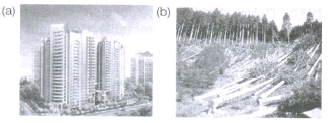
Two figures 'a' and 'b' are given below. Both are revealing two different human activities which are the cause of depletion of water table. Identify the two acts and explain how are these causing the depletion of water resource.
20.
Explain the relation between water table and ground water.
21.
Deforestation can be considered as a reason for depletion of the water table. Comment.
22.
How can you observe the three forms of water (a) in nature and (b) at home?
23.
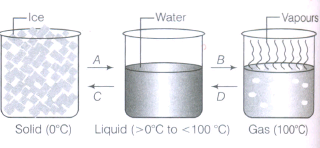
Given below are three states of water in a beaker. These states are inter-convertible. Name the process forward and back-forth labelled A, B, C, D, which cause these conversions.
24.
Place the following statements in a proper order to form a meaningful paragraph.
(a) Which in turn decreases the seepage of rainwater into the ground.
(b) This decreases the open areas like parks and playgrounds.
(c) Increasing population create demand for construction of houses, shops, offices, roads and pavements.
(d) This results in depletion of water table and creates scarcity of more water.
25.
What do you mean by ground water? What are the sources of water which are fead by ground water.
26.
What is the percentage of water on earth is available for use by human?
27.
Which day is celebrated as the world water day?
1.
(b)
2.
(a)
3.
(b)
4.
(a) freshwater
(b) recharge
(c) aquifer
(d) snow.
5.
Collecting and conserving the rainwater from the roof tops of the building is called rainwater harvesting. It is allowed to seep into the soil instead of flowing down into the drains. It helps in raising the water table more efficiently
6.
Drip irrigation is a technique of watering plants by making use of narrow tubings system which delivers water directly to the base of the plant. In this way, farmers can save lot of water.
7.
In the above condition, the groundwater get recharged through the process of infiltration. It replenishes the groundwater.
8.
The major surface area (71%) of the earth is covered with water. This imparts blue colour to the earth.
9.
()
Soluble
10.
()
Saline
11.
()
water, soil, infiltration
12.
(a)
22 March
13.
(a)
(i), (iv) and (v)
14.
(a)
0.006%
15.
(a)
A pukka floor
16.
(b)
water table
17.
(c)
importance of water
18.
(i) Actually, millions of people in our country do not get enough water. Especially during summer, in many areas there is an acute shortage of water, taps running dry, long queues for water and even fight for demand of water in a common sight.
(ii) Causes: Due to less amount of rainfall in some areas, not only water bodies like ponds, rivers become dry also due to excess extraction of ground water, water table goes down.
Remedies: Public and government both should be concern and show awareness towards this crisis. By drip irrigation system and water harvesting technique, we cannot only save water from wastage but also recharge ground water.
(iii) In these areas of hot dry and arid climate the studies of children are badly affected.
19.
(a) Large scale construction (b) Deforestation.
Large scale construction It is main cause of water table lowering because it utilises large amount of water at the time of construction. Most of the time, it is digged water table.
Secondary, when ground surface becomes cemented. It does not allow seepage of rainwater into deeper layers, so rainwater goes waste as run off water and cannot replenish the water table of that particular place.
Deforestation Plants transfer huge amount of water in the form of water vapours. So, when forests are cut down, we interrupt in the process of water cycle of that area. So, no rain occurs at that place and it gradually turns into desert area.
20.
If we dig a hole in the ground and dig deeper and deeper, we could reach a level where all the space between particles of soil and gaps between rocks are filled with water. The upper limit of this layer is called the water table. The water found below the water table is called groundwater.
21.
Large scale deforestation has occurred to accommodate the growing population, to grow food for them and to provide space for industries. Vegetation slows down the flow of rainwater on land and increases the absorption of water by the soil.
Cutting down of trees and destroying vegetation, therefore interferes with the natural process by which seeping takes place and the groundwater is recharged.
It finally results in the depletion of the water table.
22.
The three forms of water
(a) in nature are snow (solid), water (liquid) and water vapour (gas).
(b) at home are ice (solid), water (liquid) and steam (gas).
23.
A - Melting, B - Boiling, C - Freezing, D- Condensation
24.
Increasing population create demand for construction of houses, shops, offices, roads and pavements (c). This decreases the open areas like parks and playgrounds (b) which inturn decreases the seepage of rainwater into the ground (a). This results in depletion of water table and creates scarcity of more water (d).
25.
()
The water found below the water table is called ground water. The sources of ground water are well lake, pond, spring, hunt, pump etc.
26.
()
0.006%.
27.
()
22 March

7th Standard CBSE Syllabus & Materials
7th Standard CBSE
CBSE 7th Social Science Theme B - New Beginnings : Cities and States - New Sample Question Papers Study Material - QB365 Set A
NEW7th Standard CBSE
CBSE 7th Social Science Theme A - Climates of India - New Sample Question Papers Study Material - QB365 Set A
NEW7th Standard CBSE
CBSE 7th Social Science Theme A - Geographical Diversity of India - New Sample Question Papers Study Material - QB365 Set A
NEW7th Standard CBSE
CBSE 7th Science Earth, Moon and the Sun - New Sample Question Papers Study Material - QB365 Set A



CBSE 7th Standard CBSE Subjects
CBSE Standards




