
 100% FREE ACCESS
7th Standard CBSE Syllabus & Materials
7th Standard CBSE
CBSE 7th Social Science Theme E - Understanding Market - New Sample Question Papers Study Material - QB365 Set A
NEW7th Standard CBSE
CBSE 7th Social Science Theme E - From Barter to Money - New Sample Question Papers Study Material - QB365 Set A
NEW7th Standard CBSE
CBSE 7th Social Science Theme D - The Constitution of India- An Introduction - New Sample Question Papers Study Material - QB365 Set A
NEW7th Standard CBSE
CBSE 7th Social Science Theme D - From the Rulers to the Ruled : Types of Governments - New Sample Question Papers Study Material - QB365 Set A
NEW7th Standard CBSE
CBSE 7th Social Science Theme B - The Age of Reorganisation - New Sample Question Papers Study Material - QB365 Set A
NEW7th Standard CBSE
CBSE 7th Social Science Theme B - The Rise of Empires - New Sample Question Papers Study Material - QB365 Set A

Published on: 31/07/2019
Rulers And Buildings
Download CBSE Class 7th Standard CBSE Social Science question papers, sample papers, important questions, and previous year solved papers in PDF format. Get free study materials, NCERT solutions, and exam preparation resources for Class 7th Standard CBSE Social Science
Questions + Answers key
Take MCQ Social Science Test
1.
How were Sultans "the shadow of God"?
2.
What was the importance of the royal temples?
3.
An inscription in Shah Jahan's diwan-i-Khas in Delhi stated, "If there is paradise on Earth, it is here, it is here, it is here". How was this image created?
4.
How did a temple communicate the importance of a king?
5.
What are the elements of a Mughal Chahar Bagh garden?
6.
The Agra fort was built by :
Shahjahan
Akbar
Jahangir
Babar
7.
Diwan-i-Khas-o am courts were also described as :
Chahar Bagh
Chihil Sutun
Pistaq
Qibla
8.
The baolis were constructed:
To provide a place for bathing for royals
To fulfil the water demands
For rain water harvesting
For entertainment of royals
9.
Limestone cement was used in construction because it is
easily available
light to carry
cheaper than others
hardened into concrete
10.
The Trabeate style was used in the construction of temples, mosques, tombs and in buildings attached to
large dome
large minarets
large stepped-wells
large superstructures
11.
The surface of the Qutb Minar in curved and angular
12.
Large stepped wells were called quiblas
13.
Shah Jahan's capital city was at Agra.
14.
Pietra-dura inlays depicted the legendary Greek God.
15.
Chola king Rajendra I built a temple of Shiva.
16.
Akbar
17.
Dhangadeva
18.
Shah Jahan
19.
Access to the river
20.
Ceremonial hall of public and private audience
21.
Idea of construction of ____________was described by Babur in his autobiography
22.
Persian chronicler described the Sultan as the _____________
23.
The central towering dome and the tall gateway is called as __________
24.
Sena II, ordered his general to invade _________
25.
The Pandyan king ___________ invaded Sri Lanka.
26.
Observe the picture carefully and answer the questions that follow:
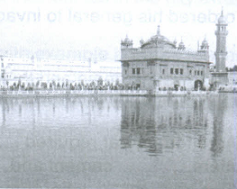
(a) Suggest the other name of the Golden Temple. What does it mean?
(b) Write a short note on the history of the Golden Temple.
27.
How did kings win the praise at their subjects?
28.
What is the special feature of Fatehpur Sikri, Akbar's capital?
29.
What is qibla?
30.
The Agra fort was built by which ruler?
31.
Akbar's capital at Fatehpur Sikri shows the influence of which style?
32.
Write an account of the regional influence on art.
1.
(i) Muslim Sultans and padshahs did not claim to be incarnations of God.
(ii) Persian court chronicles described the Sultan as the "Shadow of God".
(iii) An inscription in the Delhi mosque depicted that God choose Alauddin as a king because he had the qualities of Moses and Solomon who were the great law-givers of the past.
(iv) The greatest justice provider and architect was God Himself.
(v) He created the world out of chaos and introduced order and symmetry everywhere.
2.
The Massive temples were constructed by the kings. In a temple made by Rajarajadeva, worship of one God Rajarajeshvaram honoured another- Rajarajadeva,
The other lesser known deities were the gods and goddesses of the allies and subordinates of the ruler. The temples were the miniature model of the world rules by the king and his allies. As they worshipped the deities together in the temple, it seemed as if the rule of the gods is present on Earth.
3.
Shah Jahan's diwan-i-khas was designed in such a way that it fused together in a grand harmonious synthesis. It was carefully planned. It was placed within a large courtyard. Behind the Emperor's throne, there were a series of pietra-dura inlays.
It depicted the legendary God Orpheus playing the lute. The diwan-i-khas aimed to communicate the king's justice would treat the high and the low as equals, creating a world where everyone could line in harmony. It reflected the image of a paradise in itself.
4.
The temple communicated the importance of a king in the following ways
(i) Name of the temples and name of the king were almost similar. For example Rajarajadeva - A king Rajarajeshvaram - A temple
(ii) The main Gods were identical in name with the kings.
(iii) Lesser deities were Gods and Goddesses of the allies and subordinates of the ruler.
(iv) Temple was the miniature model of the world ruled by the king and his allies.
5.
The elements of a Mughal Chahar Bagh (garden) are that it is
(i) Placed within rectangular walled enclosures.
(ii) Divided into four quarters (portions) by artificial channels.
(iii) Symmetry in the four divisions.
(iv) Historians described it as 'riverfront garden' during Shah Jahan's time.
6.
(b)
Akbar
7.
(b)
Chihil Sutun
8.
(c)
For rain water harvesting
9.
(d)
hardened into concrete
10.
(c)
large stepped-wells
11.
(a)
12.
(b)
13.
(a)
14.
(a)
15.
(a)
16.
()
Agra fort
17.
()
Chandela dynasty
18.
()
Taj Mahal
19.
()
Dara Shukoh
20.
()
Diwan-i-khas or diwan-i-am
21.
()
Chahar bagh
22.
()
Shadow of God
23.
()
Pishtaq
24.
()
Madurai, the capital of Pandyas
25.
()
Shrimara Shrivallabha
26.
(a) The Golden Temple is also referred to as the Harmandar Sahib. The Harmandar Sahib literally means the Temple of God. It is the holiest Sikh Gurudwara located in the city of Amritsar, Punjab.
(b) In 1578 CE, Guru Ram Das excavated a tank, which subsequently became known as Amritsar (Pool of the Nectar of Immortality). This holy tank is fed by the Ravi River. The Harmandar Sahib was designed by the fifth guru, Guru Arjan. Guru Arjan completed the Adi Granth, (Guru Granth Sahib) and installed it in the gurudwara. Inside the gurudwara, there are many shrines to past Sikh gurus, saints, and martyrs.
The gurudwara is open to all persons, regardless of their religion, colour, creed or sex. Over 100000 people visit the holy shrine daily for worship. The Harmandar Sahib runs one of the largest free kitchens in the world, serving 100000 people on average daily. Most Sikhs visit Amritsar and the Golden Temple at least once during their lifetime.
27.
()
They won the praise of their subjects by making structures for their use and comfort such as temples, mosques, tanks, wells, caravanserais, and bazaars.
28.
()
In Fatehpur Sikri many of the buildings show the influence of the architectural styles of Gujarat and Malwa.
29.
()
Qibla is the direction faced by Muslims at prayer.
30.
()
The Agra fort was built by Akbar
31.
()
Akbar's capital city Fatehpur Sikri shows the influence of Gujarat and Malwa Style
32.
Regional influence on Art :
(i) Along with increase in construction activity between the eighth and eighteenth century, there was a significant sharing of ideas across regions.
(ii) The traditions of one region were adopted by the other. In Vrindavan, near Mathura, temples were constructed in architectural style, similar to the Mughal palaces in Fatehpur Sikri. Vijayanagara's architecture was influenced by the Sultanate of Bijapur and Golconda. For example, their elephant stables.
(iii) Mughal rulers were specifically skilled in adapting regional architectural styles in the construction of their own buildings
In Bengal, the local rulers had developed a roof that was designed to resemble a thatched hut.
The Mughals liked this "Bangla dome" to such extent, that they widely used it in architecture.
The impact of other regions was also evident.
In Akbar's capital at Fatehpur Sikri, many of the buildings have the impact of the architectural styles of Gujarat and Malwa.

7th Standard CBSE Syllabus & Materials
7th Standard CBSE
CBSE 7th Social Science Theme B - New Beginnings : Cities and States - New Sample Question Papers Study Material - QB365 Set A
NEW7th Standard CBSE
CBSE 7th Social Science Theme A - Climates of India - New Sample Question Papers Study Material - QB365 Set A
NEW7th Standard CBSE
CBSE 7th Social Science Theme A - Geographical Diversity of India - New Sample Question Papers Study Material - QB365 Set A
NEW7th Standard CBSE
CBSE 7th Science Earth, Moon and the Sun - New Sample Question Papers Study Material - QB365 Set A



CBSE 7th Standard CBSE Subjects
CBSE Standards




