
 100% FREE ACCESS
7th Standard CBSE Syllabus & Materials
7th Standard CBSE
CBSE 7th Social Science Theme E - Understanding Market - New Sample Question Papers Study Material - QB365 Set A
NEW7th Standard CBSE
CBSE 7th Social Science Theme E - From Barter to Money - New Sample Question Papers Study Material - QB365 Set A
NEW7th Standard CBSE
CBSE 7th Social Science Theme D - The Constitution of India- An Introduction - New Sample Question Papers Study Material - QB365 Set A
NEW7th Standard CBSE
CBSE 7th Social Science Theme D - From the Rulers to the Ruled : Types of Governments - New Sample Question Papers Study Material - QB365 Set A
NEW7th Standard CBSE
CBSE 7th Social Science Theme B - The Age of Reorganisation - New Sample Question Papers Study Material - QB365 Set A
NEW7th Standard CBSE
CBSE 7th Social Science Theme B - The Rise of Empires - New Sample Question Papers Study Material - QB365 Set A

Published on: 23/09/2019
Fractions and Decimals
Download CBSE Class 7th Standard CBSE Mathematics question papers, sample papers, important questions, and previous year solved papers in PDF format. Get free study materials, NCERT solutions, and exam preparation resources for Class 7th Standard CBSE Mathematics
Questions + Answers key
Take MCQ Mathematics Test
1.
What will the value of \([(-2\frac{3}{4}-(-1\frac{3}{4})]+[(-2\frac{3}{4})-(-1\frac{3}{4})]+\)....upto 30 times?
2.
Round off to the nearest whole number. (a) 9.2 (b) 3.8
3.
In a class of 80 students,\(\frac{1}{5}\) of the total number of students like to study English,\(\frac{2}{5}\) of the total like to study Science and remaining like to study Mathematics. What fraction of the total number of students like to study Mathematics?
4.
Reemu read \(\frac{1}{5}\)th pages of a book. If she reads further 40 pages, she would have read \(\frac{7}{10}\)th pages of the book. How many pages are left to be read?
5.
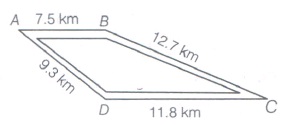
Dinesh went from place A to place B and from there to place C. A is 7.5 km from Band B is 12.7 km from C. Ayub went from place A to place D and from there to place C. D is 9.3 km from A and C is 11.8 km from D. Who travelled more and by how much?
6.
A wire of length \(4 \frac{2}{5}\) m is cut into like 5 pieces of equal length. Find the length of each piece.
7.
Sugar is sold at Rs 17\(\frac{3}{5}\) per kg. Find the cost of 16 kg of sugar.
8.
Which is greater? \(\frac{2}{7}\)of\( \frac{3}{4}\) of \( \frac{3}{5}\)of\( \frac{5}{8}\)
9.
A rectangular sheet of paper is 11\(\frac{1}{2}\) m long and 12\(\frac{1}{3}\)m wide.Find its perimeter.
10.
Ram and Ankush had 4500 stamps altogether. If Ram had \(\frac{4}{5}\)as many stamps as Ankush, how many stamps did Ankush have?
1.
-30
2.
(a) 9. (b) 4
3.
2/5
4.
Let the total number of pages be x.
Reemu read part of book = \(\frac{1}{5}\)of x=\(\frac{1}{5}\times x=\frac{x}{5}\)
She further reads 40 pages and covers \(\frac{7}{10}\)th part of book.
Accor diIng to the question, \(\frac{x}{5}+40=\frac{7x}{10}\)
\(⇒ \frac{x}{5}-\frac{7x}{10}=-40 ⇒ \frac{(2\times x)-(1\times 7x)}{10}=-40\)
\(\Rightarrow -\frac{5x}{10}=-\frac{40}{1}\)
⇒ -5x=-40 x10 [by cross-multiplication]
⇒ \(x=\frac{-40\times 10}{-5}=80\)
Total pages = 80
She read the pages = \(\frac{x}{5}+40=\frac{80}{5}+40\)
=16 + 40 = 56 pages
Left pages to be read = (80 - 56) pages = 24 pages Hence, 24 pages are left to be read.
5.
Given, distance between A and B = 7.5 km
Distance between Band C = 12.7 km
∴ Distance travelled by Dinesh = AB + BC
= 7.5+ 12.7
= 20.2km
Distance between A and D = 9.3 km
Distance between D and C = 11.8 km
∴ Distance travelled by Ayub = AD + DC
= 9.3+ 11.8
= 21.1 km
Hence, it is clear that 21.1>20.2.
∴ Ayub travelled more distance i.e. 21.1 km.
Now, difference between distances, they both travelled
= (21.1- 20.2) km
=0.9km
Hence, Ayub travelled 0.9 km more than Dinesh.
6.
\(\frac{22}{25}\)m
7.
We have
Cost of 1 kg of sugar = Rs.17\(\frac { 3 }{ 4 } \)=Rs\(\frac { 71 }{ 4 } \)k
∴ Cost of 8 kg of sugar = Rs \(\left( \frac { 71 }{ 4 } \times 8\frac { 1 }{ 2 } \right) \)
=Rs \(\left( \frac { 71 }{ 4 } \times \frac { 17 }{ 2 } \right) =Rs.\left( \frac { 71\times 17 }{ 4\times 2 } \right) \)
=Rs\(\left( \frac { 1207 }{ 8 } \right) \) =Rs.150\(\frac { 7 }{ 8 } \)
Hence, the cost of 8\(\frac { 1 }{ 2 } \) kg of sugar is Rs.150\(\frac { 7 }{ 8 } \)
8.
(I) We have, \(\frac{2}{7}\)of \(\frac{3}{4} =\frac{2}{7}\times \frac{3}{4}=\frac{1}{7}\times \frac{3}{2}=\frac{3}{14}\) [dividing numerator and denominator by 2]
and \(\frac{3}{5}\)of \( \frac{5}{8}=\frac{3}{5}\times \frac{5}{8}\) [dividing numerator and denominator by 5]
\(=\frac{3\times 1}{1\times 8}=\frac{3}{8}\)
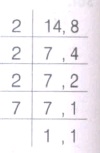
LCM of 14 and 8 = 2 X 2 X 2 X 7 = 56
On converting both the fractions into like fractions,
we get \(\frac{3}{14}=\frac{3\times 4}{14\times 4}=\frac{12}{56} \) and \( \frac{3}{8}=\frac{3\times 7}{8 \times 7}=\frac{21}{56}\)
∴ 21> 21, So, \(\frac{21}{56}>\frac{12}{56 }\) ie., \(\frac{3}{8}>\frac{3}{14}\)
Hence, \(\frac{3}{5}\) of \( \frac{5}{8}\) is greater than \(\frac{2}{7} \)of\( \frac{3}{4}\).
Alternate Method
If two fractions have the same numerator but different denominators, then fraction with smaller
denominators will be greater.
We have,\(\frac{2}{7}\)of \(\frac{3}{4}=\frac{2}{7}\times \frac{3}{4}=\frac{6}{28}=\frac{3}{14}\) [dividing numerator and denominator by 2]
and \(\frac{3}{5} \)of \( \frac{5}{8}=\frac{3}{5}\times \frac{5}{8}=\frac{3\times 5}{5\times 8}=\frac{15}{40}=\frac{3}{8}\) [dividing numerator and denominator by 5]
Here, both fractions are like fractions.
Since, 8<14, So, \(\frac{2}{7} \)of \( \frac{3}{4}\).
9.
47.66m
10.
2500 stamps

7th Standard CBSE Syllabus & Materials
7th Standard CBSE
CBSE 7th Social Science Theme B - New Beginnings : Cities and States - New Sample Question Papers Study Material - QB365 Set A
NEW7th Standard CBSE
CBSE 7th Social Science Theme A - Climates of India - New Sample Question Papers Study Material - QB365 Set A
NEW7th Standard CBSE
CBSE 7th Social Science Theme A - Geographical Diversity of India - New Sample Question Papers Study Material - QB365 Set A
NEW7th Standard CBSE
CBSE 7th Science Earth, Moon and the Sun - New Sample Question Papers Study Material - QB365 Set A



CBSE 7th Standard CBSE Subjects
CBSE Standards




