
 100% FREE ACCESS
7th Standard CBSE Syllabus & Materials
7th Standard CBSE
CBSE 7th Social Science Theme E - Understanding Market - New Sample Question Papers Study Material - QB365 Set A
NEW7th Standard CBSE
CBSE 7th Social Science Theme E - From Barter to Money - New Sample Question Papers Study Material - QB365 Set A
NEW7th Standard CBSE
CBSE 7th Social Science Theme D - The Constitution of India- An Introduction - New Sample Question Papers Study Material - QB365 Set A
NEW7th Standard CBSE
CBSE 7th Social Science Theme D - From the Rulers to the Ruled : Types of Governments - New Sample Question Papers Study Material - QB365 Set A
NEW7th Standard CBSE
CBSE 7th Social Science Theme B - The Age of Reorganisation - New Sample Question Papers Study Material - QB365 Set A
NEW7th Standard CBSE
CBSE 7th Social Science Theme B - The Rise of Empires - New Sample Question Papers Study Material - QB365 Set A

Published on: 31/08/2019
Fractions and Decimals
Download CBSE Class 7th Standard CBSE Mathematics question papers, sample papers, important questions, and previous year solved papers in PDF format. Get free study materials, NCERT solutions, and exam preparation resources for Class 7th Standard CBSE Mathematics
Questions + Answers key
Take MCQ Mathematics Test
1.
Fill in these boxes\(\frac{1}{7}\times \frac{1}{5}=\boxed {} = \boxed {}\)
2.
Multiply and reduce to lowest form and convert into a mixed fraction.\(13\times \frac{1}{3}\)
3.
Rohan solved \(\frac{3}{7}\) part of an exercise, while Ramu solved \(\frac{2}{5}\) of it, who solved lesser part?
4.
An auto driver charges Rs 10.20 per km. Then, how much will he charge for a journey of 118.5 km?
5.
Find \(\frac{1}{4}\) of \(\frac{1}{4}\) (b) \(\frac{3}{5} \) (c) \(\frac{4}{3}\)
6.
Ritu ate \(\frac{3}{5}\) part of an apple and the remaining apple was eaten by her brother Somu. How much part of the apple did Somu eat? Who had the larger share?By how much?
7.
Some pictures (a) to (c) are given below, Tell which of them show
(i) \(3\times \frac{1}{5}=\frac{3}{5}\)(ii) \(2\times \frac{1}{3}=\frac{2}{3}\) (iii)\(3\times \frac{3}{4}=2\frac{1}{4}\)
(a)
(b)
(c)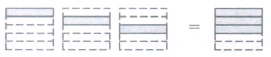
8.
\(\frac { 1 }{ 4 } \) of \(\frac { 1 }{ 7 } \) is equal to 28
9.
The reciprocal of a proper fraction is a proper fraction.
10.
1 is the only number which has its own reciprocal.
11.
\(\frac { 1 }{ 3 } \) of 6 is a same as \(\frac { 1 }{ 3 } +6\)
12.
\(\frac{5}{12}\)part of what amount will be equal to 3\(\frac{3}{4}\) part of Rs 100?
Rs 900
Rs 940
Rs 875
Rs 925
13.
The product of \(\frac{11}{13}\) and 4 is
\(3 \frac{5}{13}\)
\(5\frac{3}{13}\)
\(13\frac{5}{5}\)
\(13\frac{5}{3}\)
14.
The picture interprets
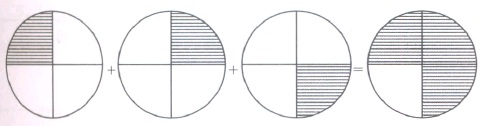
\(\frac{1}{3}\div 4\)
\(3\times \frac{1}{4}\)
\(\frac{3}{4}\times 3\)
\(3 \div \frac{1}{4}\)
15.
\(42.47 \div =\)________0.4247
16.
25.4\(\times \)1000 = _______
17.
The lowest form of the product \(2\frac{3}{7}\times \frac{7}{9}\) is _________
1.
The complete boxes are shown below:
\(\frac{1}{7}\times \frac{1}{5}=\boxed {\frac{1\times 1}{7\times 5}} = \boxed {\frac{1}{35}}\)
2.
Mixed fraction =Quotient \(\frac{Reminder}{Divisor}=4 \frac{1}{3}\)
3.
Solved part of exercise by Rohan = \(\frac{3}{7}\) [given]
Solved parr of exercise by Ramu = \(\frac{2}{5}\) [given]
Let us compare \(\frac{3}{7}\)and \(\frac{2}{5}\)
LCM is 7 and 5 is 35.
\(\frac{3}{7}=\frac{3}{7}\times \frac{5}{5}=\frac{15}{35}\) and \(\frac{2}{5}=\frac{2}{5}\times \frac{7}{7}=\frac{14}{35}\). Thus, \(\frac{15}{35}>\frac{14}{35}\) or \(\frac{3}{7}>\frac{2}{5}\)
So, Ramu solved lesser part i.e. \(\frac{2}{5}\).
4.
Rs 1208.7
5.
(a) We have, \(\frac{1}{4}\)of \(\frac{1}{4}\)=\(\frac{1}{4}\times \frac{1}{4}=\frac{1\times 1}{4\times 4}=\frac{1}{16}\) [∵'of' means multiplication]
(b) We have \(\frac{1}{4}\) of \(\frac{3}{5} \)=\(\frac{1}{4}\times \frac{3}{5}= \frac{1\times 3}{4 \times 5}= \frac{3}{20}\)
(c) We have \(\frac{1}{4}\) of \(\frac{4}{3}\)=\(\frac{1}{4}\times \frac{4}{3}=\frac{1\times 4}{4 \times 3}=\frac{4}{12}\) [dividing numerator and denominator by 4]
=\(\frac{1}{3}\)
6.
Let an apple be 1 part. Rim ate \(\frac{3}{5}\)part of an apple.
Now, remaining part=1-\(\frac{3}{5}\)=\(\frac{1}{1}-\frac{3}{5}=\frac{1\times 5-3\times 1}{5}\)
=\(\frac{5-3}{5}=\frac{2}{5}\)
So, Somu ate 2/5 part of an apple.
∵ 3>2 [numerators of fractions]
∴ \(\frac{3}{5}\)>\(\frac{2}{5}\)
i.e. Riru had larger share.
Now, d'ifference between theeilr shares=\(\frac{3}{5}\)-\(\frac{2}{5}\)=\(\frac{3-2}{5}=\frac{1}{5}\)
Hence, Ritu had the larger share which is \(\frac{1}{5}\) more than Sornu's share.
7.
(i) We have, \(3\times \frac{1}{5}=\frac{3}{5}\)
\(\Rightarrow \frac{1}{5}+\frac{1}{5}+\frac{1}{5}=\frac{3}{5}\)
It shows that, on combining three figures, in each of them out of 5 parts, 1 part is shaded. It is represented by the figure (c),
(ii) We have, \(2\times \frac{1}{3}=\frac{2}{3}\Rightarrow \frac{1}{3}+\frac{1}{3}=\frac{2}{3}\)
It shows that on combining two figures, in each of them out of 3 parts, 1 part is shaded, It is represented by the figure (a),
(iii) We have, \(3\times \frac{3}{4}=2\frac{1}{4}\)
\(\Rightarrow 3\times \frac{3}{4}=\frac{9}{4} \Rightarrow \frac{3}{4}+\frac{3}{4}+\frac{3}{4}=\frac{9}{4}\)
It shows that, on combining three figures, in each of them out of 4 parts, 3 parts are shaded, We get two figures in which all 4 parts are shaded and in third figure out of 4 parts, 1 part is shaded and it is represented by the figure (b)
8.
(b)
9.
(b)
10.
(a)
11.
(b)
12.
(a)
Rs 900
13.
(a)
\(3 \frac{5}{13}\)
14.
(b)
\(3\times \frac{1}{4}\)
15.
()
100
16.
()
25400
17.
()
\(1 \frac{8}{9}\)

7th Standard CBSE Syllabus & Materials
7th Standard CBSE
CBSE 7th Social Science Theme B - New Beginnings : Cities and States - New Sample Question Papers Study Material - QB365 Set A
NEW7th Standard CBSE
CBSE 7th Social Science Theme A - Climates of India - New Sample Question Papers Study Material - QB365 Set A
NEW7th Standard CBSE
CBSE 7th Social Science Theme A - Geographical Diversity of India - New Sample Question Papers Study Material - QB365 Set A
NEW7th Standard CBSE
CBSE 7th Science Earth, Moon and the Sun - New Sample Question Papers Study Material - QB365 Set A



CBSE 7th Standard CBSE Subjects
CBSE Standards




