
 100% FREE ACCESS
7th Standard CBSE Syllabus & Materials
7th Standard CBSE
CBSE 7th Social Science Theme E - Understanding Market - New Sample Question Papers Study Material - QB365 Set A
NEW7th Standard CBSE
CBSE 7th Social Science Theme E - From Barter to Money - New Sample Question Papers Study Material - QB365 Set A
NEW7th Standard CBSE
CBSE 7th Social Science Theme D - The Constitution of India- An Introduction - New Sample Question Papers Study Material - QB365 Set A
NEW7th Standard CBSE
CBSE 7th Social Science Theme D - From the Rulers to the Ruled : Types of Governments - New Sample Question Papers Study Material - QB365 Set A
NEW7th Standard CBSE
CBSE 7th Social Science Theme B - The Age of Reorganisation - New Sample Question Papers Study Material - QB365 Set A
NEW7th Standard CBSE
CBSE 7th Social Science Theme B - The Rise of Empires - New Sample Question Papers Study Material - QB365 Set A

Published on: 22/09/2018
Model Question Paper - 2
Download CBSE Class 7th Standard CBSE Mathematics question papers, sample papers, important questions, and previous year solved papers in PDF format. Get free study materials, NCERT solutions, and exam preparation resources for Class 7th Standard CBSE Mathematics
Questions + Answers key
Take MCQ Mathematics Test
1.
Replace the blank with an integer to make it a true statement. 5 x____ = - 35
2.
Replace the blank with an integer to make it a true statement. (-3) x _____ =27
3.
The following statement true:
[2 + 12] + 6 = 2 + [ 12 + ____ ]
4.
The following statement true:
-6 + 8 = 8 + ________
5.
- 4 + [ 15 + (- 3) ] = [ - 4 + 15 ] + ______
6.
[ 13 + (- 12) ] + ______ = 13 + [ (- 12) + (- 7) ]
7.
17 + ______ = 0
8.
-53 + ______ = - 53
9.
Using >, < or =.
21 - 5 ____ 40 - 6
10.
Using >, < or =.
18 - 16 ____ + 2
11.
(16) \(\div\) 4 is not same as:
(-4) \(\div\) 16
-(16 \(\div\) 4)
16 \(\div\) (-4)
-4
12.
\(\frac{5}{12}\)part of what amount will be equal to 3\(\frac{3}{4}\) part of Rs 100?
Rs 900
Rs 940
Rs 875
Rs 925
13.
How many pieces of 13.2 cm can be cut from a 330 cm long rod?
25
28
21
35
14.
In the year 2014, Shantanu gets Rs 3832.5 as his pocket allowance. Find his pockect allowane per day
Rs 9.5
Rs 10.5
Rs 12.5
Rs 11.5
15.
Which of the following represents \(\frac{1}{3}\)of\(\frac{1}{6}\)?
\(\frac{1}{3}+\frac{1}{6}\)
\(\frac{1}{3}-\frac{1}{6}\)
\(\frac{1}{3}\times \frac{1}{6}\)
\(\frac{1}{3}\div \frac{1}{6}\)
16.
The product of \(\frac{11}{13}\) and 4 is
\(3 \frac{5}{13}\)
\(5\frac{3}{13}\)
\(13\frac{5}{5}\)
\(13\frac{5}{3}\)
17.
Pictorial representation of \(3\times \frac{2}{3} \)is
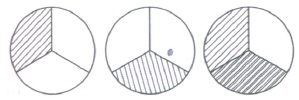
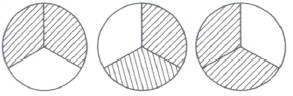
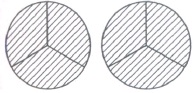
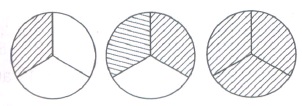
18.
\(\frac{2}{5}\times 5\frac{1}{5}\) is equaI to
\(\frac{26}{25}\)
\(\frac{52}{25}\)
\(\frac{2}{5}\)
6
19.
If \(\bigotimes \) , O and \(\bullet\) represent some integers on the number line, then descending order of these numbers is

\(\bullet ,\bigotimes ,\oslash ,O\)
\(\bigotimes ,\bullet ,\oslash ,O\)
\(O,\oslash ,\bigotimes ,\bullet \)
\(O,\bullet ,\bigotimes ,\oslash \)
20.
Next three consecutive numbers in the pattern 11, 8, 5, 2, ... are
0,-3, -4
-1, -5,-8
2, -5, -8
1, -4, -7
21.
Which of the following does not represent an integer?
0 \(\div\) (-7)
20 \(\div\) (-4)
(-9) \(\div\) 3
(-12) \(\div\) 5
22.
On the following number line, zero is shown by the point.
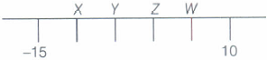
X
Z
Y
W
23.
(-43) x (-99) + 43 is equal to
4300
-4300
4257
-4214
24.
The value of (-10) x (-5) + (-7) is
40
-43
43
23
25.
Which measures of central tendency get affected, if the extreme observations on both the ends of a data a arranged in descending order are removed?
Mean and mode
Mean and median
Mode and median
Mean, median and mode
26.
If k + 2 = 6, then the value of 4k + 12 is equal to
16
-12
28
-30
27.
If 8m - 8 = 56, then m is equal to
-4
-2
-14
8
28.
If 7x + 4 = 39, then x is equal to
6
-4
5
8
29.
The solution of which of the following equations is neither a fraction not an integer?
2x + 6 = 0
3x - 5 = 0
5x - 8 = x + 4
4x + 7 = x + 2
30.
If * represents 3 mangoes, then 18 mangoes are represented by
***
****
******
None of these
31.
The value of 1200 x 2 is
600 x 20
2000 + 400
600 + 600
None of these
32.
If the sum of two integers a and b is zero, then
a=0, b=0
a = -b
Both (a) and (b) are not zero
None of these
33.
Express the following numbers in normal form:
4.0 x 10¹⁰
34.
Express the following numbers in normal form:
5.8 x 10⁵
35.
Express the following numbers in the standard form:
90040000000
36.
Express the following numbers in the standard form:
56,950
37.
Express the following numbers in the standard form:
9585.3
38.
Is (i) 1 + a = 1 and (ii) a + (-1) = -a for any integer a? Take different values of a and
check.
39.
Find 4 x (- 8), 8 x (- 2), 3 x (- 7), 10 x (- 1) using number line.
40.
A shopkeeper gains Rs 1 on each pen and loses 40 paise on each pencil. He sells 45 pens and some pencils losing Rs 5 in all. How many pencils does he sell?
41.
If * is an operation such that for integers a and b, we have a * b = a \(\times\) b + (a \(\times\)a + b \(\times\) b). then find
(i) (-3) * (-5)
(ii) (-6) * 2
42.
If \(\Delta\) is an operation such that for integers a and b, we have a\(\Delta\)b = a \(\times\) b - 2 (a + b) + b (b - a) \(\times\) b \(\times\) b Then, find
(i) 4 \(\Delta\)(-3)
(ii) (-7) \(\Delta\)(-1)
Also, show that 4 \(\Delta\)(-3) \(\neq\) (-3) \(\Delta\) 4 and (-7) \(\Delta\) (-1) \(\neq\) (-1) \(\Delta\) (-7)
43.
The mean marks (out of 100) of a group of students is 60. If their marks are 85, 62, 36, 48, 72, x, 75 and 39, then find the value of x.
44.
Following are the marks obtained by 25 students in class test (out of 25 marks) in Maths :
18, 13, 18, 16, 8, 5, 13, 5, 18, 18,2,16, 13, 8, 17, 18 5, 2, 13, 8, 19, 16, 8, 20.
How many students obtained marks more than the mean marks?
45.
What is the additive inverse of (-14)?
46.
What is the additive inverse of 0?
47.
What is the additive inverse of -1?
48.
What is the sum of (-1) and 1?
49.
What is the product of (-1) and 1?
1.
()
5 x (- 7) = - 35
2.
()
(- 3) x (- 9) = 27
3.
()
6 (associative property of addition)
4.
()
-6 (commutative property of addition)
5.
()
(- 4) + [ 15 + (-3) ] = [ (- 4) + 15 ] + (-3) [\(\because\)addition of integers is commutative]
6.
()
[ 13 + (-12) ] + (-7) = 13 + [ (-12) + (- 7) ] [\(\because\) addition of integers is associative]
7.
()
17 + (-17) = 0 [\(\because\) sum of an integer and its additive inverse is zero]
8.
()
(- 53) + 0 = - 53 [ if we add zero to any number, then we get the same number ]
9.
()
<
10.
()
=
11.
(a)
(-4) \(\div\) 16
12.
(a)
Rs 900
13.
(a)
25
14.
(b)
Rs 10.5
15.
(c)
\(\frac{1}{3}\times \frac{1}{6}\)
16.
(a)
\(3 \frac{5}{13}\)
17.
(b)
18.
(b)
\(\frac{52}{25}\)
19.
(c)
\(O,\oslash ,\bigotimes ,\bullet \)
20.
(d)
1, -4, -7
21.
(d)
(-12) \(\div\) 5
22.
(b)
Z
23.
(a)
4300
24.
(c)
43
25.
(a)
Mean and mode
26.
(c)
28
27.
(d)
8
28.
(c)
5
29.
(d)
4x + 7 = x + 2
30.
(c)
******
31.
(b)
2000 + 400
32.
(b)
a = -b
33.
40000000000
34.
580000
35.
9.004 X 10¹⁰
36.
5.695 x 10⁴
37.
9.5853 x 10³
38.
(i) Let us take a = -1, 1, 2, 3, ...
For a = -1,
L.H.S. = 1 ÷ (-1) = -1 [∵ 1 + 1 = 1]
R.H.S. = 1
i.e. L.H.S. ≠ R.H.S.
For a = 1,
L.H.S. = 1 ÷ a = 1 + 1 = 1
R.H.S. = 1
i.e. L.H.S. = R.H.S.
For a = 2,
L.H.S.= 1 ÷ a = 1 ÷ 2 = \(1\over2\)≠ R.H.S.
For a =3
L.H.S. = 1 ÷ a = 1 ÷ 3 = \(1\over3\)≠ R.H.S.
Thus, 1 ÷ a = 1 is true only for a = 1
(ii) Let us take a = 1, 2, 3, ...
For a = 1,
L.H.S.= a ÷ (-1) = 1 ÷ (-1) = -1
R.H.S.= -a = -1
i.e. L.H.S. = R.H.S.
For a = 2,
L.H.S.= a ÷ (-1) = 2 ÷ (-1) = -2
R.H.S.= a = -2
i.e. L.H.S. = R.H.S.
For a = 3,
L.H.S.= a ÷ (-1) = 3 ÷ (-1) = -3
R.H.S.= -a = -3
i.e. L.H.S. = R.H.S.
For a = 7,
L.H.S. = a ÷ (-1) = 7 ÷ (-1) = -7
R.H.S.= -a = -7
i.e. L.H.S. = R.H.S.
i.e. For every integer, we have a ÷ (-1) = -a
39.
We can write 4 x (- 8) as
4 x (- 8) = (- 8) + (- 8) + (- 8) + (- 8)
It can be represented on the number line as under:

We have, 8 x (- 2) = (- 2) + (- 2) + (- 2) + (-2) + (-2) + (-2) + (-2) + (-2)
It can be represented on the number line as under:

We have, 3 x (-7) = (-7) + (-7) + (-7)
It can be represented on the number line as under:

We have,
10 x (-1) = (-1) + (-1) + (-1) + (-1) + (-1) + (-1) + (-1) + (-1) + (-1) + (-1)
It can be represented on the number line as under:
 .
.
40.
125
41.
(i) 49
(ii) 28
42.
(i) 4\(\Delta\)(-3) = 16, (-3) \(\Delta\) 4 = 18, No,
(ii) (-7) \(\Delta\) (-1) = - 6, (-1) \(\Delta\) (-7) = 42, No
43.
Total number of students = 8
Sum of the marks obtained =85 + 62 + 36 + 48 + x + 75 + 39 + 72=417+x
\(\therefore \)Mean marks =\(\frac { (417\quad +x) }{ 8 } \)
\(\Rightarrow \)\(\frac { (417\quad +x) }{ 8 } \)=60
\(\Rightarrow \)417 + x = 60 x 8 = 480
\(\Rightarrow \)x = 480 - 417 = 63
Thus, the required value of x = 63
44.
Arranging the observations (marks) in ascending order:
2, 2, 5, 5, 5, 8, 8, 8, 8, 13, 13, 13, 13, 16, 16, 16, 17, 17, 18,18,18,18,18,19,20
Sum of observations
\(2\times2=4\\5\times3=15\\8\times4=32\\13\times4=52\\16\times3=48\\17\times2=34\\18\times5=90\\19\times1=19\\20\times1=20\\\quad\quad\quad\quad\_\_\_\_\\\ Total=314\\ \quad\quad\quad\quad\_\_\_\_\)Number of students = 25
\(\therefore\) Mean marks \(=\frac{Sum\ of\ the\ observations}{Total\ number\ of\ students}\)
\(=\frac{314}{25}=12.5\)
So, the number of students who scored marks more than mean marks is
4 + 3 + 2 + 5 + 1 + 1 = 16.
45.
()
14
46.
()
0
47.
()
1
48.
()
0
49.
()
-1

7th Standard CBSE Syllabus & Materials
7th Standard CBSE
CBSE 7th Social Science Theme B - New Beginnings : Cities and States - New Sample Question Papers Study Material - QB365 Set A
NEW7th Standard CBSE
CBSE 7th Social Science Theme A - Climates of India - New Sample Question Papers Study Material - QB365 Set A
NEW7th Standard CBSE
CBSE 7th Social Science Theme A - Geographical Diversity of India - New Sample Question Papers Study Material - QB365 Set A
NEW7th Standard CBSE
CBSE 7th Science Earth, Moon and the Sun - New Sample Question Papers Study Material - QB365 Set A



CBSE 7th Standard CBSE Subjects
CBSE Standards




