
 100% FREE ACCESS
7th Standard CBSE Syllabus & Materials
7th Standard CBSE
CBSE 7th Social Science Theme E - Understanding Market - New Sample Question Papers Study Material - QB365 Set A
NEW7th Standard CBSE
CBSE 7th Social Science Theme E - From Barter to Money - New Sample Question Papers Study Material - QB365 Set A
NEW7th Standard CBSE
CBSE 7th Social Science Theme D - The Constitution of India- An Introduction - New Sample Question Papers Study Material - QB365 Set A
NEW7th Standard CBSE
CBSE 7th Social Science Theme D - From the Rulers to the Ruled : Types of Governments - New Sample Question Papers Study Material - QB365 Set A
NEW7th Standard CBSE
CBSE 7th Social Science Theme B - The Age of Reorganisation - New Sample Question Papers Study Material - QB365 Set A
NEW7th Standard CBSE
CBSE 7th Social Science Theme B - The Rise of Empires - New Sample Question Papers Study Material - QB365 Set A

Published on: 14/09/2019
Lines and Angle
Download CBSE Class 7th Standard CBSE Mathematics question papers, sample papers, important questions, and previous year solved papers in PDF format. Get free study materials, NCERT solutions, and exam preparation resources for Class 7th Standard CBSE Mathematics
Questions + Answers key
Take MCQ Mathematics Test
1.
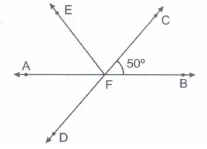
CD intersects the line AB at F,\(\angle CFB=50^0\) and \(\angle EFA=\angle AFD.\)Find the measure of \(\angle EFC.\)
2.
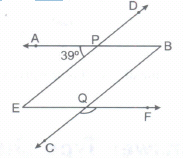
AB II EF, ED II CB and \(\angle APE\) is 39°, find \(\angle CQF.\)
3.
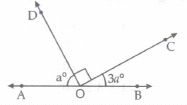
The point A, O and B are collinear. Ray OC\(\bot\) ray OD, check whether:
(a) \(\angle AOD\) and \(\angle BOC\) are complementary.
(b) \(\angle AOC\)and\( \angle BOC\) are supplementary.
4.
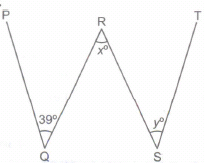
Four line segments PQ, QR, RS and ST are making the letter W, PQ II RS and QR II ST. If angle between PQ and QR is 39°. Find the value of x and y.
5.
Are the angles marked 1 and 2 in figure adjacent? If they are not adjacent, say 'why',

6.
Are the angles marked 1 and 2 in figure adjacent? If they are not adjacent, say 'why',

7.
What will be the measure of the supplement of each one of the following angles? 55°
8.
What will be the measure of the supplement of each one of the following angles? 100°
9.
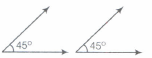
Find the pairs of supplementary angles in the question figure.
10.
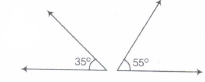
Which pairs of the following angles are complementary?
11.
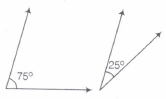
Which pairs of the following angles are complementary?
12.
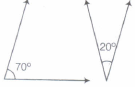
Which pairs of the following angles are complementary?
13.
What is the measure of the complement of each of the following angles? 65°
14.
What is the measure of the complement of each of the following angles? 45°
15.
Can two obtuse angles be complement to each other?
1.
Let \(\angle EFC=x\)
Then \(\angle AFD=x\)
It is given that CD intersects line AB at F.
Therefore,\(\angle CFB=\angle AFD\) (vertically opposite angles)
So,x=500
But \(\angle EFA=\angle AFD\) which gives \(\angle EFA=50^0\)
Now, \(\angle CFB+\angle EFA+\angle EFC=180^0\) [as AB is a straight line]
\(50^0+50^0+\angle EFC=180^0\)
\(\angle EFC=180^0-100^0\)
Thus,\(\angle EFC=80^0\)
2.
Since ED II BC and AB is a transversal, so \(\angle QBP=\angle APE\) [corresponding angles]
\(\angle QBP=39^0\)
Now, AB II EF and BC is a transversal.
Therefore, \(\angle FQB=\angle QBP\) [alternate interior angles]
\(\angle FQB=39^0\)
Also, \(\angle CQF+\angle FQB=180^0\) [linear pair]
so \(\angle CQF=39^0=180^0\)
or \(\angle CQF=180^0-39^0\)
or \(\angle CQF=141^0\)
3.
Since points A, O and B are collinear (Given), therefore AB is a straight line.
(a) As O is a point on the line AB, therefore
\(\angle AOD+\angle DOC+\angle BOC=180^0\)
\(\angle AOD+\angle BOC+90^0=180^0\)
\(\angle AOD+\angle BOC=90^0\)
\(\angle AOD\ \)and \(\angle BOC\)are complementary angles.
(b) Also, \(\angle AOC\) and \( \angle BOC\)are supplementary as \(\angle AOC+ \angle BOC=180^0\)
4.
Since PQ II RS and QR is transversal.So
x = 39° [alternate interior angles]
Again QR II ST and RS is a transversal.
Therefore, y = x [alternate interior angles]
or y = 39°
5.
In the given figure (v), \(\angle \) 1 and \(\angle \)2 are adjacent angles because they have a common vertex and a common arm but no common interior point.
6.
In the given figure \(\angle \) 1 and \(\angle \)2 are adjacent angles because they have a common vertex and a common arm but no common interior point.
7.
The supplement angle of 55° is 125°
8.
Let the supplement angle of 100° be x°,
We know that, the sum of two supplementary angles is 180°.
\(\therefore\) x° + 100°= 180° \(\Rightarrow\) x° = 180° -100° = 80°
Hence, the supplement angle of 100° is 80°.
9.
In this pair, measures of the given angles are 45° and 45°.
\(\therefore\) Sum of the given angles = 45° + 45° = 90°,
which is less than 180°.
So, this pair of angles is not supplementary.
10.
In this pair, sum of two angles =35° + 55° = 90°
which is equal to 90°.
So, this pair of angles is complementary.
11.
In this pair, sum of two angles = 75° + 25° = 100°
which is greater than 90°.
So, this pair of angles is not complementary.
12.
In this pair, sum of two angles = 70° + 20° = 90° So, this pair of angles is complementary.
13.
Let the complement angle of 65° be x°.
We know that, the sum of two complementary angles is 90°.
\(\therefore\) x° + 65° = 90° \(\Rightarrow\) x°= 90° - 65° = 25°
[transposing 65° to RHS]
Hence, the complement angle of 65° is 25°.
14.
Let the complement angle of 45° be x°.
We know that, the sum of two complementary angles is 90°.
\(\therefore\) x°+ 45° = 90°
\(\Rightarrow\) x° = 90° - 45° = 45°
[transposing 45° to RHS]
Hence, the complement angle of 45° is 45°.
15.
No, two obtuse angles can never be complement to each other because their sum cannot be 90°, as an obtuse angle has its measure greater than 90°.
e.g. 105° and 135° are two obtuse angles.
Their sum =105° + 135° = 240° \(\neq \) 90°
Therefore, two obtuse angles cannot be complement to each other.

7th Standard CBSE Syllabus & Materials
7th Standard CBSE
CBSE 7th Social Science Theme B - New Beginnings : Cities and States - New Sample Question Papers Study Material - QB365 Set A
NEW7th Standard CBSE
CBSE 7th Social Science Theme A - Climates of India - New Sample Question Papers Study Material - QB365 Set A
NEW7th Standard CBSE
CBSE 7th Social Science Theme A - Geographical Diversity of India - New Sample Question Papers Study Material - QB365 Set A
NEW7th Standard CBSE
CBSE 7th Science Earth, Moon and the Sun - New Sample Question Papers Study Material - QB365 Set A



CBSE 7th Standard CBSE Subjects
CBSE Standards




