
 100% FREE ACCESS
7th Standard CBSE Syllabus & Materials
7th Standard CBSE
CBSE 7th Social Science Theme E - Understanding Market - New Sample Question Papers Study Material - QB365 Set A
NEW7th Standard CBSE
CBSE 7th Social Science Theme E - From Barter to Money - New Sample Question Papers Study Material - QB365 Set A
NEW7th Standard CBSE
CBSE 7th Social Science Theme D - The Constitution of India- An Introduction - New Sample Question Papers Study Material - QB365 Set A
NEW7th Standard CBSE
CBSE 7th Social Science Theme D - From the Rulers to the Ruled : Types of Governments - New Sample Question Papers Study Material - QB365 Set A
NEW7th Standard CBSE
CBSE 7th Social Science Theme B - The Age of Reorganisation - New Sample Question Papers Study Material - QB365 Set A
NEW7th Standard CBSE
CBSE 7th Social Science Theme B - The Rise of Empires - New Sample Question Papers Study Material - QB365 Set A

Published on: 03/10/2019
Practical Geometry
Download CBSE Class 7th Standard CBSE Mathematics question papers, sample papers, important questions, and previous year solved papers in PDF format. Get free study materials, NCERT solutions, and exam preparation resources for Class 7th Standard CBSE Mathematics
Questions + Answers key
Take MCQ Mathematics Test
1.
Construct ΔPQR, if PQ = 5 cm, m \(\angle PQR\) = 105° and m \(\angle QRP\) = 40° (Hint: Recall angle-sum property of a triangle).
2.
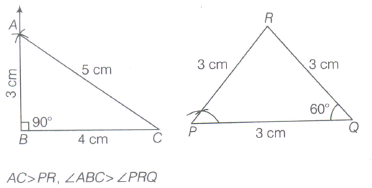
Draw \(\triangle ABC\) and \(\triangle PQR\) sueh that AB = 3 cm, BC = 4 cm and AC = 5 cm, where as PQ = 3 cm, \(\angle P=60^0,\angle Q=60^0.\) What is the relation between AC and PR and between \(\angle ABC,\angle PQR?\)
3.
Construct a \(\triangle ABC\) in which AC = 4 cm, \(\angle A=75^0,\angle C=60^0\).
4.
Draw a pair of parallel lines, where both the lines be 4 cm apart using ruler and compasses.
5.
The Measures of certain sides and angles ot triangles. Identity those which cannot be constructed and say why you cannot construct them? Construct rest ot the triangles.
| Triangle | Given Measurements | ||
| ΔABC | DE=4.5 cm | EF=5.5cm | DF=4 cm |
6.
Construct \(\triangle DEF\) such that DE = 5 cm, DF = 3 cm and m \(\angle EDF=90^0\).
7.
Construct an isosceles right angled ΔABC, where m ㄥACB = 90° and AC = 6 cm.
8.
Construct ΔPQR, if PQ = 5 cm, mㄥPQR = 105° and mㄥQRP = 40°.
9.
Draw a line, say AB, take a point C outside it. Through C, draw a line parallel to AB using ruler and compasses only.
10.
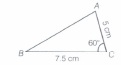
Construct ΔABC with BC = 7.5 cm, AC = 5 cm and m ㄥC = 60°.
1.
PQ = 5 cm, \(\angle PQR\) =105°, \(\angle QRP\) = 40°
\(\therefore\) 105° + 40° + \(\angle QPR\) = 180°
\(\therefore\) 145° + \(\angle QPR\) = 180°
\(\angle QPR\) = 180° - 145°
\(\angle QPR\) = 35°
(a) Draw a line segment PQ of 5 em.
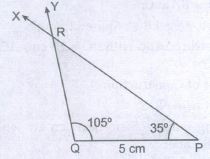
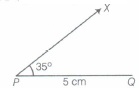
(b) From point P draw an angle of 35°, such that \(\angle QPX\) = 35°
PQR is required triangle.
2.
3.
Steps of construction
(i) Draw a line AC= 4 cm.
(ii) Construct \(\angle XAC=75^0\) at A.
(iii) Also, construct \(\angle YCA=60^0\)at C.
(iv) Ray X and ray Y cut each other at point B.
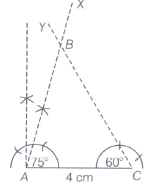
Hence, \(\triangle ABC\) is the required triangle, having \(\angle A=75^0,\angle C=60^0\) and AC = 4 cm.
4.
Steps of construction
(i) Draw a line I and mark a point C outside it.
(ii) Take a point B on line I and join BC.
(iii) Draw line parallel to line I passing through C.
(iv) Mark a point D on line m, at a distance of 4 cm from C.
(v) Through D draw AD II BC.
∴ Line I is parallel to line m
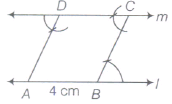
Also, AD II BC, AB=DC= 4 cm
5.
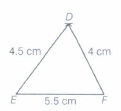
In ΔDEF, we have DE = 4.5 cm, EF = 5.5 cm and DF = 4 cm
Here, DE + DF = 4.5 + 4 = 8.5 cm and EF = 5.5 cm
∴ DE + DF > EF
Therefore, ΔDEF can be constructed.
To construct a triangle, we use the following steps.
Steps of construction
Step I Firstly, draw a rough sketch of triangle with given measures marked on it.
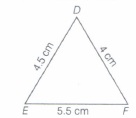
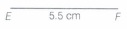
Step II Draw a line segment, EF=5.5 cm.
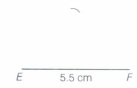
Step III With E as centre, and radius 4.5 cm, draw an arc.
Step IV With F as centre and radius 4 cm, draw an arc to intersect the previous arc at D.
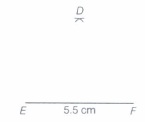
Step V Join DE and DF.
Thus, ΔDEF is the required triangle.
6.
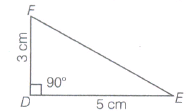
Given, two sides and an angle of \(\triangle DEF\) are DE = 5 cm, DF = 3 cm and m \(\angle EDF=90^0\).
To construct a triangle with these two sides and included angle, we use the following steps:
Steps of construction
Step I Firstly, we draw a rough sketch of triangle with given measures marked on it.
Step II Draw a line segment DE = 5 cm.

Step III At point D, construct \(\angle EDX=90^0\).
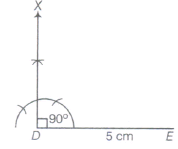
Step IV With D as centre and radius 3 cm, draw an arc which intersects DX at F.
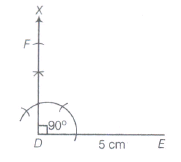
Step V Join EF.
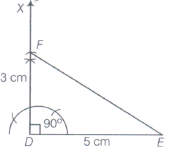
Thus, \(\triangle DEF\) is the required triangle.
7.
Given, an isoscelesright angled ΔABC in which
m ㄥACB =90°
and AC = BC =6 cm
∵ In an isoscelesright angled triangle, two sides, i.e. base and height will be equal.
To construct a triangle with these two sides and one right angle, we use the following steps:
Steps of construction
Step I Firstly, we draw a rough sketch of triangle with given measures marked on it.
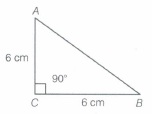
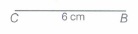
Step II Draw a line segment BC = 6 cm.
Step III At point C, draw CX 丄 BC.
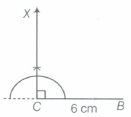
Step IV With C as centre and radius 6 cm, draw an arc to intersect ray CX at A.
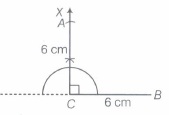
Step V Join AB .
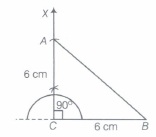
Thus, ΔABC is the required isosceles right angled triangle.
8.
Given, PQ = 5 cm, mㄥPQR = 105° and m ㄥQRP = 40°
In ΔPQR, by angle sum property, we have
ㄥPQR + ㄥQRP + ㄥRPQ = 180°
⇒ 105° + 40° + ㄥRPQ = 180°
⇒ ㄥRPQ = 180° -145° = 35°
Thus, we have PQ = 5 cm, ⇒ ⇒P = 35° and ⇒Q = 105°
Now, to draw ΔPQR, we use the following steps:
Steps of construction
Step I Firstly, we draw a rough sketch of traingle with measures marked on it.
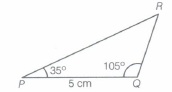
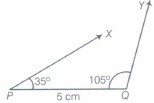
Step II Draw a line segment PQ = 5 cm.
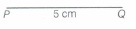
Step III At point P, draw a ray PX making an angle of 350 with PQ i.e., ㄥQPX = 350.
Step IV At point Q, draw a ray QY making an angle of 105° with PQ i.e. ㄥPQY = 105°.
Step V Extend the ray PX and QY. Let rays PX and QY intersect at R.
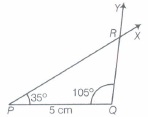
Thus, ΔPQR is the required triangle.
9.
To draw a line parallel to AB using ruler and compasses, we use the following steps:
Steps of construction
Step I Draw a line segment AB and then take any point P on it.

Step II Take a point C outside AB and join PC.
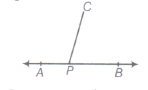
Step III With P as centre, draw an arc cutting AB and PC at X and Y respectively.
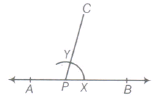
Step IV With C as as centre and the same radius as in step III, draw an arc on the opposite side of PX to cut PC at Q.
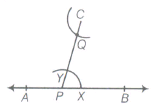
Step V Place the pointed tip of the compasses at X and adjust the opening, so that the pencil tip is at Y with this opening and with Q as centre, draw an arc cutting the arc drawn in step IV at R.
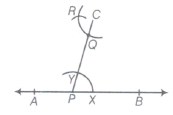
Step VI Join CR and produce it in both sides to obtain the required line l.
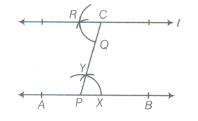
Thus, l II AB.
10.
Given, two sides and an angle of ΔABC are BC = 7.5 cm, AC = 5 cm and m ㄥC = 600
To construct a triangle with these two sides and included angle, we use the following steps:
Step I Firstly, we draw a rough sketch of triangle with given measures marked on it.
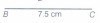
Step II Draw a line segment BC = 7.5 cm.
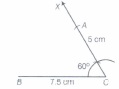
Step III At point C, draw a ray CX making an angle of 60° with BC.
Step VI With C as centre and radius 5 ern, draw an arc which intersects CX at A.
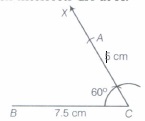
Step V Join BA
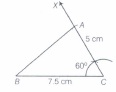
Thus, MBC is the required triangle

7th Standard CBSE Syllabus & Materials
7th Standard CBSE
CBSE 7th Social Science Theme B - New Beginnings : Cities and States - New Sample Question Papers Study Material - QB365 Set A
NEW7th Standard CBSE
CBSE 7th Social Science Theme A - Climates of India - New Sample Question Papers Study Material - QB365 Set A
NEW7th Standard CBSE
CBSE 7th Social Science Theme A - Geographical Diversity of India - New Sample Question Papers Study Material - QB365 Set A
NEW7th Standard CBSE
CBSE 7th Science Earth, Moon and the Sun - New Sample Question Papers Study Material - QB365 Set A



CBSE 7th Standard CBSE Subjects
CBSE Standards




