
 100% FREE ACCESS
7th Standard CBSE Syllabus & Materials
7th Standard CBSE
CBSE 7th Social Science Theme E - Understanding Market - New Sample Question Papers Study Material - QB365 Set A
NEW7th Standard CBSE
CBSE 7th Social Science Theme E - From Barter to Money - New Sample Question Papers Study Material - QB365 Set A
NEW7th Standard CBSE
CBSE 7th Social Science Theme D - The Constitution of India- An Introduction - New Sample Question Papers Study Material - QB365 Set A
NEW7th Standard CBSE
CBSE 7th Social Science Theme D - From the Rulers to the Ruled : Types of Governments - New Sample Question Papers Study Material - QB365 Set A
NEW7th Standard CBSE
CBSE 7th Social Science Theme B - The Age of Reorganisation - New Sample Question Papers Study Material - QB365 Set A
NEW7th Standard CBSE
CBSE 7th Social Science Theme B - The Rise of Empires - New Sample Question Papers Study Material - QB365 Set A

Published on: 06/03/2020
7th Standard CBSE Mathematics Public Exam Important Question 2019-2020
Download CBSE Class 7th Standard CBSE Mathematics question papers, sample papers, important questions, and previous year solved papers in PDF format. Get free study materials, NCERT solutions, and exam preparation resources for Class 7th Standard CBSE Mathematics
Questions + Answers key
Take MCQ Mathematics Test
1.
Simplify the following and write the answer in exponential form:
\([{5^6\over 5^3}]\times 5^2\)
2.
(a) Arrange the following rational numbers in ascending order:
\(\frac{2}{5},\frac{7}{10},\frac{8}{15},\frac{13}{30}\)
(b) Which mathematical concept is used in this problem?
(c) What is its value?
3.
In the given figure, ΔABC is an isosceles triangle in which AB = AC. If AB and AC are produced to D and E respectively such that BD = CE. Prove that BE = CD.
4.
A line segment XY is taken as 6cm. At Y, draw ZY ⊥ XY and cut-off ZY=4 cm. Complete the rectangle XYZW by drawing WZ||XY and join WX. Then, measure the lengths ZW and XW. What do you observe?
5.
Write the number of faces, edges and vertices in the solids given below:
Prism
6.
State the order of rotation and angle of rotation of the following figure.
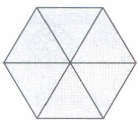
7.
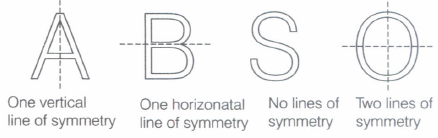
In the following figures, find the area of the shaded portions.
.png)
8.
4/5 of 5 kg apples were used on Monday. The next day, 1/ 3 of what was left was used. Find the weight (in kg) of apples left now.
9.
If Meena gives an interest of Rs 45 for one year at 9% rate p.a. What is the sum she has borrowed?
10.
Add : x2 -y2 -1, y2 -1 - x2,1 - x2 -y2
11.
In the given figure, find the value of x.
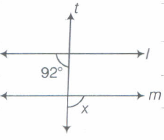
12.
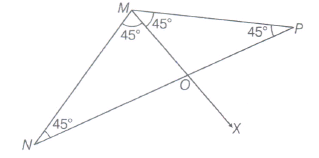
In the given \(\triangle MNP\), a line from vertex M is drawn passing through the side NP at O, such that the measure of angles are given. What would be the other name for OM?
13.
Solve the following equation 16 = 4 + 3(t + 2).
14.
Heights (in cm) of 25 children are given Below 168,165,163,160,163,161,162,164, l63, 162, 164, 163, 160, 163, 160, 165, 163, 162, 163, 164, 163, 160, 165,163, 162 What is the mode of their heights? What do we understand by mode here?
15.
In a magic square, each row, column and diagonal have the same sum. Check, which of the following is a magic square?
(i)
| 5 | -1 | -4 |
| -5 | -2 | 7 |
| 0 | 3 | -3 |
(ii)
| 1 | -10 | 0 |
| -4 | -3 | -2 |
| -6 | 4 | -7 |
16.
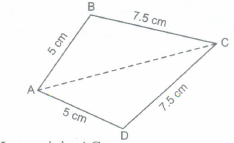
Look at the adjoining figure and show that
\(\triangle ABC\cong \triangle ADC\)
17.
Solve for y : \(2y+\frac { 5 }{ 2 } =\frac { 37 }{ 2 } \)
18.
Construct a \(\triangle MNO,\) whose sides are MN = 5 cm, NO = 5.5 cm and OM = 6 cm.
19.
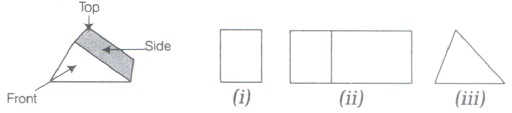
For each solid, the three views (i), (ii), (iii) are given. Identify for each solid the corresponding top, front and side views.
20.
Using laws of exponents simplify and write the answer in exponential form: (5-2)3
21.
Which of these are negative rational numbers?
0
22.
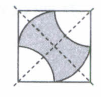
The following figures have more than one line of symmetry. Such figures are said to have multiple lines of symmetry.
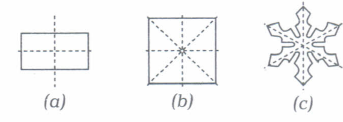
Identify multiple lines of symmetry, if any, in each of the following figures.

23.
State whether a given pair of terms is of like or unlike terms.12xz, 12x2z2
24.
Convert 0.24 into a fraction.
25.
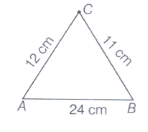
State whether the following triangle exists.
26.
If the side of a square is increased by 20%, then how much per cent does its area get increased?
27.
Find the mode of the following weights (in kg).39,36,35,36,41,49,36
28.
The sides of a triangle are in a ratio of 2 : 4 : 5. If the shortest side is 6 ern, then find the perimeter of the triangle.
29.
What's the Error? Reeta evaluated -4 + d for d = - 6 and gave an answer of 2. What might Reeta have done wrong?
30.
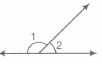
In the adjoining figure, \(\angle\) 1 and \(\angle\)2 are supplementary angles. If \(\angle\)1 is decreased, what changes should \(\angle\)2 take place in \(\angle\)2, so that both the angles still remain supplementary.
31.
Express the following numbers in the standard form:
9585.3
32.
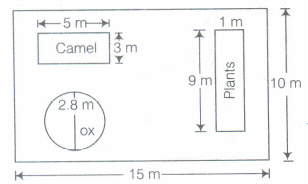
People of Khejadli village take good care of plants, trees and animals. They say that plants and animals can survive without us, but we can not survive without them. Inspired by her elders Amrita marked some land for her pets (camel and ox) and plants. Find the ratio of the areas kept for animals and plants to the living area. What value depicted here?
33.
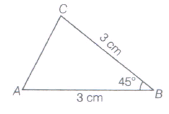
Draw an isosceles triangle with each of equal sides of length 3 cm and the angle between them as 45°.
34.
In a class of 80 students,\(\frac{1}{5}\) of the total number of students like to study English,\(\frac{2}{5}\) of the total like to study Science and remaining like to study Mathematics. How many students like to study Science?
35.
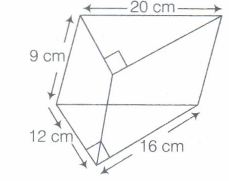
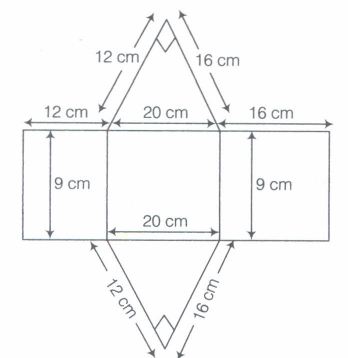
Draw a net of the solid given in the figure
36.
How much is 21a3 - 17a2 - less than 89a3 - 64a2 + 6a + 16?
37.
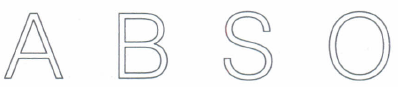
Draw all the lines of symmetry for the following letters if they exist.
38.
24 men can complete a job in 40 days, then find the number of men required to complete the job in 32 days.
39.
Write a pair of integers whose product is -36 and whose difference is 15.
40.
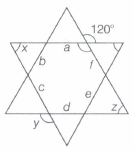
Amisha makes a star with the help of line segments a, b, C, d, e and f in which a || d, b II e and c II f. Chhaya marks an angle as 120°, as shown in figure and asks Amisha to find \(\angle\)x, \(\angle\)y and \(\angle\)z. Help Amisha in finding the angles.
41.
Add the following rational number.
\(\frac { 1 }{ 2 } +\frac { 1 }{ 6 } +\frac { 1 }{ 8 } \)
42.
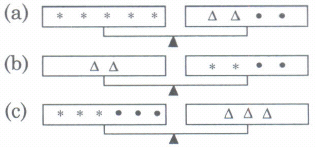
The three scales shown below are perfectly balanced if • = 3. What are the values of \(\Delta\) and *?
43.
Take any point O in the interior of a \(\triangle PQR\).Is
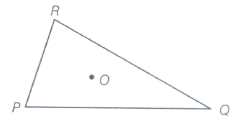
(i) OP+OQ>PQ?
(ii) OQ+OR>QR?
(iii) OR+OP>RP?
44.
Study the double bar graph shown below and answer the questions that follow:
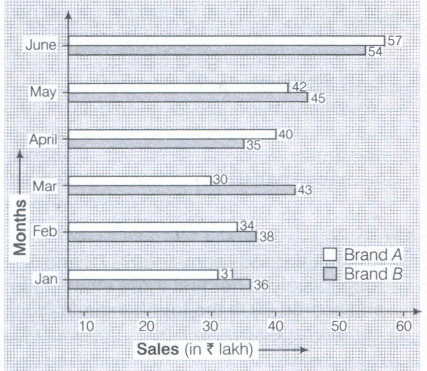
(a) What information is represented by the above double bar graph?
(b) In which month, sales of brand A decreased as compared to the previous month?
(c) What is the difference in sales of both the brands for the month of June?
(d) Find the average sales of brand 8 for the six months,
(e) List all months for which the sales of brand 8 was less than that of brand A.
(f) Find the ratio of sales of brand A as compared to brand 8 for the month of January.
45.
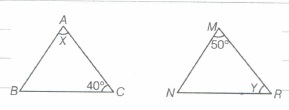
If ΔABC ≅ ΔMNR, then find the value of (2x+3y), where x and y shown in the following figures.
46.
If \(\frac{-8}{-9}=\frac{-16}{?}\) then?=
18
-18
9
-9
47.
Add a + b - 1, b - a + 1, 1 - 2b
1
-1
2
-2
48.
There are 100 voters. 50 of them votes yes. What per cent voted yes?
10%
25%
50%
5%
49.
Which congruence criterion do you use in the following?
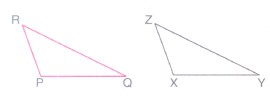
Given: ZX = RP
RQ = ZY
ㄥPRQ = ㄥXZY
So, ΔPRQ ≅ Δ XYZ
SSS
SAS
ASA
RHS
50.
What is the measure of the complement of the angle 90°?
90°
0°
180°
45°
51.
How many lines of symmetry are there in a scalene triangle?
1
0
2
4
52.
150 g is equal to
0.15 kg
0.015 kg
0.0015 kg
0.00015 kg.
53.
The solution of the equation 3m + 7 = 16 is
1
2
3
4
54.
Read the following bar graph and answer the question
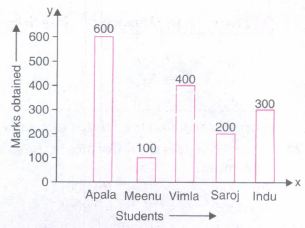
The difference between the marks obtained by Vimla and Saroj is how many times the difference between the marks obtained by Meenu and Saroj?
2
3
4
6
55.
Which of the following is not equal to 1?
\(\frac { { 2 }^{ 2 }\times { 3 }^{ 2 } }{ 4\times 18 } \)
\(\left[ \left( -2 \right) ^{ 3 }\times \left( -2 \right) ^{ 4 }\div \left( -2 \right) ^{ 7 } \right] \)
\(\frac { { 3 }^{ 0 }\times { 5 }^{ 3 } }{ 5\times 25 } \)
\(\frac { { 2 }^{ 4 } }{ \left( { 7 }^{ 0 }+{ 3 }^{ 0 } \right) ^{ 3 } } \)
56.
A table top is semicircular in shape with diameter 2.8 m. Area of this table top is
3.08 m2
6.16 m2
12.32 m2
24.64 m2
57.
The name of given solid shape is
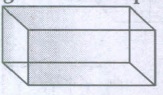
Cube
Cone
Cuboid
Pyramid
58.
PB = PD. The value of x is :
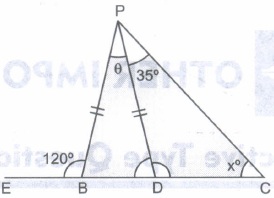
85°
90°
25°
35°
59.
Which of the following is the value of (-12) \(\times\) (- 2) \(\times\) (-5)?
-120
120
0
1
60.
In which of the following cases, a triangle can be drawn?
AB= 4 cm, BC= 8 cm and CA= 2 cm
BC= 5.2 cm, \(\angle B=90^0\) and \(\angle C=110^0\)
XY = 5 cm,\(\angle X=45^0\)and \(\angle Y=60^0\)
An isosceles triangle with the length of each equal side 6.2 cm.
61.
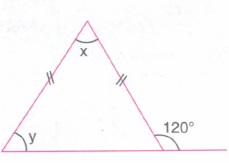
Find angles x and y in each figure.
62.
The area of a rhombus is 96 cm2. If one of its diagonals is 12 em, then find the perimeter of the rhombus.
63.
If A = 2 + 4x + 8x2,B = -3-5x +x2 ,C= 1 + 3x-7x2, find A + B + C.
64.
5. If (25)n-1 + 100 = 5(2n-1), find the value of n.
65.
In a debate competition, the judges decided that 20% of the total marks would be given for accent and presentation. 60% of the rest are reserved for the subject matter and the rest are for rebuttal. If this means 8 marks for rebuttal, then find the total marks.
66.
Ram's father is 49 years old. He is 4 years older than three times Ram's age. What is Ram's age.
67.
Following are the marks obtained by 25 students in class test (out of 25 marks) in Maths :
18, 13, 18, 16, 8, 5, 13, 5, 18, 18,2,16, 13, 8, 17, 18 5, 2, 13, 8, 19, 16, 8, 20.
How many students obtained marks more than the mean marks?
68.
Arrange the rational numbers \(\frac { -3 }{ 5 } ,\frac { 7 }{ -10 } ,\frac { -5 }{ 6 } \\ \) ascending order.
69.
Two poles of height 9 m and 14m stand upright on a plane ground. If the distance between their tops is 13 m, find the distance between their feets.
1.
we have \([{5^6\over 5^3}]\times 5^2\) =[56-3]x52 \((\because {a^m\over a^n}=a^{m-n})\)
= 53 X 52
= 53 + 2 \((\because a^m \times a^n =a^{m+n})\)
= 55
Thus,\([{5^6\over 5^3}]\times 5^2=5^5\)
2.
(a) Sequence \(\frac{2}{5},\frac{7}{10},\frac{8}{15},\frac{13}{30}\)
L.C.M.of 5, 10,15,30 = 30
Sequence be
\(\frac{2\times6}{5\times6},\frac{7\times3}{10\times3},\frac{8\times2}{15\times2},\frac{13}{30}\)
or \(\frac{12}{30},\frac{21}{30},\frac{16}{30},\frac{13}{30}\)
Its ascending order is
\(\frac{12}{30}<\frac{13}{30}<\frac{16}{30}<\frac{21}{30}\)
or \(\frac{2}{5}<\frac{13}{30}<\frac{18}{15}<\frac{7}{10}\)
(b) L.C.M: and to find ascending order.
(c) In a class, the students should stand in ascending order of height.
3.
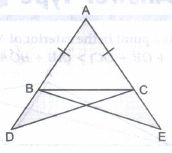
Since,
AB=AC
BD= CE
∴ AB + BD = AC + CE
⇒ AD=AE
Now in ∆ADC and ΔAEB
AD=AE
AC=AB
\(\angle\)A = \(\angle\) A
ΔADC≅ΔAEB
\(\Rightarrow\) by C.P.C.T., CD = BE
4.
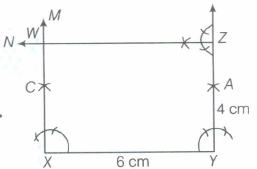
WZ =XY = 6cm
ZY = XW = 4cm
We observed that opposite sides of rectangle are equal and each angles of rectangle is 90°.
5.
Faces = 5, edges = 9, vertices = 6
6.
The given figure is a hexagon, So, the order of rotation is 6 and angle of rotation of hexagon is \(\frac { 360 }{ 6 } =60°\)
7.
Given, side of the square PQRS = 20 cm
\(\therefore\) Area of the square = (Side)2
= (20)2 = 20 x 20 = 400 cm2
Now, area of \(\Delta\)QPT = \(\frac{1}{2}\times\) Base x Height
= \(\frac{1}{2}\times\) PQ x PT = \(\frac{1}{2}\times\) 20 x 10
= \(\frac{200}{2}\) = 100 cm2
Area of \(\Delta\)TSU = \(\frac{1}{2}\times\) Base x Height
= \(\frac{1}{2}\times\) SU x TS = \(\frac{1}{2}\times\) 10 x 10 = \(\frac{100}{2}\) = 50 cm2
and area of \(\Delta\)QRU = \(\frac{1}{2}\times\) Base x Height
= \(\frac{1}{2}\times\) UR x QR = \(\frac{1}{2}\times\) 10 x 20 = \(\frac{200}{2}\) = 100 cm2
Area of shaded portion = Area of rectangle PQRS - (Area of \(\Delta\)QPT + Area of \(\Delta\)TSU + Area of \(\Delta\)QRU)
= 400 - (100 + 50 + 100) cm2 = 400 - 250 = 150 cm2
Hence, the area of the shaded portion is 150 cm2.
8.
Apples used on Monday = \(\frac{4}{5}\) of 5 kg
=\(\frac{4}{5}\times 5=\frac{4\times 5}{5}=\)4kg
Apples left = (5 - 4) kg = 1kg
Next day, apples used = \(\frac{1}{3}\)of 1 kg=\(\frac{1}{3}\)kg
Left apples =\((1-\frac{1}{3})kg=\frac{3\times 1-1\times 1}{3}=\frac{3-1}{3}=\frac{2}{3}\)kg
9.
Let the sum borrowed by Meena be Rs x.
Rate of interest, R = 9%; Time, T = 1yr; Interest, I = Rs45
\(\therefore I={P\times R\times T\over 100}\Rightarrow 45={P\times9\times1\over100}\)
\(\Rightarrow 9P=45\times100\Rightarrow P={4500\over 9}\Rightarrow P=Rs500\)
Hence, the sum borrowed by Meena is Rs 500.
10.
We have x2 -y2 -1, y2 -1 - x2,1 - x2 -y2
\(\therefore\) required sum
= =x2 -y2 -l+y2 -l-x2 + l-x2 -y2
=x2 -x2 -x2 -y2 +y2 -y2 -1-1+1 [rearranging terms]
=x2(1- 1- 1)+ y2(- 1+ 1- 1)-1
= x2(-l) + y2(-1)-1 = x2 - y2 -1
11.
88°
12.
In \(\triangle OMP\),
\(\angle OMP=\angle OPM\)
\(\therefore\) OM=OP.................1
[Since, sides opposite to equal angles are equal]
Also, in \(\triangle OMN\),
\(\angle OMN=\angle ONM\Rightarrow OM=ON\Rightarrow OP=ON\) [from Eq.1]
Hence, OM is the median of \(\triangle MPN\).
13.
We have, 16 = 4 +3{t + 2)
Given equation can be written as
4 + 3 (t + 2) = 16
On transposing (+4) from LHS to RHS, we get
3(t + 2) = 16 - 4 \(\Rightarrow\) 3(t + 2) = 12
On dividing both sides by 3, we get
\(\frac{3(t+2)}{3}=\frac{12}{3}\quad \Rightarrow\) t + 2 = 4
Again, transposing (+2) from LHS to RHS, we get
t = 4 - 2 \(\Rightarrow\) t = 2
Hence, t = 2 is a solution of the given equation.
14.
On rearranging the heights in ascending order, we get
160,160,160,160,161,162,162,162,162,163,163, 163,163,163,163, 163,163,163,164,164,164,165, 165,165,168.
| Numbers | Occuring Time(frequency) |
|---|---|
| 160 | Four time |
| 161 | One Times |
| 162 | Four times |
| 163 | Nine Times |
| 164 | Three Times |
| 165 | Three times |
| 168 | One time |
Here, we observe that 163 is occurring nine times, i.e. more frequently.
Hence, mode of their heights is 163.
By the mode calculated above, we understand that most of the children have height 163 ern.
15.
We have,
| 5 | -1 | -4 |
| -5 | -2 | 7 |
| 0 | 3 | -3 |
Sum of the digits along
Ist row = 5 + (-1) + (-4) = 5 - 5 = 0
Ilnd row = (-5) + (-2) + 7= -7 + 7=0
IIIrd row = 0 + 3 + (- 3) = 3 + (-3) = 0
Similarly, sum of the digits along
Ist column = 5 + (-5) +0=5 + (-5)=0
IInd column = (-1) + (-2) + 3= (-3) +3 =0
IIIrd column = (-4) + 7 + (- 3) = 7 + (-7) = 0
Sum of the digits along
Ist diagonal =5 + (-2) + (-3)= 5 + (-5)=0
IInd diagonal = (-4) + (-2) + 0 = - 6 \(\neq\) 0
Since, the sum of digits along the Ilnd diagonal \(\neq\) 0, so it is not a magic square.
(ii)Magic Square:
Sum of the digits along:
1st row = 1+ (-10) + 0 = 1 - 10
= -9
2nd row = (-4) + (-3) + (-2)
= (-7) + (-2) = -9
3rd row = (-6) + 4 + (-7) = (-13) + 4
= -9
1st column = 1 + (-4) + (-6) = 1 - 10
= -9
2nd column = (-10) + (-3) + 4
= (-13) + 4 = -9
3rd column = 0 + (-2) + (-7) = 0 + (-9)
=-9
One diagonal = 1 + (-3) + (-7) = 1 + (-10)
= -9
Second diagonal = (-6) + (-3) + 0
= (-9) + 0 = -9
∵ Each row, column and diagonal have the same sum.
∴ The square (ii) is the magic square.
16.
Let us join AC.
In \(\triangle ABCand\triangle ADC\)
\(\overline { AB } =5cm,\overline { AD } =5cm\quad \Rightarrow \overline { AB } =\overline { AD } \)
\(\overline { BC } =7.5cm,\overline { DC } =7.5cm\quad \Rightarrow \overline { BC } =\overline { DC } \)
\(\overline { AC } =\overline { AC } \) [common]
\(\therefore \triangle ABC\cong \triangle ADC\) [SSS congruency]
17.
\(2y+\frac { 5 }{ 2 } =\frac { 37 }{ 2 } \)
\(\Rightarrow \quad 2y=\frac { 37 }{ 2 } -\frac { 5 }{ 2 } \)
\(\Rightarrow \quad 2y=\frac { 37-5 }{ 2 } \)
\(\Rightarrow \quad 2y=\frac { 32 }{ 2 } \)
\(\Rightarrow\) 2y = 16
\(\frac { 2y }{ 2 } =\frac { 16 }{ 2 } \) [Dividing by 2]
Thus, y = 8
18.
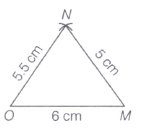
19.
(i) ➝ Side, (ii) ➝ Top, (iii) ➝ Front
20.
5-6
21.
0 (zero) is neither a positive nor a negative rational number.
22.
The multiple lines of symmetry of each figure are shown below:
This figure has 2 lines of symmetry which are shown by dotted lines.
23.
12xz, 12x2 z2 are unlike terms, since algebraic factors are not same. [in 12xz, algebraic factors are x, z and in 12x2z2, algebraic factors are x, x, z, z]
24.
We have, 0.24
\(\frac{0.24}{1}\) on removing decimal, \(\frac{024}{100}\), In simplest form =\(\frac{6}{25}\)
25.
No, the given triangle does not exist, since it doesn't satisfy the triangle inequality.
In the given \(\triangle ABC\)
\(\overline{AB}=24cm,\overline{AC}=12cm,\overline{BC}=11cm\)
Now \(\overline{AC}+\overline{BC}=12+11=23\) and \(\overline{AB}=24cm\)
\(\therefore \overline {AC}+\overline{BC}<\overline{AB}.\) Hence, the required triangle doesn't exist.
26.
44%
27.
Given weights (in kg) are 39, 36, 35, 36, 41, 49 and 36.
Mode is the most occurring observations.
Here, 36 kg occurs 3 times.
\(\therefore\) Mode = 36 kg
28.
33cm
29.
Reeta went wrong in solving + (- 6) and took it as (+ 6).
30.
We know that, the two angles are supplementary, if their sum is 180°.
\(\therefore\) \(\angle \)1 + \(\angle \)2 = 180° [given]
Now, if \(\angle \)1 is decreased, then \(\angle \)2 should be increased, so that both the angles still remain supplementary.
i.e. \(\angle \)1 + \(\angle \)2=180°
31.
9.5853 x 10³
32.
\(\therefore\) Area of rectangle = I x b and area of circle = \(\pi\)r2
\(\therefore\) Area of total rectangular land = 15 m x 10 m
=150 m2
Area of land covered by plants = 9 m x 1 m = 9 m2
Area of land covered by camel = 5 m x 3 m = 15 m2
Region of land covered by ox is circular area.
So, the diameter is given, d = 2.8 m
\(\therefore\) Radius = \(\frac{d}{2}=\frac{2.8}{2}\) = 1.4 m.
\(\therefore\) Area of land covered by ox = \(\pi\)r2
= \(\frac{22}{7}\) x 14 x 14 = 616 m2
Total area covered by plants, camel and ox
= 9 + 15 + 6.16 = 30.16 m2
Remaining land for living = Total area - Area covered by plants and animals
= (150 - 30.16 ) m2 = 119.84 m2
\(\therefore\) Ratio of areas kept for animals and plants to the living area
= 30.16: 119.84 = 3016: 11984 = 377: 1498
The value depicted here is that we should save our environment and balance environment.
33.
Steps of construction
Step I Firstly, we draw a rough sketch of triangle with given measures marked on it.
Step II Draw a line segment AB of length 3 cm.
Step III Draw an angle of 45° on point B and produce it to ray Y.
Step IV With B as centre, draw an arc of 3 cm which intersects ray BYat C.
Step V Join AC.
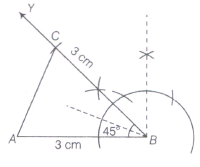
Thus, \(\triangle ABC\) is the required isosceles triangle.
34.
48
35.
The net of the given solid figure will be
36.
Required expression is
89a3 - 64a2 + 6a + 16 - (21a3 -17a2)
= 89a3 - 64a2 + 6a + 16 - 21a3 + 17a2
= 89a3 - 21a3 - 64a2 + 17a2 + 6a + 16
= 68a3 - 47a2 + 6a + 16
So, 21a3 -17a2 is 68a3 - 47a2 + 6a + 161ess than
89a3 - 64a2 + 6a + 16.
37.
38.
30 men
39.
For a pair of integers whose product is -36 and whose difference = 15.
So, first integer = -3 and second integer = 12
Their product = (-3) \(\times\) 12 = -(3 \(\times\) 12)= -36
and the difference between these two integer is 15.
40.
Given, a II d, b II e, c II f, a, b, c, d, e and f are line segments.
Give them points A, B, C, 0, E, F, G, H, I, J and K.
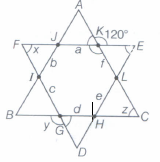
\(\because\) \(\angle\)AKE =120°
\(\therefore\)\(\angle\)JKL = \(\angle\)AKE = 120°
[vertically opposite angles)
Now, a ll d
\(\therefore\) \(\angle\)JKL + \(\angle\)KCH=180° [cointerior angles]
\(\Rightarrow\) 120° + \(\angle\)z = 180°
\(\Rightarrow\) \(\angle\)z = 180° - 120° = 60°
Also, \(\angle\)FGH + \(\angle\)KCH = 180° [cointerior angles]
\(\Rightarrow\) LFGH = 180° - 60° = 120°
\(\angle\)FGH= \(\angle\)BGD [vertically opposite angles]
\(\Rightarrow\) \(\angle\)BGD =120° \(\Rightarrow\) \(\angle\)y=120°
and \(\angle\)x + \(\angle\)FGH = 180° [cointerior angles]
\(\therefore\) \(\angle\)x = 180°-120° = 60°
Hence, \(\angle\)x = 60°, \(\angle\)y = 120° and \(\angle\)z = 60°.
41.
Given, \(\\ \frac { 1 }{ 2 } +\frac { 1 }{ 6 } +\frac { 1 }{ 8 } \)
For common/same denominator
LCM of 2,6 and 8 is 24.
\(\frac { 1 }{ 2 } =\frac { 1\times 12 }{ 2\times 12 } =\frac { 12 }{ 24 } \frac { 1 }{ 6 } =\frac { 1\times 4 }{ 6\times 4 } =\frac { 4 }{ 24 } \\ \frac { 1 }{ 8 } =\frac { 1\times 3 }{ 8\times 3 } =\frac { 3 }{ 24 } \\ \therefore \frac { 1 }{ 2 } +\frac { 1 }{ 6 } +\frac { 1 }{ 8 } =\frac { 12 }{ 24 } +\frac { 4 }{ 24 } +\frac { 3 }{ 24 } \\ =\frac { 12+4+3 }{ 24 } =\frac { 19 }{ 24 } \)
42.
and given. = 3
From (a), y + y + y + y + y = x + x + 3 + 3
\(\Rightarrow\) 5y = 2x + 6 \(\Rightarrow\) 5y - 2x = 6
\(\Rightarrow\) 2x - 5y = - 6 ...(i)
From (b), x + x = y + y + 3 + 3
\(\Rightarrow\) 2x = 2y + 6 \(\Rightarrow\) 2x - 2y = 6
\(\Rightarrow\) x - y = 3 [dividing both sides by 2] ...(ii)
From (c), y + y + y + 3 + 3 + 3 = x + x + x
\(\Rightarrow\) 3 y + 9 = 3x \(\Rightarrow\) 3x - 3y = 9
\(\Rightarrow\) x - y = 3 [dividing both sides by 3] ...(iii)
From Eq. (iii), x - y = 3 \(\Rightarrow\) x = y + 3
On putting x = y + 3 in Eq. (i). we get
2(Y + 3) - 5Y = -6 \(\Rightarrow\) 2y + 6 - 5Y = -6
-3y + 6 = - 6 \(\Rightarrow\) -3 y = - 6 - 6 = -12
\(y=\frac{12}{3}=4\)
On putting y = 4 in Eq. (ii), we get
x - y = 3 \(\Rightarrow\) x - 4 = 3
\(\Rightarrow\) x = 3 + 4 = 7 \(\Rightarrow\) x = 7
:. The value of \(\Delta\) = x = 7 and the value of • = y = 4.
43.
(i) Yes, OP+OQ>PQ because on joining OP and OQ,we get a \(\triangle OPQ\) and in a triangle, sum of the lengths of any two sides is always greater than the third side.
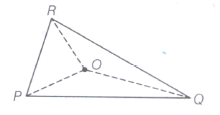
(ii) Yes, OQ+OR>QR because on joining OQ and OR,we get a \(\triangle OQR\) and in a triangle, sum of the lengths of any two sides is always greater than the third side.
(iii) Yes, OR+OP>RP because on joining OR and OP, we get a \(\triangle OPR\) and in a triangle, sum of the lengths of any two sides is always greater than the third side.
44.
(a) The above double bar graph compares the sale of brands A and 8during the months of January to June.
(b) We can clearly see from the double bar graph that sales for brand A reduced in the month of March compared to that of February.
(c) Sales of brand A in June = Rs. 57 lakh
and sales of brand 8 in June = Rs. 54 lakh
Difference in sales = 57 - 54 = Rs. 3 lakh
(d) Average sales of brand 8
=\(\frac { total\ sales\ of\ brand\ b\ in\ sin\ months\ from\ january\ to\ june }{ 6 } \)
= \(\frac { 36+38+43+35+45+54 }{ 6 } \)
= \(\frac { 251 }{ 6 } \) Rs.41.83 lakh
(e) We can clearly see from the double bar graph that sales of brand 8is less than sales of brand A in the month of April and June
(f) Sales of brand A in January = 31
and sales of brand 8 in January = 36
Required ratio = \(\frac { 31 }{ 36 } \)or 31:36
45.
2x+3y=220°
46.
\(\frac{-8}{-9}=\frac{-8\times2}{-9\times2}=\frac{-16}{-18}\)
47.
(a)
1
48.
Required percentage =\({50\over 100}\times 100\%\)
=50%.
49.
(b)
SAS
50.
90° - 90° = 0°.
51.
(b)
0
52.
\(1kg=1000gm;150g=\frac{150 gm}{1000}kg=0.15\ kg\)
53.
3m + 7 = 16 \(\Rightarrow\) 3m = 16 -7 = 9\(\Rightarrow m={9\over3}=3\)
54.
400 - 200 = 200; 200 - 100 = 100;
200 = 2\(\times\)100
55.
(d)
\(\frac { { 2 }^{ 4 } }{ \left( { 7 }^{ 0 }+{ 3 }^{ 0 } \right) ^{ 3 } } \)
56.
(a)
3.08 m2
57.
(c)
Cuboid
58.
(c)
25°
59.
(a)
-120
60.
(c)
XY = 5 cm,\(\angle X=45^0\)and \(\angle Y=60^0\)
61.
(i) x + y = 1200 ...(1)
The exterior angle of a triangle is equal to the sum of its two interior opposite angles
x + y + y = 1800
Base angles opposite to the equal sides of an isosceles triangle are equal and the sum of the measures of the three angles of a triangle is 1800
\(\Rightarrow\)x + 2y = 1800 ... (2)
Subtracting equation (1) from equation (2),
y = 60°
Put y = 60° in equation (1),
x + 60° = 120°
\(\Rightarrow\)x = 120° - 60°
\(\Rightarrow\)x = 60°
62.
ABCD is the rhombus such that its diagonals AC and BD intersect at O. Here BD = 12 cm.
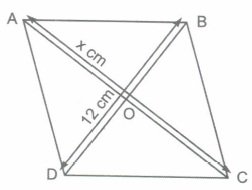
Suppose AC = x cm.
Since, the area of a rhombus =\(\frac{1}{2}\)\(\times\)[Product of 2 its diagonals]
\(\therefore\)Area of the rhombus ABCD =\(\frac{1}{2}\)\(\times\) 12 \(\times\) x cm2
2 But the area of the rhombus ABCD = 96 cm2
\(\Rightarrow\)\(\frac{1}{2}\)\(\times\)12 \(\times\) x = 96
\(\Rightarrow\)x=\(\frac{96\times2}{12}\)cm \(\Rightarrow\)x=8\(\times\)2cm
\(\Rightarrow\) x=16 cm
Since, the diagonals of a rhombus, bisect each other at right angles.
\(\therefore\)\(\angle \)COD = 90°, OC =\(\frac{1}{2}\)\(\times\) 16 cm=8 cm
and Od=\(\frac{1}{2}\)\(\times\) 12 cm =6 cm
Now, in right \(\Delta\)COD, we have
\(\Rightarrow\)OD2 + OC2 = CD2 \(\Rightarrow\) 62 + 82 = CD2
\(\Rightarrow\)36 + 64 = CD2 \(\Rightarrow\)100 = CD2
\(\Rightarrow\) 102 = CD2 \(\Rightarrow\) CD = 10 cm.
Since, all the sides of rhombus are equal and perimeter of a rhombus = 4 x Side.
\(\therefore\) Perimeter ofthe rhombus = 4 x 10 em = 40 cm
63.
A = 2 + 4x + 8x2
B = -3-5x + x2
C = 1 + 3x-7x2
A+B+C=?
A + B + C = (2 + 4x + 8x2) + (- 3 - 5x + x2)+ (1 + 3x-7x2)
= 2 + 4x + 8x2 - 3 - 5x + x2 + 1 + 3x -7x2
= x2(8 + 1 - 7) + x( 4 - 5 + 3) + 2 - 3 + 1
=2x2+2x+0
=2x2+2x
= 2x(x + 1).
64.
(25)n-1 + 100 = 5(2n-1)
⇒ (52)n-1 + 100 = 5(2n-1)
⇒ 52n-2 + 100 = 52n-1
⇒ 52n-2 - 52n-1 = - 100
⇒ 52n - 1 - 52n- 2 = 100
⇒ 52n-2 x (5 -1) = 100
⇒ 52n-2 x 4 = 100
\(⇒\ 5^{2n-2}={100\over 4}=25\)
Thus, 52n- 2 = 52
As base is same on both the sides
∴ 2n-2 = 2
⇒ 2n=2+2
⇒ 2n = 4
\(⇒\ n={4\over 2}=2\)
65.
Let the total marks = x
Then, marks for accent and presentation
= 20% of x
=\(\frac { 20 }{ 100 } \times x=\frac { x }{ 5 } \)
Remaining marks = x - \(\frac { x }{ 5 } ={5x-x\over5}={4x\over 5}\)
Now, marks for subject matter =60% of \(\frac { 4x }{ 5 } \)
\(\frac { 60 }{ 100 } \times \frac { 4x }{ 5 } =\frac { 12x }{ 25 } \)
Remaining marks \(={4x\over 5}-{12x\over 25}={5\times4x-12x\times1\over25}\)
\(={20x-12x\over25}={8x\over 25}\)
According to the question, there are 8 marks for rebuttal.
so, \(\frac { 8x }{ 25 } =8\Rightarrow 8x=25\times 8\)
\(\Rightarrow \quad x=\frac { 25\times 8 }{ 8 } 25\)
66.
Age of Ram's father = 49 years
Let the age of Ram be x years
\(\therefore\) 3x + 4 = 49
\(\Rightarrow\) 3x = 49 - 4
\(\Rightarrow\) 3x = 45
\(\Rightarrow\) \(x=\frac { 45 }{ 3 } \)
x = 15
\(\Rightarrow\) Ram's age = 15 years
67.
Arranging the observations (marks) in ascending order:
2, 2, 5, 5, 5, 8, 8, 8, 8, 13, 13, 13, 13, 16, 16, 16, 17, 17, 18,18,18,18,18,19,20
Sum of observations
\(2\times2=4\\5\times3=15\\8\times4=32\\13\times4=52\\16\times3=48\\17\times2=34\\18\times5=90\\19\times1=19\\20\times1=20\\\quad\quad\quad\quad\_\_\_\_\\\ Total=314\\ \quad\quad\quad\quad\_\_\_\_\)Number of students = 25
\(\therefore\) Mean marks \(=\frac{Sum\ of\ the\ observations}{Total\ number\ of\ students}\)
\(=\frac{314}{25}=12.5\)
So, the number of students who scored marks more than mean marks is
4 + 3 + 2 + 5 + 1 + 1 = 16.
68.
Sequence is \(\frac { -3 }{ 5 } ,\frac { 7 }{ -10 } ,\frac { -5 }{ 6 } \\ \)
L.C.M.of 5, 10 and 6=30
\(\Rightarrow \frac { -3 }{ 5 } ,\frac { 7 }{ -10 } ,\frac { -5 }{ 6 } \)
\(\Rightarrow -\frac { 3\times 6 }{ 5\times 6 } ,\frac { 7\times 3 }{ -10\times 3 } ,-\frac { 5\times 5 }{ 6\times 5 } \)
\(\Rightarrow -\frac { 18 }{ 30 } ,\frac { 21 }{ 30 } ,\frac { 25 }{ 30 } \)
Since \(-\frac { 25 }{ 30 } <\frac { 7 }{ -10 } <\frac { -3 }{ 5 } \)
Hence sequence in ascending order is
\(\frac { -5 }{ 6 } <\frac { 7 }{ -10 } <\frac { -3 }{ 5 } \).
69.
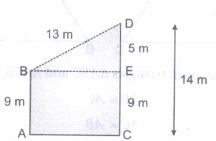
In the above figure, AB and CD are two poles whose heights are 9 m and 14m respectively.
\(\Rightarrow\) AB = EC = 9m
and BD = 13m
DE = 14 - 9
= 5m
Now in right ΔBDE, by Pythagoras
BD2 = BE2 + DE2
132 = BE2 + 52
\(\Rightarrow\) BE2 = (13)2 - (5)2
= 169-25
BE2 = 144
\(\Rightarrow\) BE = \(\sqrt { 144 } \)
\(\Rightarrow\) BE = 12m.
Hence, distance between their feet = 12 m.

7th Standard CBSE Syllabus & Materials
7th Standard CBSE
CBSE 7th Social Science Theme B - New Beginnings : Cities and States - New Sample Question Papers Study Material - QB365 Set A
NEW7th Standard CBSE
CBSE 7th Social Science Theme A - Climates of India - New Sample Question Papers Study Material - QB365 Set A
NEW7th Standard CBSE
CBSE 7th Social Science Theme A - Geographical Diversity of India - New Sample Question Papers Study Material - QB365 Set A
NEW7th Standard CBSE
CBSE 7th Science Earth, Moon and the Sun - New Sample Question Papers Study Material - QB365 Set A



CBSE 7th Standard CBSE Subjects
CBSE Standards




