
 100% FREE ACCESS
7th Standard CBSE Syllabus & Materials
7th Standard CBSE
CBSE 7th Social Science Theme E - Understanding Market - New Sample Question Papers Study Material - QB365 Set A
NEW7th Standard CBSE
CBSE 7th Social Science Theme E - From Barter to Money - New Sample Question Papers Study Material - QB365 Set A
NEW7th Standard CBSE
CBSE 7th Social Science Theme D - The Constitution of India- An Introduction - New Sample Question Papers Study Material - QB365 Set A
NEW7th Standard CBSE
CBSE 7th Social Science Theme D - From the Rulers to the Ruled : Types of Governments - New Sample Question Papers Study Material - QB365 Set A
NEW7th Standard CBSE
CBSE 7th Social Science Theme B - The Age of Reorganisation - New Sample Question Papers Study Material - QB365 Set A
NEW7th Standard CBSE
CBSE 7th Social Science Theme B - The Rise of Empires - New Sample Question Papers Study Material - QB365 Set A

Published on: 06/03/2020
7th Standard CBSE Mathematics Public Exam Sample Question 2020
Download CBSE Class 7th Standard CBSE Mathematics question papers, sample papers, important questions, and previous year solved papers in PDF format. Get free study materials, NCERT solutions, and exam preparation resources for Class 7th Standard CBSE Mathematics
Questions + Answers key
Take MCQ Mathematics Test
1.
Mention five rational numbers.
Numerator and denominator are both positive integers.
2.
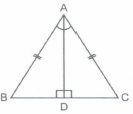
In an isosceles ΔABC, show that the, bisector of its vertical angles bisects the base at right angles.
3.
Find the value of the following expressions, when n =-2:n3 + 5n2 + 5n - 2.
4.
The cost of a flower vase is Rs.120, if the shopkeeper sells it at a loss of 10%. Find the price at which it is sold?
5.
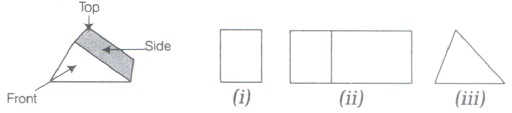
For each solid, the three views (i), (ii), (iii) are given. Identify for each solid the corresponding top, front and side views.
6.
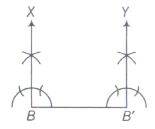
In the following construction figure, is BX II B' Y?
7.
Simplify and express each of the following in exponential form: \(\frac { { 2 }^{ 8 }\times { a }^{ 5 } }{ { 4 }^{ 3 }\times { a }^{ 3 } } \)
8.
Find the perimeter of an isosceles triangle whose one of the two equal side is 5 cm and third side is 6 cm.
9.
Copy the figure with punched holes and find the axes of symmetry for the following:

10.
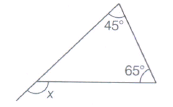
Find the value of the unknown exterior angle x in the following figures.
11.
Two complementary angles are in the ratio of 2:7, find the angles.
12.
Find the product, using suitable properties. (- 41) \(\times\) 102
13.
A die is thrown. What is the probability - of getting 7?
14.
Multiply and express as a mixed fraction.\(4\times 6\frac{1}{3}\)
15.
Write equations for The number b divided by 5 gives 6.
16.
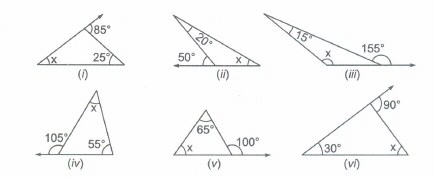
Find the measure of x in each of the following figures.
17.
By what number should (- 4)5 be divided so that the quotient may be equal to (-4)3?
18.
If x = 2x+ 3 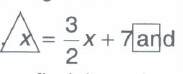 x = x -3, then find the value of - i)
 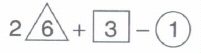 ii)
ii) .png)
19.
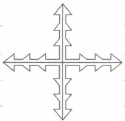
Find the number of lines of symmetry and order of symmetry of the following figure.
20.
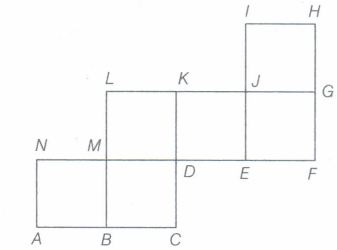
The net given below in figure can be used to make a cube.
(i) Which edge meets AN?
(ii) Which edge meets DE?
21.
A plot is in the form of a parallelogram ABCD. Owner of this plot wants to build OLD AGE HOME, DISPENSARY, PARK and HEALTH CENTRE for elderly people as shown in the figure given below:
P is a point on the diagonal BD.
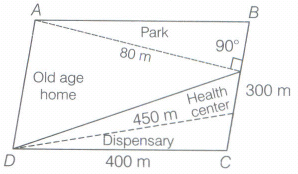
(a) Find the area of plot ABCD.
(b) Which values are depicted here?
22.
Lalita reads a book for 2\(\frac{4}{8}\)h everyday. She reads the entire book in 64 days. How many hours in all were required by her to the read the entire book?
23.
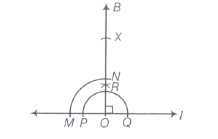
Draw a line l. Draw a perpendicular to l at any point on l. On this perpendicular, choosea point X, 4 cm away from l. Through X, draw a line mparallel to l.
24.
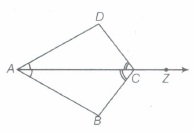
In the given figure, ray AZ biscets ㄥDAB as well as ㄥDCB.
(i) State the three pairs of equal parts in ΔBAC and ΔDAC
(ii) Is ΔBAC ≅ ΔDAC? Give reasons.
(iii) Is AB = AD? Justify your answer
(iv) Is CD = CB? Give reasons.
25.
A certain sum of money amounts to Rs 15900 at simple rate of interest at 6% per annum in 5 yr. What is the value of principal sum?
26.
Taking x\(=\frac { -4 }{ 9 } \), y\(=\frac { 5 }{ 12 } \),and z\(=\frac { 7 }{ 18 } \) , Find
x-(y+z)
27.
Write a pair of integers whose product is -36 and whose difference is 15.
28.
The drawings below (in figures), show angles formed by the goalpost at different positions of a football player. The greater the angle, the better chance the player has of scoring a goal. For example, the player has a better chance of scoring a goal from position A than from position B.
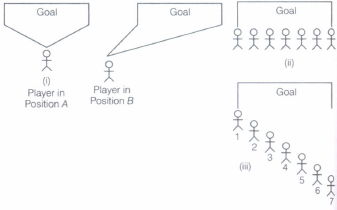
Parts (a) and (b) given above, may help to trace the diagrams and draw and measure angles.
(a) Seven football players are practicing their kicks. They are lined up in a straight line in front of the goalpost. Which player has the best (the greatest) kicking angle?
(b) Now the players are linked up as shown in Figure. Which player has the best kicking angle?
(c) Estimate atleast two situations such that the angles formed by different positions of two players are complement to each other.
29.
The length of a rectangle is two times its width. The perimeter of the rectangle is 180 cm. Find the dimensions of the rectangle.
30.
The bar graph in figure shows the result of a survey to test water resistant watches made by different companies. Each of these companies claimed that their watches were water resistant. After a test, the above results were revealed.
(a) Can you work out a fraction of the number of watches that leaked to the number tested for each company?
(b) Could you tell on this basis which company has better watches?
31.
Which is greater \(-\frac{4}{5}\ or\ -\frac{3}{7}?\)
32.
Take at least five different values for each of a, band c and verify this property.
33.
Find 2.7 x 1.35.
34.
\(\frac{-p}{3}\)=5
35.
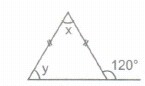
Find angles x and y
36.
To make idlis, Reena's mother said you must take 2 parts rice and 1 part urad dal. Could you say what, percent of such a mixture would be rice or what percent of it would be urad dal?
37.
Write the number 6.234269 x 10⁶ in the usual form.
38.
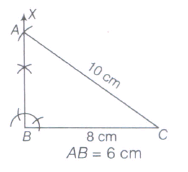
Constuct a right angled triangle at B, such that BC = 8 cm and AC = 10 cm. Measure AB.
39.
If the circumference of a circular sheet is 154 m, then find its diameter.
40.
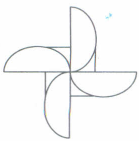
State the order of rotation and angle of rotation of the following figure.
41.
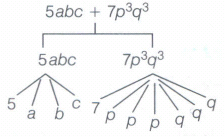
Identify the terms and represent in the form of tree diagram 5abc + 7p3q3
42.
Give an oblique sketch for the following:
A cube with an edge 4 cm long.
43.
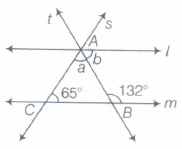
In the following figure, if l II m, find the value of a and b.
44.
The following graph shows the age of 5 people, study the graph carefully and answer the questions:
.png)
By how many year is Mr. White older than Mr. Red?
45.
When two triangles, say ABC and PQR are given, there are in all, six possible matchings or correspondences. Two of them are
(i) ABC ↔️ PQR (ii) ABC ↔️ QRP
Find the other four correspondences by using two cut outs of triangles. Will all these correspondences lead to congruence?
46.
Which of the following is correct?
\(\frac{1}{-2}>\frac{-1}{3}\)
\(\frac{1}{-2}<\frac{-1}{3}\)
\(\frac{1}{-2}=\frac{-1}{3}\)
None of these.
47.
If (- 3)4 x (- 3)6 = (- 3)?, then? =
4
10
6
2
48.
Which of the following pairs of terms is a pair of unlike terms?
-p2q2, 12q2p2
41, 100
qp2, 13p2q
-4yx2, -4xy2
49.
'Under a given correspondence, two triangles are congruent if two sides and the angle included between them in one of the triangles are equal to the corresponding sides and the angle included between them of the other triangle.'
The above is known as
SSS congruence of two triangles
SAS congruence of two triangles
ASA congruence of two triangles
RHS congruence of two right-angled triangles.
50.
Area of a square
side\(\times\)side
2\(\times\)side
3\(\times\)side
4\(\times\)side
51.
How many lines of symmetry are there in the following figure?
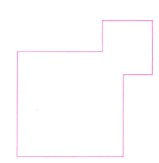
1
2
3
4
52.
Read the following bar graph and answer the question
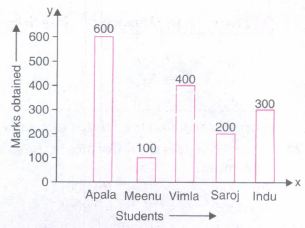
The ratio between the marks obtained by Saroj and Vimla is
1:2
2:3
3:4
1:6
53.
Number of lines of symmetry of a parallelogram is:
zero
one
two
four
54.
1% of 100 is ______
100
1
55.
Which of the following pairs can form a linear pair?
Pair of complementary angles
Pair of supplementary angles
Pair of adjacent angles
Pair of vertically opposite angles
56.
When zero is subtracted from an integer, we get:
0
1
the inverse of the number
the same number
57.
Which of the following has the smallest value?
0.0002
\(\frac { 2 }{ 1000 } \)
\(\frac { (0.2)^{ 2 } }{ 2 } \)
\(\frac { 2 }{ 100 } \div 0.01\)
58.
The sum of three times a number and 11 is 32. Find the number?
6
7
10
21
59.
Which one of the following is not a criterion for congruence of two triangles?
ASA
SSA
SAS
SSS
60.
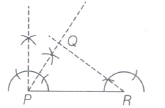
In the given figure, the value of \(\angle PQR\) is
35°
45°
55°
30°
61.
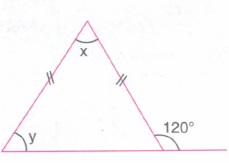
Find angles x and y in each figure.
62.
The area of a rhombus is 96 cm2. If one of its diagonals is 12 em, then find the perimeter of the rhombus.
63.
Find the value of the following expressions, for a = 3,b = 2:
(a) a + b
(b) 7a-4b
(c) a2 + 2ab + b2
(d) a3 - b3
64.
5. If (25)n-1 + 100 = 5(2n-1), find the value of n.
65.
If \(\frac { 2x-3 }{ 5 } +\frac { x+3 }{ 4 } =\frac { 4x+1 }{ 7 } \) , find the value of x.
66.
In a debate competition, the judges decided that 20% of the total marks would be given for accent and presentation. 60% of the rest are reserved for the subject matter and the rest are for rebuttal. If this means 8 marks for rebuttal, then find the total marks.
67.
Following are the marks obtained by 25 students in class test (out of 25 marks) in Maths :
18, 13, 18, 16, 8, 5, 13, 5, 18, 18,2,16, 13, 8, 17, 18 5, 2, 13, 8, 19, 16, 8, 20.
How many students obtained marks more than the mean marks?
68.
Write four numbers in the following pattern :
\(\frac { -1 }{ 3 } ,\frac { -2 }{ 6 } ,\frac { -3 }{ 9 } '\frac { -4 }{ 12 } ,...\)
69.
Two poles of height 9 m and 14m stand upright on a plane ground. If the distance between their tops is 13 m, find the distance between their feets.
1.
\(\frac{2}{3},\frac{4}{7},\frac{7}{9},\frac{8}{11},\frac{9}{17}\)
2.
Given: A triangle ABC
such that AB = AC.
Bisector of ㄥA is AD.
To prove: ㄥADB = ㄥADC=90° and \(\overline { BD } =\overline { CD } \)
Proof: In \(\triangle \)ADB and \(\triangle \)ADC, We have
\(\overline { AD } =\overline { AD } \)
ㄥBAD=ㄥCAD
[\(\because \) AD is the bisector of ㄥBAC]
\(\overline { AB } =\overline { AC } \) [Given]
\(\therefore \)\(\triangle \)ADB ≅\(\triangle \)ADC [SAS congruency]
\(\Rightarrow \) Their corresponding parts are equal.
\(\therefore \quad \overline { BD } =\overline { CD } \)
i.e. the side BC is bisected at D.
Also ㄥADB =ㄥADC
But ADB and ADC form a linear pair.
\(\therefore \)ㄥADB +ㄥADC=180°
ㄥADB+ㄥADB=180°
\(\Rightarrow \) 2ㄥADB=180°
\(\Rightarrow \)\(\angle ADB=\frac { 180^{ \circ } }{ 2 } \Rightarrow \angle ADB={ 90 }^{ \circ }\)
i.e. AD \(\bot \)BC
Hence AD is the perpendicular bisector of BC.
3.
Now, for n = - 2
5n2 + 5n-2 = 8 and n3 = (- 2)3 = (- 2) x (- 2) x (- 2) = - 8
Combining,
n3 + 5n2 + 5n - 2 = - 8 + 8 = o.
4.
The cost of a flower vase = Rs.120
Loss % = 10%
Price at which it is sold =?
\(\frac { 10 }{ 100 } \times 20\)
=Rs.12
\(\therefore \) S.P=C.P-Loss
=Rs.120-Rs.12
=Rs.108
5.
(i) ➝ Side, (ii) ➝ Top, (iii) ➝ Front
6.
In the given figure, a perpendicular is drawn at both Band B'.
\(\angle XBB'=\angle YB'B=90^0\)
∴ The angle between made by rays with BB' is equal to 90°. Hence, both rays BX II B'Y.
7.
we have, \(\frac { { 2 }^{ 8 }\times { a }^{ 5 } }{ { 4 }^{ 3 }\times { a }^{ 3 } } =\frac { { 2 }^{ 8 }\times { a }^{ 5 } }{ { \left( { 2 }^{ 2 } \right) }^{ 3 }\times { a }^{ 3 } } \) [\(\because\) 4 = 2 x 2 = 22]
\(=\frac { { 2 }^{ 8 }\times { a }^{ 5 } }{ { 2 }^{ 2\times 3 }\times { a }^{ 3 } } =\frac { { 2 }^{ 8 }\times { a }^{ 5 } }{ { 2 }^{ 6 }\times { a }^{ 3 } } \) [\(\because\) (am)n = amn]
=28-6 x a5-3 =22 x a2 [\(\because\)am \(\div\)an =am-n]
= (2a)2 [\(\because\)am x bm = (ab)m]
8.
In an isosceles triangle, two sides are equal in length.
\(\therefore\) Perimeter of an isosceles triangle
= Sum of length of all three sides
= 2 x 5 + 6 [since, two sides are equal]
= 10 + 6 = 16 cm.
9.
On copying the figure with punched holes, the axis of symmetry corresponding to the punched holes are shown by dotted lines in the figures given below

10.
Since, interior opposite angles are 45° and 65°.
We know that, the exterior angle of a triangle is equal to sum of its interior opposite angles.
So, x = 45°+ 65° = 110°
11.
Let the two complement angles be 2x and 7x.
\(\therefore\) 2x + 7x = 90°
[\(\because\) the sum of two complement angles = 90°]
\(\Rightarrow\) 9x = 90° \(\Rightarrow\) x = 10°
So, the angles are 2\(\times\)10° = 20° and 7\(\times\)10°=70°
12.
We have, (- 41) \(\times\) 102 = - (41 \(\times\)102)
[\(\because\) (- a) \(\times\) b = - (a \(\times\) b)]
= - [41 x (100 + 2)] = -(41 \(\times\)100 + 41 \(\times\) 2) [ by distributive property of multiplication over addition ]
= - [4100 + 82] = - [4182] = - 4182
13.
0
14.
Mixed fraction = 25\(\frac{1}{3}\)
15.
According to the question,
Number b divided by 5 =\(\frac { b }{ 5 } \) and the quotient = 6 Hence, the required equation is \(\frac { b }{ 5 } \)=6
16.
(i) 60°
(ii) 30°
(iii) 140°
(iv) 50°
(v) 35°
(vi) 60°
17.
(-4)2 or 16
18.
Given, .png) =2x + 3,
=2x + 3,  = \(\frac { 3 }{ 2 } \) + 7 and
  = x -3
i) = 2[2x6+3]+\(\frac { 3 }{ 2 } \)x 3+7 - (1-3)
= 2 x 15 +\(\frac { 9 }{ 2 } \) + 7 + 2=30 + \(\frac { 9 }{ 2 } \) + 9
= 39 + \(\frac { 9 }{ 2 } \) = \(\frac { 78+9 }{ 2 } =\frac { 87 }{ 2 } \)
ii) .png)
\(\frac { 1 }{ 2 } \left[ \frac { 3 }{ 2 } \times 2+7 \right] +[8-3]-3\left[ 2\times 0+3 \right] \)
\(\frac { 1 }{ 2 } \)[10] +5-9 = 5 + 5 -9 = 1
19.
Line of symmetry = 2, Order of symmetry = 4
20.
(i) The given net of a cube shows edge GH meets edge AN.
(ii) The given net of a cube shows, DC meets DE edge.
21.
(a) In the parallelogram ABCD, AD = BC, AB = DC
Base = 300 m and height = 80 m
\(\therefore\) Area of a parallelogram = Base x Height
so, area of parallelogram = 300 m x 80 m
= 24000 m2
(b) The values are depicted here is that owner of the plot is a very helpful cooperative to the society.
22.
Given, Lalita reads the book for 2\(\frac{4}{8}\)h everyday. If she reads the entire book in 64 days.
∴ The total number of reading hours
= 64 x Reading hours per day
\(=64 \times 2 \frac{4}{8}=64\times \frac{(2\times 8)+4}{8}\)
=\(64 \times \frac{16+4}{8}=64\times \frac{20}{8}= \frac{64}{1}\times \frac{20}{8}\)
=\( \frac{64 \times 20}{8}=8\times 20=160 h\)
Hence, Lalita reads the entire book in 160 h.
23.
Here, we use the following steps:
Steps of construction
Step I Draw a line I and take any point O on it.
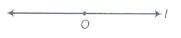
Step II With O as centre and any radius, draw an-arc to intersect line I at P and Q.
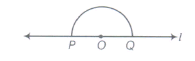
Step III Now, with P and Q as centres and radius greater than \(\frac{1}{2}PQ,\) draw two arcs respectively which intersects each other at R.
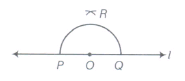
Step IV Join RO and produce it to B, then OB is perpendicular to I.
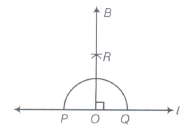
Step V With O as centre and radius 4 cm, draw an arc which intersect OB at X, then OX = 4 cm.
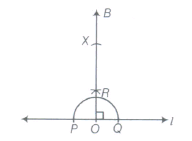
Step VI Take O as centre and draw an are, which intersects I and OB at M and N, respectively.
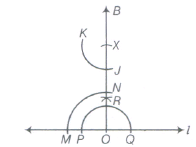
Step VII With X as centre and with same radius as in Step VI, draw an arc JK which cuts OX at j.
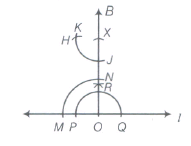
Step VIII Place the pointed tip of the compasses at M and adjust the opening so that the pencil tip is at N. With this opening and with J as centre, draw an arc cutting the arc JK at H.
Step IX Now, join XH to draw a line m.
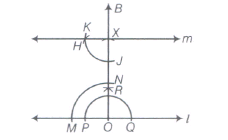
Thus, m || l.
24.
(i) Given, ray AZ i.e. AC is the bisector of ㄥDAB as well as ㄥDCB.
∴ ㄥDAC = ㄥBAC and ㄥDCA = ㄥBCA
Now, three pairs of equal parts in ΔBAC and ΔDAC are
ㄥDAC = ㄥBAC
[since, AC is the bisector of ㄥDAB]
AC = AC [common]
and ㄥDCA = ㄥBCA [since,AC is the bisector of ㄥDAB]
(ii) Yes, in ΔBAC and ΔDAC, we have
ㄥDAC = ㄥBAC, AC = AC, ㄥDCA = ㄥBCA
So, by ASA congruence rule, two triangles are congruent.
The correspondence is A ↔️ A, C ↔️ C and D ↔️ B.
In symbolic form, ΔBAC ≅ ΔWAC
iii) Yes, here ΔBAC ≅ ΔDAC
We know that, the corresponding parts of two congruent triangles are equal.
So, AB = AD [corresponding sides]
(iv) Yes, Here, ΔBAC ≅ ΔDAC
We know that, the corresponding parts of two triangles are equal.
So, CD = CB [corresponding sides]
25.
Rs 12246.15
26.
We have, x-(y+z)
\(=\frac { -4 }{ 9 } -\left( \frac { 5 }{ 12 } +\frac { 7 }{ 18 } \right) \\ =\frac { -4 }{ 9 } -\left( \frac { 5\times 3+7\times 2 }{ 36 } \right) =\frac { -4 }{ 9 } -\left( \frac { 15+14 }{ 36 } \right) \\ =\frac { -4 }{ 9 } -\frac { 29 }{ 36 } =\frac { -4\times 4-29 }{ 36 } \\ =\frac { -16-29 }{ 36 } \\ =\frac { -45 }{ 36 } =\frac { -5 }{ 4 } \)
27.
For a pair of integers whose product is -36 and whose difference = 15.
So, first integer = -3 and second integer = 12
Their product = (-3) \(\times\) 12 = -(3 \(\times\) 12)= -36
and the difference between these two integer is 15.
28.
Given, the greater angle, the better chance of the player scoring a goal.
(a) From the figure, seven football players are practicing their kicks. They are lined up in a straight line in front of the goalpost. So, fourth player have the best (the greatest) kicking angle.
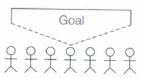
(b) From the figure, fourth player has the best kicking angle.
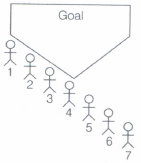
(c) We know that, when the sum of the measures of two angles is 90°, then the angles are called complementary angles.
So, two players are complement to each other (i.e. 45°).
29.
As per the given information in the question, the perimeter of the rectangle is 180 cm.
Let x be the width of the rectangle.
So, length of the rectangle will be 2x.
Perimeter of a rectangle = 2 length + 2 width
\(\therefore\) 2x + 2(2x) = 180 \(\Rightarrow\) 6x = 180
\(x=\frac{180}{6}=\) 30cm
Hence, width of the rectangle is 30 cm and length of the rectangle is 2 x 30 = 60 cm.
30.
.png)
(a) For company A Number of tested watches=40
Number of leaked watches = 20
Now, required fraction = \(\frac { Leaked\quad watches }{ Tested\quad watches } =\frac { 20 }{ 40 } =\frac { 1 }{ 2 } \) [dividing numerator and denominator by 10]
For company B Number of tested watches = 40
Number of leaked watches = 10
Required fraction = \(\frac { 10 }{ 40 } =\frac { 1 }{ 4 } \) [dividing numerator and denominator by 10]
For company C Number of tested watches = 40
Number of leaked watches = 15
Required fraction = \(\frac { 15 }{ 40 } =\frac { 3 }{ 8 } \) [dividing numerator and denominator by 5]For company D Number of tested watches = 40
Number of leaked watches = 25
Required fraction = \(\quad \frac { 25 }{ 40 } =\frac { 5 }{ 8 } \) [dividing numerator and denominator by 5]
(b) From above discussion, it is clear that company B has better watches, because company B has least fraction of the number of watches that leaked to the number of watches that were tested.
31.
We have
\(\frac{4}{5}=\frac{4\times7}{5\times7}=\frac{28}{35}\)
\(\frac{3}{7}=\frac{3\times5}{7\times 5}=\frac{15}{35}\)
\(\frac{28}{35}>\frac{15}{35}\Rightarrow\frac{4}{5}>\frac{3}{7}\)
\(\Rightarrow \frac{-4}{5}<\frac{-3}{5}\Rightarrow\frac{-3}{7}>\frac{-4}{5}\)
32.
(i) Take a = 3, b = 4, c = 5
a \(\times\) (b - c) = 3 \(\times\) (4 - 5)
= 3 \(\times\) (- 1) = - 3
a\(\times\)b-a\(\times\)c=3\(\times\)4-3\(\times\)5
= 12 -15 =-3
\(\therefore\) a \(\times\) (b - c) = a \(\times\) b - a \(\times\) c
(ii) Take a = - 3, b = - 4, c = - 5
(iii) Take a = 3, b = 4, c = - 5
(iv) Take a = 3, b = - 4, c = 5
(v) Take a = - 3, b = 4, c = 5
(vi) Take a = 3, b = - 4, c = - 5
Verify the remaining parts yourself exactly as in (i).
33.
- Multiply 27 and 135. We get 3645.
- In 2.7, there is 1 digit to the right of the decimal point and in 1.35, there are 2 digits to the right of the decimal point.
- So, count 1 + 2 = 3 digits starting from the right most digit (i.e., 5) in 3645 and move towards left.
- We get 3.645.
34.
Multiplying both sides by 3, we have
\(\frac{-p}{3}\)\(\times\)3=5\(\times\)3
or -p=15
or -p\(\times\)(-1)=15\(\times\)(-1)
[multiplying both sides by(-1)]
Thus, p=-15 is the required solution.
35.
In the figure, two sides of the triangle are equal.
\(\therefore\)The base angles opposite to the equal sides are equal.
Since, one of the base angles is y,
\(\therefore\) Other base angle = y
Now, y and 120° form a linear pair,
\(\therefore\)y + 120° = 180°
or y = 180° - 120° = 60°
Now, sum of the three angles = 180°
\(\therefore\) x + Y + Y = 180°
or x + 60° + 60° = 180°
or x + 120° = 180°
or x = 180° - 120° = 60°
Thus, x = 60° and y = 60°.
36.
In ratio, we would write this as
Rice : Urad dal = 2 : 1
= 2 + 1 = 3 total parts
Now, thi s means \(\frac { 2 }{ 3 } \)X100%
=\(\frac { 200 }{ 3 } =66\frac { 2 }{ 3 } \)%
and, urad dal in % =\(\frac { 1 }{ 3 } \times 100\)% = 33 \(\frac { 1 }{ 3 } \)%
37.
6234269
38.
39.
Given, circumference of the circular sheet = 154 m
\(\therefore\) Circumference of a circular sheet = 2\(\pi\)r
\(\Rightarrow \) 154 = 2\(\pi\)r
\(\Rightarrow \) r = \(\frac{154}{2\pi}=\frac{154\times 7}{2\times 22}=\frac{7\times 7}{2}=\frac{49}{2}\)m
\(\therefore\) Diameter = 2 x Radius
= 2 x \(\frac{49}{2}\)
= 49 cm.
40.
The order of rotation is 4 and angle of rotation of given figure is \(\frac { 360° }{ 4 } =90°\)
41.
Given, 5 abc + 7p3q3
Total terms = 2, i.e. 5abc and 7p3q3
Tree diagram
42.
(i) Oblique sketch of the cube of edge 4 cm is as follows:
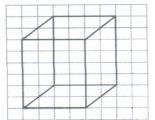
(ii) An isometric sketch of this cube is as follows:
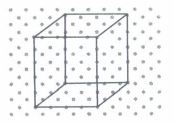
43.
Since, \(\angle \)b and \(\angle \)132° are pair of interior angles on the same side of transversal line.
\(\therefore\) \(\angle \)b + 132° =180° [\(\because\) cointerior angles]
\(\Rightarrow\) \(\angle \)b=180°-132°\(\Rightarrow\) \(\angle \)b=48°
Also, \(\angle \)a + \(\angle \)b and \(\angle \)65° are pair of interior angles
on the same side of transversal line.
\(\therefore\) \(\angle \)a + \(\angle \)b + 65° =180° [by linear pair]
\(\Rightarrow\) \(\angle \)a + 48° + 65° =180°
\(\Rightarrow\) \(\angle \)a=180°-113° \(\Rightarrow\)\(\angle \)a=67°
Hence, \(\angle \)a=67° and \(\angle \)b=48°
44.
Five years
45.
In Δ ABC and Δ PQR, there are side possible matchings or correspondences. Out of them, four correspondences are as follow:
(i) ABC ↔️ PRQ
(ii) ABC ↔️ RPQ
(iii) ABC ↔️ RQP
(iv) ABC ↔️ QPR
Yes, all these correspondences may lead to congruence.
46.
(b)
\(\frac{1}{-2}<\frac{-1}{3}\)
47.
(-3)4 x (3)6 = (-3)4+6 = (3)10
48.
(d)
-4yx2, -4xy2
49.
(b)
SAS congruence of two triangles
50.
51.
(a)
1
52.
200 : 400 = 1 : 2
53.
(a)
zero
54.
(b)
1
55.
(c)
Pair of adjacent angles
56.
(d)
the same number
57.
(a)
0.0002
58.
(b)
7
59.
(b)
SSA
60.
(b)
45°
61.
(i) x + y = 1200 ...(1)
The exterior angle of a triangle is equal to the sum of its two interior opposite angles
x + y + y = 1800
Base angles opposite to the equal sides of an isosceles triangle are equal and the sum of the measures of the three angles of a triangle is 1800
\(\Rightarrow\)x + 2y = 1800 ... (2)
Subtracting equation (1) from equation (2),
y = 60°
Put y = 60° in equation (1),
x + 60° = 120°
\(\Rightarrow\)x = 120° - 60°
\(\Rightarrow\)x = 60°
62.
ABCD is the rhombus such that its diagonals AC and BD intersect at O. Here BD = 12 cm.
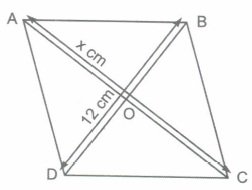
Suppose AC = x cm.
Since, the area of a rhombus =\(\frac{1}{2}\)\(\times\)[Product of 2 its diagonals]
\(\therefore\)Area of the rhombus ABCD =\(\frac{1}{2}\)\(\times\) 12 \(\times\) x cm2
2 But the area of the rhombus ABCD = 96 cm2
\(\Rightarrow\)\(\frac{1}{2}\)\(\times\)12 \(\times\) x = 96
\(\Rightarrow\)x=\(\frac{96\times2}{12}\)cm \(\Rightarrow\)x=8\(\times\)2cm
\(\Rightarrow\) x=16 cm
Since, the diagonals of a rhombus, bisect each other at right angles.
\(\therefore\)\(\angle \)COD = 90°, OC =\(\frac{1}{2}\)\(\times\) 16 cm=8 cm
and Od=\(\frac{1}{2}\)\(\times\) 12 cm =6 cm
Now, in right \(\Delta\)COD, we have
\(\Rightarrow\)OD2 + OC2 = CD2 \(\Rightarrow\) 62 + 82 = CD2
\(\Rightarrow\)36 + 64 = CD2 \(\Rightarrow\)100 = CD2
\(\Rightarrow\) 102 = CD2 \(\Rightarrow\) CD = 10 cm.
Since, all the sides of rhombus are equal and perimeter of a rhombus = 4 x Side.
\(\therefore\) Perimeter ofthe rhombus = 4 x 10 em = 40 cm
63.
Substituting a = 3 and b = 2 in
(a) a + b, we get
a + b = 3 + 2 = 5
(b) 7a - 4b, we get
7a - 4b = 7 x 3 - 4 x 2
= 21 - 8 = 13
(c) a2 + 2ab + b2, we get
a2 + 2ab + b2 = 32 + 2 x 3 x 2 + 22
= 9 + 2 x 6 + 4
= 9 + 12 + 4 = 25.
(d) a3 - b3, we get
a3 - b3 = 33 - 23 = 3 x 3 x 3 - 2 x 2 x 2
= 27 -8 = 19.
64.
(25)n-1 + 100 = 5(2n-1)
⇒ (52)n-1 + 100 = 5(2n-1)
⇒ 52n-2 + 100 = 52n-1
⇒ 52n-2 - 52n-1 = - 100
⇒ 52n - 1 - 52n- 2 = 100
⇒ 52n-2 x (5 -1) = 100
⇒ 52n-2 x 4 = 100
\(⇒\ 5^{2n-2}={100\over 4}=25\)
Thus, 52n- 2 = 52
As base is same on both the sides
∴ 2n-2 = 2
⇒ 2n=2+2
⇒ 2n = 4
\(⇒\ n={4\over 2}=2\)
65.
Given, \(\frac { 2x-3 }{ 5 } +\frac { x+3 }{ 4 } =\frac { 4x+1 }{ 7 } \)
\(\Rightarrow \quad \frac { 4(2x-3) }{ 5\times 4 } +\frac { 5(x+3) }{ 5\times 4 } =\frac { 4x+1 }{ 7 } \)
\(\Rightarrow \quad \frac { 8x-12 }{ 20 } +\frac { 5x+15 }{ 20 } =\frac { 4x+1 }{ 7 } \)
\(\Rightarrow \quad \frac { 8x-12+5x+15 }{ 20 } =\frac { 4x+1 }{ 7 } \)
\(\Rightarrow \quad \frac { 13x+3 }{ 20 } =\frac { 4x+1 }{ 7 } \)
\(\Rightarrow\) 7(13x + 3) = 20(4x + 1)
\(\Rightarrow\) 91x + 21 = 80x + 20
\(\Rightarrow\) 91x - 80x = 20 - 21
\(\Rightarrow\) 11x = -1
Thus, \(x=-\frac { 1 }{ 11 } \)
66.
Let the total marks = x
Then, marks for accent and presentation
= 20% of x
=\(\frac { 20 }{ 100 } \times x=\frac { x }{ 5 } \)
Remaining marks = x - \(\frac { x }{ 5 } ={5x-x\over5}={4x\over 5}\)
Now, marks for subject matter =60% of \(\frac { 4x }{ 5 } \)
\(\frac { 60 }{ 100 } \times \frac { 4x }{ 5 } =\frac { 12x }{ 25 } \)
Remaining marks \(={4x\over 5}-{12x\over 25}={5\times4x-12x\times1\over25}\)
\(={20x-12x\over25}={8x\over 25}\)
According to the question, there are 8 marks for rebuttal.
so, \(\frac { 8x }{ 25 } =8\Rightarrow 8x=25\times 8\)
\(\Rightarrow \quad x=\frac { 25\times 8 }{ 8 } 25\)
67.
Arranging the observations (marks) in ascending order:
2, 2, 5, 5, 5, 8, 8, 8, 8, 13, 13, 13, 13, 16, 16, 16, 17, 17, 18,18,18,18,18,19,20
Sum of observations
\(2\times2=4\\5\times3=15\\8\times4=32\\13\times4=52\\16\times3=48\\17\times2=34\\18\times5=90\\19\times1=19\\20\times1=20\\\quad\quad\quad\quad\_\_\_\_\\\ Total=314\\ \quad\quad\quad\quad\_\_\_\_\)Number of students = 25
\(\therefore\) Mean marks \(=\frac{Sum\ of\ the\ observations}{Total\ number\ of\ students}\)
\(=\frac{314}{25}=12.5\)
So, the number of students who scored marks more than mean marks is
4 + 3 + 2 + 5 + 1 + 1 = 16.
68.
Given pattern is
\(-\frac { 1 }{ 3 } ,\frac { 2 }{ 6 } ,\frac { 3 }{ 9 },-\frac { 4 }{ 12 } ...\)
Here, \(-\frac { 1 }{ 3 } =\frac { (-1)\times 1 }{ 3\times 1 } \)
\(-\frac { 2 }{ 6 } =\frac { (-1)\times 2 }{ 3\times 2 } \)
\(-\frac { 3 }{ 9 } =\frac { (-1)\times 3 }{ 3\times 3 } \)
and \(-\frac { 4 }{ 12 } =\frac { (-1)\times 4 }{ 3\times 4 } \)
Hence, next four numbers are
\(\frac { (-1)\times 5 }{ 3\times 5 } =-\frac { 5 }{ 15 } \)
\(\frac { (-1)\times 6 }{ 3\times 6 } =-\frac { 6 }{ 18 } \)
\(\frac { (-1)\times 7 }{ 3\times 7 } =-\frac { 7 }{ 21 } \)
\(\frac { (-1)\times 8 }{ 3\times 8 } =-\frac { 8 }{ 24 } \).
69.
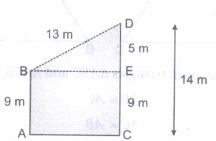
In the above figure, AB and CD are two poles whose heights are 9 m and 14m respectively.
\(\Rightarrow\) AB = EC = 9m
and BD = 13m
DE = 14 - 9
= 5m
Now in right ΔBDE, by Pythagoras
BD2 = BE2 + DE2
132 = BE2 + 52
\(\Rightarrow\) BE2 = (13)2 - (5)2
= 169-25
BE2 = 144
\(\Rightarrow\) BE = \(\sqrt { 144 } \)
\(\Rightarrow\) BE = 12m.
Hence, distance between their feet = 12 m.

7th Standard CBSE Syllabus & Materials
7th Standard CBSE
CBSE 7th Social Science Theme B - New Beginnings : Cities and States - New Sample Question Papers Study Material - QB365 Set A
NEW7th Standard CBSE
CBSE 7th Social Science Theme A - Climates of India - New Sample Question Papers Study Material - QB365 Set A
NEW7th Standard CBSE
CBSE 7th Social Science Theme A - Geographical Diversity of India - New Sample Question Papers Study Material - QB365 Set A
NEW7th Standard CBSE
CBSE 7th Science Earth, Moon and the Sun - New Sample Question Papers Study Material - QB365 Set A



CBSE 7th Standard CBSE Subjects
CBSE Standards




