
 100% FREE ACCESS
7th Standard CBSE Syllabus & Materials
7th Standard CBSE
CBSE 7th Social Science Theme E - Understanding Market - New Sample Question Papers Study Material - QB365 Set A
NEW7th Standard CBSE
CBSE 7th Social Science Theme E - From Barter to Money - New Sample Question Papers Study Material - QB365 Set A
NEW7th Standard CBSE
CBSE 7th Social Science Theme D - The Constitution of India- An Introduction - New Sample Question Papers Study Material - QB365 Set A
NEW7th Standard CBSE
CBSE 7th Social Science Theme D - From the Rulers to the Ruled : Types of Governments - New Sample Question Papers Study Material - QB365 Set A
NEW7th Standard CBSE
CBSE 7th Social Science Theme B - The Age of Reorganisation - New Sample Question Papers Study Material - QB365 Set A
NEW7th Standard CBSE
CBSE 7th Social Science Theme B - The Rise of Empires - New Sample Question Papers Study Material - QB365 Set A

Published on: 13/08/2019
Rational Numbers
Download CBSE Class 7th Standard CBSE Mathematics question papers, sample papers, important questions, and previous year solved papers in PDF format. Get free study materials, NCERT solutions, and exam preparation resources for Class 7th Standard CBSE Mathematics
Questions + Answers key
Take MCQ Mathematics Test
1.
The denominator of the rational number - 9 is
-9
9
-1
1
2.
The denominator of the rational number \(\frac{-6}{-5}\) is
6
-6
5
-5
3.
The denominator of the rational number \(\frac{4}{7}\) is
7
4
3
11
4.
rational number \(\frac{p}{q}\)is said to be in its simplest form, when
'p' is a prime number.
'q' is a prime number.
'p' and 'q' both are prime to each other.
all of the above.
5.
Which of the following is equivalent to \(\frac{4}{5}\)?
\(\frac{5}{4}\)
\(\frac{16}{25}\)
\(\frac{16}{20}\)
\(\frac{15}{25}\)
6.
How many rational numbers are there between 2 and 4?
Zero
one
two
uncountable
7.
Which of the following is the standard form \(\frac{36}{-24}\)is
\(\frac{-3}{2}\)
\(\frac{3}{2}\)
\(\frac{2}{3}\)
\(\frac{2}{-3}\)
8.
The subtraction \(6\frac { 4 }{ 5 } \)from \(\frac { 50 }{ 5 } \)
\(3\frac { 1 }{ 5 } \)
\(2\frac { 1 }{ 5 } \)
\(\frac { 31 }{ 95 } \)
\(\frac { 39 }{ 95 } \)
9.
-3 can be written in the form of \(\frac { p }{ q } \) as
\(\frac { -3 }{ -1 } \)
\(\frac { -3 }{ 0 } \)
\(\frac { 0 }{ -3 } \)
\(\frac { -3 }{ 1 } \)
10.
Which of the following rational numbers is postive?
\(\frac { -8 }{ 7 } \)
\(\frac { 19 }{ -13 } \)
\(\frac { -3 }{ -4 } \)
\(\frac { -21 }{ 13 } \)
11.
\(\frac{-16}{24}\)and\(\frac{20}{-16}\) represent____________ rational numbers.
12.
\(\frac{-1}{2}\) is__________than \(\frac{1}{5}\)
13.
\(\frac { -5 }{ 3 } \times \left( \frac { -3 }{ 5 } \right) =\) __________
14.
\(\frac { -5 }{ 6 } +\frac { -1 }{ 6 }\)=_________
15.
Additive inverse of \(\frac { 2 }{ 3 } \) is__________
16.
Arrange the rational numbers \(\frac{-2}{5},\frac{9}{-10}\) and \(\frac{-5}{6}\).
17.
Write four more rational numbers in each of the following patterns:
\(\\ \frac { -1 }{ 6 } ,\frac { 2 }{ -12 } ,\frac { 3 }{ 18 } ,\frac { 4 }{ -24 } ,....\)
18.
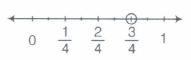
Draw the number line and represent the following rational numbers on it .
\(\frac { 3 }{ 4 } \)
19.
Find \(\frac{-4}{7}\times3,\)using both ways. What do you observe?
20.
Taking x \(=\frac { -4 }{ 9 } \),y\(=\frac { 5 }{ 12 } \)and z\(=\frac { 7 }{ 18 } \), Find
The rational number, which when added to x gives y.
21.
Write three rational numbers between \(-\frac{1}{2}\) and \(\frac{1}{2}\).
22.
Write the following rational numbers in their standard form:
\(\frac{36}{-24}\)
23.
What is the standard form of \(\frac{105}{-185}\)?
24.
If product of two rational numbers is \(\frac{-8}{9}\) and one of the number is\(\frac{-10}{3}\) find the other.
25.
'a' and 'b' are two different numbers taken from the numbers 1-50. What is the largest value that \(\frac{a-b}{a+b}\) can have? What is the largest value that \(\frac{a+b}{a-b}\) can have?
1.
(d)
1
2.
(d)
-5
3.
(a)
7
4.
(c)
'p' and 'q' both are prime to each other.
5.
(c)
\(\frac{16}{20}\)
6.
(b)
one
7.
(a)
\(\frac{-3}{2}\)
8.
(a)
\(3\frac { 1 }{ 5 } \)
9.
(d)
\(\frac { -3 }{ 1 } \)
10.
(c)
\(\frac { -3 }{ -4 } \)
11.
()
different
12.
()
less
13.
\(\frac { -5 }{ 3 } \times \left( \frac { -3 }{ 5 } \right) =\frac { 15 }{ 15 } =1\)
14.
\(\frac { -5 }{ 6 } +\frac { -1 }{ 6 } =\frac { -5-1 }{ 6 } =\frac { -6 }{ 6 } =\)-1
15.
Additive inverse of \(\frac { 2 }{ 3 } \) is \(-\frac { 2 }{ 3 } \)
16.
The given rational numbers are: \(\frac{-2}{5},\frac{9}{-10}\) and \(\frac{-5}{6}\).
First let us express the given rational numbers with positive denominators.
\(\therefore\) \(\frac{-2}{5}=\frac{-2\times1}{5\times1}=\frac{-2}{5}\)
\(\frac{9}{-10}=\frac{9\times(-1)}{(-10)\times(-1)}=\frac{-9}{10}\)
\(\frac{-5}{6}=\frac{-5\times1}{6\times1}=\frac{-5}{6}\)
Since, LCM of 5, 10 and 6 is 30.
\(\therefore\)Making the denominators of the given rationals the same, we have
\(\frac{-2}{5}=\frac{-2}{5}\times \frac{6}{6}=\frac{-12}{30}\)
\(\frac{9}{-10}=\frac{-9}{10}\times \frac{3}{3}=\frac{-27}{30}\)
\(\frac{-5}{6}=\frac{-5}{6}\times \frac{5}{5}=\frac{-25}{30}\)
Since, (-27) <(-25) <(-12)
i.e. \(\frac{-27}{30}<\frac{-25}{30}<\frac{-12}{30}\)
Thus, \(\frac{9}{-10}<\frac{-5}{6}<\frac{-2}{5}\)
17.
The required four more rational numbers are
\(\frac { 5 }{ -30 } ,\frac { 6 }{ -36 } ,\frac { 7 }{ -42 }\) and \(\frac { 8 }{ -48 }\)
18.
Representation of rational number \(\frac { 3 }{ 4 } \) on number line .
19.
(a) On the number line, it will mean three jumps of \(\frac{4}{7}\) to the left from zero. We reach at \(\frac{-12}{7}.\)

So, \(\frac{-4}{7}\times3=\frac{-12}{7}\)
(b) \(\frac{-4}{7}\times3=\frac{-4\times3}{7}=\frac{-12}{7}\)
We observe that we arrive at the same rational number.
20.
Let we add A to x to find y,
A+x=y\(\Rightarrow \) \(A+\left( \frac { -4 }{ 9 } \right) =\left( \frac { 5 }{ 12 } \right) \)
\(A=\frac { 5 }{ 12 } -\left( \frac { -4 }{ 9 } \right) =\frac { 5 }{ 12 } +\frac { 4 }{ 9 } \)
\(=\frac { 5\times 3+4\times 4 }{ 36 } =\frac { 15+16 }{ 36 } =\frac { 31 }{ 36 } \)
21.
()
\(-\frac{1}{4}\),0,\(\frac{1}{4}\)
22.
()
\(\frac{-3}{2}\)
23.
()
-\(\frac{21}{37}\)
24.
()
Let other number be x
\(x\times \left( \frac { -10 }{ 3 } \right) =\frac { -8 }{ 9 } \)
\(x={8\times3\over10\times9}\)
=\(\frac{4\times1}{5\times3}=\frac{4}{15}\)
25.
Since, a and b are two different numbers.
Let a = 15 and b = 10.
\(\therefore\) \(\frac{a-b}{a+b}\)=\(\frac{15-10}{15+10}\)=\(\frac{5}{25}=\frac{1}{5}\)
and \(\frac{a+b}{a-b}\)=\(\frac{15+10}{15-10}=\frac{25}{5}\)=5
So, (a + b) always greater than (a - b) when denominator is less number is greater,
then \(\left(\frac{a+b}{a-b}\right)>\left(\frac{a-b}{a+b}\right)\)

7th Standard CBSE Syllabus & Materials
7th Standard CBSE
CBSE 7th Social Science Theme B - New Beginnings : Cities and States - New Sample Question Papers Study Material - QB365 Set A
NEW7th Standard CBSE
CBSE 7th Social Science Theme A - Climates of India - New Sample Question Papers Study Material - QB365 Set A
NEW7th Standard CBSE
CBSE 7th Social Science Theme A - Geographical Diversity of India - New Sample Question Papers Study Material - QB365 Set A
NEW7th Standard CBSE
CBSE 7th Science Earth, Moon and the Sun - New Sample Question Papers Study Material - QB365 Set A



CBSE 7th Standard CBSE Subjects
CBSE Standards




