
 100% FREE ACCESS
7th Standard CBSE Syllabus & Materials
7th Standard CBSE
CBSE 7th Social Science Theme E - Understanding Market - New Sample Question Papers Study Material - QB365 Set A
NEW7th Standard CBSE
CBSE 7th Social Science Theme E - From Barter to Money - New Sample Question Papers Study Material - QB365 Set A
NEW7th Standard CBSE
CBSE 7th Social Science Theme D - The Constitution of India- An Introduction - New Sample Question Papers Study Material - QB365 Set A
NEW7th Standard CBSE
CBSE 7th Social Science Theme D - From the Rulers to the Ruled : Types of Governments - New Sample Question Papers Study Material - QB365 Set A
NEW7th Standard CBSE
CBSE 7th Social Science Theme B - The Age of Reorganisation - New Sample Question Papers Study Material - QB365 Set A
NEW7th Standard CBSE
CBSE 7th Social Science Theme B - The Rise of Empires - New Sample Question Papers Study Material - QB365 Set A

Published on: 22/09/2018
Slip Test
Download CBSE Class 7th Standard CBSE Mathematics question papers, sample papers, important questions, and previous year solved papers in PDF format. Get free study materials, NCERT solutions, and exam preparation resources for Class 7th Standard CBSE Mathematics
Questions + Answers key
Take MCQ Mathematics Test
1.
\(\left[ \{ \left( \frac { 2 }{ -9 } \right) ^{ 2 }\} ^{ 0 } \right] ^{ 2 }\) is equal to
2
\(\frac { 4 }{ 81 } \)
\(\frac { 81 }{ 4 } \)
1
2.
(- 4)4 x (-2)0 x (-1)202 is equal to
64
1
0
256
3.
\(\left( \frac { 2 }{ 3 } \right) ^{ 3 }\times \left( \frac { 5 }{ 7 } \right) ^{ 3 }\) is equal to
\(\left( \frac { 10 }{ 21 } \right) ^{ 9 }\)
\(\left( \frac { 10 }{ 21 } \right) ^{ 6 }\)
\(\left( \frac { 10 }{ 21 } \right) ^{ 3 }\)
\(\left( \frac { 10 }{ 21 } \right) ^{ 0 }\)
4.
The value of \(\frac { { 10 }^{ 22 }+{ 10 }^{ 20 } }{ 10^{ 20 } } \) is
10
1042
101
1022
5.
Which pair shows equivalent rational numbers?
\(\frac { 3 }{ 4 } ,\frac { 6 }{ 8 } \)
\(\frac { 5 }{ 6 } ,\frac { 5 }{ 12 } \)
\(\frac { 3 }{ 2 } ,\frac { 3 }{ 4 } \)
None of these
6.
The standard form of \(-\frac { 32 }{ 40 } \) is
\(-\frac { 32 }{ 40 } \)
\(\frac { -4 }{ 5 } \)
\(\frac { 4 }{ -5 } \)
\(\frac { 32 }{ 40 } \)
7.
In the standard form of a rational number, the common factor of numerator and denominator is always
0
1
-2
2
8.
Which of the following rational numbers is negative?
\(-\left( \frac { -3 }{ 7 } \right) \)
\(\frac { -5 }{ -8 } \)
\(\frac { 9 }{ 8 } \)
\(\frac { 3 }{ -7 } \)
9.
Which of the following pair of figures are congruent?
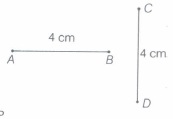
10.
Which of the following pair of figures are congruent?
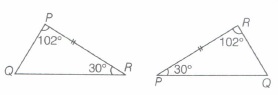
11.
Which of the following pair of figures are congruent?
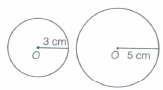
12.
If ΔABC ≅ ΔMNR, then find the value of (2x+3y), where x and y shown in the following figures.
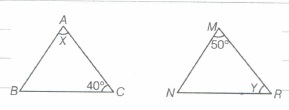
13.
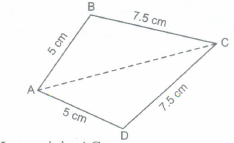
Look at the adjoining figure and show that
\(\triangle ABC\cong \triangle ADC\)
14.
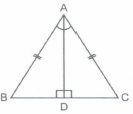
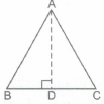
In an isosceles ΔABC, show that the, bisector of its vertical angles bisects the base at right angles.
15.
In an isosceles ΔABC,AB = AC. Show that angles opposite to the equal sides are equal.
16.
In the given figure, DA丄AB, CB丄AB and AC=BD.
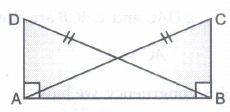
State the three pairs of equal parts in ΔABC and ΔBAD.
17.
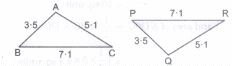
In the given figure, two triangles ΔABC and ΔPQR are given. Examine whether the triangles are congruent.
18.
If \(\triangle PQR\cong \triangle OMN\),then \(\angle P\)=_______
19.
If ΔXYZ ≅ ΔGDF, then, \(\angle ZXY\)=________
20.
If ΔXYZ ≅ ΔGDF, then , \(\angle ZYX\)=________
21.
If ΔXYZ ≅ ΔGDF, then
Side \(\overline { YZ } \)= Side_________
22.
If ΔXYZ ≅ ΔGDF, then
Vertex X corresponds to vertex _________
23.
If \(\triangle \) PQR ≅ \(\triangle \)BAC, then \(\angle \)R=_____ [\(\angle \)C/\(\angle \)B]
24.
If \(\triangle \) PQR ≅ \(\triangle \)BAC, then ㄥQ=_______ [∠B/\(\angle \)A]
25.
If \(\triangle \) PQR ≅ \(\triangle \)BAC, then \(\overline { RQ } \)=________ [\(\overline { CA } \)/\(\overline { AB } \)]
26.
If \(\triangle \)PQR ≅ \(\triangle \)BAC, then ㄥA=___________ [ㄥP/ㄥQ]
27.
If \(\triangle \)ABC - \(\triangle \)DEF, then \(\overline { AB } \)=_________
28.
Narain bought 120 oranges at Rs.4 each. He sold 60% of the oranges at Rs. 5 each and the remaining at Rs. 3.50 each. His __________is___________ %
29.
If 20 lemons are bought for Rs.10 and sold at 5 for three rupees, then_____________ in the transaction is _________%.
1.
(d)
1
2.
(d)
256
3.
(c)
\(\left( \frac { 10 }{ 21 } \right) ^{ 3 }\)
4.
(c)
101
5.
(a)
\(\frac { 3 }{ 4 } ,\frac { 6 }{ 8 } \)
6.
(b)
\(\frac { -4 }{ 5 } \)
7.
(b)
1
8.
(d)
\(\frac { 3 }{ -7 } \)
9.
Not congruent
10.
Congruent
11.
Not congruent
12.
2x+3y=220°
13.
Let us join AC.
In \(\triangle ABCand\triangle ADC\)
\(\overline { AB } =5cm,\overline { AD } =5cm\quad \Rightarrow \overline { AB } =\overline { AD } \)
\(\overline { BC } =7.5cm,\overline { DC } =7.5cm\quad \Rightarrow \overline { BC } =\overline { DC } \)
\(\overline { AC } =\overline { AC } \) [common]
\(\therefore \triangle ABC\cong \triangle ADC\) [SSS congruency]
14.
Given: A triangle ABC
such that AB = AC.
Bisector of ㄥA is AD.
To prove: ㄥADB = ㄥADC=90° and \(\overline { BD } =\overline { CD } \)
Proof: In \(\triangle \)ADB and \(\triangle \)ADC, We have
\(\overline { AD } =\overline { AD } \)
ㄥBAD=ㄥCAD
[\(\because \) AD is the bisector of ㄥBAC]
\(\overline { AB } =\overline { AC } \) [Given]
\(\therefore \)\(\triangle \)ADB ≅\(\triangle \)ADC [SAS congruency]
\(\Rightarrow \) Their corresponding parts are equal.
\(\therefore \quad \overline { BD } =\overline { CD } \)
i.e. the side BC is bisected at D.
Also ㄥADB =ㄥADC
But ADB and ADC form a linear pair.
\(\therefore \)ㄥADB +ㄥADC=180°
ㄥADB+ㄥADB=180°
\(\Rightarrow \) 2ㄥADB=180°
\(\Rightarrow \)\(\angle ADB=\frac { 180^{ \circ } }{ 2 } \Rightarrow \angle ADB={ 90 }^{ \circ }\)
i.e. AD \(\bot \)BC
Hence AD is the perpendicular bisector of BC.
15.
Given: A ΔABC in which \(\overline { AB } =\overline { AC. } \)
To prove:\(\angle B=\angle C\)
Construction: Draw AD 丄 BC
Proof: In right ΔADB and right ΔADC, we have
side AD = side AD [Common]
Hypt. AB = Hypt. AC [Given]
⇒ ΔADB ≅ΔADC [RHS congruency]
\(\therefore \)Their corresponding parts are equal.
⇒ ㄥB=ㄥC
16.
In ΔABC and ΔBAD,
AC= BD
= hypotenuse [given]
\(\angle\) A = \(\angle \) B = 90° [given]
AB = AB [common side]
17.
In the given triangles.
ΔABC and ΔQPR
AB = QP= 3·5
AC= QR = 5·1
BC= PR = 7·1
So there exists S.S.S. congruency.
Hence, ΔABC ≌ ΔQPR
18.
()
\(\angle O\)
19.
()
\(\angle FGD\)
20.
()
\(\angle FDG\)
21.
()
\(\overline { DF } \)
22.
()
G
23.
()
\(\angle \)C
24.
()
\(\angle \)A
25.
()
\(\overline { CA } \)
26.
()
ㄥQ
27.
()
\(\overline { DE } \)
28.
()
profit, 10%
29.
()
profit, 20%

7th Standard CBSE Syllabus & Materials
7th Standard CBSE
CBSE 7th Social Science Theme B - New Beginnings : Cities and States - New Sample Question Papers Study Material - QB365 Set A
NEW7th Standard CBSE
CBSE 7th Social Science Theme A - Climates of India - New Sample Question Papers Study Material - QB365 Set A
NEW7th Standard CBSE
CBSE 7th Social Science Theme A - Geographical Diversity of India - New Sample Question Papers Study Material - QB365 Set A
NEW7th Standard CBSE
CBSE 7th Science Earth, Moon and the Sun - New Sample Question Papers Study Material - QB365 Set A



CBSE 7th Standard CBSE Subjects
CBSE Standards




