
 100% FREE ACCESS
7th Standard CBSE Syllabus & Materials
7th Standard CBSE
CBSE 7th Social Science Theme E - Understanding Market - New Sample Question Papers Study Material - QB365 Set A
NEW7th Standard CBSE
CBSE 7th Social Science Theme E - From Barter to Money - New Sample Question Papers Study Material - QB365 Set A
NEW7th Standard CBSE
CBSE 7th Social Science Theme D - The Constitution of India- An Introduction - New Sample Question Papers Study Material - QB365 Set A
NEW7th Standard CBSE
CBSE 7th Social Science Theme D - From the Rulers to the Ruled : Types of Governments - New Sample Question Papers Study Material - QB365 Set A
NEW7th Standard CBSE
CBSE 7th Social Science Theme B - The Age of Reorganisation - New Sample Question Papers Study Material - QB365 Set A
NEW7th Standard CBSE
CBSE 7th Social Science Theme B - The Rise of Empires - New Sample Question Papers Study Material - QB365 Set A

Published on: 09/10/2019
Symmetry
Download CBSE Class 7th Standard CBSE Mathematics question papers, sample papers, important questions, and previous year solved papers in PDF format. Get free study materials, NCERT solutions, and exam preparation resources for Class 7th Standard CBSE Mathematics
Questions + Answers key
Take MCQ Mathematics Test
1.
Draw the line of symmetry of the given figure below and also determine the order of rotational symmetry.

2.
In the following figure, the mirror line (i.e. line of symmetry) is given as a dotted line. Complete the figure performing reflection in the dotted line. Are you able to recall the name of the figure you complete?

3.
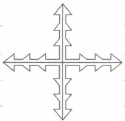
Find the number of lines of symmetry and order of symmetry of the following figure.
4.
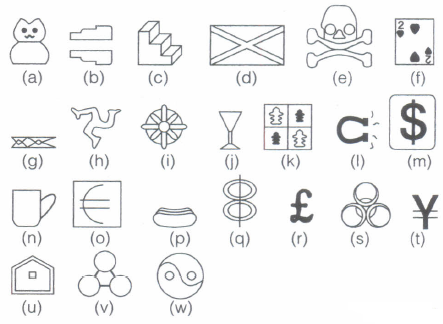
In each of the following figures, write the number of lines of symmetry and order of rotational symmetry.
5.
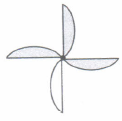
State whether the figure shows rotational symmetry. If yes, then what is the order of rotational symmetry?

6.
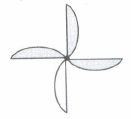
Does the figure have rotational symmetry?
7.
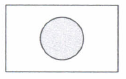
The flag of Japan is shown below. How many lines of symmetry does the flag have?
8.
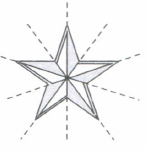
In the following figure, show if possible both line and rotational symmetry.
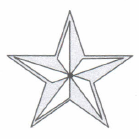
9.
In the following figure, show if possible both line and rotational symmetry.
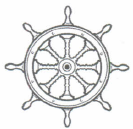
10.
Give the order of rotational symmetry for each figure.
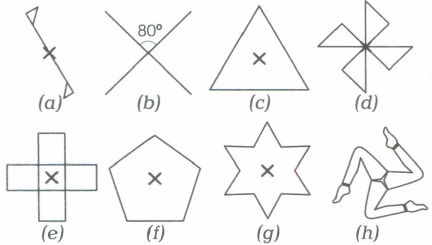
1.
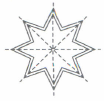
Line of symmetry = 4
Order of symmetry = 8 (angle of rotation = 45°)
2.
Pentagon

3.
Line of symmetry = 2, Order of symmetry = 4
4.
| Figure | Number of lines of symmetry | Order of rotational symmetry |
|---|---|---|
| a | 1 | 1 |
| b | 1 | 1 |
| c | 1 | 1 |
| d | 2 | 2 |
| e | 1 | 1 |
| f | 0 | 1 |
| g | 1 | 1 |
| h | 0 | 3 |
| i | 4 | 4 |
| j | 1 | 1 |
| k | 0 | 1 |
| l | 1 | 1 |
| m | 0 | 2 |
| n | 0 | 1 |
| o | 1 | 1 |
| p | 1 | 1 |
| q | 2 | 2 |
| r | 0 | 1 |
| s | 3 | 3 |
| t | 1 | 1 |
| u | 1 | 1 |
| v | 3 | 3 |
| w | 0 | 2 |
5.
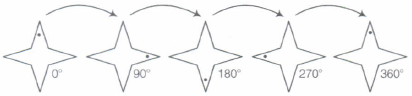
The given figure shows rotational symmetry. The order of symmetry is 4, which is clear from the following figure:
6.
The given figure does not show rotational symmetry, because one part of design is undarken, whereas other three part are darken. Hence, the design does not show symmetry.
7.
The flag of Japan shows line of symmetry as
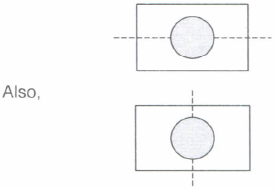
Hence, two lines of symmetry is shown in flag of japan.
8.
In the given figure, line symmetry will be shown as
Also, rotational symmetry will be shown as
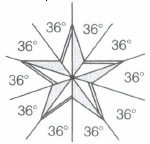
\(\frac { 360° }{ 10 } =36°\), i.e. rotational angle is equal to 36°.
9.
In the given figure, line symmetry will be shown as
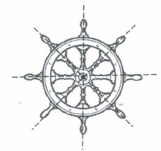
Also, rotational symmetry will be shown as
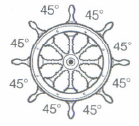
\(\frac { 360° }{ 8 } \)=45° , i.e. rotational angle is equal to 45°
10.
Let mark a point A on each figure and also, indicate the angle through which is to be rotated as shown below:
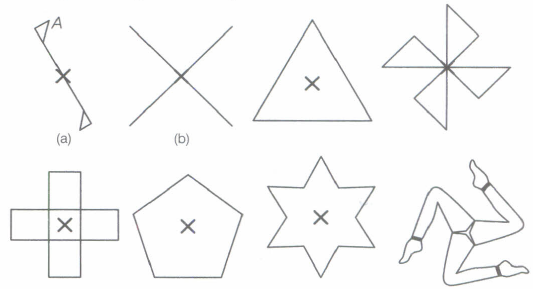
Now, to find the rotational symmetry,we proceed as follows:
For figure (a), it requires two rotations, each through an angle of 180°, about the marked point (X) to come back to its original position. So, it has a rotational symmetry of order 2.
For figure (b), it requires two rotations, each through an angle of 180°, about the marked point (X) to come back to its original position. So, it has a rotational symmetry of order 2.
For figure (c), it requires three rotations, each through an angle of 120° about the marked point (X) to come back to its original position. So, it has a rotational symmetry of order 3.
For figure (d), it requires four rotations, each through an angle of 90°, about the marked point (X) to come back to its original position. So, it has a rotational symmetry of order 4.
For figure (e), it requires four rotations, each through an angle of 90° about the marked point (X) to come back to its original position. So, it has a rotational symmetry of order 4.
For figure (f), it requires five rotations, each through an angle of 72°, about the marked point (X) to come back its original position. So, it has rotational symmetry of order 5.
For figure (g), it requires six rotations, each through an angle of 60° about the marked point (X) to come back its original position. So, it has rotational symmetry of order 6.
For figure (h), it requires three rotations, each through an angle of 120°, about the marked point to come back to its original position. So, it has rotational symmetry of order 3.

7th Standard CBSE Syllabus & Materials
7th Standard CBSE
CBSE 7th Social Science Theme B - New Beginnings : Cities and States - New Sample Question Papers Study Material - QB365 Set A
NEW7th Standard CBSE
CBSE 7th Social Science Theme A - Climates of India - New Sample Question Papers Study Material - QB365 Set A
NEW7th Standard CBSE
CBSE 7th Social Science Theme A - Geographical Diversity of India - New Sample Question Papers Study Material - QB365 Set A
NEW7th Standard CBSE
CBSE 7th Science Earth, Moon and the Sun - New Sample Question Papers Study Material - QB365 Set A



CBSE 7th Standard CBSE Subjects
CBSE Standards




