
 100% FREE ACCESS
7th Standard CBSE Syllabus & Materials
7th Standard CBSE
CBSE 7th Social Science Theme E - Understanding Market - New Sample Question Papers Study Material - QB365 Set A
NEW7th Standard CBSE
CBSE 7th Social Science Theme E - From Barter to Money - New Sample Question Papers Study Material - QB365 Set A
NEW7th Standard CBSE
CBSE 7th Social Science Theme D - The Constitution of India- An Introduction - New Sample Question Papers Study Material - QB365 Set A
NEW7th Standard CBSE
CBSE 7th Social Science Theme D - From the Rulers to the Ruled : Types of Governments - New Sample Question Papers Study Material - QB365 Set A
NEW7th Standard CBSE
CBSE 7th Social Science Theme B - The Age of Reorganisation - New Sample Question Papers Study Material - QB365 Set A
NEW7th Standard CBSE
CBSE 7th Social Science Theme B - The Rise of Empires - New Sample Question Papers Study Material - QB365 Set A

Published on: 06/03/2020
7th Standard CBSE Science Annual Exam Model Question 2020
Download CBSE Class 7th Standard CBSE Science question papers, sample papers, important questions, and previous year solved papers in PDF format. Get free study materials, NCERT solutions, and exam preparation resources for Class 7th Standard CBSE Science
Questions + Answers key
Take MCQ Science Test
1.
Decomposers convert the dead plant and animal tissue into:
Clay
Inorganic debris
Humus
Soil
2.
The end product of respiration are
CO2 and energy
CO2 and water
CO2 and oxygen
CO2 water and energy
3.
Which mark is necessary on electric appliances?
ISI
FICEI
AGMARK
KSK
4.
Chemical used to disinfect water is:
Chlorine
Nitrogen
Methane
Phosphate
5.
Purest form of natural water is:
Rain water
Spring water
Ground water
Lake water
6.
Which one is a physical change?
Melting of ice
Melting of wax
Formation of steam from water
All of these
7.
The tropical desert climates is found in:
Rajasthan
Kerala
Kashmir
Delhi
8.
Silk fibre is obtained from
fleece of sheep
cotton ball
cocoon
shiny jute stalk
9.
A virtual image larger than the object can be produced by a
concave lens
concave mirror
convex mirror
plane mirror
10.
Boojho has three thermometers as shown in figure. He wants to measure the temperature of his body and that of boiling water. Which thermometer(s) should he choose?
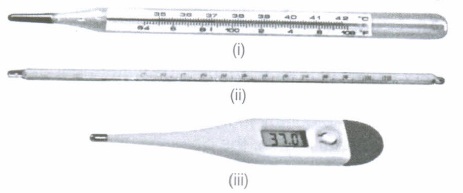
Thermometers (i) and (iii) for measuring body temperature and (ii) for measuring the temperature of boiling water
Thermometer (i) for measuring temperature of both
Thermometer (ii) for measuring temperature of both
Thermometer (iii) for measuring temperature of both
11.
A bus travels 54 km in 90 min.The speed of the bus is
0.6 m/s
10 m/s
5.4 m/s
3.6 m/s
12.
The process of fusion of the male and the female gametes is called
fertilisation
pollination
reproduction
seed formation
13.
A curtain is hanging at the entrance of a room. A long corridor runs at right angles to the door, that is parallel to the curtain. If a strong wind blows along the corridor, the curtain will
get pushed inside the room
get pushed outside the room
get collected towards one end/ swirled
remain unaffected
14.
The muscular tube through which stored urine is passed out of the body is called
kidney
ureter
urethra
urinary bladder
15.
Percolation rate is measured in unit
mL/min
min/mL
lit/min
mL/sec
16.
Cellulose rich food substances are good sources of roughage in human beings because
human beings do not have cellulose: digesting enzymes
cellulose gets absorbed in the human blood and converts into fibres
the cellulose digesting bacteria convert cellulose into fibres
cellulose breaks down into smaller components which are egested as roughage
17.
Which of the following is an acid-base indicator?
Vinegar
Lime water
Turmeric
Baking soda
18.
Which part of the plant takes in carbon dioxide from the air for photosynthesis?
Root hair
Stomata
Leaf veins
Sepals
19.
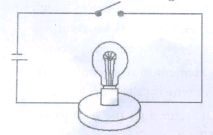
What do you mean by open circuit?
20.
Does this explain why we feel hungry after a physical activity?
21.
Given below a table showing time taken by a car to travel various distances.
| Time (min) | Distance (km) |
|---|---|
| 0 | 0 |
| 10 | 5 |
| 20 | 10 |
| 30 | 20 |
| 40 | 30 |
| 50 | 35 |
| 60 | 45 |
What do you infer from this data?
22.
What are converging and diverging lens?
23.
What is tongue? Explain its function.
24.
Observe various things in your home and make a list of those which are made from material which may have been obtained from the forest.
25.
Describe the processing of fibres into wools?
26.
Some slogans has been given for the conservation of water. What does the slogan 'Jal hai to kal hai' means?
27.
Shopkeepers selling ice blocks usually cover them with jute sacks. Explain why.
28.
A flower consists of different parts. Name these parts of a flower.
29.
Mention the period proclaimed as the International Decade for action on Water for Life.
30.
Name some cyclones that occurred in the past.
31.
Is souring of milk a physical change or a chemical change? Why?
32.
Name the organ which is located in the chest cavity with its lower tip slightly tilted towards the left.
33.
Which type of soil absorbs more water but allows less water to percolate?
34.
A leguminous plant can restore the soil's concentration of mineral nutrients. Can you give examples of some such plants?
35.
Is lime water an acidic or basic solution?
36.
Maximum and minimum temperature is recorded at which time of the day?
37.
Draw a diagram of pistil to show pollen grain, pollen tube, ovary and ovule.
38.
What are electric fuses? Write their importance
39.
How do forests help in controlling floods and maintain steady supply of water?
40.
As Rishab is fond of eating chocolates, his mother always discusses about the importance of teeth in our life and to take care of it. Rishab is reluctant to follow the instructions given by his mother. One day while bitting guava he saw blood patch on it. He became afraid and asked his mother the following questions:
(i) Which is the problem coming in my teeth which cause toothache?
(ii) How can I get rid of it?
(iii) Which value is promoted by Rishab's mother?
41.
How is the mean temperature of a given month determined?
42.
You are provided with liquids A, Band C. One contains NaOH, another contains HCI and third is sugar solution. You are given phenolphthalein solution. How will you identify these solutions?
43.
Out of the following, which are the two terms related to silk production? Sericulture, floriculture, moriculture, apiculture, silviculture.
Hints: (i) Silk production implies the cultivation of mulberry leaves and rearing silkworms.
(ii) 'Morus Alba' is the scientific name of mulberry
44.
A number of problems can be faced due to shortage of water. List some of them.
45.
Explain the reason for the general fitting of air conditioner at higher level on the wall of the room.
46.
A sewage treatment plant involves few steps in its working.
Aeration tank, grit and sand removal tank, second sedimentation tank, bar screen, first sedimentation tank.
Which step gives most of the sludge?
47.
Differentiate between a plane mirror, concave mirror and a convex mirror without touching them.
48.
Last Sunday, Priyanka decided to go outside with her family for the dinner in some particular restaurant. Then, she thought to go through her own car. So, while moving she increased the speed of the car from 36 km/h to 54 km/h. All of sudden, a rickshaw came in front of her car but due to applying of brakes at the right time, both of them got safe from meeting with an accident.
(a) Calculate the increase in the speed of the car in the terms of m/s.
(b) Mention a positive action performed by Priyanka here.
49.
List the similarities and differences between aerobic and anaerobic respiration
50.
Give three precautions that should be taken to protect oneself from the thunderstorm.
51.
Why plants absorb a large quantity of water from the soil, then give it off by transpiration?
52.
Explain why rusting of iron objects is faster in coastal areas than in deserts.
53.
What are the various raw materials for photosynthesis?
54.
Describe the different type of soil
55.
Write the differences between respiration and combustion
56.
While watching news channel on television, Ajay comes to know about the water scarcity which goes on in some of the areas of West India. In the clippings on news he sees that women and even children are engaged in fetching water from distant wells/ponds which are also not a good state. He feels unhappy and next day asked the following questions to his a science teacher.
Answer the questions pretending that you are science teacher.
(i) Is true that we are facing the actual shortage of water?
(ii) What might be 'the causes and remedies of this water scarcity?
(iii) If the children are engaged in carrying water, when do they manage to go to school to study?
57.
Explain that temperature is also involved in the increasing or decreasing speed of wind.
58.
Explain the composition of blood.
59.
Two railway stations are 320 km apart from each other. Train-I covers this distance in 4.5 hours whereas train-If reaches the destination 10 minutes earlier, through it departs the station 20 minutes later.
Based on this information answer the following questions:
(i) What might be the reason that the train-If reaches the destination earlier?
(ii) Calculate the speed of both the trains.
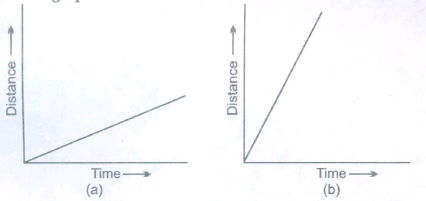
(iii) If we consider that both the trains move with constant speed, then assign one distance-time graph for each train.
60.
What is the role of sun for controlling the weather?
61.
You are provided with four test tubes containing sugar solution, baking soda solution, tamarind solution, salt solution. Write down an activity to find the nature (acidic/basic/neutral) of each solution.
62.
One day, Pinki was ironing the clothes in her room. After half an iron of ironing, the light went off and Pinki went outside to the lobby of her house to check it there was any problem in the household circuit. At the same time, she listened the voice of her 4 years old daughter from the same room where she was ironing the clothes. Her daughter was about to touch the hot electric iron but at the same moment, Pinki entered in the room and pushed her daughter back from that place.
(a) On which effect of electric current, does the electric iron works?
(b) Mention the values showed by Pinki here.
63.
Explain the reason for the following statement, "When heat is applied at the bottom of the water vessel, then it gets heated more quickly than when it is heated at the top."
64.
Ravi was sitting in a garden with his family. His younger sister comes running with different types of flowers and starts to name their parts. She stops as she forgets some names and Ravi noticing this comes to help her.
His sister askes many questions related to flowers and Ravi answers her with all information he has.
(a) What is a flower and mention its function during reproduction?
(b) Flowers help in pollination and fertilisation.
Yes/No? Give reason.
(c) Do all flowers have both male and female parts on them specify?
(d) What values are observed in Ravi and his sister?
65.
One day Sachin had gone to his uncle who lives in a village. He saw there a large number of people defecate in an open area because proper toilet facilities are not there. He wondered about the groundwater contamination, as he studied in his class that this act may cause water-borne diseases. He convinced village people to make toilets to avoid such an out break of water-borne diseases.
(a) Name two water-borne diseases.
(b) Explain vermi-composting toilets.
(c) What values are shown by Sachin?
66.
Namit was driving a car and suddenly became aware of a loud sound coming from behind. He looked through his rear view mirror and saw an ambulance. He recalled reading that such emergency vehicles often have their name written in the mirror (AMBULANCE) or writing,
i.e. 3 J VI A J U 8 M A.
He quickly made way for the ambulance, murmuring a quick prayer for the speedy recovery of the patient inside the ambulance.
(a) Name the type of mirror which is used as a rear view mirror and why?
(b) Mention values did Namit exhibit.
67.
Paheli went to the market to buy sarees for her mother. She took out a thread from the edge of the two sarees shown by the shopkeeper and burnt them. One thread burnt with a smell of burning hair and the other burnt with the smell of burning paper. Which thread is from a pure cotton saree and which one from a pure silk saree? Give reason for your answer.
68.
Sachin lives in a village, this village is surrounded by a forest. One day he noticed that in nearby pond sedimentation is increased so much that water has become muddy, streams are drying up. There is scarcity of fuel wood. He soon realised that he has to raise the issue of forest protection from cutting down trees, etc. Soon he involved the nearby village people and made an organisation to take an initiative.
Now, answer the following questions
(a) What changes might have Sachin noticed in his area?
(b) Give the porbable reason for such changes mentioned above.
(c) What are the values shown by Sachin?
69.
Give an example of a chemical reaction for each of the following situations:
(a) A change in colour is observed.
(b) A gas is evolved.
(c) Sound is produced.
70.
The contamination of soil with waste materials causes soil pollution. Does the use of pesticides in agriculture also contribute to the soil pollution? Explain.
71.
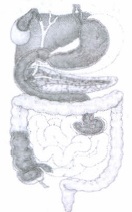
Label the following parts of above figure and name them.
(a) The largest gland in our body.
(b) The organ where protein digestion starts.
(c) The organ that releases digestive juice into the small intestine.
(d) The organ where bile juice gets stored.
72.
Asha went to visit her grandfather in his village. He was having a serious discussion with his fellow members regarding the productivity level of crops for present year. They all were worried about how to increase the productivity of crop Asha listened to this and then suggested to the group that the reason may be decreased level of minerals in soil.
She told her grandfather to plant crops like pulses, gram, beans, etc., for a year then follow with regular crops. This will increase the crop productivity?
(a) What will you name the process suggested by Asha? Why is there decrease in crop productivity?
(b) What are noted benefits of this process? Will the results be as what Asha expressed?
(c) What values are shown by Asha?
1.
(c)
Humus
2.
(d)
CO2 water and energy
3.
(a)
ISI
4.
(a)
Chlorine
5.
(a)
Rain water
6.
(d)
All of these
7.
(a)
Rajasthan
8.
(c)
cocoon
9.
Concave mirror can form real image and virtual image of larger size than the object
10.
(a)
Thermometers (i) and (iii) for measuring body temperature and (ii) for measuring the temperature of boiling water
11.
(b)
10 m/s
12.
The process of fusion of the male and the female gametes is called fertilisation.
13.
(b)
get pushed outside the room
14.
(c)
urethra
15.
(a)
mL/min
16.
(a)
human beings do not have cellulose: digesting enzymes
17.
(c)
Turmeric
18.
(b)
Stomata
19.
When the switch is in off position then the circuit from the positive terminal of battery to the negative terminal is not complete. The circuit is then said to be opened and current does not flow throughout the circuit and bulb does not glow.
20.
Yes, because after physical activity we require energy.
21.
We see that the car covers a distance of 5 km in first 10 min. It again covers a distance of 5 km in next 10 min. In the next 10 min, it covers 10 km, then again 10 km in 10 min. Then it covers 5 km in 10 min. This shows that the car travels unequal distances in various slots of 10 min. So we conclude that the car is moving with a non-uniform speed.
22.
A convex lens bends inwards the light falling on it. It is called a converging lens. On the other hand, concave lens bends outwards the light and is called diverging lens.
23.
Tongue is a fleshy muscular organ attached at the back to the floor or the buccal cavity and free at the front. It can move in all the directions. It mixes the saliva with the food during chewing. It helps in swallowing the food. It has various taste buds which help to detect different tastes of food.
24.
Doors and window frames, table, chair, bed, paper, match stick, gum, spices etc.
25.
Following steps are involved in making wool.
(i) Shearing: First of all, the fleece of the sheep along with a thin layer of the skin is removed.
(ii) Scouring: Sheared skin is thoroughly washed in tanks to remove grease, dust and dirt.
(iii) Sorting: This involves the separation of hairs of different textures.
(iv) Drawing out the fibre: The small fluffy fibres popularly known as 'burrs' are picked out from the hair first, then scoured, dried and finally drawn into fibres.
(v) Dyeing: Finally the fibres can be dyed into a variety of colours.
26.
This means if you have water, you can think of future, i.e. no life is possible without water.
27.
As we know that jute sacks is thermal insulators, it helps ice not to be melt immediately. So, shopkeepers used to cover ice blocks with jute sacks.
28.
The four main parts of a flower are
(i) Sepals
(ii) Petals
(iii) Stamen
(iv) Pistil.
29.
2005 -2015 is the period proclaimed as the International Decade for action on Water for Life.
30.
Hugo, Katrina, Rita, Hud-Hud and Phailin are the various types of cyclones that occurred in the past.
31.
Souring of milk is a chemical change because original substances present in milk lose their nature and identity and form new chemical substances.
32.
The heart is located in the chest cavity with its lower tip slightly tilted towards the left.
33.
Clayey soil absorbs more water but allows less water to percolate
34.
Plants such as gram, pulses and beans are leguminous.
35.
Lime water (calcium hydroxide) is a basic solution.
36.
When the temperature due to the sun's heat reaches to its maximum level it is called maximum temperature and when it goes down to the lowest level it is called minimum temperature.
37.
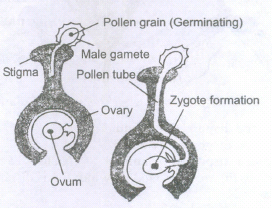
38.
Fuse is a safety device which prevents our houses, appliances and electric circuit from electrical hazards at the time of the short circuiting or overloading. The fuse works on the basis of heating effects of the electric current. If, by an accident the current exceeds a certain limit this device becomes overheated and melts which breaks the circuit and supply of electricity is stopped. In this way, it helps in prevention of short circuits
39.
The uppermost layer of the forest canopy intercepts the flow of rain drops and most of the water comes down through the branches and stems of the trees. From leaves it drips slowly over branches of the shrubs and herbs. All this slows down the speed of raindrops and also slows down the speed of running water.
Thus, forests act as a natural absorber of rainwater and allows it to seep. It helps to maintain the water table throughout the year. In this way, forests help in controlling floods and maintain steady supply of water.
40.
(i) The problem is of tooth decay which causes toothache.
(ii) One should clean the teeth with a toothbrush twice a day. Chocolates should be avoided.
(iii) She is aware and concerned about the problems arising in the teeth especially of younger children.
41.
The mean temperature for a given month is found in two steps:
(i) First we find the average of the temperatures recorded during the month.
(ii) Second we calculate the average of such average temperature over many years. That gives the mean temperature.
42.
Add a drop of phenolphthalein separately in liquids A, B and C. The one which turns pink is sodium hydroxide, let it be A. Divide this into two parts. Now add a few drops of other solutions in the above solution taken into parts. The solution which again turns solution A colourless is hydrochloric acid. Let it be B. Then solution left is sugar.
43.
Sericulture and moriculture.
44.
The number of problems that can be faced due to shortage of water are as follows
(i) Less amount of pure drinking water will be available.
(ii) Lack of equal distribution of water.
(iii) Drought.
45.
As a fact that warm air is much lighter than the cold air, so being heavier the cold air from air conditioner moves downwards while the hot air moves upwards at the lower level and gets cooled and come downwards once again. So, due to this convection of heat are set in the air and room gets warmer faster.
46.
First sedimentation tank.
47.
These mirrors can be differentiated by bringing our face close to each mirror turn by turn. Since, a plane mirror will produce an image of the same size as our face while a concave mirror will produce a magnified image and our face will look much bigger and on other sides, a convex mirror will produce a diminished image and our face will look much smaller like a small child.
48.
Initial speed = 36km/h\(=\frac{5}{18}\times36=10m/s\)
Final speed = 54km /h\(=\frac{5}{18}\times54=15m/s\)
Increase in speed = Final speed - Initial speed = (15-1 0) m/s = 5 m/s
(b) Priyanka applied the brakes at a right time while driving the car and prevented her family and the person on rickshaw from meeting with an accident.
49.
Differences between aerobic and anaerobic respiration are as follows
| Aerobic respiration | Anaerobic respiration |
| It uses oxygen | It takes place in the absence of oxygen |
| Glucose is completely broken down into Co2 and water along with release of high amount of energy | Glucose is broken into ethyl alcohol or lactic acid CO2 and energy produced is in low amount |
| It occurs in all living organisms like mammals | It occurs in lower organisms like yeast, fungi and bacteria |
| Glucose + O2 \(\rightarrow\) co2 + H2O2 + Energy | Glucose \(\rightarrow\) ethyl alcohol + Co2 + Energy |
Similarities between aerobic and anaerobic respiration are as follows
(i) Both break down the glucose.
(ii) Release of energy takes place in both.
(iii) CO2 is the common product in both.
50.
The following three precautions must be taken to protect oneself from the lightning of thunderstorm
(i) Do not take shelter under an isolated tree.
(ii) Do not lie on the ground
(iii) Do not take shelter under an umbrella with a metallic end.
51.
Plants absorb a large quantity of water from the soil because they need nutrients which are dissolved in the water. The excess water evaporates through the stomata present on the leaf surface by the process of transpiration.
52.
We know that for rusting, the presence of both oxygen and water (water vapours) is essential.
Thus, in coastal areas, the air contains high moisture which means more humid environment and rusting becomes faster.
Whereas in deserts, moisture in air is less, hence rusting of iron is very slow there.
53.
Plants utilise carbon dioxide from air and water and minerals are derived from soil (through roots) as raw material for photosynthesis. Besides these chlorophyll present in green leaf is necessary for the process and sunlight is the source of energy which is converted into chemical energy during the process of photosynthesis.
54.
There are three different types of soil
(i) Sandy soil containing sand particles in them.
(ii) Clayey soil contains clay particles with small amount of humus in it. It is a fertile soil.
(iii) Loamy soil is a mixture of sand, clay silt and humus. It is a fertile soil
55.
Difference between respiration and combustion
| Respiration | Combustion |
| 1.The energy released is stored in chemical molecules. |
The energy released does not get stored |
| 2.No release of light and heat | Heat and light released |
| 3.Stepwise release of energy, no rise in temperature. |
Fast reaction and sudden release of energy in one step. Rise in temperature takes place |
| 4.Happens at the body temperature. | Requires high ignition temperature (for burning fuel molecules.) |
56.
(i) Actually, millions of people in our country do not get enough water. Especially during summer, in many areas there is an acute shortage of water, taps running dry, long queues for water and even fight for demand of water in a common sight.
(ii) Causes: Due to less amount of rainfall in some areas, not only water bodies like ponds, rivers become dry also due to excess extraction of ground water, water table goes down.
Remedies: Public and government both should be concern and show awareness towards this crisis. By drip irrigation system and water harvesting technique, we cannot only save water from wastage but also recharge ground water.
(iii) In these areas of hot dry and arid climate the studies of children are badly affected.
57.
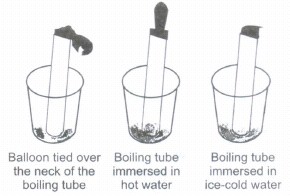
Take a boiling tube. Stretch a balloon tightly over the neck of the tube. Pour some hot water in a beaker. Insert the boiling tube with the balloon in the hot water. Observe for any change in shape of balloon. We see that balloon lifts upward. Take the tube out, let it cool down to the room temperature. Take some ice cold water in another beaker and place the boiling tube in it. The balloon inflates when the boiling tube is placed in hot water. But the same balloon deflates when tube is kept in cold water. This activity shows that warm air rises up and warm air is lighter than the cold air. In this way, we can say that difference in temperature also involved in making speed of wind.
58.
Blood is a liquid which is composed of following two parts:
(i) Plasma: The fluid part of the blood is called plasma.
(ii) Cells: There are three kinds of cells suspended in the plasma of blood
(a) Red Blood cells (RBC): These cells contain a red pigment called haemoglobin. Haemoglobin binds with oxygen and transports it to all the parts of the body and ultimately to all cells. It will be difficult to provide oxygen efficiently to all the cells of the body without haemoglobin. Due to the presence of haemoglobin the blood appears red.
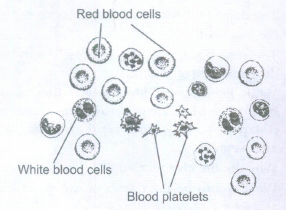
(b) Platelets: The third type of cells found in the blood are platelets. Their function is to form clot to prevent loss of blood when we are injured.
(c) White Blood Cells (WBC): WBCs fight against germs that may enter our body and thus protect us from infection.
59.
(i) Train-II might have gone in higher speed then the train-I as it takes less time to cover the same distance.
(ii) For train - I
Distance = 320 km
Time taken = 4 h 30 mins
= \(4\frac { 1 }{ 2 } \)
Speed = \(\frac { distance }{ Time } \)
\(\frac { 320 }{ 9/2 } km/h\)
= \(\frac { 320\times 2 }{ 9 } =\frac { 640 }{ 9 } \)
= 71.1 km.h
For train - II
Distance = 320km
Time taken = 30 mins less than the first train
=4h
Speed = \(\frac { Distance }{ Time } \)
= \(\frac { 320 }{ 4 } km/h\)
=80 km/h
(iii) The graph in figure (a) is of train-I
The graph in figure (b) is of train-II.
60.
All changes in the weather are caused by the sun. The energy sent out by the sun is so huge that it is the source of all heat and light on the earth. Energy absorbed and reflected by the earth surface, oceans and the atmosphere play an important role in determining weather of any particular place.
61.
Use both red and blue litmus solution and predict the colours in each case. In acidic medium, blue litmus solution turns to red. In basic medium, red litmus solution turns to blue
62.
(a) The electric iron works on the basis of heating effect of electric current.
(b) The values showed by Pinki here is a great concern and love towards her own 4 years old daughter.
63.
The particles of water become more lighter and rise up in the middle. Due to this, the cold particles of water which are heavier come down along the sides of the vessel. So, the convection currents of heat are setup and water becomes hot. The moment, when the heat is applied at the top, then the water present in the upper portion becomes hot and these hot water molecules get fixed over the surface. Since, water is a bad conductor of heat, due to which water present at the lower end (or bottom) of the vessel remains.
64.
(a) A flower is the reproductive part of plant which helps in sexual reproduction.
A flower ensures the occurrence of process of fertilisation.
(b) Yes, flower aids in both pollination and fertilisation. Different colours and fragrance of flowers attract insects to them causing dispersal of pollen grain ensuring pollination.
Fertilisation occurs in the ovary of the flower after pollination of male and female parts.
(c) Number of some flowers can either have male or female parts on them, these flowers are called unisexual.
Some flowers have both, the male and female parts on them so they are called bisexual flowers.
(d) Ravi is aware, sincere, helpful as he helps others and knowledgeable while his sister is inquisitive, ready to acquire new knowledge and observant.
65.
(a) Typhoid and cholera.
(b) In vermi-composting toilets, human excreta is treated by earthworms in a pit.
(c) He is intelligent and concious about health
66.
(a) Convex mirror is a mirror which is used as a rearview mirror. It is used to get a wide view of traffic behind.
(b) The values exhibit by Namit here is courtesy concerned for other, sympathy, knowledgeable.
67.
In first saree, one thread which burnt with a smell of burning hair is from pure silk, silk and hair are protein fibres. So, on burning these threads, a smell of burning hair comes out. In second saree, second thread which burnt with the smell of burning cotton and paper because cotton and paper both are carbohydrates and on burning they give similar smell.
68.
(a) Sachin noticed the disturbance in the water cycle in his area like stream drying up. Pond water getting muddy, less availability of fuel wood, etc.
(b) Deforestation.
(c) Love for nature and environmental consciousness.
69.
(a) Chemical reaction between copper sulphate solution and iron metal. In this reaction, blue colour of copper sulphate solution changes to light green colour due to the formation of iron sulphate.
Copper sulphate + Iron \(\longrightarrow\) Iron sulphate + Copper
(Blue) (Grey) (Light green) (Brown)
(b) When baking soda and vinegar are mixed together then a chemical change takes place and bubbles of carbon dioxide gas are formed along with some other substances.
Baking soda + Vinegar \(\longrightarrow\) Sodium acetate + Carbon dioxide + Water
(Sodium hydrogen carbonate) (Acetic acid)
(c) Explosion of a firework produces heat, light, sound and unpleasant gases. Explosion of a firework is a chemical change.
70.
The contamination of soil with waste materials especially used polythene bags and plastics, pesticides, fertilisers, acid rain industrial chemical wastes, etc., is called soil pollution
Pesticides are the poisonous chemical substances which are sprayed on standing crops to save them from the harmful insects and diseases. Some of these pesticides also mix up with the soil in the fields and pollute it. The grains, fruits and vegetables grown in this polluted soil contain pesticides. When we eat such contaminated grains, fruits or vegetables, the pesticides present in them damage our health also.
71.
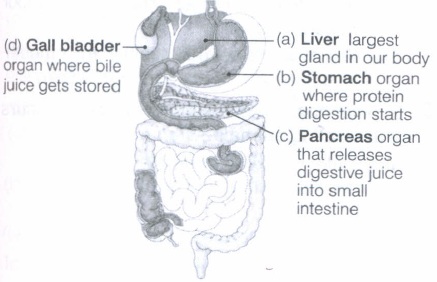
72.
(a) This process is known as crop rotation. All the plants/crops grown in soil use the minerals present in soil for their own use. This continuous usage depletes the concentration of mineral in soil.
(b) After growing leguminous plants, the mineral content of soil is restored and enriched to new level. Yes, the benefit of leguminous plant is the re-enrichment of soil minerals.
(c) Asha is observant, sincere and interested in applying her knowledge to situations.

7th Standard CBSE Syllabus & Materials
7th Standard CBSE
CBSE 7th Social Science Theme B - New Beginnings : Cities and States - New Sample Question Papers Study Material - QB365 Set A
NEW7th Standard CBSE
CBSE 7th Social Science Theme A - Climates of India - New Sample Question Papers Study Material - QB365 Set A
NEW7th Standard CBSE
CBSE 7th Social Science Theme A - Geographical Diversity of India - New Sample Question Papers Study Material - QB365 Set A
NEW7th Standard CBSE
CBSE 7th Science Earth, Moon and the Sun - New Sample Question Papers Study Material - QB365 Set A



CBSE 7th Standard CBSE Subjects
CBSE Standards




