
 100% FREE ACCESS
7th Standard CBSE Syllabus & Materials
7th Standard CBSE
CBSE 7th Social Science Theme E - Understanding Market - New Sample Question Papers Study Material - QB365 Set A
NEW7th Standard CBSE
CBSE 7th Social Science Theme E - From Barter to Money - New Sample Question Papers Study Material - QB365 Set A
NEW7th Standard CBSE
CBSE 7th Social Science Theme D - The Constitution of India- An Introduction - New Sample Question Papers Study Material - QB365 Set A
NEW7th Standard CBSE
CBSE 7th Social Science Theme D - From the Rulers to the Ruled : Types of Governments - New Sample Question Papers Study Material - QB365 Set A
NEW7th Standard CBSE
CBSE 7th Social Science Theme B - The Age of Reorganisation - New Sample Question Papers Study Material - QB365 Set A
NEW7th Standard CBSE
CBSE 7th Social Science Theme B - The Rise of Empires - New Sample Question Papers Study Material - QB365 Set A

Published on: 24/09/2019
Fibre to Fabric
Download CBSE Class 7th Standard CBSE Science question papers, sample papers, important questions, and previous year solved papers in PDF format. Get free study materials, NCERT solutions, and exam preparation resources for Class 7th Standard CBSE Science
Questions + Answers key
Take MCQ Science Test
1.
What are the three grades of silk produced?
2.
What is raw silk? How is it produced?
3.
Out of the following, which are the two terms related to silk production? Sericulture, floriculture, moriculture, apiculture, silviculture.
Hints: (i) Silk production implies the cultivation of mulberry leaves and rearing silkworms.
(ii) 'Morus Alba' is the scientific name of mulberry
4.
What is meant by the following terms?
(i) Rearing, (ii) Shearing, (iii)Sericulture
5.
Steps for the production of silk are given below in a jumbled order. Arrange them in their proper sequence.
(a) Eggs are warmed to a suitable temperature for the larvae to hatch from eggs.
(b) Fibres are taken out from the cocoon.
(c) After 25 to 30 days, the caterpillars stop eating and start spinning cocoons.
(d) The larvae/caterpillars or silkworms are kept in clean trays along with freshly chopped mulberry leaves.
(e) Female silk moths lay eggs.
(f) Cocoons are kept under the sun or boiled in water.
6.
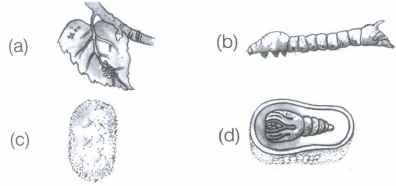
Write a caption for each of the figures given as figure (a-d).
7.
Explain the phrase - "Unity is Strength" on the basis of the making of fabric from fibre.
8.
Give a brief account of wool manufacturing.
9.
Ajay's father works in a wool industry. In his line of work, he does the job of sorting the fleece of sheep into fibres of different qualities. Ajay noticed that his father and other workers who were doing the similar kind of jobs faced a number of health problems. Ajay discussed this problem with his friends and he came to know that his father is getting health problems due to the nature of his work. Ajay is worried about his father's health. He advised his father to take care of their health and told him about the occupational hazards.
Now answer the following questions.
(a) What do you mean by occupational hazard?
(b) Name the disease that workers may at risk.
(c) What values are shown by Ajay?
10.
Paheli went to the market to buy sarees for her mother. She took out a thread from the edge of the two sarees shown by the shopkeeper and burnt them. One thread burnt with a smell of burning hair and the other burnt with the smell of burning paper. Which thread is from a pure cotton saree and which one from a pure silk saree? Give reason for your answer.
1.
Three grades of silk obtained from a cocoon are :
(a) Reeled silk: It is the unwound fibres and form the finest quality of silk.
(b) Spun silk: It is the carded or combed silk from left overs after the reeled silk. It constitutes an inferior quality. It is slightly honey coloured.
(c)Nail silk: Still shorter fibres left behind after carding constitute an even inferior quality of silk.It is a richly textured rough silk.
2.
After brushing, filaments from four to eight cocoons are joined and twisted. About 48 such twisted filaments are joined to make a thread that is wound on a reel. This thread is called raw silk.
3.
Sericulture and moriculture.
4.
(i) Rearing: Raising the sheep and taking its care is called rearing.
(ii) Shearing: For obtaining wool, the fleece of the sheep together with a thin layer of skin is taken off its body. This process is known as shearing.
(iii) Sericulture: By sericulture we mean the rearing of silkworms for obtaining silk.
5.
The correct order is
(e) Female silk moths lay eggs.
(a) Eggs are warmed to a suitable temperature for the larvae to hatch from eggs.
(d) The larvae/caterpillars or silkworms are kept in clean trays along with freshly chopped mulberry leaves.
(c) After 25 to 30 days, the caterpillers stop eating and start spinning Cocoons.
(f) Cocoons are kept under the sun or boiled in water.
(b) Fibres are taken out from the Cocoon.
6.
(a) Eggs of silk moth on mulberry leaves
(b) Silkworm
(c) Cocoon
(d) Cocoon with developing moth
7.
Fibres and fabric play a large role in everyday application. A fibre is a hair-like strand of material. They are the smallest visible unit of a fabric and denoted by being extremely long in relation to their width. Fabric can be spun into yarn and made into fabric.A single fibre is too week to break but when it one made a fabric it is difficult to tear. Fabric needs more energy to tear apart as compared to single fibre.
8.
The wool is obtained from the hair of sheep in the following steps:
Step I-Shearing: The fleece of the sheep along with a thin layer of skin is removed from its body. Machines similar to those used by barbers are used to shave off hair. Usually, hair removed during the hot weather.
Step II-Scouring: The sheared skin with hair is thoroughly washed in tanks to remove grease, dust and dirt.
Step III-Sorting: The hairy skin is sent to a factory where hair of different textures are separated or sorted.
Step IV-The small fluffy fibres, called burrs are picked out from the hair. The fibres are scoured again and again and dried.
Step V-Fibres can be dyed in various colours.
Step VI-The fibres are straightened, combed and rolled into yarn. The long fibres are made into wool for sweaters and the shorter fibres are spun and woven into woollen clothes.
9.
(a) The risks faced by people working in any industry due to the nature of their work are called occupational hazards.
(b) The people who do the job of sorting, sometimes, get infected by the bacteria called anthrax which cause a deadly blood disease called sorter's disease.
(c) Ajay is very caring, intelligent and sensible boy.
10.
In first saree, one thread which burnt with a smell of burning hair is from pure silk, silk and hair are protein fibres. So, on burning these threads, a smell of burning hair comes out. In second saree, second thread which burnt with the smell of burning cotton and paper because cotton and paper both are carbohydrates and on burning they give similar smell.

7th Standard CBSE Syllabus & Materials
7th Standard CBSE
CBSE 7th Social Science Theme B - New Beginnings : Cities and States - New Sample Question Papers Study Material - QB365 Set A
NEW7th Standard CBSE
CBSE 7th Social Science Theme A - Climates of India - New Sample Question Papers Study Material - QB365 Set A
NEW7th Standard CBSE
CBSE 7th Social Science Theme A - Geographical Diversity of India - New Sample Question Papers Study Material - QB365 Set A
NEW7th Standard CBSE
CBSE 7th Science Earth, Moon and the Sun - New Sample Question Papers Study Material - QB365 Set A



CBSE 7th Standard CBSE Subjects
CBSE Standards




