
 100% FREE ACCESS
7th Standard CBSE Syllabus & Materials
7th Standard CBSE
CBSE 7th Social Science Theme E - Understanding Market - New Sample Question Papers Study Material - QB365 Set A
NEW7th Standard CBSE
CBSE 7th Social Science Theme E - From Barter to Money - New Sample Question Papers Study Material - QB365 Set A
NEW7th Standard CBSE
CBSE 7th Social Science Theme D - The Constitution of India- An Introduction - New Sample Question Papers Study Material - QB365 Set A
NEW7th Standard CBSE
CBSE 7th Social Science Theme D - From the Rulers to the Ruled : Types of Governments - New Sample Question Papers Study Material - QB365 Set A
NEW7th Standard CBSE
CBSE 7th Social Science Theme B - The Age of Reorganisation - New Sample Question Papers Study Material - QB365 Set A
NEW7th Standard CBSE
CBSE 7th Social Science Theme B - The Rise of Empires - New Sample Question Papers Study Material - QB365 Set A

Published on: 31/10/2019
Download CBSE Class 7th Standard CBSE Science question papers, sample papers, important questions, and previous year solved papers in PDF format. Get free study materials, NCERT solutions, and exam preparation resources for Class 7th Standard CBSE Science
Questions + Answers key
Take MCQ Science Test
1.
Explain the working of a thermo flask.
2.
Explain the phrase - "Unity is Strength" on the basis of the making of fabric from fibre.
3.
Explain the human digestive system with the help of labelled diagram.
4.
Name some fruit bearing plants. Now make a table and describe the method of seed dispersal in these fruits as well as the part which helps in the seed dispersal.
5.
Discuss vermi-processin toilets. Name the useful product obtained from such toilets.
6.
A soil sample was taken from an agricultural land and was weighed. The mass of the soil was found to be 50 g. 100 mL of water was taken in a measuring cylinder and added into the soil sample. The soil absorbed 80 mL of water and rest left in the measuring cylinder. Calculate the absorption rate of water by the soil.
7.
Define oral rehydration solution and when it is given to the patient? How can you prepare ORS at home?
8.
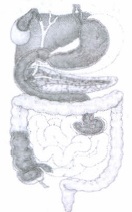
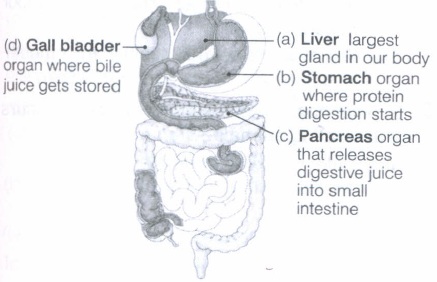
Label the following parts of above figure and name them.
(a) The largest gland in our body.
(b) The organ where protein digestion starts.
(c) The organ that releases digestive juice into the small intestine.
(d) The organ where bile juice gets stored.
9.
Describe the process by which plants prepare their food using different raw materials.
10.
Boojho, Paheli and their friend Golu were provided with a test, each containing China rose solution which was pink in colour. Boojho added 2 drops of solution 'A' in his test tube and got dark pink colour. Paheli added 2 drops of solution '8'to her test tube and got green colour. Golu added 2 drops of solution 'C' but could not get any change in colour. Suggest the possible cause for the variation in their results.
1.
Thermo flask is a special kind of flask for keeping liquids. It prevents loss or gain of heat by any of the three methods. It keeps liquid warm or cold for a long time. It was invented by Sir James Dewan in 1893.
It consists of a double-walled glass-cylinder. A vacuum is created in the space between the double walls. The two inner surfaces of glass walls are silvered. The flask is placed on a spring within a non-conducting cylindrical case to protect it from jerks and breakages. The gaps between flask and outer casing is packed with felt pads. The mouth of the flask is finally closed with a cork.
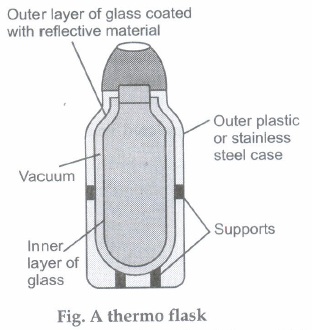
Since the container is made of glass which is a bad conductor of heat and therefore, the loss or gain of heat due to conduction is prevented. As there is vacuum between the double walls, it prevents transmission of heat by convection. Due to silvering of the inner surfaces, the heat loss by radiation is prevented. The cork and the felt pads also help to preserve the heat inside the flask. So, the hot liquids like tea, coffee, etc., remain hot and cold liquids like water, juice, etc., remain cold for a long time.
2.
Fibres and fabric play a large role in everyday application. A fibre is a hair-like strand of material. They are the smallest visible unit of a fabric and denoted by being extremely long in relation to their width. Fabric can be spun into yarn and made into fabric.A single fibre is too week to break but when it one made a fabric it is difficult to tear. Fabric needs more energy to tear apart as compared to single fibre.
3.
When the ingest food in our mouth, salivary glands of the mouth secrete saliva which moistens the food. It also converts the starch into sugar. The tongue helps in chewing by moving the food in various directions. Saliva contains enzyme called salivary amylase which converts starch into sugar.
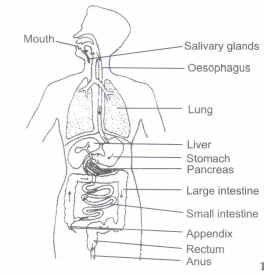
From mouth, food goes into food pipe called oesophagus. As food enters into the food pipe, muscles of its wall starts contraction and relaxation movement. This movement is called peristaltic movement that pushes the food into the stomach. The peristaltic movement occurs throughout the alimentary canal. The oesophagus leads the food to a saclike structure called stomach. The food is churned and partly digested in the stomach. The semi-solid food passes from the stomach to much coiled tube-like structure called the small intestine. The small intestine serves two purposes-digestion and absorption of the digested food. It is about 20 feet long. The inner surface of the small intestine has a large number of finger-like projections called villi. The villi increase the surface area for the absorption of digested food. The absorbed food enters into the blood stream and carried away to various parts of the body for assimilation. The undigested food moves from the small intestine to the large intestine where mainly absorption of water from the undigestion takes place. From the large intestine, the undigested food passes to the rectum which pushes it out of the body through the opening called the anus as faeces.
4.
The method of seed dispersal in the fruits and the parts which help in the seed dispersal:
| Name of fruits bearing plants | Agents through which seeds are dispersed | Parts or seeds which helps in dispersal |
| Drumstick | Air/wind | Winged seeds |
| Sunflower | Wind | Hairy seeds |
| Gokhru | Animal | Spines and Hooks |
| Coconut | Water | Fibrous coating |
| Lotus | Water | Thalamus float in water |
| Poppy | Explosion | Pericarp bursts |
| Grass | Wind | minute, light weighted seeds |
5.
In the vermi-processing toilet, the human excreta is treated by earthworms in a pit. The earthworms gradually eat up all the organic matter present in human excreta, decompose it and pass out from their body in the form of warm casting (also called vermi cakes).
The useful product obtained from a vermi-processing toilet is vermi cakes which is kind of high quality manure.
6.
The absorption rate of water by soil can
be calculated by the formula as follows:
Absorption rate = - (V1) initial volume of water
(V2)final = \(\frac { volume\quad of\quad water }{ mass\quad of\quad soil(w) } x100\)
\(\frac { { V }_{ 1 }-{ V }_{ 2 } }{ w } \times 100\)
Given, initial volume of water = 100 mL
Final volume of water = 80 mL
Mass of the soil from agricultural land = 50 9
Therefore, the percentage absorbed
\(\frac { { V }_{ 1 }-{ V }_{ 2 } }{ w } \times 100=\frac { 100-80 }{ 50 } \times 100=\frac { 20 }{ 50 } \times 100=40%\)
40% of the water has been absorbed by the soil.
7.
Oral rehydration solution is the solution of sugar and salt in a particular ratio in the clean water. When a person passes out watery stools frequently, the disease is called diarrhoea. In this condition there is a loss of water and salt from the body of a person.
This is called dehydration which may be fatal if not cured at proper time. In order to prevent dehydration, the person or patient should be given ORS. ORS makes up the loss of water and salts in the body and sugar provides energy which helps in the recovery of disease. It should be given to a patient suffering from diarrhoea at a regular interval.
At home the ORS can be prepared by dissolving a teaspoonful of sugar and pinch of salt in a glass of clean water. The water used for preparing ORS should be first boiled and then cooled so that all the microorganisms or harmful bacteria may be killed.
8.
9.
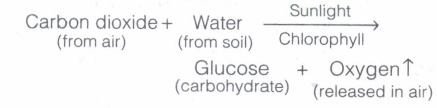
The process by which green plants can prepare their own food is called photosynthesis. Green plants possess chlorophyll in their leaf and utilises carbon dioxide (from air) water, minerals (from soil, through root) as raw material and sunlight as source of energy and convert light energy into chemical energy. The food thus synthesied is in the form of starch (carbohydrate). The overall reaction for photosynthesis can be given as follows:
10.
China rose (gudhal) is an acid-base indicator.
China rose solution in different medium shows following changes:
China rose + acid \(\longrightarrow\) Give dark pink colour, hence A is an acidic solution.
China rose + base \(\longrightarrow\) give green colour, hence B is a basic solution.
China rose + neutral \(\longrightarrow\) No change in colour, hence C is a neutral solution.

7th Standard CBSE Syllabus & Materials
7th Standard CBSE
CBSE 7th Social Science Theme B - New Beginnings : Cities and States - New Sample Question Papers Study Material - QB365 Set A
NEW7th Standard CBSE
CBSE 7th Social Science Theme A - Climates of India - New Sample Question Papers Study Material - QB365 Set A
NEW7th Standard CBSE
CBSE 7th Social Science Theme A - Geographical Diversity of India - New Sample Question Papers Study Material - QB365 Set A
NEW7th Standard CBSE
CBSE 7th Science Earth, Moon and the Sun - New Sample Question Papers Study Material - QB365 Set A



CBSE 7th Standard CBSE Subjects
CBSE Standards




