
 100% FREE ACCESS
7th Standard CBSE Syllabus & Materials
7th Standard CBSE
CBSE 7th Social Science Theme E - Understanding Market - New Sample Question Papers Study Material - QB365 Set A
NEW7th Standard CBSE
CBSE 7th Social Science Theme E - From Barter to Money - New Sample Question Papers Study Material - QB365 Set A
NEW7th Standard CBSE
CBSE 7th Social Science Theme D - The Constitution of India- An Introduction - New Sample Question Papers Study Material - QB365 Set A
NEW7th Standard CBSE
CBSE 7th Social Science Theme D - From the Rulers to the Ruled : Types of Governments - New Sample Question Papers Study Material - QB365 Set A
NEW7th Standard CBSE
CBSE 7th Social Science Theme B - The Age of Reorganisation - New Sample Question Papers Study Material - QB365 Set A
NEW7th Standard CBSE
CBSE 7th Social Science Theme B - The Rise of Empires - New Sample Question Papers Study Material - QB365 Set A

Published on: 22/09/2018
Model Question Paper
Download CBSE Class 7th Standard CBSE Science question papers, sample papers, important questions, and previous year solved papers in PDF format. Get free study materials, NCERT solutions, and exam preparation resources for Class 7th Standard CBSE Science
Questions + Answers key
Take MCQ Science Test
1.
What is rusting? How do we prevent it ?
2.
Observe the given figure and answer the following questions.
(a) Name the plant?
(b) Which type of reproduction is seen in this plant?
(c) Is ginger a root or stem?
(d) Label the part of this plant?
.png)
3.
Name some fruit bearing plants. Now make a table and describe the method of seed dispersal in these fruits as well as the part which helps in the seed dispersal.
4.
Explain the process of reproduction in plants, involving the fusion of cells from male and female parts of a flower.
5.
Observe the given figures as A and Band answer the following questions
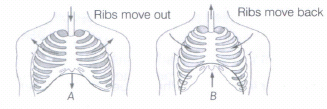
(a) Among both figures identity which A or B indicates the process of inhalation and which shows the process of exhalation?
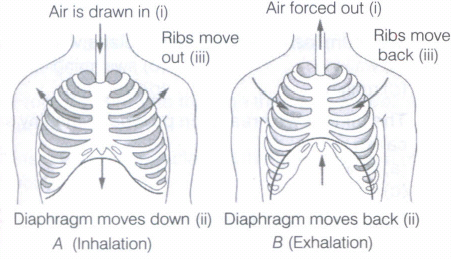
(b) In the figure label the arrows and indicate the direction of
(i) movement of air (ii) movement of diaphragm (iii) movement of ribs
6.
Observe the figures carefully and answer the following questions.
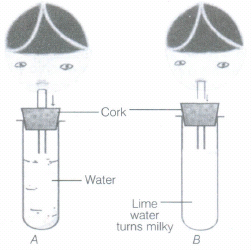
(a) Which process is being tested in the activity?
(b) What is the result of the activity? Give reasons.
7.
If you leave a piece of iron in the open for a few days, it acquires a film of brownish substance, called rust.
(a) Do you think rust is different from iron?
(b) Can you change rust back into iron by some simple method?
(c) Do you think the formation of rust on iron is a chemical change?
(d) Give two other examples of a similar type of change.
8.
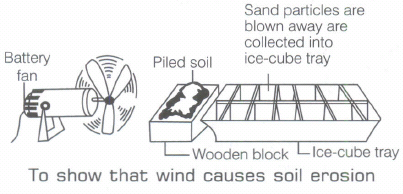
Design an activity to show the soil erosion on a barren land.
9.
In a class, the teacher was explaining a concept from weather and climate chapter. Anand got confused and slowly asked his teacher to repeat again. She smiled and started again. In equatorial belt the climate is hot and wet. It has evergreen rainforest and variety of plants. Similarly the vegetation of tropical region also has variations. The forest located between two tropics is called tropical forest. Desert shows arid region and only xerophytes are observed. These plants show specific modification for their survival in this arid region.
(a) Which type of forest is formed in equatorial region?
(b) What are the variation in vegetation seen in tropical forest?
(c) Give some adaptations of plants that are formed in desert.
(d) Some places conifers are seen. What are these places?
(e) What values do we observe in the teacher and Anand?
10.
Plant
11.
Tornado
12.
Veins
13.
Dissolving common salt in water
14.
Garden soil
15.
We should eat freshly cut apple. Why?
16.
Suggest two methods to prevent rusting.
17.
Name the metals which are mixed (alloyed) with iron to make stainless steel.
18.
Name the metal which is used for galvanising iron.
19.
Name the process by which common salt is obtained from sea water.
20.
What is the nature of magnesium oxide solution?
21.
Complete the following reaction Ca (OH2) + CO2 \(\longrightarrow\)
22.
Is souring of milk a physical change or a chemical change? Why?
23.
How can you say that ripening of a fruit is a chemical change?
24.
What colour of flame is observed when magnesium ribbon burnt in air.
25.
Sonu's mother served a glass of hot milk before going to school. As Sonu was in a hurry he forgot to drink the same. Unfortunately, his mother also had gone out. When they came back home, Sonu noticed the changes arose in the milk, which was no more milk, but set into a thick substance known as curd.
Based on this situation answer the following questions:
(i) What is this process of setting milk into curd known as? Is this a physical/chemical change?
(ii) Is this change harmful?
(iii) How does it happen?
(iv) Which value Sonu exhibit her
26.
A magnesium strip is burnt. The ash obtained is dissolved in water. What kind of changes are these? Write word equations for these.
27.
Whether mixing of ash obtained by burning of magnesium with water is a chemical change or physical change ? Give reason in support of your answer. Express the change in the form of equation.
28.
(a) Why does stainless steel not get rust?
(b) What type of change takes place when sound is produced by radio?
(c) Why do iron pipes coated with zinc do not get rust quickly?
29.
Ice, water and steam have similar chemical properties. In what respect to these differ?
30.
State the difference between physical and chemical changes.
31.
Does the electric current have other effect except heating? Name it.
32.
Boojho made an electromagnet by winding 50 turns of wire over an iron screw. Paheli also made an electromagnet by winding 100 turns over a similar iron screw. Which electromagnet will attract more pins? Give reason.
33.
Distinguish between an open circuit and a closed circuit.
34.
Explain how a battery can be constructed.
35.
If cells are placed side by side. Then, how are the terminals of the cells connected?
36.
Can we use the same fuse in a geyser and a television set? Explain.
37.
Breathing is a process that
(a) provides O2 to the body
(b) breaks down food to release energy
(c) helps the body to get rid of CO2
(d) produces water in the cells
Which of the following gives the correct combination of functions of breathing?
(i)and (ii)
(ii)and (iii)
(i)and (iii)
(ii)and (iv)
38.
Which of the following organism can respire anaerobically?
Amoeba
Yeast
Paramecium
Euglena
39.
The end product of respiration are
CO2 and energy
CO2 and water
CO2 and oxygen
CO2 water and energy
40.
Removal of metabolic waste from body is termed as:
Ingestion
Egestion
Excretion
Elimination
41.
Function of WBCs is/an:
Transport of O2
Fight against germ
Help in clotting of blood
None of these
42.
Which controls blood circulation?
Lungs
Kidney
Heart
Liver
43.
The excretory substance in fishes is :
Urea
Ammonia
Uric acid
None of these
44.
Transport of food in plants takes place through;
Xylem
Phloem
Lenticels
Bark
45.
The colour of blood is red due to the presence of:
Chlorophyll
Haemoglobin
Oxygen
Carbon dioxide
46.
Select a method to prevent rusting:
Sedimentation
Centrifugation
Electroplating
Crystallization
47.
Select a chemical change:
Blooming of a flower
Stretching of a rubber band
Burning of petrol
Condensation of steam
48.
Which one is a chemical change?
Burning of paper
Germination of seed
Formation of coal from wood
All of these
49.
Following figure shows an oscillating pendulum
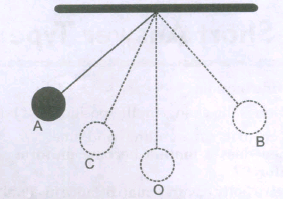
Time taken by the bob to move from A to C is 4 and from C to 0 is t2 The time period of this simple pendulum is :
(t1 + t2)
2(t1+ t2)
3(t1+ t2)
4 (t1+ t2)
50.
The distance moved by the vehicle is measured by
Odometer
Galvanometer
Speedometer
Thermometer
51.
A solar day is
24 h
1440 min
86400 sec
All of these
52.
One millionth second is
Microsecond
Nanosecond
Picosecond
None of these
53.
In a graph, on which axis dependent variable is shown ?
x
y
On any axis
Depends on data
54.
Distance is a
Vector quantity
Scalar quantity
Both (a) and (b)
None of these
55.
Speed is
Distance x time
Distance / time
Distance + time
Distance - time
56.
The motion of pedal of a bicycle is
Circular
Periodic
Straight line
Oscillatory
1.
If we leave a piece of iron in the open for some time, it acquires a coating of brownish substances. This substance is called rust and the process of its formation is called rusting. This is the change that effects iron articles and slowly destroys them. Since iron is used in making bridges, ships, cars, truck bodies and many other articles. The monetary loss due to rusting is huge. For rusting the presence of both oxygen and water (or water vapour) is essential. Infact, if the moisture content in air is high which means if it is more humid, rusting becomes faster.
Methods of preventing rust formation: Rusting of an iron object can be prevented or reduced by not allowing air and moisture to come in contact with the surface of iron objects. Following are the methods of prevention form rusting.
(i) Putting oil or paint over the surface of iron implements.
(ii) Galvanization: In this method, surface of iron is covered with a layer of more active metal like zinc. Zinc metal looses electrons in preference to iron and hence, prevents the rusting of iron.
(iii) By tin-plating
(iv) Use of anti-rust solutions: Alkaline chromate and alkaline phosphate solution act as anti-rust solutions. When iron objects are dipped into a boiling and strongly alkaline solution of sodium phosphate, a protective insoluble film of iron phosphate is formed on them. This film protects the article form rusting.
2.
(a) The given figure is of ginger tuber.
(b) Asexual reproduction is seen in this plant.
(c) Ginger is a stem.
(d) Various parts of this plant can be shown as follows:
.png)
3.
The method of seed dispersal in the fruits and the parts which help in the seed dispersal:
| Name of fruits bearing plants | Agents through which seeds are dispersed | Parts or seeds which helps in dispersal |
| Drumstick | Air/wind | Winged seeds |
| Sunflower | Wind | Hairy seeds |
| Gokhru | Animal | Spines and Hooks |
| Coconut | Water | Fibrous coating |
| Lotus | Water | Thalamus float in water |
| Poppy | Explosion | Pericarp bursts |
| Grass | Wind | minute, light weighted seeds |
4.
When the reproduction in an organism includes two types of gametes, i.e male and female from two different parents, it is called sexual reproduction, The sexual reproduction takes place by the fusion of male and female gametes by the process called fertilisation to form zygote.
.png)
Sexual reproduction (fertilisation) in plants The different steps that take place during sexual reproduction in plants are
(i) The pollens are deposited on stigma and begin to germinate.
(ii) Pollen tube containing male gametes reaches to the ovary of flower.
(iii) The tip of the pollen tubes gets dissolved and male gametes comes out of the pollen tube.
(iv) Inside the ovary male gametes fuse with the female gamete or egg present in the ovule.
(v) The fusion of both the gametes will result into a fertilised egg cell which is also called as zygote.
5.
(a) Figure A indicates inhalation and figure B indicates exhalation.
(b) Movement of air, diaphragm and ribs are indicated in below figure
6.
(a) Exhalation process of respiration is being tested in the activity.
(b) The lime water in test tube B turns milky but water in test tube A remains unchanqed Because CO2 is present in the exhaled air, it mixes with lime water in test tube B and turns it milky.
7.
(a) Yes, rust is iron oxide (Fe2O3). Thus, rust and iron are not the same substance.
(b) No, rusting of iron is a chemical change because in this reaction, a new substance, rust (iron oxide) is formed. It cannot be reversed by any method.
(c) Yes, rusting of iron is a chemical change. During the rusting of iron, it combines with the oxygen in the presence of water (moisture) to form a new compound 'iron oxide'. This iron oxide is a rust.
Iron + Oxygen + Water \(\longrightarrow\) Iron oxide
(From damp air) (Rust)
It is a permanent change which cannot be reversed back. So, rusting of iron is a chemical change.
(d) Two other examples are
(i) Setting of curd from milk.
(ii) Burning of magnesium ribbon to form magnesium oxide.
8.
Strong wind and rain can cause soil erosion from the barren land. This can be shown by performing an activity.
Take a wooden block and place some soil or sand on it. Keep an ice-cube tray at one end of the wooden black. Take a small battery-operated fan or hair dryer and hold it at the other end of the black near sand so that it blows the sand into the tray.
We will observe that when the fan blows it causes sand or soil particles to move and these get land in the various compartment of the ice-cube tray. This activity shows that the wind blows the soil on a barren land and may cause soil erosion.
9.
(a) Evergreen rainforest with the greatest variety of plants are seen in equational region.
(b) In tropical regions, vegetation varies from broad leaves evergreen trees to tropical deciduous trees to grassland.
(c) The plants in the arid of desert regions have modified leaves covered with hair or waxy coating and an extensive root system.
(d) Conifers are maintained and adapted to withst and snow fall and shortage ofwater in colder belt.
(e) Anand is observant and sincere boy. He is not afraid to ask question in the class.
10.
()
Stomata,lenticels and roots
11.
()
Dark funnel shaped cloud
12.
()
Deoxygenated blood
13.
()
Physical change
14.
()
Living organisms are ant and insects
15.
We should eat freshly cut apple because if we leave the apple after cutting, it starts turn to brownish due to the oxidation of the essential nutrients present in it and its food value decreases.
16.
The two methods to prevent rusting are
(i) Painting the iron articles.
(ii) Greasing or oiling the iron articles.
17.
Metals like chromium and nickel are mixed (alloyed) with iron to make stainless steel.
18.
Zinc metal is used for galvanising iron.
19.
The common salt can be obtained by the evaporation of sea water.
20.
Magnesium oxide is basic in nature because it turns red litmus solution to blue.
21.
Ca (OH2) + CO2 \(\longrightarrow\) CaCO3 + H2O
Calcium hydroxide Carbon dioxide Calcium carbonate Water
22.
Souring of milk is a chemical change because original substances present in milk lose their nature and identity and form new chemical substances.
23.
Ripening of a fruit is a chemical change because after ripening, a new product with different properties is formed.
24.
When magnesium is burnt in the air then a brilliant white flame is obtained.
25.
(i) Curdling of milk, chemical change.
(ii) This change is done by Lactobacillus bacteria and it is beneficial/useful for us.
(iii) By converting lactose sugar into lactic acid.
(iv) Irresponsibility, carelessness
26.
These are chemical changes :
Magnesium + Oxygen⟶ Magnesium oxide
Magnesium oxide + Water ⟶ Magnesium hydroxide
27.
Dissolving of the ash in water is a chemical change.
Reason: When magnesium is burnt in air, it forms magnesium oxide in the form of white ash.
Mg + O2 ⟶ MgO (magnesium oxide)
28.
(a) Stainless steel is an alloy of iron mixed with certain corrosion resistant non-metal.
(b) It is a physical change.
(c)The coating of zinc protects iron pipes from the effects of air and moisture and thus does not r
29.
Differences between ice, water and steam:
| Ice | Water | Steam |
|---|---|---|
| 1.Incompressible. | Can be compressed to some extent | Highly |
| 2.Does not flow | Flows from higher level to lower level | Flow in all directions. |
| 3. Has definite shape and volume. | Has a definite volume but no definite shape. | Has neither definite shape nor a definite volume |
| 4. Solid state | Liquid state | Gaseous state |
30.
Difference between physical and chemical changes.
| Chemical changes | Physical changes |
|---|---|
| 1. It is irreversible. | It is mostly reversible |
| 2. The composition of substances changes | No change in the composition of the substance |
| 3. It is a permanent change. | Change in temporary. |
| 4. A new substance is formed. | No new substance is formed. |
31.
Yes, electric current have other effect except heating, i.e. magnetic effect of current.
When electric current is passed through a coil, there is a magnetic field developed around the coil or wire, if magnetic compass is placed near by, it deflects the magnetic needle.
32.
Since the magnetic effect directly depends on the number of turns of the coil. As, Paheli's coil has more number of turns than Boojho. So, her electromagnet is stronger than Boojho.
So, electromagnet of Paheli attracts more pins as compared to Boojho.
33.
Difference between an open circuit and a closed circuit
| Open (Electric) circuit | Closed (Electric) circuit |
| An open electric circuit is or electric path which begins from the positive terminal of a battery or cell, gets broken at some point. | A closed circuit is an electric path which begins from the positive terminal of a cell or battery and terminates at its negative terminal without any break. |
34.
As we know that a battery is a combination of two or more cells and it can be constructed by placing cells property on cell holder in such a way that the positive terminal of one cell is connected to the negative terminal of other.
A piece of wire is connected to each of the two metal clips on the cells holder.
35.
If cells are placed side by side, then with the help of some connecting wires, the positive terminal of one cell is connected to the negative terminal of other to produce a combined power of all cells which can be called a battery.
36.
No, we cannot use same fuse in a geyser and in a television set because the fuse used in every appliances has some limit to withstand the current flows through it. So, different appliances have different fuses.
37.
(c)
(i)and (iii)
38.
(b)
Yeast
39.
(d)
CO2 water and energy
40.
(c)
Excretion
41.
(b)
Fight against germ
42.
(c)
Heart
43.
(b)
Ammonia
44.
(b)
Phloem
45.
(b)
Haemoglobin
46.
(c)
Electroplating
47.
(c)
Burning of petrol
48.
(d)
All of these
49.
(d)
4 (t1+ t2)
50.
(a)
Odometer
51.
(d)
All of these
52.
(a)
Microsecond
53.
(b)
y
54.
(b)
Scalar quantity
55.
(b)
Distance / time
56.
(a)
Circular

7th Standard CBSE Syllabus & Materials
7th Standard CBSE
CBSE 7th Social Science Theme B - New Beginnings : Cities and States - New Sample Question Papers Study Material - QB365 Set A
NEW7th Standard CBSE
CBSE 7th Social Science Theme A - Climates of India - New Sample Question Papers Study Material - QB365 Set A
NEW7th Standard CBSE
CBSE 7th Social Science Theme A - Geographical Diversity of India - New Sample Question Papers Study Material - QB365 Set A
NEW7th Standard CBSE
CBSE 7th Science Earth, Moon and the Sun - New Sample Question Papers Study Material - QB365 Set A



CBSE 7th Standard CBSE Subjects
CBSE Standards




