
 100% FREE ACCESS
7th Standard CBSE Syllabus & Materials
7th Standard CBSE
CBSE 7th Social Science Theme E - Understanding Market - New Sample Question Papers Study Material - QB365 Set A
NEW7th Standard CBSE
CBSE 7th Social Science Theme E - From Barter to Money - New Sample Question Papers Study Material - QB365 Set A
NEW7th Standard CBSE
CBSE 7th Social Science Theme D - The Constitution of India- An Introduction - New Sample Question Papers Study Material - QB365 Set A
NEW7th Standard CBSE
CBSE 7th Social Science Theme D - From the Rulers to the Ruled : Types of Governments - New Sample Question Papers Study Material - QB365 Set A
NEW7th Standard CBSE
CBSE 7th Social Science Theme B - The Age of Reorganisation - New Sample Question Papers Study Material - QB365 Set A
NEW7th Standard CBSE
CBSE 7th Social Science Theme B - The Rise of Empires - New Sample Question Papers Study Material - QB365 Set A

Published on: 21/11/2019
Nutrition in Plants
Download CBSE Class 7th Standard CBSE Science question papers, sample papers, important questions, and previous year solved papers in PDF format. Get free study materials, NCERT solutions, and exam preparation resources for Class 7th Standard CBSE Science
Questions + Answers key
Take MCQ Science Test
1.
2. (a) Draw a diagram of a pitcher plant to show the following parts:
(i) Pitcher
(ii) Lid
(b) What is the mode of nutrition of this plant?
(c) Is it an autotroph or partial heterotroph?
2.
If plant has a requirement for nitrogen, then from where will they obtain it?
3.
In what unique manner does a pitcher plant derive its nutrition?
4.
Wheat dough if left in the open, after a few days, starts to emit a foul smell and becomes unfit for use. Give reason.
5.
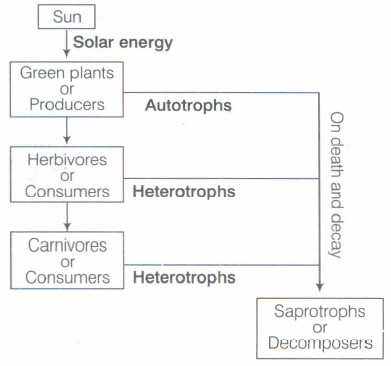
Show with the help of a sketch that the plants are the ultimate source of food.
6.
Photosynthesis along with other raw materials like ................
7.
This energy is used in process of .............
8.
The openings present on the surface of leaves are protected by cells called _____________
9.
__________________ plants derive their nutrient from dead and decaying animals or plants.
10.
The food synthesised by the plants is stored as ________________
11.
Tiny pores present on the surface of the leaves are called ..................
12.
............ is produced and ..............is utilised during photosynthesis.
13.
Name the following the pores through which leaves exchange gases.
14.
Name the following a plant that has both autotrophic and heterotrophic mode of nutrition.
15.
Name the following a parasitic plant with yellow, slender and tubular stem.
16.
Why is it true to say that insectivorous plants are partial heterotrophs? Explain
17.
How to Rhizobium bacteria take nitrogen from atmosphere?
18.
A goat eats away all the leaves of a small plant (balsam). However, in a few days, new leaves could be seen sprouting in the plant again. How did the plant survive without leaves?
19.
A carbohydrate is produced by plants as food source. It is constituted from which molecules?
20.
Which parts of the plant are called food factories of the plant?
21.
(a) Draw a schematic diagram showing photosynthesis.
(b) What are the products of photosynthesis?
(c) Name the gases utilized and liberated in photosynthesis.
(d) Can all plants do photosynthesis?
22.
Wild animals like tiger, wolf, lion and leopard do not eat plants. Does this mean that they can survive without plants? Can you provide a suitable explanation?
23.
Algae is:
Parasite
Saprotroph
Autotroph
None of these
24.
If iodine is dropped on the boiled leaf it gives blue-black colour due to the presence of
starch
protein
fat
vitamin
25.
In the plant of cactus leaves are modified into
branches
spines
leaf vein
pitcher
26.
The raw material used by plants during photosynthesis
N2 and O2
O2, H2, CO2
CO2 and water
water and minerals
27.
In the process of photosynthesis, which of the following energy conversions occur?
Solar energy is changed into chemical energy
Solar energy is changed into mechanical energy.
Bioenergy is converted into chemical energy
Chemical energy is changed into light energy.
1.
(a)
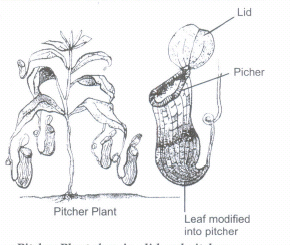
Fig. : Pitcher Plant showing lid and pitcher
(b) Autotrophic and Heterotrophic both.
(c) Partial heterotroph.
2.
Soil contains nitrogen in the form that is not usable by plants. Bacteria like Rhizobium converts nitrogen into soluble form that can be easily used Q. by plants. So, if plant has a requirement for nitrogen, then it will obtain that which the help of bacteria.
3.
Nepenthes or pitcher plant modifies its leaf axis into a long tubular pitcher to form a pitfall trap. Inside the pitcher sticky liquid is present. When any insect comes in contact with the leaf, the lid present on it is closed and insect is trapped. The liquid contains digestive enzymes which slowly digest the trapped insects.
4.
Carbohydrates in wheat dough encourage the growth of yeast and other saprophytic fungi which breakdown carbohydrates into simpler compounds like CO2 and alcohol and emit a foul smell.
5.
The following sketch shows that the plants are the ultimate source of food.
6.
()
Carbon dioxide
7.
()
photosynthesis
8.
()
guard cells
9.
()
Saprophytic
10.
()
starch
11.
()
Stomata
12.
()
Oxygen, carbon dioxide
13.
()
Stomata
14.
()
Pitcher plant (insectivorous plant)
15.
()
Cuscuta (amarbel)
16.
Insectivorous plants are green and can do photosynthesis so they are called autotrophs. But they also can trap insects and digest them. Due to this, they are called partial heterotrophs.
17.
Rhizobium bacteria can take nitrogen from atmosphere and convert it into a soluble form which is used by that plant in which bacteria live.
18.
The plant of balsam survived on the food stored in the stem and roots.
19.
Carbohydrates are composed of carbon, hydrogen and oxygen.
20.
Leaves are referred to as food factories of plants. This is because, leaves synthesise food by the process of photosynthesies.
21.
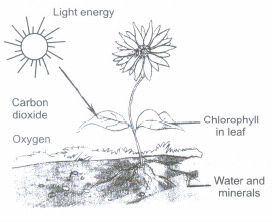
(b) Carbohydrates and oxygen.
(c) Liberated-oxygen, Utilised-carbon dioxide.
(d) All plants cannot do photosynthesis, only green plants can do photosynthesis.
22.
Animals like tiger, wolf, lion and leopard are carnivores and do not eat plants. They hunt and eat herbivorous animals like deer, gaur, bison, zebra, giraffe, etc., which are dependent on plants for food.
If there are no plants, herbivorous animals will not survive and ultimately animals like tiger, wolf, lion and leopard will have nothing to eat.
23.
(c)
Autotroph
24.
(a)
starch
25.
(b)
spines
26.
(c)
CO2 and water
27.
(a)
Solar energy is changed into chemical energy

7th Standard CBSE Syllabus & Materials
7th Standard CBSE
CBSE 7th Social Science Theme B - New Beginnings : Cities and States - New Sample Question Papers Study Material - QB365 Set A
NEW7th Standard CBSE
CBSE 7th Social Science Theme A - Climates of India - New Sample Question Papers Study Material - QB365 Set A
NEW7th Standard CBSE
CBSE 7th Social Science Theme A - Geographical Diversity of India - New Sample Question Papers Study Material - QB365 Set A
NEW7th Standard CBSE
CBSE 7th Science Earth, Moon and the Sun - New Sample Question Papers Study Material - QB365 Set A



CBSE 7th Standard CBSE Subjects
CBSE Standards




