
 100% FREE ACCESS
7th Standard CBSE Syllabus & Materials
7th Standard CBSE
CBSE 7th Social Science Theme E - Understanding Market - New Sample Question Papers Study Material - QB365 Set A
NEW7th Standard CBSE
CBSE 7th Social Science Theme E - From Barter to Money - New Sample Question Papers Study Material - QB365 Set A
NEW7th Standard CBSE
CBSE 7th Social Science Theme D - The Constitution of India- An Introduction - New Sample Question Papers Study Material - QB365 Set A
NEW7th Standard CBSE
CBSE 7th Social Science Theme D - From the Rulers to the Ruled : Types of Governments - New Sample Question Papers Study Material - QB365 Set A
NEW7th Standard CBSE
CBSE 7th Social Science Theme B - The Age of Reorganisation - New Sample Question Papers Study Material - QB365 Set A
NEW7th Standard CBSE
CBSE 7th Social Science Theme B - The Rise of Empires - New Sample Question Papers Study Material - QB365 Set A

Published on: 06/03/2020
7th Standard CBSE Science Public Exam Sample Question 2020
Download CBSE Class 7th Standard CBSE Science question papers, sample papers, important questions, and previous year solved papers in PDF format. Get free study materials, NCERT solutions, and exam preparation resources for Class 7th Standard CBSE Science
Questions + Answers key
Take MCQ Science Test
1.
The full form of WWTP is:
Water trickling from a damaged tap
Water coming out of a shower
Water flowing in a river
Water coming out of a laundry
2.
The device used for measuring current is
Compass
Ammeter
Voltmeter
Potentiometer
3.
Plants needs water for:
Transport of nutrients
Transpiration
Respiration
Colouration
4.
Pick the odd one out of the following:
Monsoon
Typhoon
Hurricane
Cyclone
5.
Which of the following is a chemical change?
Burning of food
Cooking of food
Germination of seed
All of these
6.
The rearing of silkworms for getting silk is called:
Cocoon
Silk
Sericulture
Silviculture
7.
Common salt is
Acidic
Basic
Neutral
None of these
8.
Figure (a, b, c, d) shows the reading of four different thermometers. Indicate which of the reading shows the normal human body temperature?




9.
An image formed by a lens is erect. Such an image could be formed by
convex lens provided the image is smaller than object
concave lens provided the image is smaller than object
concave lens provided the image is larger than object
concave lens provided the image is of the same size
10.
Mature ovary forms the
seed
stamen
pistil
fruit
11.
Plants do not depend on animals for
pollination
food
seed dispersal
nutrients
12.
The mountaineers carry oxygen with them because
at an altitude of more than 5 km, there is no air
the amount of air available to a person is less than that available on the ground
the temperature of air is higher than that on the ground
the pressure of air is higher than that on the ground
13.
They are pipe-like consisting of a group of specialised cells. They transport substances and form a two-way traffic in plants. Which of the following terms qualifies for the features mentioned above?
Xylem tissue
Vascular tissue
Root hairs
Phloem tissue
14.
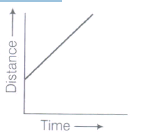
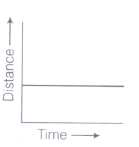
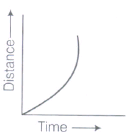
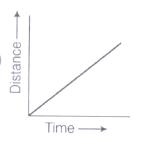
Which of the following distance-time graphs shows a truck moving with speed which is not constant?
15.
Humus helps in making soil
thick
hard
porous
dead
16.
Cud is the name given to the food of ruminants which is
swallowed and undigested
swallowed and partially digested
properly chewed and partially digested
properly chewed and completely digested
17.
Which features adapt polar bears to live in extremely cold climate?
A white fur, fat below skin, keen sense of smell.
Thin skin, large eyes, a white fur.
A long tail, strong claws, white large paws
White body, paws for swimming, gills for respiration.
18.
Amarbel is an example of
autotroph
parasite
saprotroph
host
19.
Does your body receive sufficient oxygen?
20.
Why are earthworms called a farmer's friend?
21.
What precautions you would take to provide protection against lightning?
22.
What is underground water? How is it obtained?
23.
What happens when a new substance is formed in a chemical reaction?
24.
How are silk fibres of different texture prepared?
25.
Which indicator is generally used to observe neutralization reaction?
26.
The nails attract the pins.Comment.
27.
While constructing a house in a coastal area, in which direction should the windows preferably face and why?
28.
Fungus, moss and fern reproduce by a common method of asexual reproduction. Name the method.
29.
Mention the role of effluent treatment plants in cities.
30.
Briefly mention how many types of lens are there Explain each of them
31.
State the condition under which the distance-time graph of an object is a horizontal line parallel to the axis of time.
32.
Paheli wrote a food chain in the following way: Frog ⟶ Eagle ⟶ Insects ⟶ Grass ⟶ Snake. The chain is not in the correct order. Help her to write the food chain correctly.
33.
Usually, veins carry deoxygenated blood except in one case. Specify.
34.
In a plant, photosynthesis occurs in a part other than leaf. Name that plant and the part where photosynthesis occurs.
35.
Suggest the organ of digestive system where the digestive juices from liver and pancreas is poured.
36.
In North-Eastern regions of India, which type of climate is found?
37.
Given below is a square of letters in which are hidden different words related to respiration in organisms. These words may be present in any direction upwards, downwards or along the diagonal structures surrounding chest cavity
(iii) Muscular floor of chest cavity
(iv) Tiny pores on the surface of leaf
(v) Small openings on the sides of the body of an insect
(vi) The respiratory organs of human beings
(vii) The openings through which we inhale
(viii) An anaerobic organism
(ix) An organism with tracheal system
38.
Why sheared skin with hair is thoroughly washed in tanks? What is this process called?
39.
Distinguish between the following:
(i) Acid and alkali
(ii) Base and alkali
(iii) Organic acid and mineral acid.
40.
A number of problems can be faced due to shortage of water. List some of them.
41.
Electromagnets are better than permanent magnets. Explain why.
42.
Observe the given figure?
(a) Which plant is this? Give the name of the plant.
(b) What does it shows?
(c) From where the new plants are developing?
.png)
43.
In places of hot climate, it is advised that the outer walls of houses be painted white.
Explain.
44.
Given below is a jumbled sequence of the processes involved in a wastewater treatment plant.
Arrange them in their correct sequence.
(a) Sludge is scraped out and skimmer removes floating grease.
(b) Water is made to settle in a large tank with a slope in the middle.
(c) Large objects like plastic bags are removed by passing wastewater through bar screens.
(d) Sand, grit and pebbles are made to settle by decreasing the speed of incoming wastewater.
(e) Wastewater enters a grit and sand removal tank.
45.
Differentiate between a plane mirror, concave mirror and a convex mirror without touching them.
46.
The average age of children of class VII is 12 years and 3 months. Express this age in second.
47.
Give two examples for each of the following cases:
(a) Physical changes which are reversible.
(b) Physical changes which are not reversible.
(c) Chemical changes
48.
Describe the following terms briefly.
Polar winds
49.
Make a table depicting the function of all chambers of the human heart.
50.
Explain how animals dwelling in the forest help it to grow and regenerate.
51.
Some plants have deep red, violet or brown coloured leaves. Can these leaves perform the photosynthesis process?
52.
Name the various components of food and their simpler forms.
53.
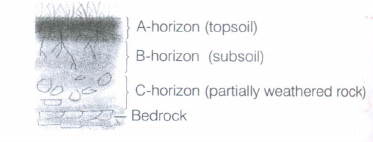
Sketch the cross-section of soil and label the various layers.
54.
Write the factors which affect the climate of a particular place.
55.
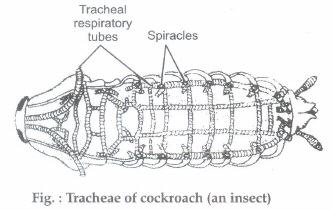
Explain the respirating system in cockroach
56.
While cooking food Mrs. Goenka needed help of her daughter Simrni, to chop vegetables. Surprisingly, Simmi, a student of VIIth standard observed that some of the potatoes started to sprout from their notched areas. Obviously a few questions arose in her mind.
Answer those questions on behalf of Simmi.
(i) How does the new potato plant sprout from 'potato' itself without seed formation? Also name the method.
(ii) Are there any other plants which reproduce in the same way?
(iii) Is there any advantage of this process?
(iv) Which value is shown by Simmi?
57.
Describe various house-keeping practices for efficient working of sewage system.
58.
What is an electromagnet? Write its uses.
59.
While watching news channel on television, Ajay comes to know about the water scarcity which goes on in some of the areas of West India. In the clippings on news he sees that women and even children are engaged in fetching water from distant wells/ponds which are also not a good state. He feels unhappy and next day asked the following questions to his a science teacher.
Answer the questions pretending that you are science teacher.
(i) Is true that we are facing the actual shortage of water?
(ii) What might be 'the causes and remedies of this water scarcity?
(iii) If the children are engaged in carrying water, when do they manage to go to school to study?
60.
Explain how cyclones can cause tremendous loss of life and property?
61.
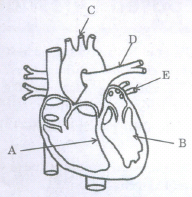
Label five parts (A to E) of heart and state their functions.
62.
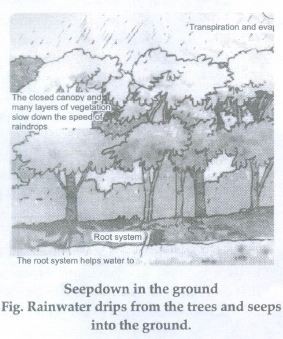
Explain how the forest act a natural absorber of rain water.
63.
Aman made a graph to show the relationship between the speed of a car and time
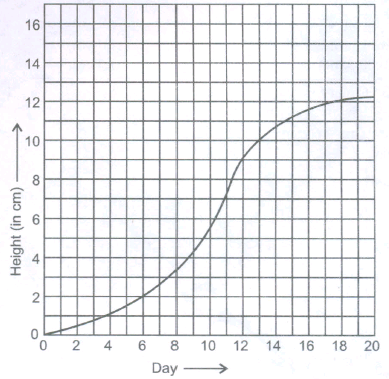
Look at the graph and answer the following questions:
(i) What has Aman shown on each axis?
(ii) What is the scale of the graph?
(iii) What is the speed of the car at 3.30 minutes?
(iv) What distance is covered by the car in 4 minutes?
(v) At what time the car has assumed constant speed?
64.
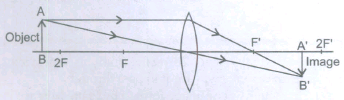
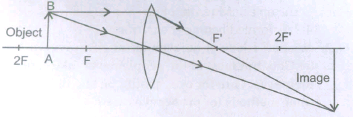
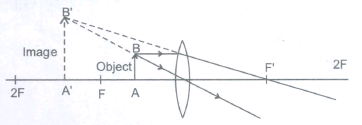
Draw the ray diagram formed by a convex lens under three different positions of the object.
65.
Explain the reason for the following statement, "When heat is applied at the bottom of the water vessel, then it gets heated more quickly than when it is heated at the top."
66.
Paheli went to the market to buy sarees for her mother. She took out a thread from the edge of the two sarees shown by the shopkeeper and burnt them. One thread burnt with a smell of burning hair and the other burnt with the smell of burning paper. Which thread is from a pure cotton saree and which one from a pure silk saree? Give reason for your answer.
67.
Give an example of a chemical reaction for each of the following situations:
(a) A change in colour is observed.
(b) A gas is evolved.
(c) Sound is produced.
68.
(a) Soil has various important component. Write them.
(b) Arrange the following rock particles which occur in soil in the increasing order. Silt, clay, gravel, sand.
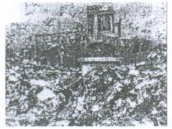
(c) Observe the following figure. What does this figure show?
69.
Little Rishi (student of class VI) was watching his favourite cartoon serial on television. Suddenly he got hiccups. His elder brother Shubham who was sitting near by him gave him a glass of water and suggested not to eat too fast in a hurry. Little Rishi got confused as he had heard that 'hicki' comes when someone remembers. He asked his father. His father smiled and explained him that it is only a myth. He also explained him the proper scientific reason behind it.
(a) What is hiccup?
(b) Why do we get hiccup?
(c) What are the values shown by Rishi?
70.
Describe the process by which plants prepare their food using different raw materials.
71.
You are provided with three test tubes A, B and C as shown in the figure with different liquids.
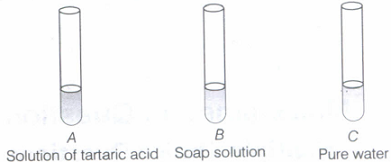
What will you observe when you put
(a) a piece of blue litmus paper in each test tube?
(b) a piece of red litmus paper in each test tube?
(c) a few drops of phenolphthalein solution to each test tube?
72.
Rohan went to the desert of Rajasthan with his freinds. He saw an animal. It had a hump. Its feet had large soles. He wondered about this animal. He found that these were adaptations of that animal which helped it to survive in very hot and dry climate of the desert. Answer the following questions on the basis of the observations seen by Rohan.
(a) Name the animal Rohan observed in the desert of Rajasthan?
(b) What role does this hump has in this animal?
(c) Why do it has large soles?
(d) Can you give same more adaptations of this animal which help it to survive in desert?
(e) What values do you observe in Rohan?
1.
(d)
Water coming out of a laundry
2.
(b)
Ammeter
3.
(a)
Transport of nutrients
4.
(a)
Monsoon
5.
(d)
All of these
6.
(c)
Sericulture
7.
(c)
Neutral
8.
As we know that normal body temperature is 370C.
9.
(b)
concave lens provided the image is smaller than object
10.
Mature ovary forms the fruit.
11.
(b)
food
12.
(b)
the amount of air available to a person is less than that available on the ground
13.
(d)
Phloem tissue
14.
(c)
15.
(a)
thick
16.
(b)
swallowed and partially digested
17.
(a)
A white fur, fat below skin, keen sense of smell.
18.
(b)
parasite
19.
No. Our body does not get enough oxygen in such cases.
20.
Earthworms are called a farmer's friend because earthworms till the land by moving in soil when the land is watered.
21.
(i) Lightning conductor should be installed on large buildings. When lightning strikes, it provides a path to the charge to pass through it.
(ii) We should be stand under a tree because lightning can set the tree on fire.
(iii) We should confine ourselves indoors.
22.
The water found deep below the earth between particles of soil and the gaps between the rocks is called underground water. It gets filtered through many layers of sand, rock and soil. It contains dissolved salts but is free from suspended impurities. It can be obtained from wells, tube wells and hand pumps.
23.
When a new substance is formed in a chemical reaction, heat, light is produced or used up. The chemical properties of the reaction mixture becomes different from the reactions.
24.
The silk yarn is obtained form the cocoon of the silk moth. There is a variety of silk moths which look very different from one another and the silk yarn they yield is different in texture like coarse, smooth and shiny etc. Thus tassar silk, mooga silk and kosa silk are obtained from cocoons spun by different types of moths. The common silk moth is the mulberry silk moth. The cocoon of this moth yield soft, lustrous and elastic silk fibre.
25.
Phenolphthalein indicator is generally used in neutralization reaction.
26.
When the current is passed through the wire wound on the nail, it behave as electromagnet. Due to this reason, the nails attract the pins.
27.
Window should preferably towards the sea beach so that the sea breeze coming from sea keeps the house cool during the day time.
28.
Fungus, moss and fern reproduce by the common method of spore formation which is a type of asexual reproduction.
29.
The effluent treatment plants filter out undissolved materials form water.
30.
There are two types of lenses.
The lens which is thinner in the middle than at the edges is called a concave lens while the lens which is thicker in the middle than at the edges is called a convex lens
31.
When the object is at rest, then the distance-time graph of an object is a horizontal line parallel to the axis of time.
32.
Grass ⟶ Insects ⟶ Frog ⟶ Eagle
33.
Pulmonary veins carry oxygenated blood from lungs to heart.
34.
Cactus, the part where photosynthesis occurs are stem and branches which are green.
35.
The digestive juices from liver and pancreas is poured into small intestine which helps in complete digestion and absorption of food.
36.
In North-Eastern regions, wet climate is found because it receives rain for major part of the year.
37.
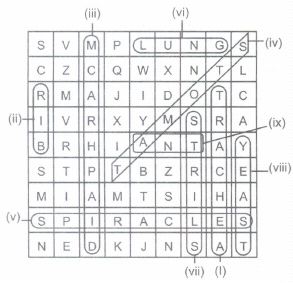
38.
The wool obtained after shearing contains a substance called yalk which consists of complex chemical lanolin. In addition to it, the same wool contains suint, which is dried perspiration of sheep. These are removed by washing with soap-alkali preparation or some suitable detergent in tanks. This process is called scouring.
39.
(i) An acid is the compound formed by the reaction of acidic oxide with water. e.g., HCl, whereas alkali is the hydroxide of metals dissolved in water. e.g., KOH.
(ii) A base is a substance containing hydroxide group. e.g., NH4OH, whereas alkali is the base which is soluble in water. e.g.,NaOH.
(iii) Organic acid is a weak acid derived from plants or animals. e.g., acetic acid. Mineral acid is a strong acid derived from earth minerals. e.g., HCl.
40.
The number of problems that can be faced due to shortage of water are as follows
(i) Less amount of pure drinking water will be available.
(ii) Lack of equal distribution of water.
(iii) Drought.
41.
An electromagnet can be switched OFF or switched ON as desired and this is not possible in the permanent magnets. That is why the electromagnets are better than the permanent magnets.
42.
(a) The given figure is of Bryophyllum leaf. It is also called as sprout leaf plant.
(b) It shows vegetative reproduction by leaves.
(c) The leaves of Bryophyllum develops some buds in its margin or edges which grow into new plants when buried in the soil.
43.
In places of hot climate, it is advised that the outer walls of houses be painted white because white colour does not absorb any heat radiation from ·the sun which keep inside cool even if there is hot climate outside the house.
44.
The correct sequence of wastewater treatment in treatment plant is
(c) Large objects like plastic bags are removed by passing wastewater through bar screens.
(e) Wastewater enters a grit and sand removal tank.
(d) Sand, grit and pebbles are made to settle by decreasing the speed of incoming wastewater.
(b) Water is made to settle in a large tank with a slope in the middle.
(a) Sludge is scraped out and skimmer removes the floating grease.
45.
These mirrors can be differentiated by bringing our face close to each mirror turn by turn. Since, a plane mirror will produce an image of the same size as our face while a concave mirror will produce a magnified image and our face will look much bigger and on other sides, a convex mirror will produce a diminished image and our face will look much smaller like a small child.
46.
Given, the average age of children 12 years and 3 months
1 year = 365 days = 365 \(\times\) 24 h [ 1 day = 24 h ]
= 365 \(\times\) 24 \(\times\) 3600 s [ 1 h = 36000 s]
12 years = 31536000 s \(\times\)12 = 378432000 s
3 months = 30 \(\times\) 3 days = 30 \(\times\) 3 \(\times\) 24 h = 30 \(\times\) 3 \(\times\) 24 \(\times\) 3600s = 7776000s
So, total age in second = 378432000 + 7776000 = 386208000s
47.
(a) (i) Folding of paper
(ii) Melting of ice
(b) (i) Tearing of paper
(ii) Breaking of glass
(c) (i) Reaction between vinegar and baking soda.
(ii) Burning of a matchstick.
48.
The set of wind blowing from the cold polar regions towards 60° Nand 60° S latitudes are called polar winds.
49.
The human heart is divided into four chambers, i.e. upper two atrium and lower two ventricles. The functions of these chambers can be tabulated as follows
| Chamber | Function |
| Left atrium | Receives oxygenated blood from lungs through pulmonary veins and pours it into left ventricle. |
| Right atrium | Receives deoxygenated blood from various body parts through superior and inferior vena cava and pours it into right ventricle. |
| Left ventricle | Pumps oxygenated blood to various parts of body through aorta. |
| Right ventricle | Pumps deoxygenated blood into lungs through pulmonary artery |
50.
The animals in forests are of various types. These could be herbivores, carnivores, microorganisms, etc. These play an important role in maintaining the food chains.
(i) Microorganisms convert the dead plants and animals into humus. This humus helps in returning the nutrients back to the soil. These are absorbed by plants.
(ii) The animals also help in dispersing the seeds of certain plants.
(iii) The decaying animal dung provides nutrients.
All these activities of animals dwelling in the forest help it to grow and regenerate.
51.
Yes, plants having deep red, violet or brown coloured leaves can also carry out photosynthesis because they contain chlorophyll. But their green o colour of chlorophyll is masked by the large amount of all other coloured pigments.
52.
The various components of food and their simpler forms are
| Components of food | Simpler form |
| Carbohydrate | Glucose |
| Fats | Fatty acids and glycerol |
| Proteins | Amino acids |
| Vitamins | Vitamins |
| Minerals and water | Minerals and water |
53.
Labelled sketch of the cross-section of soil is
54.
The factors that affect the climate of a place are
(i) Temperature zone or latitude, i.e. amount of sunshine it receives or distance from equator.
(ii) Distance from sea.
(iii) Altitude or height above the sea level.
(iv) Humidity or the presence of moisture in air.
(v) Amount of precipitation received or rainfall.
55.
A cockroach has small opening on the side of its body. These openings are called spiracles. Insects have a network or air tubes called tracheae for gas exchange, oxygen rich air rushes through spiracles into the tracheal tubes, diffuses into the body tissues and reaches every cell of the body. Similarly carbon dioxide from the cells goes into the tracheal tubes and moves out through spiracles. These air tubes or tracheae are found only in insects
56.
(i) This is a method known as asexual reproduction in which new plants may appear from older parts like stem, root, leaf etc. without seed formation. This is called as vegetative propagation.
(ii) Ginger, garlic, bryophyllum, banana etc.
(iii) (a) It takes less time to grow and bear flowers and fruits.
(b) New plants are exact copy of the parent plant.
(iv) Helping attitude towards her mother, curiosity to know scientific fact.
57.
(i) Left overfood contains lot of oil and fat, it should not be thrown down the drain. They choke the pipe when they become harden. These waste when thrown in open drains block the oil pores thereby decreasing its effectiveness to filter water. Such wastes should be thrown in dustbin only.
(ii) Solid wastes such as used tea leaves, plastic bags, soft toys, cotton and sanitary towels should not be thrown in drains. Such wastes block the drain. They reduce free flow of oxygen and thus slow down the process of degradation.
(iii) Chemical products like medicines, motor oil, paint, machine oil and insecticide should also be not thrown down the drain. These substances kill water purifying organisms and hamper degradation.
58.
When current is passed through a coil of wire then the coil behaves like a magnet. One end of coil acts as north pole and other end acts as south pole When the electric current is swithed off, the coil generally loses its magnetism. Such coils are called electromagnets. The electromagnets are very strong and their power can be increased so they are very important.
Two important applications (uses)of electromagnets are:
(i)They are used in electric bells, telegraphs telephones and speakers etc
(ii) They are used in cranes to lift heavy loads of scrap iron or iron sheets
59.
(i) Actually, millions of people in our country do not get enough water. Especially during summer, in many areas there is an acute shortage of water, taps running dry, long queues for water and even fight for demand of water in a common sight.
(ii) Causes: Due to less amount of rainfall in some areas, not only water bodies like ponds, rivers become dry also due to excess extraction of ground water, water table goes down.
Remedies: Public and government both should be concern and show awareness towards this crisis. By drip irrigation system and water harvesting technique, we cannot only save water from wastage but also recharge ground water.
(iii) In these areas of hot dry and arid climate the studies of children are badly affected.
60.
Cyclones can be very destructive as they travel over seas at 15-30 km/h and the strong winds push water towards the shore even when the storm is hundreds of kilometres away. This is actually the first indication of an approaching cyclone. The central low pressure area lifts the water surface in the centre to a height of 3 - 12 metres and it appears like a water wall moving towards the shore. As a result seawater enters and floods the low lying coastal areas causing loss of life and property. This reduces the fertility of the soils also. Since cyclones are accompanied by heavy rainfall, it further worsens the flood situation. In addition, the communication system, livestock, trees, buildings, bridges and many other man-made structures are also damaged by high speed wind.
61.
A-Septum between right and left side of heart. It prevents mixing of oxygenated and deoxygenated blood.
B-Left ventricle,which pumps oxygenated blood to body parts.
C-Aorta is the main artery emerging from left ventricle. It gives rise to other arteries which carry blood to different body parts.
D-Left auricles, which receives oxygenated blood from lungs and pushes it into left ventricle.
E-Pulmonary vein brings oxygenated blood from lungs to left auricle.
62.
The forest acts as a natural absorber of rain water and allows it to seep. It helps to maintain the water table throughout the year. Forests not only helps in controlling floods but also help to maintain the flow of water in the streams so that we get a steady supply of water. On the other hand, if trees are not present rain hits the ground directly and may flood the area around it. Heavy rain may also damage the soil. Roots of trees normally bind the soil together, but in their absence the soil is washed away or eroded.
63.
(i) Time in minutes on x-axis and speed in m/min on y-axis.
(ii) On x-axis, 10 divisions = 1 min and on y-axis 10 divisions = 25 m/min
(iii) At 3.30 minutes, the speed of car is 30 m/min.
(iv) Distance at 4 min = Speed x Time = 52.5 x 4 = 210.0 m
(v) After 6.30 minutes the car has assumed constant speed.
64.
(a) When the object is far away the image is real, inverted and smaller in size.
(b) When the object is between F and radius lens, the image is real, inverted but bigger in size.
(c) When the object is near to the lens. The image is real, inverted and much bigger (magnified).
65.
The particles of water become more lighter and rise up in the middle. Due to this, the cold particles of water which are heavier come down along the sides of the vessel. So, the convection currents of heat are setup and water becomes hot. The moment, when the heat is applied at the top, then the water present in the upper portion becomes hot and these hot water molecules get fixed over the surface. Since, water is a bad conductor of heat, due to which water present at the lower end (or bottom) of the vessel remains.
66.
In first saree, one thread which burnt with a smell of burning hair is from pure silk, silk and hair are protein fibres. So, on burning these threads, a smell of burning hair comes out. In second saree, second thread which burnt with the smell of burning cotton and paper because cotton and paper both are carbohydrates and on burning they give similar smell.
67.
(a) Chemical reaction between copper sulphate solution and iron metal. In this reaction, blue colour of copper sulphate solution changes to light green colour due to the formation of iron sulphate.
Copper sulphate + Iron \(\longrightarrow\) Iron sulphate + Copper
(Blue) (Grey) (Light green) (Brown)
(b) When baking soda and vinegar are mixed together then a chemical change takes place and bubbles of carbon dioxide gas are formed along with some other substances.
Baking soda + Vinegar \(\longrightarrow\) Sodium acetate + Carbon dioxide + Water
(Sodium hydrogen carbonate) (Acetic acid)
(c) Explosion of a firework produces heat, light, sound and unpleasant gases. Explosion of a firework is a chemical change.
68.
(a) The various important component of soil are air, water, rock particles, minerals,
humus and living organisms like bacteria fungi, worms (earthworm), rodents, insects (ant and beetle), etc.
(b) The increasing order of rock particles are
Clay \(\rightarrow\) Silt \(\rightarrow\) Sand \(\rightarrow\) Gravel
(c) The figure shows waste rnaterial like polythene bags, plastics, glass and metal objects are dumped which causes soil pollution.
69.
(a) Hiccup is a choking sensation that produces a characteristic gulping sound repeatedly. It is called 'hicki' in our local language.
(b) Sometimes, when we eat too fast in a hurry or talk too much or laugh while eating, then a little of windpipe remains open due to which food particles may enter the windpipe. It may result in a choking sensation called hiccups.
(c) He is sincere and curious to know about the things at an early age.
70.
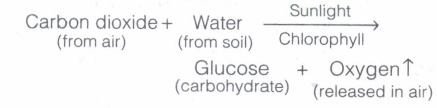
The process by which green plants can prepare their own food is called photosynthesis. Green plants possess chlorophyll in their leaf and utilises carbon dioxide (from air) water, minerals (from soil, through root) as raw material and sunlight as source of energy and convert light energy into chemical energy. The food thus synthesied is in the form of starch (carbohydrate). The overall reaction for photosynthesis can be given as follows:
71.
| Test tube | Effect on blue litmus paper | Effect on red litmus paper | Effect on phenolphthalein solution |
| A | Turns red | Remains red | Colourless |
| B | Remains blue | Turns blue | Pink colour |
| C | Remains blue | Remains red | Colourless |
72.
(a) Rohan observed a camel in the desert of Rajasthan.
(b) The hump stores fat which provides camel with food in times of food shortage.
(c) The feets of camel has large soles which help it to walk on soft sond.
(d) Camel can drink a very large quantity of water at a time which is stored in its stomach. It sweats very little which helps it to conserve water. Also it excretes very little water in the form of urine.
(e) Rohan is observant, curious and adventurer. He asks intelligent questions.

7th Standard CBSE Syllabus & Materials
7th Standard CBSE
CBSE 7th Social Science Theme B - New Beginnings : Cities and States - New Sample Question Papers Study Material - QB365 Set A
NEW7th Standard CBSE
CBSE 7th Social Science Theme A - Climates of India - New Sample Question Papers Study Material - QB365 Set A
NEW7th Standard CBSE
CBSE 7th Social Science Theme A - Geographical Diversity of India - New Sample Question Papers Study Material - QB365 Set A
NEW7th Standard CBSE
CBSE 7th Science Earth, Moon and the Sun - New Sample Question Papers Study Material - QB365 Set A



CBSE 7th Standard CBSE Subjects
CBSE Standards




