
 100% FREE ACCESS
7th Standard CBSE Syllabus & Materials
7th Standard CBSE
CBSE 7th Social Science Theme E - Understanding Market - New Sample Question Papers Study Material - QB365 Set A
NEW7th Standard CBSE
CBSE 7th Social Science Theme E - From Barter to Money - New Sample Question Papers Study Material - QB365 Set A
NEW7th Standard CBSE
CBSE 7th Social Science Theme D - The Constitution of India- An Introduction - New Sample Question Papers Study Material - QB365 Set A
NEW7th Standard CBSE
CBSE 7th Social Science Theme D - From the Rulers to the Ruled : Types of Governments - New Sample Question Papers Study Material - QB365 Set A
NEW7th Standard CBSE
CBSE 7th Social Science Theme B - The Age of Reorganisation - New Sample Question Papers Study Material - QB365 Set A
NEW7th Standard CBSE
CBSE 7th Social Science Theme B - The Rise of Empires - New Sample Question Papers Study Material - QB365 Set A

Published on: 24/09/2019
Respiration in Organisms
Download CBSE Class 7th Standard CBSE Science question papers, sample papers, important questions, and previous year solved papers in PDF format. Get free study materials, NCERT solutions, and exam preparation resources for Class 7th Standard CBSE Science
Questions + Answers key
Take MCQ Science Test
1.
After coming from football match Ravi had cramping in his leg muscles. His father Mr. Sharma who is a physical trainer in his school advised him to take hot water bath
On this situation answer the following questions:
(i) Why do we get muscle cramps after heavy exercise?
(ii) How far the advice given by Ravi's father is effective?
(iii) Which value is shown by Mr. Sharma?
2.
Explain the respiratory system in humans.
3.
Explain an anaerobic respiration in yeast and in our muscles
4.
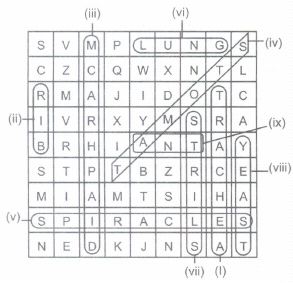
Given below is a square of letters in which are hidden different words related to respiration in organisms. These words may be present in any direction upwards, downwards or along the diagonal structures surrounding chest cavity
(iii) Muscular floor of chest cavity
(iv) Tiny pores on the surface of leaf
(v) Small openings on the sides of the body of an insect
(vi) The respiratory organs of human beings
(vii) The openings through which we inhale
(viii) An anaerobic organism
(ix) An organism with tracheal system
5.
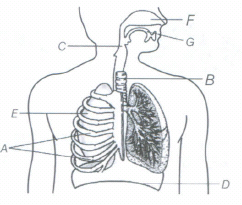
Observe the given diagram of human respiratory system. List the organs from (A) to (G).
6.
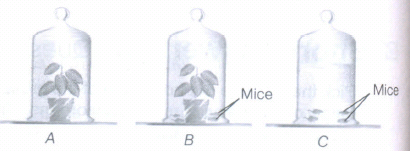
Observe the given figures carefully and answer the following questions.
(a) The amount of CO2 be the highest in which jar. Why?
(b) The amount of CO2 be the lowest in which one and why?
7.
After we work hard or perform physical activity, we feel hungry. Explain why
8.
Pick the odd one out from each of the groups given below on the basis of respiratory organs. Give reason for your answer.
(a) Cockroach, grasshopper, snail, ant
(b) Lizard, cow, earthworm, snake
(c) Crocodile, whale, dolphin, fish
(d) Snake, tadpole, crow, goat
9.
Take three test tubes. Fill 3/4th of each with water. Label them A, B and C. Keep a snail in test tube A, a water-plant in test tube B and in C, keep snail and plant both. Which test tube would have the highest concentration of CO2?
10.
Why do we often sneeze when we inhale a lot of dust-laden air?
1.
(i) The cramps occur when muscle cells respire anaerobically. The partial break down of glucose produces lactic acid, accumulation of which causes muscle cramps.
(ii) Hot water bath improves circulation of blood. As a result, the supply of oxygen to the muscle cells increases and complete breakdown of lactic acid occurs to form carbon dioxide and water.
(iii) Apart from his profession Mr. Sharma is caring and conscious about his son, so he gave the perfect advice to him to get relief from fatigue.
2.
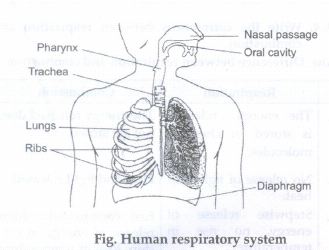
We take air through our nostrils. When we inhale air, it passes through our nostrils into the nasal cavity. From nasal cavity the air reaches our lungs through the wind pipe. Lungs are present in the chest cavity. This cavity is surrounded by ribs on the sides. A large muscular sheet called diaphragm forms the floor of the chest cavity. Breathing involves the movement of the diaphragm and the rib cage
3.
In Yeast: Yeast gets energy through anaerobic respiration. In the absence of oxygen, glucose breaks down into alcohol and carbon dioxide
GIucose\(\xrightarrow{in\ the\ absence\ of\ oxygen}\) Alcohol + Carbon dioxide + Energy
In Muscles: Our muscles can also respire anaerobically, but only for a short time. During heavy exercise, anaerobic respiration takes place in which glucose broken into lactic acid and energy.
Glucose\(\xrightarrow[of\ O_2]{absence}\)Lactic acid + Energy
4.
5.
The human respiratory system have following organs:
A- Ribs
B- Trachea
C- Pharynx
D - Diaphragm
E- Lungs
F- Nasal passage
G- Oral cavity
6.
(a) The amount of CO2 will be the highest in jar C. It is because the mice kept under the jar will breathe out CO2 continuously increasing its amount in the jar.
(b) The amount of CO2 will be the lowest in jar A. It is because in jar A, CO2 released during respiration is used by the plants, i.e. during the process of photosynthesis.
7.
When we work hard or perform physical activity (like running, swimming, cycling), we need more energy. To fulfil the energy requirement, we breathe faster. Fast breathing helps in supply of more oxygen to our cells. Due to this, rate of breakdown of food increases and more energy is released. The rapid breakdown of food makes us to feel more hungry.
8.
(a) Snail, as it does not breathe by means of trachea.
(b) Earthworm, because it breathes through its skin and it (does not have lungs.
(c) Fish as most fish breathe through their gills and do not have lungs.
(d) Tadpole, as it breathes through hills and do not have lungs.
9.
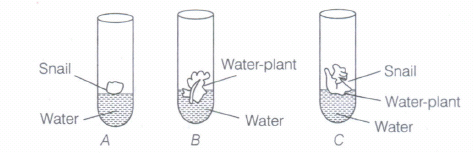
Test tube A will have higher concentration of CO2, This experiment shows the relationship between plants and animals. During breathing, snail inhales dissolved oxygen from water and releases CO2.
Water-plant along with respiration performs another important function called photosynthesis. During photosynthesis, water-plant absorbs CO2, prepares food and releases oxygen.
Therefore, test tube Band C have less amount of CO2 concentration as compared to test tube A.
10.
When we inhale dust-laden air, dirt-particles are captured within the nostrils. Sometimes, they get past the nostril hair in the nasal cavity and irritate the lining of the cavity, as a result, we sneeze. Sneezing expels these foreign particles from the inhaled air and a dust free, clean air enters in our body

7th Standard CBSE Syllabus & Materials
7th Standard CBSE
CBSE 7th Social Science Theme B - New Beginnings : Cities and States - New Sample Question Papers Study Material - QB365 Set A
NEW7th Standard CBSE
CBSE 7th Social Science Theme A - Climates of India - New Sample Question Papers Study Material - QB365 Set A
NEW7th Standard CBSE
CBSE 7th Social Science Theme A - Geographical Diversity of India - New Sample Question Papers Study Material - QB365 Set A
NEW7th Standard CBSE
CBSE 7th Science Earth, Moon and the Sun - New Sample Question Papers Study Material - QB365 Set A



CBSE 7th Standard CBSE Subjects
CBSE Standards




