
 100% FREE ACCESS
7th Standard CBSE Syllabus & Materials
7th Standard CBSE
CBSE 7th Social Science Theme E - Understanding Market - New Sample Question Papers Study Material - QB365 Set A
NEW7th Standard CBSE
CBSE 7th Social Science Theme E - From Barter to Money - New Sample Question Papers Study Material - QB365 Set A
NEW7th Standard CBSE
CBSE 7th Social Science Theme D - The Constitution of India- An Introduction - New Sample Question Papers Study Material - QB365 Set A
NEW7th Standard CBSE
CBSE 7th Social Science Theme D - From the Rulers to the Ruled : Types of Governments - New Sample Question Papers Study Material - QB365 Set A
NEW7th Standard CBSE
CBSE 7th Social Science Theme B - The Age of Reorganisation - New Sample Question Papers Study Material - QB365 Set A
NEW7th Standard CBSE
CBSE 7th Social Science Theme B - The Rise of Empires - New Sample Question Papers Study Material - QB365 Set A

Published on: 31/10/2019
Download CBSE Class 7th Standard CBSE Science question papers, sample papers, important questions, and previous year solved papers in PDF format. Get free study materials, NCERT solutions, and exam preparation resources for Class 7th Standard CBSE Science
Questions + Answers key
Take MCQ Science Test
1.
Describe the mode of heat transfer in water or gases.
2.
What are the different types of inorganic and organic impurities generally present in sewage?
3.
What are the various alternative arrangements for sewage disposal other than WWTP?
4.
What do you mean by water cleaning?
5.
Write three main differences between distance and displacement
6.
State the uses of different kinds of mirrors.
7.
Explain the process of rumination in the ruminant animals.
8.
"The polar region presents an extreme climate", comment on the statement.
9.
Write three differences between an organic acid and a mineral acid.
10.
Make sketches of the two stages in the life history of the silk moth which are directly related to the production of silk.
11.
2. (a) Draw a diagram of a pitcher plant to show the following parts:
(i) Pitcher
(ii) Lid
(b) What is the mode of nutrition of this plant?
(c) Is it an autotroph or partial heterotroph?
12.
Given below is a sequence of steps in the processing of wool. Which are the missing step? Add them.
Shearing, .... sorting ......, ......,......
13.
In the absence of photosynthesis, life would be impossible on earth. Is it true or false?
14.
If plant has a requirement for nitrogen, then from where will they obtain it?
15.
Ruminants such as cows and buffaloes swallow their food hurriedly and then sit restfully and chew their food. Give reason.
16.
Discuss the various associated glands of digestive system and their role in digestion.
17.
Why do we get instant energy from glucose?
18.
Name the type of carbohydrate that can be digested by ruminants but not by humans. Give the reason also.
19.
Give a brief description of the process of synthesis of food in green plants.
20.
Distinguish between a parasite and a saprotroph.
1.
Take water in a flask and heat it. It is seen that water near the flame gets hot and it rises up. The cold water from the side moves down, towards the source of heat. This water also
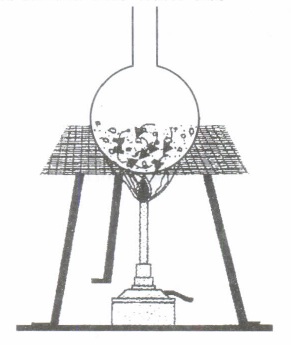
gets hot and rises and more water moves down from the side. This process continues till the whole water gets hot. This mode of heat transfer is called convection. Similar process happens in gases.
2.
(i) Inorganic impurities - nitrates, phosphates and metals.
(ii) Organic impurities - fruit and vegetable wastes, oil, urea, human faeces, animal waste, pesticides and herbicides
3.
Various alternative arrangements for sewage disposal other than WWTP are septic tanks, chemical toilets and composting pits. Septic tanks are suitable for places where there is no sewage system, such as hospitals, isolated buildings or cluster of 4-5 houses. In other methods, the excreta flow through covered drains into a biogas plant. The biogas thus produced is used as a source of energy.
4.
Cleaning of water is a process of removing pollutants from water before it enters a water body or is reused. This process of waste water treatment is commonly known as sewage treatment. It takes place in several stages.
5.
Differences between distance and displacement:
| Distance | Displacement |
|---|---|
| Distance is the length of the actual path covered by a body, irrespective of its direction of motion | Displacement is the shortest distance between the initial and final positions of a body in a given direction |
| Distance between two given points may be same or different for different paths chosen | Displacement between two given points is always same |
| It is scalar quantity | It is vector quantity |
| Distance covered is always positive or zero | Displacement covered may be positive, negative or zero |
6.
(a) Plane mirrors are used as looking glasses. They are also used in solar cookers, periscopes and kaleidoscopes.
(b) Concave mirrors are used as reflectors in the headlights of automobiles. As these give erect and magnified images, these are used by doctors to examine parts of bodies, such as ear, nose, throat etc.
(c) Convex mirrors can be used to view a much larger area than is possible with a plane mirror. These are therefore used as rear view or side view mirrors in cars and scooters.
7.
The animals which have a separate part of stomach (rumen) are called ruminants. In this part the food is partially digested and is called cud. But later the cud returns to mouth in small lumps and the animal chews it. This process is called rumination or chewing cud. These animals are called ruminants.
8.
Polar regions present an extreme climate because:
(i)These regions are covered with snow and it is very cold for most part of the year.
(ii) For six months the sun does not set at the poles while for another six months it does not rise.
(iii) In winters, the temperature can be as low as - 37°C.
9.
| Organic acid | Mineral acid |
|---|---|
| These acids are naturally occurring acids and are found in plants and animals. These contain- COOH as functional group as reactive part. These acids are week. Examples: Lactic acid, acetic acid, citric.acid. |
These are derived from the mineral of the earth These contain H+ ions as reactive part. These acids are strong. Examples: Hydrochloric acid, sulphuric acid, nitric acid. |
10.
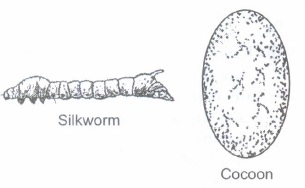
11.
(a)
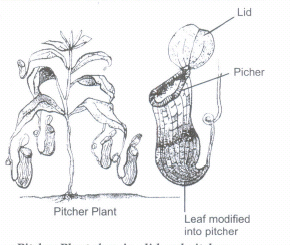
Fig. : Pitcher Plant showing lid and pitcher
(b) Autotrophic and Heterotrophic both.
(c) Partial heterotroph.
12.
(i) Shearing
(ii) Scouring,
(iii) Sorting
(iv) Fibre spinning,
(v) Dyeing
(vi) Rolling intp the yarn
13.
True, because photosynthesis is important for the existence of life on the earth. Photosynthesis is important process as it is provides food to all living organisms and maintains CO2 - O2 balance of nature.
14.
Soil contains nitrogen in the form that is not usable by plants. Bacteria like Rhizobium converts nitrogen into soluble form that can be easily used Q. by plants. So, if plant has a requirement for nitrogen, then it will obtain that which the help of bacteria.
15.
Ruminants such as cows and buffaloes swallow their food hurriedly and store it in a part of the stomach called rumen. The cellulose of the food is digested here by the action of certain bacteria which are not present in humans. Later, this partially digested food is returned to the buccal cavity of the animals in small lumps and animal chews it to complete the process of digestion. This process is called rumination.
16.
The various associated glands of digestive system and their role in digestion are as follows.
(i) Salivary gland digestion of starch in mouth.
(ii) Liver secretes bile juices which help in the digestion of fats.
(iii) Pancreas secretes pancreatic juices which act on carbohydrate, fats and proteins and change them into simpler compounds.
17.
Glucose is a simple sugar or carbohydrate which is broken down in the presence of oxygen into CO2 and H2O and releases instant energy. Glucose is easily absorbed by the blood, hence provides instant energy to the body.
18.
Cellulose is the carbohydrate that can be digested by ruminants but not by humans because ruminants have a large sac-like structure called rumen which is located between the small intestine and large intestine. Certain bacteria are present in rumen which helps in digesting cellulose.
19.
Plants prepare their own food by the process of photosynthesis. Leaves of the plants have green pigment called chlorophyll, which helps them to capture the energy of the sunlight. The plants synthesise their food from carbon dioxide and water in the presence of sunlight. This process is called photosynthesis. The reaction for the process of photosynthesis can be shown as follows:

During photosynthesis, food is synthesised and oxygen is released in the process.
20.
Differences between parasites and saprotrophs
| Parasites | Saprotrophs |
|---|---|
| These are the organisms that live inside the body of another organism (host) and derive the food from it. | These are the organisms that feed on dead and decaying organic matter. They do not require any host |
| They harm the body of the host. | They are cleaning agents. |
| e.g. Cuscuta | e.g. Fungi |

7th Standard CBSE Syllabus & Materials
7th Standard CBSE
CBSE 7th Social Science Theme B - New Beginnings : Cities and States - New Sample Question Papers Study Material - QB365 Set A
NEW7th Standard CBSE
CBSE 7th Social Science Theme A - Climates of India - New Sample Question Papers Study Material - QB365 Set A
NEW7th Standard CBSE
CBSE 7th Social Science Theme A - Geographical Diversity of India - New Sample Question Papers Study Material - QB365 Set A
NEW7th Standard CBSE
CBSE 7th Science Earth, Moon and the Sun - New Sample Question Papers Study Material - QB365 Set A



CBSE 7th Standard CBSE Subjects
CBSE Standards




