
 100% FREE ACCESS
7th Standard CBSE Syllabus & Materials
7th Standard CBSE
CBSE 7th Social Science Theme E - Understanding Market - New Sample Question Papers Study Material - QB365 Set A
NEW7th Standard CBSE
CBSE 7th Social Science Theme E - From Barter to Money - New Sample Question Papers Study Material - QB365 Set A
NEW7th Standard CBSE
CBSE 7th Social Science Theme D - The Constitution of India- An Introduction - New Sample Question Papers Study Material - QB365 Set A
NEW7th Standard CBSE
CBSE 7th Social Science Theme D - From the Rulers to the Ruled : Types of Governments - New Sample Question Papers Study Material - QB365 Set A
NEW7th Standard CBSE
CBSE 7th Social Science Theme B - The Age of Reorganisation - New Sample Question Papers Study Material - QB365 Set A
NEW7th Standard CBSE
CBSE 7th Social Science Theme B - The Rise of Empires - New Sample Question Papers Study Material - QB365 Set A

Published on: 05/09/2019
Physical and Chemical Changes
Download CBSE Class 7th Standard CBSE Science question papers, sample papers, important questions, and previous year solved papers in PDF format. Get free study materials, NCERT solutions, and exam preparation resources for Class 7th Standard CBSE Science
Questions + Answers key
Take MCQ Science Test
1.
Explain how painting of an iron gate prevents it from rusting.
2.
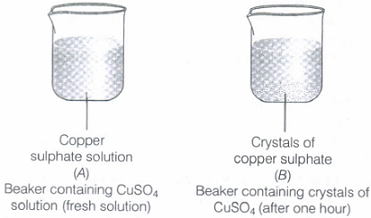
Describe how crystals of copper sulphate are prepared.
3.
Explain why burning of wood and cutting it into small pieces are considered as two different types of changes.
4.
How would you show that setting of curd is a chemical change?
5.
Condensation of steam is not a chemical change.
6.
Iron and rust are the same substances.
7.
Iron pipes coated with zinc do not get rusted easily.
8.
Formation of manure from leaves is a physical change.
9.
Cutting a log of wood into pieces is a chemical change.
10.
What is the nature of magnesium oxide solution?
11.
Complete the following reaction Ca (OH2) + CO2 \(\longrightarrow\)
12.
Is souring of milk a physical change or a chemical change? Why?
13.
How can you say that ripening of a fruit is a chemical change?
14.
If you leave a piece of iron in the open for a few days, it acquires a film of brownish substance, called rust.
(a) Do you think rust is different from iron?
(b) Can you change rust back into iron by some simple method?
(c) Do you think the formation of rust on iron is a chemical change?
(d) Give two other examples of a similar type of change.
15.
In the summer holidays, Karan went to Rann of Kutch in Gujarat with his parents. Karan was aware that in the coastal regions of India especially in the Rann of Kutch common salt is obtained from seawater. Karan was very excited to see that place. He requested his father that he wants to see the process of obtaining salt from the sea. His father helped him and they went to see the place where common salt was collecting. And he also explained the whole process. Karan was very happy to see the process. Now, answer the following questions.
(a) How is common salt obtained from sea water?
(b) Name the process by which salt is collected from seawater
(c) What values are shown by Karan?
16.
Which of the following statements is incorrect for a chemical reaction?
Heat may be given out but never absorbed
Sound may be produced
A colour change may take place
A gas may be evolved
17.
Galvanisation is a process used to prevent the rusting of which of the following?
Iron
Zinc
Aluminium
Copper
18.
A man painted his main gate made up of iron, to
(i) and (ii)
(ii) and (iii)
Only (ii)
(i) and (iii)
19.
A chemical change may involve
change in colour only
change in temperature only
evolution of gas only
All of the above
20.
Which of the following is a physical change?
Rusting of iron
Combustion of magnesium ribbon
Burning of candle
Melting of wax
21.
Souring of milk is a ___________ change
22.
The presence of _________ in seawater makes the process of rust formation on ships faster
23.
Energy is ________ in the formation of curd from milk.
24.
Iron benches kept in lawns and gardens get __________ It is a _______change because a new ________ is formed.
25.
Grinding of wheat grain changes its size. It is a __________ change
26.
Has it changed in any way?
27.
Do you see any change in the colour of the solution?
28.
On the basis of this test, how do you classify the aqueous Solution-acidic or basic?
29.
Does the mixture turn blue litmus red?
30.
Does the mixture turn red litmus blue?
1.
Rusting of iron is due to the exposure of iron to the atmosphere for some time. To prevent rusting of iron gate, we paint it. Painting prevents the iron gate to come in direct contact of atmosphere, water or both. Thus, a coat of paint cuts the contact between iron and atmosphere and it prevents rusting of iron.
Also we know that
Iron (Fe)+ Oxygen (O2)+ Water (H2O) \(\longrightarrow\) Rust (iron oxide, Fe2O3)
Thus, it is necessary to cut the oxygen contact with iron to prevent rusting.
2.
Crystals of copper sulphate are prepared in the following manner:
(i) Take a cup full of water in a beaker.
(ii) Add a few drops of dilute sulphuric acid.
[Caution Never add water to the acid as the acid may splash on you].
(iii) Heat the water.
(iv) When it starts boiling, add copper sulphate powder slowly with constant stirring.
(v) Continue adding copper sulphate powder till no more powder can be dissolved.
(vi) Filter the solution.
(vii) Allow it to cool.
(viii) Do not disturb the solution, when it is cooling.
(ix) Look at the solution after some time and wait till it changes into crystals.
3.
Burning of wood is a chemical change while cutting of wood is a physical change because, during burning, new substances are formed. After burning, we cannot get original substance (i.e. wood) back. Cutting of wood into small pieces is a physical change because no new substance is formed.
4.
The setting of curd is a chemical change because we cannot get the original substance (milk) back. The new substance, i.e. curd is different from the milk in taste, smell and chemical properties.
5.
(a)
6.
(b)
7.
(a)
8.
(b)
9.
(b)
10.
Magnesium oxide is basic in nature because it turns red litmus solution to blue.
11.
Ca (OH2) + CO2 \(\longrightarrow\) CaCO3 + H2O
Calcium hydroxide Carbon dioxide Calcium carbonate Water
12.
Souring of milk is a chemical change because original substances present in milk lose their nature and identity and form new chemical substances.
13.
Ripening of a fruit is a chemical change because after ripening, a new product with different properties is formed.
14.
(a) Yes, rust is iron oxide (Fe2O3). Thus, rust and iron are not the same substance.
(b) No, rusting of iron is a chemical change because in this reaction, a new substance, rust (iron oxide) is formed. It cannot be reversed by any method.
(c) Yes, rusting of iron is a chemical change. During the rusting of iron, it combines with the oxygen in the presence of water (moisture) to form a new compound 'iron oxide'. This iron oxide is a rust.
Iron + Oxygen + Water \(\longrightarrow\) Iron oxide
(From damp air) (Rust)
It is a permanent change which cannot be reversed back. So, rusting of iron is a chemical change.
(d) Two other examples are
(i) Setting of curd from milk.
(ii) Burning of magnesium ribbon to form magnesium oxide.
15.
(a) Seawater is collected in shallow pits. It is then allowed to evaporate in the sun. As the water evaporates, the salt solution becomes supersaturated (concentrated). This supersaturated solution cannot hold the excess salt. Thus, it separates out in the form of salt crystals. These salt crystals are collected and are redissolved in water and filtered to remove insoluble impurities. The clear solution is again evaporated to obtain the crystals of pure salt.
(b) Salt is obtained from sea water by the process of evaporation.
(c) The values shown by Karan are curious, aware and intelligence
16.
(a)
Heat may be given out but never absorbed
17.
(a)
Iron
18.
(d)
(i) and (iii)
19.
(d)
All of the above
20.
(d)
Melting of wax
21.
()
chemical
22.
()
salt
23.
()
evolved
24.
()
rusted, chemical, substance
25.
()
physical
26.
()
There is a brown coat deposited on the nail
27.
()
Yes, the solution becomes green from blue
28.
()
On the basis of this test, how do you classify the aqueous Solution-acidic or basic?
29.
()
No
30.
()
Does the mixture turn blue litmus red?

7th Standard CBSE Syllabus & Materials
7th Standard CBSE
CBSE 7th Social Science Theme B - New Beginnings : Cities and States - New Sample Question Papers Study Material - QB365 Set A
NEW7th Standard CBSE
CBSE 7th Social Science Theme A - Climates of India - New Sample Question Papers Study Material - QB365 Set A
NEW7th Standard CBSE
CBSE 7th Social Science Theme A - Geographical Diversity of India - New Sample Question Papers Study Material - QB365 Set A
NEW7th Standard CBSE
CBSE 7th Science Earth, Moon and the Sun - New Sample Question Papers Study Material - QB365 Set A



CBSE 7th Standard CBSE Subjects
CBSE Standards




