
 100% FREE ACCESS
7th Standard CBSE Syllabus & Materials
7th Standard CBSE
CBSE 7th Social Science Theme E - Understanding Market - New Sample Question Papers Study Material - QB365 Set A
NEW7th Standard CBSE
CBSE 7th Social Science Theme E - From Barter to Money - New Sample Question Papers Study Material - QB365 Set A
NEW7th Standard CBSE
CBSE 7th Social Science Theme D - The Constitution of India- An Introduction - New Sample Question Papers Study Material - QB365 Set A
NEW7th Standard CBSE
CBSE 7th Social Science Theme D - From the Rulers to the Ruled : Types of Governments - New Sample Question Papers Study Material - QB365 Set A
NEW7th Standard CBSE
CBSE 7th Social Science Theme B - The Age of Reorganisation - New Sample Question Papers Study Material - QB365 Set A
NEW7th Standard CBSE
CBSE 7th Social Science Theme B - The Rise of Empires - New Sample Question Papers Study Material - QB365 Set A

Published on: 21/10/2019
Water: A Precious Resource
Download CBSE Class 7th Standard CBSE Science question papers, sample papers, important questions, and previous year solved papers in PDF format. Get free study materials, NCERT solutions, and exam preparation resources for Class 7th Standard CBSE Science
Questions + Answers key
Take MCQ Science Test
1.
While watching news channel on television, Ajay comes to know about the water scarcity which goes on in some of the areas of West India. In the clippings on news he sees that women and even children are engaged in fetching water from distant wells/ponds which are also not a good state. He feels unhappy and next day asked the following questions to his a science teacher.
Answer the questions pretending that you are science teacher.
(i) Is true that we are facing the actual shortage of water?
(ii) What might be 'the causes and remedies of this water scarcity?
(iii) If the children are engaged in carrying water, when do they manage to go to school to study?
2.
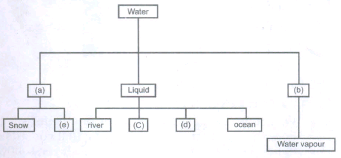
Complete the following chart by writing appropriate words in the boxes marked (a) to (e).
3.
Describe various reasons for depletion of water table. Explain how does increasing population affect the water table.
4.
What is the impact of increasing industries and agricultural activities on the depletion of water table?
5.
Describe the water cycle.
6.
All the rain that falls over an area is not utilised. Do you agree? Explain.
7.
Water is very precious for all the living beings. What will happen in future, if we do not save water now?
8.
Shishir returned from school and found his mother busy in the kitchen. He noticed that she is making his favourite dosa. Shishir rushed to his mother as he was feeling hungry and found that the tap in the kitchen was leaking. He told his mother to replace it as leaking taps lead to the wastage of water. His mother smiled and ensured him to do the same
(a) What is water management?
(b) Why should we save water?
(c) What values are shown by Shishir?
9.
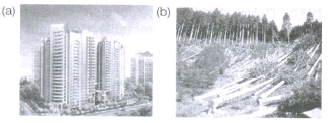
Two figures 'a' and 'b' are given below. Both are revealing two different human activities which are the cause of depletion of water table. Identify the two acts and explain how are these causing the depletion of water resource.
10.
Sachin lives in an area where on and off water scarcity is there. He gave a thought to the problem and planned to get a solution. He decided to harvest rainwater in his village. He made efforts to convince the people of his area, built some drainage system and water tanks where rainwater could be collected.
(a) Name few structures he might have built.
(b) Name the process of water cycle, Sachin will use for harvesting water.
(c) Write the methods, Sachin will tell the people to use water wisely
1.
(i) Actually, millions of people in our country do not get enough water. Especially during summer, in many areas there is an acute shortage of water, taps running dry, long queues for water and even fight for demand of water in a common sight.
(ii) Causes: Due to less amount of rainfall in some areas, not only water bodies like ponds, rivers become dry also due to excess extraction of ground water, water table goes down.
Remedies: Public and government both should be concern and show awareness towards this crisis. By drip irrigation system and water harvesting technique, we cannot only save water from wastage but also recharge ground water.
(iii) In these areas of hot dry and arid climate the studies of children are badly affected.
2.
(a) solid,
(b) gaseous,
(c) well,
(d) lake,
(e) ice.
3.
The reasons of depletion of water table:
(1) Increase in population.
(2) Industrialisation.
(3) Agricultural activities.
(4) Scanty rainfall.
(5) Deforestation.
(6 Decrease in the effective area for seepage of water.
Effect of increasing population:
As the population increases, demand for construction of houses, shops, offices, roads and pavements is increased. This decreases the open areas like parks and playgrounds. This in turn decreases the seepage of rainwater into the ground. More over a huge amount of water is required for construction work. Often groundwater is used for this purpose.
So, on the one hand we are consuming more groundwater and on the other hand we are allowing less water to seep into the ground. This results in the depletion of water table.
4.
(i) Increasing industries:
Water is used by all the industries. Almost everything that we use needs water somewhere in the production process. The number of industries is increasing continuously. Water used by most of the industries is drawn from the ground thus depleting water table.
(ii) Agricultural Activities:
A majority of farmers in India depend upon rains for irrigation of their crops. Irrigation systems such as canals are there only at few places. Even these systems may suffer from lack of water due to erratic rainfall. Therefore, farmers have to use groundwater for irrigation. Population pressure on agriculture forces increasing use of groundwater day by day. This results in depletion of water table.
5.
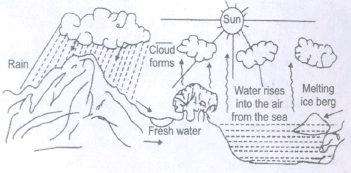
The sun heats up the water of oceans, ponds and rivers due to which water evaporates. These water vapours being lighter are carried up by the air. These water vapours get cooled at height and water droplets are formed. These water droplets form a cloud. When these water droplets in a cloud come close together, they form drops of water. These drops of water may fall on the earth as rain. The rain water is absorbed by the soil. A part of rain water collected in the rivers flows into the sea, where again the evaporation occurs. This completes the water cycle.
6.
Precipitation (rain) is a natural process and is a part of natural water cycle. It replenishes all the natural resources of water like ponds, lakes, river and finally oceans and seas too.
When we say utilisation of rainwater, we mean that rain in a particular area.
Yes, it is not properly utilised as most of the water is run off as surface water to the rivers and goes to oceans.
We can harness/harvest this water to local waterbodies like ponds, lakes and groundwater by proper planning as it is being done in some districts of Rajasthan successfully.
7.
Water is needed for various life activities. If we continue the misuse of water and do not conserve it, the groundwater level will be depleted. This may result into various consequences like
(i) Lowering of the water table Excessive pumping can lower the groundwater table.
(ii) Reduced surface water supply Groundwater and surface water are connected. When groundwater is overused, the lakes, streams and rivers connected to groundwater, can also have little supply.
(iii) Loss of plants from land We fully depend on the plants for food directly or indirectly. Plants need water to prepare their food. If there will be scarcity of water on earth, the plants will be unable to prepare their food. This inturn will lead to the end of the life because world without plants means no food, no oxygen, not enough rain and other innumerable problems. Therefore, it is true that water is a precious resource
8.
(a) Minimum wastage of water is called water management.
(b) We should save water to prevent water crisis.
(c) Shishir is sincere, responsible and has capability of applying knowledge practica
9.
(a) Large scale construction (b) Deforestation.
Large scale construction It is main cause of water table lowering because it utilises large amount of water at the time of construction. Most of the time, it is digged water table.
Secondary, when ground surface becomes cemented. It does not allow seepage of rainwater into deeper layers, so rainwater goes waste as run off water and cannot replenish the water table of that particular place.
Deforestation Plants transfer huge amount of water in the form of water vapours. So, when forests are cut down, we interrupt in the process of water cycle of that area. So, no rain occurs at that place and it gradually turns into desert area.
10.
(a) Sachin has build up cemented drainage channels in the elevated area and tanks where these channels will collect water.
(b) Sachin is planning to harvest rainwater.
(c) Sachin will educate people to use water judicially in the following way
(i) Use mug for brushing, shaving and bathing.
(ii) Water plants with drip irrigation.
(iii) Use and reuse water in home activities.

7th Standard CBSE Syllabus & Materials
7th Standard CBSE
CBSE 7th Social Science Theme B - New Beginnings : Cities and States - New Sample Question Papers Study Material - QB365 Set A
NEW7th Standard CBSE
CBSE 7th Social Science Theme A - Climates of India - New Sample Question Papers Study Material - QB365 Set A
NEW7th Standard CBSE
CBSE 7th Social Science Theme A - Geographical Diversity of India - New Sample Question Papers Study Material - QB365 Set A
NEW7th Standard CBSE
CBSE 7th Science Earth, Moon and the Sun - New Sample Question Papers Study Material - QB365 Set A



CBSE 7th Standard CBSE Subjects
CBSE Standards




