
 100% FREE ACCESS
7th Standard CBSE Syllabus & Materials
7th Standard CBSE
CBSE 7th Social Science Theme E - Understanding Market - New Sample Question Papers Study Material - QB365 Set A
NEW7th Standard CBSE
CBSE 7th Social Science Theme E - From Barter to Money - New Sample Question Papers Study Material - QB365 Set A
NEW7th Standard CBSE
CBSE 7th Social Science Theme D - The Constitution of India- An Introduction - New Sample Question Papers Study Material - QB365 Set A
NEW7th Standard CBSE
CBSE 7th Social Science Theme D - From the Rulers to the Ruled : Types of Governments - New Sample Question Papers Study Material - QB365 Set A
NEW7th Standard CBSE
CBSE 7th Social Science Theme B - The Age of Reorganisation - New Sample Question Papers Study Material - QB365 Set A
NEW7th Standard CBSE
CBSE 7th Social Science Theme B - The Rise of Empires - New Sample Question Papers Study Material - QB365 Set A

Published on: 02/11/2019
CIV - A Shirt In The Market
Download CBSE Class 7th Standard CBSE Social Science question papers, sample papers, important questions, and previous year solved papers in PDF format. Get free study materials, NCERT solutions, and exam preparation resources for Class 7th Standard CBSE Social Science
Questions + Answers key
Take MCQ Social Science Test
1.
Write a letter to the minister asking for what you think would be proper payment to the workers.
2.
What is a chain of market? Do you think that everyone gains equally in the market?
3.
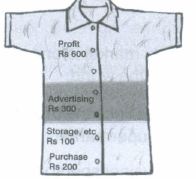
The shirt below shows the profit made by the businessperson and the various costs that he had to pay. Find out from the diagram below, what the cost price includes.
4.
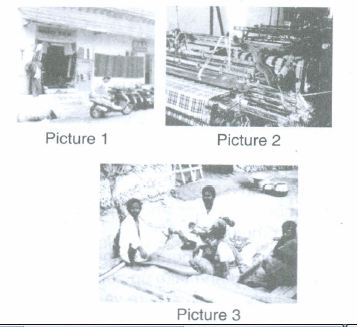
Observe the picture given below and answer the questions that follow
What are the traders doing in the 3rd picture?
5.
Observe the picture given below and answer the question
What do you know about powerlooms?
6.
Observe the picture given below and answer the question
What do you understand by looking at picture 1?
7.
'The poor depend on rich and powerful for loans. Because of this dependence, the poor are exploited.' Explain how.
8.
"No person gains equally in the market".Why?
9.
Write a note on garment exporting factory.
10.
"The market works more in favour of the merchants". How?
1.
To
The, Minister
Human Resource
Development
Respected Sir,
I kindly request you to pay attention towards the low paid workers for maximum workout. According to me, the proper payment to the workers should be:
Tailoring Rs5,000-6,000
Ironing Rs 3 (per piece)
Checking Rs 3,500
Thread cutting and buttoning Rs 2,500
Kindly look at my suggestions and put some efforts so that the workers are paid accordingly.
Thanking you
Date
Name.
2.
There is a chain of market which links the producer to the buyer, but everyone does not benefit equally in the market.
The foreign business persons made huge profits. Compared to this, the garment exporters made moderate profits. Some people like small farmers (like Swapna), weavers, workers earn little. The profits made by the merchants or traders are somewhere in between. So everyone does not gain equally in the market. In democracy everybody has right to earn a fair wage for his work.
If people don't earn enough then they cannot think themselves as equal to others and cannot live with dignity.
The market offers people opportunities to work and earn fairly. But it is the people, who are rich powerful and have large establishments take away the maximum benefit. And the poor people, because of their dependence on the rich, are exploited in the market.
3.
The cost price of the shirt includes advertising+storage+purchase
=Rs300+Rs100+Rs200=Rs600
4.
They then bring back the finished cloth to the traders. Here, they can be seen getting ready to go to the merchant in the town. The trader keeps an account of the yarn given and pays them money for weaving this into cloth.
5.
This photograph shows a power loom in one such home. The weavers and their families spend long hours working on these looms.
Most weaving units have about 2-8 powerlooms on which the yarn is woven into cloth. A variety of sarees, towels, shirting, ladies dress material and bedsheets are produced in these looms.
6.
This is a merchant's shop in the bazaar. Over the years, these traders have developed extensive contacts with garment firms around the country from whom they get orders. These traders purchase the yarn (thread) from others.
7.
It is the market which provides opportunities for work and to serf things. But mostty It rs me rich and powerful who receive the maximum benefit from the market. Rich and powerful includes people having money, land holdings, shops, etc. The poor are dependent on these people for
(i) Loans (ii) Raw materials (iii) Marketing of goods (iv) Employment
It is this dependency which exploits them. Measures should be taken to reduce such exploitation. For example, cooperatives should be formed and it should be ensured that law are strictly followed.
8.
No person gains equally in the market. The foreign businessmen earned huge profits followed by garment exporter, merchant and traders. The small cotton farmer, weaver and factory worker earned so little so that they can't even fulfil their day-to-day requirements. Though democracy is all about getting a fair wage in market, this is not the case in reality.
It is important for families to earn enough so that they can think of themselves as equal to others.
9.
The cloth is supplied to a garment-exporting factory by the Erode merchant, which is used to make shirts. The shirts will then be exported to the foreign buyers. Foreign buyers include the businessmen from US and Europe. They run a chain of stores on their own terms. They demand low prices from the supplier, high standards of quality and timely delivery. No defects or delay is entertained by the buyers. Hence, exporter puts all his efforts to fulfil the demands of foreign buyers.
The pressure from buyers results in the following
(i) Cutting costs by garment factories.
(ii) Workers are forced to work maximum at lowest possible wages.
(iii) Maximisation of profit.
(iv) Supply of garments to foreign buyers at a cheap price.
10.
This dependence of weavers on merchants for both raw materials and markets makes merchants powerful. Merchants get what they want and that too at very low prices.
The weavers don't have any way of knowing that to whom their cloth have been sold to. The merchants sell cloth to the garments factories and this is how they are benefitted to a large extent. Weavers invest all their money and sometimes borrow money to buy looms. Weaver and another adult member work for almost 12 hours a day to produce cloth and then too do not earn enough.
This scheme between the merchant and the weaver is an instance of putting out system. Weaving industry in India uses this system.

7th Standard CBSE Syllabus & Materials
7th Standard CBSE
CBSE 7th Social Science Theme B - New Beginnings : Cities and States - New Sample Question Papers Study Material - QB365 Set A
NEW7th Standard CBSE
CBSE 7th Social Science Theme A - Climates of India - New Sample Question Papers Study Material - QB365 Set A
NEW7th Standard CBSE
CBSE 7th Social Science Theme A - Geographical Diversity of India - New Sample Question Papers Study Material - QB365 Set A
NEW7th Standard CBSE
CBSE 7th Science Earth, Moon and the Sun - New Sample Question Papers Study Material - QB365 Set A



CBSE 7th Standard CBSE Subjects
CBSE Standards




