
 100% FREE ACCESS
7th Standard CBSE Syllabus & Materials
7th Standard CBSE
CBSE 7th Social Science Theme E - Understanding Market - New Sample Question Papers Study Material - QB365 Set A
NEW7th Standard CBSE
CBSE 7th Social Science Theme E - From Barter to Money - New Sample Question Papers Study Material - QB365 Set A
NEW7th Standard CBSE
CBSE 7th Social Science Theme D - The Constitution of India- An Introduction - New Sample Question Papers Study Material - QB365 Set A
NEW7th Standard CBSE
CBSE 7th Social Science Theme D - From the Rulers to the Ruled : Types of Governments - New Sample Question Papers Study Material - QB365 Set A
NEW7th Standard CBSE
CBSE 7th Social Science Theme B - The Age of Reorganisation - New Sample Question Papers Study Material - QB365 Set A
NEW7th Standard CBSE
CBSE 7th Social Science Theme B - The Rise of Empires - New Sample Question Papers Study Material - QB365 Set A

Published on: 05/09/2019
Devotional Paths To The Divine
Download CBSE Class 7th Standard CBSE Social Science question papers, sample papers, important questions, and previous year solved papers in PDF format. Get free study materials, NCERT solutions, and exam preparation resources for Class 7th Standard CBSE Social Science
Questions + Answers key
Take MCQ Social Science Test
1.
How did miniature paintings develop under the Mughal patronage?
2.
Why was the Mughal Emperor Jahangir hostile to the Sikh community?
3.
Who were the followers of Baba Guru Nanak?
4.
Who was Ramanuja? What are the main points of his preachings?
5.
For any of the saint-poets whose compositions have been included in this chapter, find out more about their works, noting down other poems. Find out whether these are sung, how they are sung and what the poet wrote about.
6.
They__________argued strongly for the equality of all human beings.
7.
From 7th to 9th centuries saw the emergence of new religious movements, led by the Nayanars and___________
8.
________was an important centre of the Bhakti tradition in Maharashtra.
9.
_________,___________and____________were advocates of Virashaivism.
10.
Shankara was an advocate of_________
11.
Ramanuja, was born in
Kerala
Tamil Nadu
Sri lanka
Bombay
12.
The Nayanars and Alvars went from place to place
composing exquisite poems
composing devotional songs
composing epics
composing religious texts
13.
Many learned texts made the belief among people that social privileges come from birth in a
rich family
poor family
noble family
brahman family
14.
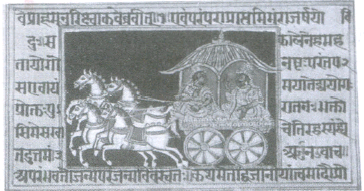
Interpret the picture and answer what does this figure of Bhagvadgita signify?
15.
Write a brief note on new religious developments in North India.
16.
Adi Granth is the other name of Guru Granth Sahib.
17.
Saint Janeshwara rewrote Gita in Marathi.
18.
Mirabai became a disciple of Ravidas.
19.
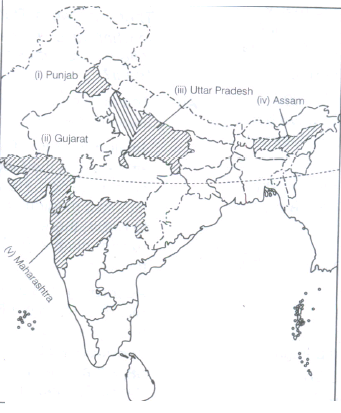
In the given below map, some states associated with great saints are marked. Name the saint that belong to each of the following states.
20.
What is Abhang?
21.
What are Namghars?
22.
What is Guru Granth Sahib?
23.
Who was Surdas?
1.
Miniatures are small-sized paintings generally done in water colour on cloth or paper. The earliest miniatures were on palm leaves or wood.
These painters illustrated manuscripts containing historical accounts and poetry. The Mughal Emperors patronised these highly skilled painters
2.
Amritsar had developed around the central Gurudwara known as Harmandar Sahib, the Golden Temple. It was virtually a self-governing body and the modern historians refer to the early 17th century Sikh community as 'a state within state'. This made the Mughal Emperor Jahangir hostile to the Sikh community.
3.
Baba Guru Nanak had a large number of followers. They belonged to a number of castes but traders, agriculturists, artisans and craftsmen predominated.
4.
Ramanuja was a Bhakti saint. He was born in Tamil Nadu in the 11th century. He was deeply influenced by the Alvars. The main points of his preachings are
(i) He taught people to get salvation by showing devotion to Vishnu.
(ii) He propounded the doctrine of Vishishtadvaita or qualified oneness.
5.
There are many saint-poets whose compositions have been included in this chapter. More about their works have been given in holy books. Most notable among them are Guru Nanak, Surdas, Kabir, Mirabai, Goswami Tulsidas. Their religious poems, songs are read out and are sung at religious places and by devotees who are singers and composers. Devotional songs, poems can be heard in radio also. I have read certain books which belong to Guru Nanak. Many pada, poems, depict scenes about his life and good deeds that he did. It all speak about the upholding of ethical values, deeds, paths one should go after.
6.
()
Virashaivas
7.
()
Alvars
8.
()
Vitthala temple
9.
()
Basavanna, Allama Prabhu, Akkamahadevi
10.
()
advaita
11.
(b)
Tamil Nadu
12.
(a)
composing exquisite poems
13.
(c)
noble family
14.
The given picture depicts the figure from Gita, the holy text of Hinduism. In the picture, the Lord Krishna is looking back to convince Arjuna, the one of five Pandavas to go ahead, fight for truth. Lord Krishna is explaining the philosophy of 'KARMA' (Duty) to Arjuna that is do your duty, under all circumstances and leave the rest on God.
15.
A New wave of Bhakti movement erupted during the 13th century. This was an age when Islam, Brahmanical Hinduism, Sufism, various strands of Bhakti, the Nath panthis, Siddhas and yogis influenced one another.
The main reason was that the ordinary strata of the society such as craftspersons, peasants, traders, etc showed their interest in listening to these new saints. The notable saints like Kabir and Baba Guru Nanak did not approve the orthodox religions. Tulsidas and Surdas accepted existing beliefs and practices but wanted to make these accessible to all. Tulsidas conceived of God in theform of Rama who wrote Ramacharitmanas in praise of him.
Surdas was an ordent devotee of Krishna. His compositions compiled in the Sursagara, Sursarawali and Sahitya Lahari, express his devotion. Shankaradeva of Assam emphasised devotion to Vishnu and composed poems and plays in Assamese. Besides, Surdas, Dadu Dayal, Ravidas and Mirabai are worth mentioning about their role in Bhakti movement.
16.
(a)
17.
(b)
18.
(a)
19.
(i) Guru Nanak, (ii) Mirabai, Narsi Mehta (iii) Surdas (iv) Shankaradeva (v) Eknath, Tukaram, Namdev
20.
()
Abhang is a Marathi devotional hymn.
21.
()
Namghars are houses of recitation and prayer, a practice that continues even today.
22.
()
Guru Granth Sahib is the holy scripture of the Sikhs.
23.
()
Surdas was an ardent devotee of Krishna.

7th Standard CBSE Syllabus & Materials
7th Standard CBSE
CBSE 7th Social Science Theme B - New Beginnings : Cities and States - New Sample Question Papers Study Material - QB365 Set A
NEW7th Standard CBSE
CBSE 7th Social Science Theme A - Climates of India - New Sample Question Papers Study Material - QB365 Set A
NEW7th Standard CBSE
CBSE 7th Social Science Theme A - Geographical Diversity of India - New Sample Question Papers Study Material - QB365 Set A
NEW7th Standard CBSE
CBSE 7th Science Earth, Moon and the Sun - New Sample Question Papers Study Material - QB365 Set A



CBSE 7th Standard CBSE Subjects
CBSE Standards




