
 100% FREE ACCESS
7th Standard CBSE Syllabus & Materials
7th Standard CBSE
CBSE 7th Social Science Theme E - Understanding Market - New Sample Question Papers Study Material - QB365 Set A
NEW7th Standard CBSE
CBSE 7th Social Science Theme E - From Barter to Money - New Sample Question Papers Study Material - QB365 Set A
NEW7th Standard CBSE
CBSE 7th Social Science Theme D - The Constitution of India- An Introduction - New Sample Question Papers Study Material - QB365 Set A
NEW7th Standard CBSE
CBSE 7th Social Science Theme D - From the Rulers to the Ruled : Types of Governments - New Sample Question Papers Study Material - QB365 Set A
NEW7th Standard CBSE
CBSE 7th Social Science Theme B - The Age of Reorganisation - New Sample Question Papers Study Material - QB365 Set A
NEW7th Standard CBSE
CBSE 7th Social Science Theme B - The Rise of Empires - New Sample Question Papers Study Material - QB365 Set A

Published on: 10/10/2019
GEO - Inside Our Earth
Download CBSE Class 7th Standard CBSE Social Science question papers, sample papers, important questions, and previous year solved papers in PDF format. Get free study materials, NCERT solutions, and exam preparation resources for Class 7th Standard CBSE Social Science
Questions + Answers key
Take MCQ Social Science Test
1.
See the following objects carefully and answer the questions that follow
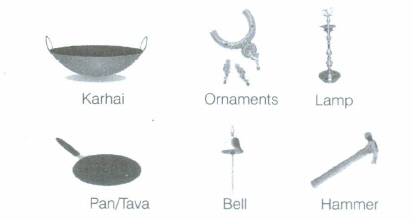
(a) Which minerals most commonly used in the above objects?
(b) Identify some more objects made up of different minerals?
2.
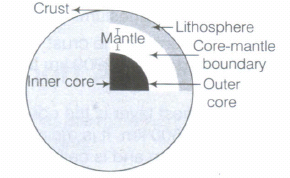
Observe the given picture carefully and answer the questions that follow
(a) What is the uppermost layer of the Earth?
(b) What is the mineral constituent of the oceanic crust?
(c) What is the innermost layer of the Earth?
3.
Explain basic features of the interior of the earth.
4.
Discuss the various types of rocks in detail.
5.
What do you mean by sedimentary rocks? How are sedimentary rocks formed?
6.
What are minerals? How are minerals important to us?
7.
Explain the rock cycle with the help of a diagram.
8.
Describe the interior of the earth
1.
(a) Iron
(b) Karhai-lron, Ornaments-Gold, silver, Lamp-Brass, Pan/Iava-Iron, Bell-Brass, Hammer-Iron
2.
(a) Crust.
(b) Silica and Magnesium (SiMa).
(c) Core is the innermost layer of the Earth
3.
The earth is made up of several concentric layers with one inside another just like an onion. The basic features of the interior of the earth are
(i) Crust It is the uppermost layer over the earth's surface which is the thinnest of all the layers. It is about 35 km on the continental masses and only 5 km on the ocean floors. The continental mass are made up of silica and alumina. It is thus called SiAl (Si-Silica and AI-Alumina). The oceanic crust mainly consists of Silica and Magnesium; it is therefore called SiMa (Si-Silica and Ma-Magnesium.
(ii) Mantle It is just beneath the crust which extends up to a depth of 2900 km below the crust.
(iii) Core The innermost layer is the core with a radius of about 3500 km. It is mainly made up of Nickel and Iron and is called NiFe (Ni-Nickel and Fe-Ferrous i.e. iron). The central core has very high temperature and pressure.
4.
Rocks are of three major types i.e. igneous rocks, sedimentary rocks and metamorphic rocks.
(i) Igneous rocks When the molten magma cools, it becomes solid. Rocks thus formed are called igneous rocks. e.g. basalt. They are also called primary rocks.
There are two types of igneous rocks
(a) An intrusive rock Sometimes the molten magma cools down deep inside the Earth's crust. Solid rocks so formed are called intrusive igneous rocks, e.g. basalt.
(b) An extrusive rock When molten lava comes on the Earth's surface, it rapidly cools down and becomes solid. Rocks formed in such a way on the crust are called extrusive igneous rocks. e.g. granite.
(ii) Sedimentary rocks It is formed by transported and deposited small fragmented roc ks by wind, water, etc and these loose sediments are compressed and hardened to form layers of rocks. e.g. sandstone is made from grains of sand.
(iii) Metamorphic rocks They are formed due to great heat and pressure over igneous and sedimentary rocks. e.g. clay changes into slate and limestone into marble.
5.
Compressed and hardened layers of the sediments are called sedimentary rocks. These are secondary rocks and may also contain fossils of plants, animals and other micro-organisms that once lived on them. Sedimentary rocks can change into metamorphic rocks under great heat and pressure.
Rocks break down into small fragments known as sediments. These sediments are transported and deposited by wind and water, etc. When these sediments are compressed and hardened, the sedimentary rocks are formed.
6.
Minerals are defined as solid, inorganic, naturally occurring substances with a definite chemical formula and certain physical properties. Almost all chemical elements in the Earth's crust are associated with at least one mineral.
Minerals are very important to mankind. Some are used as fuels, e.g. coal, natural gas, and petroleum. They are also used in industries, e.g. Iron, gold, aluminium uranium, etc., in medicines in fertilisers etc.
7.
Rocks are constantly being formed, worn down and then formed again. It takes thousands and millions of years for rocks to change. This process of transformation of the rock from one form to another is called rock cycles.
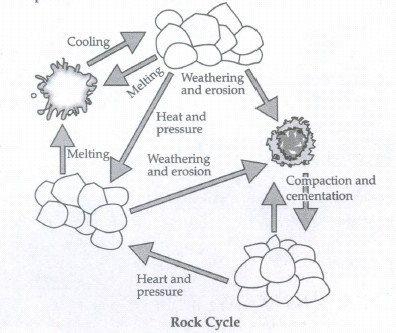
(i) When the molten magma cools down, it solidifies to become igneous rocks.
(ii) These igneous rocks are broken down into small particles, known as sediments.
(iii) These sediments are transported and deposited to form sedimentary rocks.
(iv) When these igneous and sedimentary rocks are subjected to heat and pressure, they change into metamorphic rocks.
(v) The metamorphic rocks which are still under heat and pressure, melt down to form molten magma, which again cools and solidifies into igneous rocks.
8.
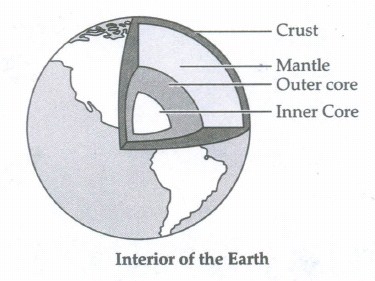
The earth is made up of several concentric layers with one inside another.
There are three main layers are Crust, Mantle, and Core
(i) Crust: It is the uppermost layer over the earth's surface and thinnest among all layer The continental mass of the crust consisting of silica and alumina, thus it is called sial (si- silica and al-alumina). The oceanic crust consist of silica and magnesium, thus called sima (si-silica, ma-magnesium). It is about 35 km thick on the continental masses and only 5 km thick on the oceans floors.
(ii) Mantle: It is just beneath the crust, with a depth of 2,900kms.
(iii)Core: It is the innermost layer of the earth, mainly made up of nickel and ferrous. The central core has very high temperature and pressure.

7th Standard CBSE Syllabus & Materials
7th Standard CBSE
CBSE 7th Social Science Theme B - New Beginnings : Cities and States - New Sample Question Papers Study Material - QB365 Set A
NEW7th Standard CBSE
CBSE 7th Social Science Theme A - Climates of India - New Sample Question Papers Study Material - QB365 Set A
NEW7th Standard CBSE
CBSE 7th Social Science Theme A - Geographical Diversity of India - New Sample Question Papers Study Material - QB365 Set A
NEW7th Standard CBSE
CBSE 7th Science Earth, Moon and the Sun - New Sample Question Papers Study Material - QB365 Set A



CBSE 7th Standard CBSE Subjects
CBSE Standards




