
 100% FREE ACCESS
7th Standard CBSE Syllabus & Materials
7th Standard CBSE
CBSE 7th Social Science Theme E - Understanding Market - New Sample Question Papers Study Material - QB365 Set A
NEW7th Standard CBSE
CBSE 7th Social Science Theme E - From Barter to Money - New Sample Question Papers Study Material - QB365 Set A
NEW7th Standard CBSE
CBSE 7th Social Science Theme D - The Constitution of India- An Introduction - New Sample Question Papers Study Material - QB365 Set A
NEW7th Standard CBSE
CBSE 7th Social Science Theme D - From the Rulers to the Ruled : Types of Governments - New Sample Question Papers Study Material - QB365 Set A
NEW7th Standard CBSE
CBSE 7th Social Science Theme B - The Age of Reorganisation - New Sample Question Papers Study Material - QB365 Set A
NEW7th Standard CBSE
CBSE 7th Social Science Theme B - The Rise of Empires - New Sample Question Papers Study Material - QB365 Set A

Published on: 21/10/2019
GEO - Water
Download CBSE Class 7th Standard CBSE Social Science question papers, sample papers, important questions, and previous year solved papers in PDF format. Get free study materials, NCERT solutions, and exam preparation resources for Class 7th Standard CBSE Social Science
Questions + Answers key
Take MCQ Social Science Test
1.
(i) The name of one river is hidden in each of the sentences below. Spot it. Example : Mandira, Vijayalakshmi and Surinder are my best friends Answer: Ravi
(a) The snake charmer's bustee, stables where horses are housed, and the piles of wood, all caught fire accidentally. (Hint: Another name for River Brahmaputra)
(b) The conference manager put pad, material for reading and a pencil for each participant. (Hint: a distributary on the. Ganga-Brahmaputra delta)
(c) Either jealousy or anger cause a person's fall (Hint: Name of a juicy fruit!)
(d) Bhavani germinated the seeds in a pot (Hint: Look for her in West Africa)
(e) "I am a zonal champion now" declared the excited athlete. (Hint: The river that has the biggest basin in the world)
(f) The tiffin box rolled down and all the food fell in dusty potholes. (Hint: Rises in India and journeys through Pakistan)
(g) Malini leaned against the pole when she felt that she was going to faint. (Hint: Her delta in Egypt is famous)
(h) Samantha mesmerised everybody with her magic tricks. (Hint: London is situated on her estuary)
(i) "In. this neighbourhood, please don't yell! Owners of these houses like to have peace". Warned my father when we moved into our new flat". (Hint: Colour!)
(j) 'Write the following words, Marc!" "On", "go", "in" , said the teacher to the little boy in KG Class. (Hint: Rhymes with "bongo') Now make some more on your own and ask your classmates to spot the hidden name. You can do this with any name: that of a lake, mountains, trees, fruits, school items, etc.
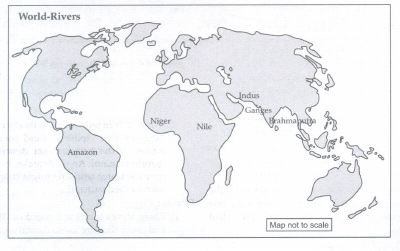
(ii) With the help of an atlas, draw each river which you discovered in For Fun (i), on an outline map of the world.
2.
On the basis of following picture, answer the given questions.
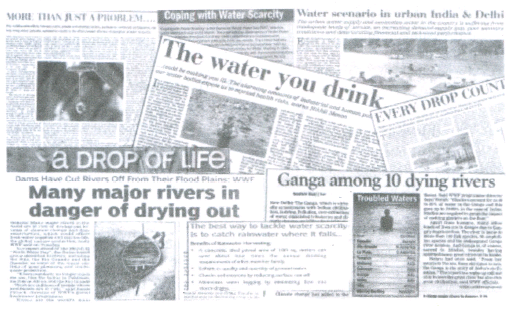
Why is water important for us?
3.
Explain the occurrence of Tsunami and its effects?
4.
How do we classify ocean movements? Explain.
5.
Discuss the different types of ocean currents and their causes.
6.
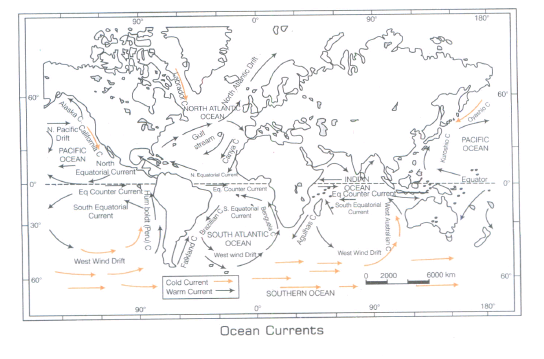
Show on the world map.
Warm Currents
(a) North Pacific Drift (b) Gulf Stream (c) North Atlantic Drift (d) Equator Counter Current (e) South Equatorial Current
Cold Currents
(a) Peru Current (b) West Wind Drift (c) West Australian Current (d) Oyashio Current (e) Labrador Current
7.
What is Tsunami? Explain its effect
8.
What is a tide? Explain its types.
1.
(a) Teesta
(b) Padma
(c) Orange
(d) Niger (River)
(e) Amazon (River)
(f) Indus
(g) Nile
(h) Thames
(i) Yellow
(j) Mango
Students do themselves (Some of them are given below).
2.
Water is life-line of human. We use water for drinking, cooking, washing and irrigation.
3.
i) Tsunami is a Japanese word that means 'Harbour waves' as the harbours get destroyed whenever there is tsunami. During a storm, the winds blowing at very high speed form huge waves. These may cause tremendous destruction.
ii) An earthquake, a volcanic eruption or underwater landslides can shift large amounts of ocean water. As a result, a huge tidal wave called tsunami, that may be as high as 15 m, is formed. The largest tsunami ever measured was 150 m high. These waves travel at a speed of more than 700 km per hour.
iii) The tsunami of 2004 caused widespread damage in the coastal areas of India. The Indira Point in the Andaman and Nicobar Islands got submerged after the tsunami.
4.
The movements that occur in oceans can be broadly categorised as: waves, tides and currents.
(i) When the water on the surface of the ocean rises and falls alternately, they are called waves. During a storm, the winds blowing at very high speed form huge waves. These may cause tremendous destruction. An earthquake, a volcanic eruption or underwater landslides can shift large amounts of ocean water.
(ii) The rhythmic rise and fall of ocean water twice in a day is called a tide. It is high tide when water covers much of the shore by rising to its highest level. It is low tide when water falls to its lowest level and recedes from the shore.
(iii) Ocean currents are streams of water flowing constantly on the ocean surface in definite directions which may be warm or cold. The warm ocean currents originate near the equator and move towards the poles. The cold currents carry water from polar or higher latitudes to tropical or lower latitudes
5.
i) Ocean currents are streams of water flowing constantly on the ocean surface in definite directions. The ocean currents may be warm or cold. Generally, the warm ocean currents originate near the equator and move towards the poles. The cold currents carry water from polar or higher latitudes to tropical or lower latitudes. The Labrador Ocean current is a cold current while the Gulf Stream is a warm current.
ii) The ocean current influence the temperature conditions of the area. Warm currents bring about warm temperature over land surface. The areas where the warm and cold currents meet provide the best fishing grounds of the world.
iii) Seas around Japan and the Eastern coast of North America are such examples. The areas where a warm and cold current meet also experience foggy weather making it difficult for navigation.
6.
7.
Tsunami is a Japanese word meaning 'harbour waves' as the harbours get destroyed whenever there is tsunami. An earthquake, volcanic eruption or underwater landslide might trigger huge ocean waves called tsunami.
Effects :
(i) These waves travel at a speed of 700 km per hour and cause damage to the coastal areas.
(ii) The areas near the coast get submerged and it leads to earthquake.
8.
Rhythmic rise and fall of ocean water twice a day is called a tide.
There are two types of tides:
High tides: It is high tide when water covers much of the shore by rising to its highest level.
Low tides : It is low tide when water falls to its lowest level and recedes from the shore.

7th Standard CBSE Syllabus & Materials
7th Standard CBSE
CBSE 7th Social Science Theme B - New Beginnings : Cities and States - New Sample Question Papers Study Material - QB365 Set A
NEW7th Standard CBSE
CBSE 7th Social Science Theme A - Climates of India - New Sample Question Papers Study Material - QB365 Set A
NEW7th Standard CBSE
CBSE 7th Social Science Theme A - Geographical Diversity of India - New Sample Question Papers Study Material - QB365 Set A
NEW7th Standard CBSE
CBSE 7th Science Earth, Moon and the Sun - New Sample Question Papers Study Material - QB365 Set A



CBSE 7th Standard CBSE Subjects
CBSE Standards




