
 100% FREE ACCESS
7th Standard CBSE Syllabus & Materials
7th Standard CBSE
CBSE 7th Social Science Theme E - Understanding Market - New Sample Question Papers Study Material - QB365 Set A
NEW7th Standard CBSE
CBSE 7th Social Science Theme E - From Barter to Money - New Sample Question Papers Study Material - QB365 Set A
NEW7th Standard CBSE
CBSE 7th Social Science Theme D - The Constitution of India- An Introduction - New Sample Question Papers Study Material - QB365 Set A
NEW7th Standard CBSE
CBSE 7th Social Science Theme D - From the Rulers to the Ruled : Types of Governments - New Sample Question Papers Study Material - QB365 Set A
NEW7th Standard CBSE
CBSE 7th Social Science Theme B - The Age of Reorganisation - New Sample Question Papers Study Material - QB365 Set A
NEW7th Standard CBSE
CBSE 7th Social Science Theme B - The Rise of Empires - New Sample Question Papers Study Material - QB365 Set A

Published on: 28/09/2019
HIS - Devotional Paths To The Divine
Download CBSE Class 7th Standard CBSE Social Science question papers, sample papers, important questions, and previous year solved papers in PDF format. Get free study materials, NCERT solutions, and exam preparation resources for Class 7th Standard CBSE Social Science
Questions + Answers key
Take MCQ Social Science Test
1.
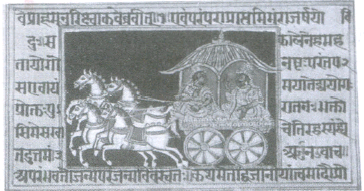
Interpret the picture and answer what does this figure of Bhagvadgita signify?
2.
Write a brief note on new religious developments in North India.
3.
What were the major teachings of Baba Guru Nanak?
4.
Read the following extract and answer the question that follows
Beyond the Rana's palace
This is a song composed by Mirabai:
Ranaji, I have left your norms of shame,
and false decorum of the princely life.
I have left your town.
And yet Rana why have you kept up enmity against me?
Rana you gave me a cup of poison.
I drank it laughing.
Rana I will not be destroyed by you.
And yet Rana why have you kept up?
enmity against me?
Why do you think Mirabai left the Rana's palace?
5.
Describe the works of Baba Guru Nanak
6.
Write a brief note on new religious developments in North India.
1.
The given picture depicts the figure from Gita, the holy text of Hinduism. In the picture, the Lord Krishna is looking back to convince Arjuna, the one of five Pandavas to go ahead, fight for truth. Lord Krishna is explaining the philosophy of 'KARMA' (Duty) to Arjuna that is do your duty, under all circumstances and leave the rest on God.
2.
A New wave of Bhakti movement erupted during the 13th century. This was an age when Islam, Brahmanical Hinduism, Sufism, various strands of Bhakti, the Nath panthis, Siddhas and yogis influenced one another.
The main reason was that the ordinary strata of the society such as craftspersons, peasants, traders, etc showed their interest in listening to these new saints. The notable saints like Kabir and Baba Guru Nanak did not approve the orthodox religions. Tulsidas and Surdas accepted existing beliefs and practices but wanted to make these accessible to all. Tulsidas conceived of God in theform of Rama who wrote Ramacharitmanas in praise of him.
Surdas was an ordent devotee of Krishna. His compositions compiled in the Sursagara, Sursarawali and Sahitya Lahari, express his devotion. Shankaradeva of Assam emphasised devotion to Vishnu and composed poems and plays in Assamese. Besides, Surdas, Dadu Dayal, Ravidas and Mirabai are worth mentioning about their role in Bhakti movement.
3.
The major teachings of Baba Guru Nanak were as
under:
(i) He emphasised the importance of the worship of one God.
(ii) He insisted that caste, creed or gender was irrelevant for attaining liberation.
(iii) His idea of liberation was not that of a state of inert bliss but the pursuit of active life with a strong sense of social commitment.
(iv) He, himself, used the terms nam, elan and insan-for the essence of his teachings which actually meant right worship, welfare of purity of conduct.
(v) He directed to the importance of right belief and worship, honest living and helping others
4.
One evening a marriage procession was passing by the side of Mirabai, the Rajput princes's fort. She was standing along with his grandfather, she saw the bride and asked her grandfather, who would marry me? Her grandfather without consciousness told that she will be married to Lord Krishna.
But, unfortunately, she got married to Bhojraj, ruler of Chittor without her wish.
Meera's brother-in-law and Rana gave her immense pain and sufferings to make her forget about Lord Krishna.
Out of love of Krishna, she left the fort and royal life. However, it is considered a myth by many others.
5.
Guru Nanak and (1469-1539) born at Talwandi (Nankana Sahib in Pakistan). He travelled widely before establishing a centre at Kartarpur (Dera Baba Nanak on the river Ravi). A regular worship that consisted of the singing of his own hymns was established there for his followers.
Irrespective of their previous creed, caste or gender, his followers ate together in the common kitchen (langar). The holy space thus created by Guru Nanak was known as dharmsal. It is now known as Gurdwara.
Before his death in 1539, Guru Nanak appointed one of his followers as his successor. His name was Lehna but later he came to be known as Guru Angad, representing that he was a part of Guru Nanak himself.
Guru Angad compiled the compositions of Guru Nanak, to which he added his own new script known as Gurmukhi.
The three successors of Guru Angad also wrote under the name of 'Nanak' and all of their compositions were compiled by Guru Arjan in 1604. In 1706 this compilation was authenticated by his son and successor, Guru Gobind Singh. It is now known as Guru Granth Sahib, the holy scripture of the Sikhs.
6.
(i) During the thirteenth century a new wave of the bhakti movement began in North India. This was an age when Islam, Brahmanical Hinduism, Sufism, various strands of bhakti, and the Nathpanths, Siddhas and Yogis influenced one another. Ordinary people like craftspersons, peasants, traders and labourers spread their ideas.
(ii) Kabir and Baba Guru Nanak rejected all orthodox religions. Others like Tulsidas and Surdas accepted existing beliefs and practices but wanted to make these accessible to all. Tulsidas conceived God in the form of Rama. His unique creation Ramcharitmanas, written in Awadhi is an example.
(iii) Surdas was an ardent devotee of Krishna. His compositions, compiled in the Sursagara, Surasaravali and Sahitya Lahari, express his devotion.
(iv) Saints like Dadu Dayal, Ravidas and Mirabai are worth mentioning here. Mirabai was a Rajput princess who married into the royal family of Mewar in the sixteenth century. She became a disciple of Ravidas, a saint from a caste considered "untouchable". She was devoted to Krishna and composed innumerable bhajans expressing her intense devotion.
(v)A unique feature of most of the saints is that their works were composed in regional languages and could be sung.

7th Standard CBSE Syllabus & Materials
7th Standard CBSE
CBSE 7th Social Science Theme B - New Beginnings : Cities and States - New Sample Question Papers Study Material - QB365 Set A
NEW7th Standard CBSE
CBSE 7th Social Science Theme A - Climates of India - New Sample Question Papers Study Material - QB365 Set A
NEW7th Standard CBSE
CBSE 7th Social Science Theme A - Geographical Diversity of India - New Sample Question Papers Study Material - QB365 Set A
NEW7th Standard CBSE
CBSE 7th Science Earth, Moon and the Sun - New Sample Question Papers Study Material - QB365 Set A



CBSE 7th Standard CBSE Subjects
CBSE Standards




