
 100% FREE ACCESS
7th Standard CBSE Syllabus & Materials
7th Standard CBSE
CBSE 7th Social Science Theme E - Understanding Market - New Sample Question Papers Study Material - QB365 Set A
NEW7th Standard CBSE
CBSE 7th Social Science Theme E - From Barter to Money - New Sample Question Papers Study Material - QB365 Set A
NEW7th Standard CBSE
CBSE 7th Social Science Theme D - The Constitution of India- An Introduction - New Sample Question Papers Study Material - QB365 Set A
NEW7th Standard CBSE
CBSE 7th Social Science Theme D - From the Rulers to the Ruled : Types of Governments - New Sample Question Papers Study Material - QB365 Set A
NEW7th Standard CBSE
CBSE 7th Social Science Theme B - The Age of Reorganisation - New Sample Question Papers Study Material - QB365 Set A
NEW7th Standard CBSE
CBSE 7th Social Science Theme B - The Rise of Empires - New Sample Question Papers Study Material - QB365 Set A

Published on: 19/08/2019
Our Changing Earth
Download CBSE Class 7th Standard CBSE Social Science question papers, sample papers, important questions, and previous year solved papers in PDF format. Get free study materials, NCERT solutions, and exam preparation resources for Class 7th Standard CBSE Social Science
Questions + Answers key
Take MCQ Social Science Test
1.
Differentiate between endogenic forces and exogenic forces.
2.
Draw a flow-chart of 'Evolution of landforms'.
3.
Define the following terms.
(a) focus (b) epicentre?
4.
Why do the plates move?
5.
What are sand dunes?
6.
Why do the plates move?
7.
As the river enters the plain it twists and turns forming long bends known as:
levees
arches
Meanders
Stacks
8.
Angel falls is located in :
South Africa
South America
South India
None of these
9.
The raised banks of the rivers are called
distributary
delta
levees
flood plains
10.
Ox-bow lakes are found in
glaciers
river valleys
deserts
11.
Which is not an erosional feature of sea waves?
Cliff
Beach
Sea cave
12.
L waves
13.
P waves
14.
Glacier
15.
Sand dunes
16.
Glacier
17.
Briefly describe the journey of a river forming waterfalls and flood plains.
18.
The 'Earthquake-A case study' given in the form of headlines that appeared in the newspapers after the quake. Arrange the events in the right sequence of their happening.
19.
How sea waves gives rise to coastal landforms?
20.
An earthquake is measured by ______
21.
The greatest damage is usually closest to the______________ and the strength of the earthquake decreases away from the____________
22.
Sudden movements like_______________ and ____________cause mass destruction over the surface of the Earth.
23.
The_________________ inside the Earth moves in a circular manner.
24.
_____________and ______________of the sea waves gives rise to coastal landforms.
25.
State some commonly used earthquake prediction methods adopted by local people.
26.
What are the different types of landforms found near or around sea?
27.
In which continent, the Victoria fall is located?
28.
What is seismograph?
29.
What is lithospheric plates?
30.
What is seismograph? How is the magnitude of earthquake measured?
31.
Give some earthquake preparedness measures?
32.
What is the difference between the focus and the epicentre of an earthquake?
33.
What are endogenic forces?
1.
Endogenic forces act in the interior of the Earth.
Exogenic forces act on the surface of the Earth.
2.
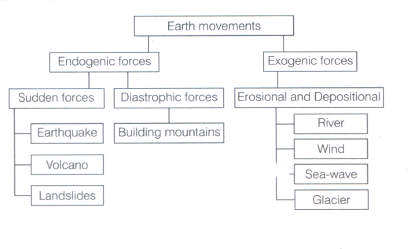
A flow chart of 'Evolution of landforms' are as follow
3.
(a) The place in the crust where the movement starts is called the 'focus'.
(b) The place on the surface above the focus is called the 'epicentre'.
4.
The plates are moving because they are floating on the molten magma inside the Earth.
5.
Sand dunes are those hill-like structures which are formed by the deposition of blowing wind in deserts.
6.
The plates are moving because they are floating on the molten magma inside the Earth.
7.
(c)
Meanders
8.
(b)
South America
9.
(c)
levees
10.
(b)
river valleys
11.
(b)
Beach
12.
()
Surface waves
13.
()
Longitudinal waves
14.
()
River of ice
15.
()
Deserts
16.
()
River of ice
17.
(i) When the river enters the plain it twists, turns and forms large bends. These bends are known as meanders.
(ii) Due to continuous erosion and deposition along the sides of the meander, the ends of the meander loop comes closer and closer. In due course of the meander loop cuts off from the river and forms a cut-off lake. It is called an ox-bow lake. At times the river overflows its banks. This leads to the flooding of the neighbouring areas. The flood water. deposits layers of fine soil and other materials, called sediments, along its banks. This leads to the formation of a flat fertile land called a flood plain.
(iii) The raised banks are called levees.
(iv) As the river approaches the sea, the speed of the running water decreases. The river begins to break up in number of streams.
18.
Earthquake- A case study
(i) Earthquake hits Bhuj: A massive earthquake measuring (6.9 on Richter scale hilts Bhuj Town on 26th January 2001.
(ii) School worst affected: At least 971 students and 31 teachers are feared to have lost their lives following the collapse of school buildings
(iii) Bhuj relief effort blighted: Three days after the quake, concern rose about food, blankets; and medical supplies not reaching everyone.
(iv) Destruction of Bhuj: Phone lines, water pipelines and power stations transmissions lines were knocked out.
(v) Fire in the city: Hundreds of fires started as charcoal, cookers overturned
(vi) Emergency declared in quake zone: The president declares a state of emergency.
(vii) CM's appeal to the Centre: Gujarat Chief Minister appeals for financial help. The Chief Minister of Gujarat has launched an appeal for the Centre to deal with the disaster.
19.
i) Sea waves continuously strike at the rocks. Thus, cracks develop. Over time they become larger and wider. Thus, hollow like caves are formed on the rocks. They are called sea caves. As these cavities become bigger and bigger only the roof of the caves remain, thus forming sea arches.
ii) Further, erosion breaks the roof and only walls are left. These walls like features are called stacks. The steep rocky coast rising almost vertically above sea water is called sea cliff. The sea waves deposit sediments along the shores forming beaches.
20.
()
Seismograph.
21.
()
epicentre, centre
22.
()
earthquakes, volcanoes
23.
()
molten magma
24.
()
Erosion, deposition
25.
()
By studying animal behaviour local people can predict earthquake. For example, fish in the ponds get agitated snakes come to the surface, etc.
26.
()
Sea caves, sea arches, stacks and sea cliff are the different types of landforms.
27.
()
The Victoria fall is located on the borders of Zambia and Zimbabwe in Africa.
28.
()
A seismograph is a machine which measures an earthquake.
29.
()
When the lithosphere is broken into a number of plates is called the lithospheric plates.
30.
Seismograph is a machine by which earthquake is measured.
The magnitude of earthquake is measured by Richter scale.
(i) An earthquake of 2.0 or less is felt only a little.
(ii) An earthquake over 5.0 causes damage from things falling.
(iii) A 6.0 or higher magnitude is considered very strong and 7.0 is classified as a major earthquake.
31.
During an earthquake we can take shelter under a table or desk, or against an inside corner or wall. We should stay away from fire places and windows. We should confidently face the situation.
32.
The place in the crust where the movement of an earthquake starts is called the focus. The place on the surface above the focus is called the epicentre.
33.
The forces which act in the interior of the earth are called endogenic forces.
They sometimes produce sudden movements and
at the other times produce slow movements.
Sudden movements like earthquake, volcanoes cause mass destruction.
Slow movements like diastrophic forces help in building mountains.

7th Standard CBSE Syllabus & Materials
7th Standard CBSE
CBSE 7th Social Science Theme B - New Beginnings : Cities and States - New Sample Question Papers Study Material - QB365 Set A
NEW7th Standard CBSE
CBSE 7th Social Science Theme A - Climates of India - New Sample Question Papers Study Material - QB365 Set A
NEW7th Standard CBSE
CBSE 7th Social Science Theme A - Geographical Diversity of India - New Sample Question Papers Study Material - QB365 Set A
NEW7th Standard CBSE
CBSE 7th Science Earth, Moon and the Sun - New Sample Question Papers Study Material - QB365 Set A



CBSE 7th Standard CBSE Subjects
CBSE Standards




