
 100% FREE ACCESS
7th Standard CBSE Syllabus & Materials
7th Standard CBSE
CBSE 7th Social Science Theme E - Understanding Market - New Sample Question Papers Study Material - QB365 Set A
NEW7th Standard CBSE
CBSE 7th Social Science Theme E - From Barter to Money - New Sample Question Papers Study Material - QB365 Set A
NEW7th Standard CBSE
CBSE 7th Social Science Theme D - The Constitution of India- An Introduction - New Sample Question Papers Study Material - QB365 Set A
NEW7th Standard CBSE
CBSE 7th Social Science Theme D - From the Rulers to the Ruled : Types of Governments - New Sample Question Papers Study Material - QB365 Set A
NEW7th Standard CBSE
CBSE 7th Social Science Theme B - The Age of Reorganisation - New Sample Question Papers Study Material - QB365 Set A
NEW7th Standard CBSE
CBSE 7th Social Science Theme B - The Rise of Empires - New Sample Question Papers Study Material - QB365 Set A

Published on: 21/09/2019
The Creation of an Empire the Mughal Dynasty
Download CBSE Class 7th Standard CBSE Social Science question papers, sample papers, important questions, and previous year solved papers in PDF format. Get free study materials, NCERT solutions, and exam preparation resources for Class 7th Standard CBSE Social Science
Questions + Answers key
Take MCQ Social Science Test
1.
Describe the Mughal traditions of succession.
2.
How did the Mughals become successful in ruling the subcontinent?
3.
Who founded the Mughal rule in India and how?
4.
What was 'Zabt'?
5.
What is 'Sulh-i-kul' or 'universal peace'?
6.
Consider the following information and answer the question that follows.
Zat Ranking
Nobles with a zat of 5000 were ranked higher than those of 1000. In Akbar's reign there were 29 mansabdars with a rank of 5000 zat; by Aurangzeb's reign, the number of mansabdars had increased to 79. Would this have meant more expenditure for the state?
7.
Read the paragraph and answer the following question:
A miniature painting (dated 1702-1712) of Timur, his descendants, and the Mughal Emperors. Timur is in the centre and on his right is his son Miran Shah (the first Mughal Emperor Babur's great-great-grandfather) and then Abu Said (Babur's grandfather). To the left of Timur are Sultan Muhammad Mirza (Babur's great-grandfather) and Umar Shaikh (Babur's father). The Mughal Emperors Babur, Akbar, and Shah Jahan are the third, fourth and fifth individuals on Timur's right and on his left, in the same order, are Humayun, Jahangir, and Aurangzeb.
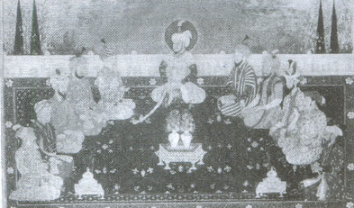
Do you think this painting suggests that the Mughals claimed kingship as a birthright?
8.
What were the main features of Sulh-i-Kul?
9.
How Todar Mal organised his revenue system?
10.
Aurangzeb insulted Shivaji when he declared himself an independent king and resumed campaigns against the British. What was the consequence of it?
11.
Analyse the Mughal relations with other rulers, especially the Rajputs.
12.
How Babur became the ruler of Delhi?
13.
How were the Mughal Emperors greater than their predecessors?
14.
How important was the income from land revenue to the stability of the Mughal Empire?
15.
Why did the Mughals emphasise their Timurid and not their Mongol descent?
1.
Mughal Traditions of Succession:
(i) The Mughals did not believe in the rule of primogeniture (inheritance).
(ii) Instead, they followed the Mughal and Timurid custom of coparcenary inheritance. It is a division of the inheritance amongst all the sons.
(iii) Mughal princess rebelled against their fathers, overthrew them and captured power.
2.
(i) Contrary to their predecessors, the Mughals created an empire and ruled over it for a long period of time.
(ii) From the later half of the sixteenth century, they expanded their kingdom from Agra and Delhi up to the seventeenth century.
(iii) They controlled nearly the entire subcontinent.
(iv) They imposed structure of administration and idea of governance.
(v) They outlasted their rule, leaving a political legacy that succeeding rulers of the subcontinent could not ignore.
3.
Babur was the first Mughal Emperor in India (1526- 1530).At the age of 12, he was forced to leave his ancestral home Ferghana due to Uzbeg attacks.
(i) In 1526, he defeated Ibrahim Lodi at the Battle of Panipat and occupied Delhi and Agra.
(ii) In 1527, he defeated Rana Sanga at Khanua.
(iii) In 1528, he defeated the Rajputs at Chanderi and further strenghtened his control over Delhi and Agra.
4.
(i) Akbar's revenue minister, Todarmal, carried out a very careful survey of crop yields, prices and areas cultivated for a ten-year period between 1570-1580.
(ii) On the basis of this data, tax was fixed on each crop in cash.
(iii) Each province was divided into revenue circles, with its own schedule of revenue rates for individual crops.
(iv) This revenue system was called as 'Zabt'.
5.
The idea of 'Sulh-i-kul' was introduced by Akbar, the Great.
This idea of 'Sulh-i-kul' was based on the idea of tolerance which did not discriminate between the people of different religions in his realm.
6.
Those who joined Mughal Service were enrolled as Mansabdars. The term mansabdar refers to an individual who holds a mansab, meaning a position or rank. Rank and salary were determined by a numerical value called Zat. The higher, the zat, the more prestigious was the noble's position and salary. So, nobles having a zat of 5000 were ranked higher than those of 1000.
In Akbar's rule, there were 29 mansabdars with a rank of 5000 zat. By Aurangzeb, the number of mansabdars rose to 79. So, it was obvious that the expenditure of Akbar would be much lesser than that of Aurangzeb. So, it was the liability of the state to pay them which resulted the heavy expenditure for the state.
7.
Many rulers of the Mughal Empire had virtually denied their subordination to the Khalifah, claiming themselves to be the supreme authority of the Islamic World. All the rulers were seen sitting together in a hierarchical way. They patronised painters to paint their combined portrays illustrate the genealogical picture of the Mughals. The inheritance was regarded as their birth right. They showed great respect to be a descendants of Timurids. All the kings showed ability to rule which they considered to be as high as the heavens. This painting truly suggests that the Mughals claimed kingship as a birth right.
8.
The idea of Sulh-i-Kul was introduced by Akbar, the Great. It meant universal peace. Its main features were
(i) This idea was based on the idea of tolerance which did not discriminate between people of different religions in his realm.
(ii) This idea focussed on a system of ethics which included honesty, justice, and peace. These values were universally applicable.
9.
Todar Mal was Akbar's revenue minister. He carried out a careful survey of crop yields, prices and areas cultivated for a 10 year period (1570-1580). On the basis of this survey, tax was fixed on each crop in cash. Each province was divided into revenue circles with its own schedule of revenue rates for individual crops. This revenue system came to be known as Zabt. However, this zabt system was prevalent in only those areas where Mughal administrators could survey the land.
10.
Shivaji went to Agra to accept the Mughal authority. But after being insulted by Auranqzeb, Shivaji resumed his campaigns against the Mughals. Prince Akbar rebelled against Aurangzeb and received support from the Marathas and the Deccan Sultanate. He finally fled to Safavid, Iran. From 1698, Aurangzeb personally managed campaigns in the Deccan against the Marathas who started Guerrilla warfare which was difficult to suppress.
11.
The Mughal rulers constantly campaigned against rulers who were not ready to accept their authority. Gradually, when the Mughals became powerful, many other rulers joined them willingly.
Many Rajputs offered their daughters into Mughal families in order to gain high positions or offices. The Sisodiya Rajputs refused to accept Mughal authority for a long time. Mughals never humiliated their opponents, even though they got defeated by them. This quality enabled them to extend their influence.
12.
Babur succeeded to the throne of Ferghana in 1494 at the tender age of 12 years. Unfortunately, he had to leave his ancestral throne due to the invasion of the Uzbegs, a Mongol group. He wandered for several years. Then, in 1504, he seized Kabul. In 1526, he defeated the Sultan of Delhi, Ibrahim Lodhi, at the battle of Panipat. Thus, he captured Delhi, where he laid the foundation of the Mughal Empire
13.
Unlike their predecessors, who believed in plunder and massacre, the Mughals felt proud to be called the descendants of Timurid. Mughals created a huge empire and accomplished much more what had hitherto seemed impossible in short time. They captured Indian subcontinent, introduced different ideas of governance, left a political legacy.
14.
Mughal Empire was dependent on land revenue. Without the revenue, nothing could be carried on. The king could not pay the salary to his soldiers. Neither could he do any of the welfare work. The administrative expenditure was so vast that it could be met with the help of revenue. Hence, revenue was important to hold each of the Subas under the Empire.
15.
The Mughal rulers were descendants of two great lineages of rulers. From their mother's side, they were descendants of Genghis Khan, ruler of the Mongol tribes. From their father's side, they were the successors of Timur, the ruler of Iran, Iraq and modern day Turkey.
However, the Mughals did not like to be called Mongol because Mongol's especially Genghis Khan's, memory was associated with the massacre of innumerable people. It was also linked with the Uzbegs, their Mongols competitors. On the other hand, the Mughals were proud of their Timurid ancestry, because Timur captured Delhi in 1398.

7th Standard CBSE Syllabus & Materials
7th Standard CBSE
CBSE 7th Social Science Theme B - New Beginnings : Cities and States - New Sample Question Papers Study Material - QB365 Set A
NEW7th Standard CBSE
CBSE 7th Social Science Theme A - Climates of India - New Sample Question Papers Study Material - QB365 Set A
NEW7th Standard CBSE
CBSE 7th Social Science Theme A - Geographical Diversity of India - New Sample Question Papers Study Material - QB365 Set A
NEW7th Standard CBSE
CBSE 7th Science Earth, Moon and the Sun - New Sample Question Papers Study Material - QB365 Set A



CBSE 7th Standard CBSE Subjects
CBSE Standards




