
 100% FREE ACCESS
7th Standard CBSE Syllabus & Materials
7th Standard CBSE
CBSE 7th Social Science Theme E - Understanding Market - New Sample Question Papers Study Material - QB365 Set A
NEW7th Standard CBSE
CBSE 7th Social Science Theme E - From Barter to Money - New Sample Question Papers Study Material - QB365 Set A
NEW7th Standard CBSE
CBSE 7th Social Science Theme D - The Constitution of India- An Introduction - New Sample Question Papers Study Material - QB365 Set A
NEW7th Standard CBSE
CBSE 7th Social Science Theme D - From the Rulers to the Ruled : Types of Governments - New Sample Question Papers Study Material - QB365 Set A
NEW7th Standard CBSE
CBSE 7th Social Science Theme B - The Age of Reorganisation - New Sample Question Papers Study Material - QB365 Set A
NEW7th Standard CBSE
CBSE 7th Social Science Theme B - The Rise of Empires - New Sample Question Papers Study Material - QB365 Set A

Published on: 05/08/2019
Tribes, Nomads And Settled Communities
Download CBSE Class 7th Standard CBSE Social Science question papers, sample papers, important questions, and previous year solved papers in PDF format. Get free study materials, NCERT solutions, and exam preparation resources for Class 7th Standard CBSE Social Science
Questions + Answers key
Take MCQ Social Science Test
1.
Write in brief about the fall of Garha Katanga.
2.
Discuss why the Mughals were interested in the land of the Gonds.
3.
Ahom tribe migrated from ________________
4.
The _________________ prescribed the Varna rules.
5.
The difference between the high and low and between the rich and poor,_________
6.
A census of the population was carried on under the_________
7.
The new castes emerging within varnas were called______________
8.
Ahom society was divided into clans/khels.
9.
Akbar Nama mentions the Gond kingdom of Garha Katanga that had 70,000 villages
10.
The Chaurasi in Gond states contained several cities.
11.
There were no tribal communities in the North-Western part of the subcontinent.
12.
Tribal societies had rich oral traditions.
13.
Sib Singh
14.
Clan
15.
Labourer
16.
Tanda
17.
Garh
18.
Practising system of having many wives were called:
Polygamous
Swayamvaras
Jauhar
Buranji
19.
The Gonds practised:
Shifting cultivation
Intensive agriculture
Subsistence cultivation
Plantation agriculture
20.
Who was Bir Narain?
Ruler of Punjab
Son of Rani Durgawati
Ruler of Multan
Ruler of Sind
21.
Who assumed the title of Sangram Shah?
Bir Narain
Dal pat
Aman Das
Chaman Das
22.
Chero chiefdoms had emerged by the
11th century
13th century
12th century
14th century
23.
Give an account of the tribal people found in Indian subcontinent. How they settled in forests, hills, deserts and difficult places to reach?
24.
Plot the location of the tribes mentioned in this chapter on a map. For any two, discuss whether their mode of livelihood was suited to the geography and the environment of the area where they lived.
25.
What do you mean by 'Paiks and Bhuiyans?'
26.
Enlist the major features of the tribal societies.
27.
Have you ever seen tribal people? Mention some states where tribal people live in India.
1.
(i) Garha Katanga was a rich state and earned much wealth by trapping and exporting wild elephants to other kingdoms.
(ii) When the Mughals defeated the Gonds, they captured huge booty of precious coins and elephants.
(iii) They annexed part of the kingdom and granted the rest to Chandra Shah, an uncle of Bir Narain.
(iv) Despite the fall of Garha Katanga, the Gond kingdoms survived for some time.
(v) However, they became much weaker and later struggled unsuccessfully against the stronger Bundelas and Marathas.
2.
Garha Katanga was a rich state and Rani Durgawati extended her empire. To centro] her and capture the wealth of Garha Katanga, Mughal forces under Asaf Khan attacked it. The Mughals defeated the Gonds, captured huge booty of precious coins and elephants. Mughals were ambitious, they desired to expand their empire and capture the wealth of the land of the Gonds.
3.
()
Myanmar.
4.
()
Brahmanas
5.
()
increased
6.
()
Ahoms
7.
()
Jatis
8.
(a)
9.
(a)
10.
(b)
11.
(b)
12.
(a)
13.
()
Ahom state
14.
()
Khel
15.
()
Paik
16.
()
Caravan
17.
()
Chaurasi
18.
(a)
Polygamous
19.
(a)
Shifting cultivation
20.
(b)
Son of Rani Durgawati
21.
(c)
Aman Das
22.
(c)
12th century
23.
There were several other societies in the subcontinent which did not follow the social rules and rituals prescribed by the Brahmanas. Such societies are called as tribes. Tribal people were found in every region of the subcontinent. In Punjab, the Khokhar tribe was influential during the 13th and 14th centuries. In Multan and Sind, the Langahs and Arghuns dominated extensive regions. The Balochis were large and powerful tribe, Gaddis. The Nagas, Ahoms lived in the North Eastern part of the subcontinent.
Chero, Mundas and Santhals were in Bihar, Jharkhand Orissa and Bengal.
The other tribes were the Kolis, Berads Koragas, Vetars, Maravars, Gonds etc.
The Bhils By the late 16th century many of them had become settled agriculturists and some even zamindars. So, now they considered forests, deserts and difficult places to reach as their home. They do not want to be treated as unequals as it is being practiced in varna system of society.
24.
Several tribes live in different parts of India. See the map given below
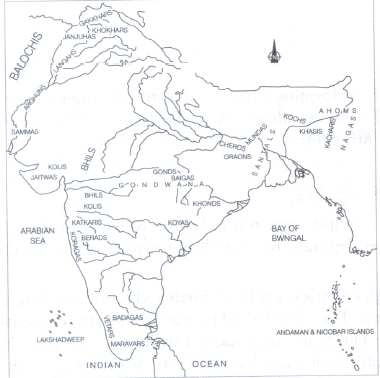
These tribes settled temporarily at the places which suited them as per their need and livelihood. Whenever, they found the environment or their mode of living unfavourable, they migrated to other suitable places.
(i) The Khokhar tribes are from the Punjab region of Pakistan and North Western India. They were designated as an agricultural tribal and were usually classified as Jat and Rajput. There were several subdivisions of the Khohhan bribe, e.g., Bandial, Bhachan, Dhaulka, Ganjial, Jalap etc. All of them were mainly dependent on their fertle land for livelihood.
(ii) The Gaddia are people who normally reside in the Mandi, Kangra and Bilaspur district of Himachal Pradesh. Their main occupation is Shepherding. They make their livelihood by rearing and selling sheep, goats, mules and horses. They spent their winter in the low hills of Siwalik range, grazing their flocks in forests. By April, they moved on to higher mountain meadows when the snow melted. By September, they again began their return movement.
25.
()
Paiks were the labourers who were forced to work in Ahom state. Bhuiyans were the landlords.
26.
Major Features of the Tribal Societies:
(i) Members of each tribe were united by kinship bonds.
(ii) Many tribes obtained their livelihood from agriculture.
(iii) Others were hunter-gatherers or herders.
(iv) Some tribes were nomadic and moved from one place to another.
(v) A tribal group controlled land and pastures jointly, and divided these amongst households according to its own rules.
(vi) Many large tribes evolved in different parts of the subcontinent. They usually lived in forests, hills, deserts and places difficult to reach. Sometimes they clashed with the more powerful caste-based societies.
(vii) The tribes retained their freedom and preserved their separate culture.
27.
Yes, I have seen tribal people when I went for a visit to Chhattisgarh last year. Some states where tribal people live in India include Chhattisgarh, Odisha, Jharkhand, Madhya Pradesh and some parts of north-eastern states.

7th Standard CBSE Syllabus & Materials
7th Standard CBSE
CBSE 7th Social Science Theme B - New Beginnings : Cities and States - New Sample Question Papers Study Material - QB365 Set A
NEW7th Standard CBSE
CBSE 7th Social Science Theme A - Climates of India - New Sample Question Papers Study Material - QB365 Set A
NEW7th Standard CBSE
CBSE 7th Social Science Theme A - Geographical Diversity of India - New Sample Question Papers Study Material - QB365 Set A
NEW7th Standard CBSE
CBSE 7th Science Earth, Moon and the Sun - New Sample Question Papers Study Material - QB365 Set A



CBSE 7th Standard CBSE Subjects
CBSE Standards




