
 100% FREE ACCESS
7th Standard CBSE Syllabus & Materials
7th Standard CBSE
CBSE 7th Social Science Theme E - Understanding Market - New Sample Question Papers Study Material - QB365 Set A
NEW7th Standard CBSE
CBSE 7th Social Science Theme E - From Barter to Money - New Sample Question Papers Study Material - QB365 Set A
NEW7th Standard CBSE
CBSE 7th Social Science Theme D - The Constitution of India- An Introduction - New Sample Question Papers Study Material - QB365 Set A
NEW7th Standard CBSE
CBSE 7th Social Science Theme D - From the Rulers to the Ruled : Types of Governments - New Sample Question Papers Study Material - QB365 Set A
NEW7th Standard CBSE
CBSE 7th Social Science Theme B - The Age of Reorganisation - New Sample Question Papers Study Material - QB365 Set A
NEW7th Standard CBSE
CBSE 7th Social Science Theme B - The Rise of Empires - New Sample Question Papers Study Material - QB365 Set A

Published on: 30/09/2019
Understanding Media
Download CBSE Class 7th Standard CBSE Social Science question papers, sample papers, important questions, and previous year solved papers in PDF format. Get free study materials, NCERT solutions, and exam preparation resources for Class 7th Standard CBSE Social Science
Questions + Answers key
Take MCQ Social Science Test
1.
What does TV do to us and what can we do with TV?
In many of our homes. TV is on for a very long time. In many ways, a lot of our impressions about the world around us are formed by what we see on TV it is like a window on the world. How do you think it influences us? TV has different types of programmes, soap operas like Saas Bhi Kabhi Bahu Thi, game shows, like Kaun Banega Crorepati, reality TV shows like Big Boss, news, sports and cartoons. Before, in between and after each programme are advertisements. Since, TV time costs so much money, only those programmes that can attract the maximum number of viewers are shown. Can you think of what such programmes might be? Think of what are the kinds of things that TV shows and what it does not. Does it show us more about the lives of the rich or the poor?
We need to think about what TV does to us, how it shapes our views of the world, our beliefs, attitudes and values. We need to realise that it gives us a partial view of the world. While we enjoy our favourite programmes, we should always be aware of the large exciting world beyond our TV screens. There is so much happening out there that TV ignores. A world beyond film stars, celebrities and rich lifestyles, a world that all of us need to reach out to and respond to in various ways. We need to be active viewers, who question whatever we see and hear, while we may enjoy it too!
(a) What does TV do to us?
(b) Do television programmes show us all the happenings around the world?
2.
What do you know about Khabar Lahriya?
3.
The reality is that media is far from independent' Comment.
4.
'Writing a balanced report, however, depends on the media is being independent.' Discuss.
5.
How does television affect our lives?
6.
"Everything ranging from the stall at the local fair to the programme that you see on TV can be called media." Discuss.
7.
You have read about the ways in which the media ' set the agenda'.What kind of effect does this have in a democracy? Provide two examples to support your point of view.
8.
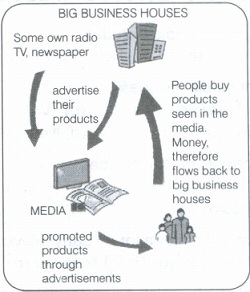
Can you give this diagram a title? What do you understand about the link between media and big business from this diagram?
9.
Can you think of an issue that does not seem important to you because it is never featured in the media?
10.
What is the consequence of the media 'setting the agenda' by reporting on the Fashion Week rather than the slum demolitions?
11.
Pretend that you are a journalist for a newspaper and write a balanced story from the two news reports.
12.
Do you think it is important to know both sides of story? Why?
13.
List three things that you know about some other part of the world from watching television.
14.
Ask older members of your family about what they used to listen to on the radio when there was no TV around. Find out from them when the first TV came to your area. When was cable TV introduced?
15.
Look at the collage and list six various kinds. of media that you see.
1.
(a) Television plays a significant role in lives of people. We form a lot of impressions about the world around us by watching TV. It influences our thinking and helps develop various viewpoints.
(b) There is so much happening round the world that TV ignores. There is a world beyond film stars, celebrities, etc which we need to see and respond to.
2.
Khabar Lahriya is a local newspaper of Chitrakoot district, Uttar Pradesh, which is fortnightly run by eight Dalit women. This is eight-page newspaper written in Bundeli, the local language and reports on Dalit issues and cases of violence against women and political corruption.
3.
The media is not able to provide a balanced report which is an important aspect of providing information. The reason is that media is always under the government control. Government controls through censoring its information in a way of preventing news items, scenes from movies, lyrics of song, etc from being shared with the larger public. Sometimes it is the interest of big business houses which controls the media's coverage. Hence, media houses are not able to work independently.
4.
It is significant for the media to work under no one's control and influence. Coverage of news should not be controlled by any business house, government or by any body's interest. It is only then that balanced report is provided to the citizens. The media house should not be pressurised into covering any particular aspect of the story. It is independent media which provides reliable and unbiased information.
5.
Television has become so significant that we cannot think of our lives without it. It has made us of think ourselves as members of larger global world.
Television helps us to view news and entertainment channels from other parts of the world.
For example, we can see images of a storm that has hit the coast of Florida, United States by sitting in India. TV has brought the world closer to us.
6.
Media is a word frequently used to collectively refer television, radio, newspapers, internet and various other forms of communication. Media is something that affects our daily lives. It is a plural form of the term 'medium' and includes all things through which we communicate in society. Everything ranging from phone call to evening news on TV or stall at local fair to any programme we watch on TV, called media.
7.
Media 'setting the agenda' has following effect in democracy
(i) It is through the media that people come to know about working of the government.
(ii) People form opinion based on the agenda set by the media.
(iii) Sometimes government prevents the media from publishing particular things and is known as censorship.
(iv) On the other hand, media is also under the influence of big business houses.
(v) Big business houses make media work for their own interests and hence balanced report is not prepared.
Two such examples are
(a) Clean drinking water is a major issue but media is never seen discussing this issue.
(b) News of fashion week formed the headlines of front page which largely benefitted the media houses.
8.
TITLE - Big Business Houses and Media
Link between media and big business houses is
(i) Maximum number of media houses are owned by big business houses.
(ii) They advertise their products through these media houses and media houses earn heavy amount in return. People get attracted towards these products and buy them.
(iii) It is a mutually beneficial relationship between the media and business houses.
9.
Poor sanitary conditions of the people living below the poverty line.
10.
By 'setting the agenda' on the fashion week rather than the slum demolitions, media houses will earn huge amount of money.
11.
Balanced story
(i) The government order closure of polluting factories in the city. The pollution had already assumed alarming proportions.
(ii) Factory owners and workers protested violently against the closure. The city life came to a standstill.
(iii) For clean and green city, closure of factories was essential.
(iv) The government should have relocated the factories at suitable locations wirh proper time frame.
12.
Yes, it is important to know both sides of story in order to develop correct views about that information and give opinions.
13.
(i) Tsunami in Indonesia
(ii) Rita and Caterina in USA
(iii) Blast in Samjhauta Express.
14.
They used to listen following programmes on the radio when there was no television around.
Radio Ceylon
Ap Hi Ke Geet
Binaca Geet Mala
Vividh Bharati
Hawa Mahal
Man Chahe Geet
The first TV came in 1984 in our area.
Cable TV was introduced in 1990 in our area.
15.
(i) Radio
(ii) DVD
(iii) Computer
(iv) Newspapers, magazines
(v) Television
(vi) Transistor
(vii) Internet
(viii) Periodicals.

7th Standard CBSE Syllabus & Materials
7th Standard CBSE
CBSE 7th Social Science Theme B - New Beginnings : Cities and States - New Sample Question Papers Study Material - QB365 Set A
NEW7th Standard CBSE
CBSE 7th Social Science Theme A - Climates of India - New Sample Question Papers Study Material - QB365 Set A
NEW7th Standard CBSE
CBSE 7th Social Science Theme A - Geographical Diversity of India - New Sample Question Papers Study Material - QB365 Set A
NEW7th Standard CBSE
CBSE 7th Science Earth, Moon and the Sun - New Sample Question Papers Study Material - QB365 Set A



CBSE 7th Standard CBSE Subjects
CBSE Standards




