
 100% FREE ACCESS
7th Standard CBSE Syllabus & Materials
7th Standard CBSE
CBSE 7th Social Science Theme E - Understanding Market - New Sample Question Papers Study Material - QB365 Set A
NEW7th Standard CBSE
CBSE 7th Social Science Theme E - From Barter to Money - New Sample Question Papers Study Material - QB365 Set A
NEW7th Standard CBSE
CBSE 7th Social Science Theme D - The Constitution of India- An Introduction - New Sample Question Papers Study Material - QB365 Set A
NEW7th Standard CBSE
CBSE 7th Social Science Theme D - From the Rulers to the Ruled : Types of Governments - New Sample Question Papers Study Material - QB365 Set A
NEW7th Standard CBSE
CBSE 7th Social Science Theme B - The Age of Reorganisation - New Sample Question Papers Study Material - QB365 Set A
NEW7th Standard CBSE
CBSE 7th Social Science Theme B - The Rise of Empires - New Sample Question Papers Study Material - QB365 Set A

Published on: 14/08/2019
Eighteenth-Century Political Formations
Download CBSE Class 7th Standard CBSE Social Science question papers, sample papers, important questions, and previous year solved papers in PDF format. Get free study materials, NCERT solutions, and exam preparation resources for Class 7th Standard CBSE Social Science
Questions + Answers key
Take MCQ Social Science Test
1.
Malwa
2.
Nadir Shah
3.
Umara
4.
Misl
5.
Subadar
6.
___________________ adopted the title of Chhatrapati in 1962.
7.
____________ were Telugu warrior chiefs
8.
Asaf [ah founded the Hyderabad state in ___________
9.
The Mughal Emperors under........were unable to arrest the gradual shifting of political and economic authority in the hands of provincial governors.
10.
Aurangzeb fought a protracted war in the.......
11.
[ats consolidated their power under the leadership of Churaman.
12.
Influential Rajput families claimed the subadari of the rich provinces of Gujarat and Malwa
13.
Nizam-ul-Mulk was the founder of Awadh state.
14.
Poona became the capital of the Marathas in the 18th century.
15.
Nadir Shah invaded Bengal
16.
Who were the very powerful governors of Awadh, Bengal and Hyderabad among the early and later
Mughal rulers?
17.
What is the Khalsa?
18.
How did the Mughals influence got reduced in Awadh region?
19.
Why did the Marathas want to expand beyond the Deccan?
20.
Panipat and Ballabhgarh became important trading centres under the domination of the
Jats
Marathas
Sikhs
Rajputs
21.
Chauth was the.....of the land revenue
10%
25%
50%
20%
22.
The Jats consolidated their power during the
late 17th and 18th centuries
late 18th and 19th centuries
late 19th and 20th centuries
late 16th and 17th centuries
23.
Maratha seized from the Mughals
Malwa and Gujarat
Agra and Delhi
Awadh and Hyderabad
Bengal and Orissa
24.
The third battle of Panipat was fought in
1760
1761
1762
1763
25.
What common features were shared by the three states-Awadh, Bengal and Hyderabad?
26.
(i) In the map of India, mark the territory under British Control during the mid-18th Century.
(ii) Also mark external boundary of Mughal empire, 1700
27.
Under whom did Bharatpur emerge as a strong state?
28.
Name the three states that were carved out of the old Mughal provinces in the 18th century
29.
Upto where does the Sikh territories extended?
30.
How Sikhs organised themselves?
31.
Who held the governorship of Gujarat?
32.
Write the common features of Awadh, Bengal and Hyderabad.
1.
()
Sawai Raja [ai Singh
2.
()
Delhi
3.
()
a high noble
4.
()
a band of Sikh warriors
5.
()
provincial governor
6.
()
Shivaji.
7.
()
Nayakar
8.
()
1720 A.D.
9.
()
Aurangzeb
10.
()
Deccan
11.
(a)
12.
(a)
13.
(b)
14.
(a)
15.
(b)
16.
(i) Saadat Khan was powerful governor of Awadh with zat rank 6,000.
(ii) Murshid Quli Khan was powerful ~overnor of Bengal with zat rank 7,000.
(iii)Asaf [ah was powerful governor of Hyderabad with zat rank 7,000.
17.
i) The Mughal Emperor Jahangir looked upon the Sikh communiry as a potential threat and he ordered the execution of Guru Arjan in 1606. The Sikh movement began to get politicised in the 17th century, a development that culminated in the institution of the Khalsa by Guru Gobind Singh in 1699. The community of the Sikhs, called the Khalsa panth, became a political entity.
ii) He emphasised the worship of one God.
iii) He laid stress on the importance of right belief and worship, honest living and helping others.
18.
Burhan-ul-Mulk tried to reduce Mughal influence in the Awadh region by taking the following steps
(i) He reduced the number of office holders (Jagirdars) appointed by the Mughals.
(ii) He reduced the size of Jagirs and appointed his own loyal servants to vacant positions.
(iii) The accounts of Jagirdars were checked to prevent cheating and the revenues of all districts were re-assessed by officials appointed by the Nawab's court
19.
Marathas wanted to expand beyond the Deccan because of the following reasons
(i) They wanted to reduce the authority of the Mughal Empire. Maratha king wanted to be recognised as the overlord of the entire Deccan Plateau.
(ii) To possess the right to collect chauth and sardeshmukhi in the entire region.
20.
21.
(b)
25%
22.
(a)
late 17th and 18th centuries
23.
(a)
Malwa and Gujarat
24.
(b)
1761
25.
The common features of the three states are
(i) Though many of the larger states were established by erstwhile Mughal nobles, they were highly suspicious of some of the administrative systems that they had inherited, specially the Jagirdari system
(ii) All the three regimes contracted with revenue farmers for the collection of revenue rather than relying upon the officers of the state.
(iii) The third common feature in these three states was their emerging relationship with rich bankers and merchants. These people lent money to revenue farmers, received land as security and collected taxes from these lands through their own agents.
26.
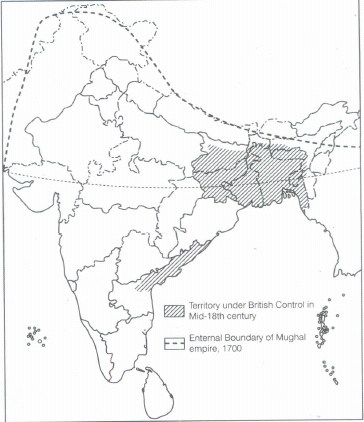
27.
()
Under Suraj Mal the kingdom of Bharatpur emerged as a strong state.
28.
()
Awadh, Bengal and Hyderabad were the three states that were carved out of the old Mughal provinces in the 18th century.
29.
()
The Sikh territories extended from the Indus to the Jamuna in the late 18th century.
30.
()
The Sikhs organised themselves into a number of bands called Jathas and later on misls.
31.
()
The governorship of Gujarat was held by Raja Ajit Singh of Jodhpur.
32.
The three states Awadh, Bengal and Hyderabad had certain common features:
(i) They were all established by the Mughal nobles, They were highly suspicious of some of the administrative system that they had interested in particular, the jagirdari system.
(ii) Their methods of tax collection were different. Rather than relying upon the officers of the state all three regimes contracted with revenue farmers for the collection of revenue.
(iii) All these states had relationship with the bankers and the moneylenders. These people lent money to revenue farmers, received land as security and collected taxes from these lands through their own agents.

7th Standard CBSE Syllabus & Materials
7th Standard CBSE
CBSE 7th Social Science Theme B - New Beginnings : Cities and States - New Sample Question Papers Study Material - QB365 Set A
NEW7th Standard CBSE
CBSE 7th Social Science Theme A - Climates of India - New Sample Question Papers Study Material - QB365 Set A
NEW7th Standard CBSE
CBSE 7th Social Science Theme A - Geographical Diversity of India - New Sample Question Papers Study Material - QB365 Set A
NEW7th Standard CBSE
CBSE 7th Science Earth, Moon and the Sun - New Sample Question Papers Study Material - QB365 Set A



CBSE 7th Standard CBSE Subjects
CBSE Standards




