
 100% FREE ACCESS
7th Standard CBSE Syllabus & Materials
7th Standard CBSE
CBSE 7th Social Science Theme E - Understanding Market - New Sample Question Papers Study Material - QB365 Set A
NEW7th Standard CBSE
CBSE 7th Social Science Theme E - From Barter to Money - New Sample Question Papers Study Material - QB365 Set A
NEW7th Standard CBSE
CBSE 7th Social Science Theme D - The Constitution of India- An Introduction - New Sample Question Papers Study Material - QB365 Set A
NEW7th Standard CBSE
CBSE 7th Social Science Theme D - From the Rulers to the Ruled : Types of Governments - New Sample Question Papers Study Material - QB365 Set A
NEW7th Standard CBSE
CBSE 7th Social Science Theme B - The Age of Reorganisation - New Sample Question Papers Study Material - QB365 Set A
NEW7th Standard CBSE
CBSE 7th Social Science Theme B - The Rise of Empires - New Sample Question Papers Study Material - QB365 Set A

Published on: 26/07/2019
New Kings And Kingdoms
Download CBSE Class 7th Standard CBSE Social Science question papers, sample papers, important questions, and previous year solved papers in PDF format. Get free study materials, NCERT solutions, and exam preparation resources for Class 7th Standard CBSE Social Science
Questions + Answers key
Take MCQ Social Science Test
1.
Which district provided the details of the way in which sabha was organised? What was the system of election of committee members for sabha?
2.
What were Prashastis?
3.
What did the new dynasties do to gain acceptance?
4.
How did the Rashtrakutas become powerful?
5.
What were the two major cities under the control of the Chahamanas?
6.
Who defeated Muhammad Ghori?
7.
Who were called 'nadu'?
8.
Who opposed the expansion of Chahamanas towards West and East?
9.
Who were the persons who were given task of collecting revenue?
10.
What type of taxes were collected by Cholas according to the inscriptions?
11.
Explain 'Tripartite Struggle'.
12.
What were the achievements of Nagabhatta?
13.
In the mid of 8th century _______ overthrew his Chalukya ruler.
14.
Revenue was also collected from ______
15.
Vetti was one kind of ____________ taken in the form of forced labour.
16.
The wealth Mahmud carried away was used to create a splendid capital city at ________________.
17.
Some rich landowners of Chola rule were honoured with the titles like _________.
18.
Palas ruled over present state of Tamil Nadu.
19.
In the mid of 8th century Dantidurga overthrew his Chola ruler
20.
Ellora cave sculpture is a work of Rashtrakuta period.
21.
Brahmanas often received land grants called as Jagir.
22.
Chola Kings gave some rich landowners titles like Muvendavelan (A velan or peasant serving 'three kings).
23.
Muttavaiyar power
24.
Vetti
25.
Chola rule
26.
Rashtrakutas
27.
Gurjara-Pratiharas
28.
Locate the following
(i) Gurjara - Pratiharas (ii) Rashtrakutas (iii) Palas (iv) Cholas (v) Chahamanas
29.
Sultan Mahmud of Ghazni came from
Afghanistan
Arab
Persia
China
30.
Kings rewarded Brahmanas grants of
money
land
gold
big palace
31.
In the mid-8th, Dantidurga overthrew his Chalukya overlord and became the chief of
Rashtrakuta
Chola
Brahmana
Samanta
32.
Many new dynasties emerged after
15th century
7th century
6th century
12th century
33.
Who were Maha-Samantas?
Samantas who gained wealth
Samantas who wrote good text
Samantas who became more powerful
Both 'a' and 'c'
1.
Inscriptions from Uttaramerur in Chingleput district, Tamil Nadu, provided details of the way in which sabha was organized. The sabha had separate committees to look after irrigation work, gardens, temples, etc. Names of the eligible candidates were written on small tickets of palm leaf. The tickets were put into an earthenware pot. A young boy was asked to take out the tickets one by one for each committee.
2.
Prashastis were the certificates which contained details that may be literally true. They tell us how rulers wanted to depict themselves as valiant, victorious warriors.
These were composed by learned Brahmanas, who occasionally helped in the administration.
3.
The new dynasties undertook the following things to gain acceptance
The new dynasties were based in some specific region.
They tried to control other areas.
The most prized area was the city of Kanauj in the Ganga valley.
Rulers belonging to Gurjara-Pratiharas, Rashtrakutas and the Palas fought against each other to get control of Kanauj for centuries.
New temples were built to demonstrate.ruler's power and wealth. They attacked other's kingdom and used to plunder the temples of the capital so as to gain wealth.
4.
Rashtrakutas become powerful in the following ways
In the beginning, Rashtrakutas were subordinates to the Chalukyas of Karnataka.
In the mid-Bth century Dantidurga, a Rashtrakuta chief, overthrew his Chalukya overlord.
He performed a ritual called Hiranya - Garbha with the help of Brahmanas.
This ritual was then, considered to lead the rebirth of the sacrificer as Kshatriya, even if he was not a Kshatriya born.
5.
The two major cities under the control of the Chahamanas were Delhi and Ajmer.
6.
()
Prithviraj Chauhan defeated Muhammad Ghori in 1191 in first battle of Tarain but later on in 1192, he was defeated in second battle of Tarain by Ghori.
7.
()
The larger units of the groups of 'ur' or villages were called nadu.
8.
()
The Chalukyas of Gujarat and Gahadavalas of Western Uttar Pradesh opposed the Chahamanas.
9.
()
The persons who were given task for collecting revenue were from influential families called revenue functionaries and positions were often hereditary.
10.
()
According to the inscription, Cholas used to collect Vetti (tax in the form of forced labour) and Kadamai (tax as a land revenue) and many other taxes.
11.
All the ruling dynasties were based in a specific region. At the same time they tried to control the other areas. One particularly prized area was the city of Kanauj in the Ganga valley. For centuries, rulers belonging to the Curjara-Pratihara, Rashtrakuta and Pala dynasties fought for control over Kanauj. As there were three 'parties' in this long drawn conflict. Historians often describe it as the "tripartite struggle". Rulers also tried to demonstrate their power and resources by building large temples. When they attacked one another's kingdom; they often chose to target temples, which were sometimes extremely rich.
12.
Many rulers described their achievements in Prashastis. One prashasti, written in Sanskrit was found in Gwalior (Madhya Pradesh) spoke highly about the success of Nagabhatta, a Pratihara King. It follows like this.
The king of Andhra, Saindhava (Sind), Vidarbha (Maharashtra) Kalinga (part of Orissa) fell before him even as he was a prince.
He won a victory over Chakrayudha (the ruler of Kanauj). He defeated king of Vanga (Part of Bengal), Anarta (part of Gujarat), Malava (part of Madhya Pradesh), Kirata (forest peoples), Turushka (Turks), VatsaMatsya (both from North India).
13.
()
Dantidurga
14.
()
Traders
15.
()
Tax
16.
()
Ghazni
17.
()
Muvendavelan, araiyar
18.
(b)
19.
(b)
20.
(a)
21.
(b)
22.
(a)
23.
()
Kaveri
24.
()
tax
25.
()
Tamil Nadu
26.
()
Western Deccan
27.
()
Gujarat and Rajasthan
28.
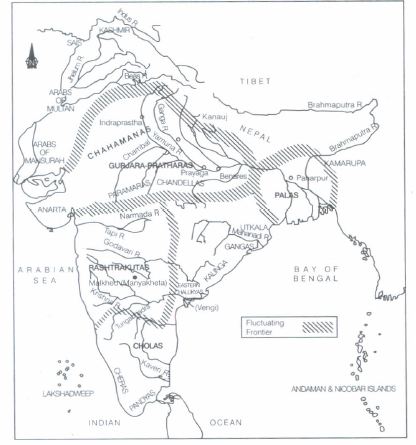
29.
(a)
Afghanistan
30.
(b)
land
31.
(a)
Rashtrakuta
32.
(b)
7th century
33.
(d)
Both 'a' and 'c'

7th Standard CBSE Syllabus & Materials
7th Standard CBSE
CBSE 7th Social Science Theme B - New Beginnings : Cities and States - New Sample Question Papers Study Material - QB365 Set A
NEW7th Standard CBSE
CBSE 7th Social Science Theme A - Climates of India - New Sample Question Papers Study Material - QB365 Set A
NEW7th Standard CBSE
CBSE 7th Social Science Theme A - Geographical Diversity of India - New Sample Question Papers Study Material - QB365 Set A
NEW7th Standard CBSE
CBSE 7th Science Earth, Moon and the Sun - New Sample Question Papers Study Material - QB365 Set A



CBSE 7th Standard CBSE Subjects
CBSE Standards




