
 100% FREE ACCESS
7th Standard CBSE Syllabus & Materials
7th Standard CBSE
CBSE 7th Social Science Theme E - Understanding Market - New Sample Question Papers Study Material - QB365 Set A
NEW7th Standard CBSE
CBSE 7th Social Science Theme E - From Barter to Money - New Sample Question Papers Study Material - QB365 Set A
NEW7th Standard CBSE
CBSE 7th Social Science Theme D - The Constitution of India- An Introduction - New Sample Question Papers Study Material - QB365 Set A
NEW7th Standard CBSE
CBSE 7th Social Science Theme D - From the Rulers to the Ruled : Types of Governments - New Sample Question Papers Study Material - QB365 Set A
NEW7th Standard CBSE
CBSE 7th Social Science Theme B - The Age of Reorganisation - New Sample Question Papers Study Material - QB365 Set A
NEW7th Standard CBSE
CBSE 7th Social Science Theme B - The Rise of Empires - New Sample Question Papers Study Material - QB365 Set A

Published on: 12/08/2019
Devotional Paths To The Divine
Download CBSE Class 7th Standard CBSE Social Science question papers, sample papers, important questions, and previous year solved papers in PDF format. Get free study materials, NCERT solutions, and exam preparation resources for Class 7th Standard CBSE Social Science
Questions + Answers key
Take MCQ Social Science Test
1.
What is a Khanqahs?
2.
Who was Ramanuja? What are the main points of his preachings?
3.
You can observe this process of local myths and legends receiving wider acceptance even today. Can you find some examples around you?
4.
Surdas
5.
Sufis
6.
Divya prabandham
7.
Social privileges came from
8.
The Buddha
9.
Shankara was an advocate of ___________
10.
They__________argued strongly for the equality of all human beings.
11.
From 7th to 9th centuries saw the emergence of new religious movements, led by the Nayanars and___________
12.
_________,___________and____________were advocates of Virashaivism.
13.
Shankara was an advocate of_________
14.
Whose songs become popular in Rajasthan and Gujarat?
Surdas
Tulsidas
Guru Nanak
Mira Bai
15.
Surdas was an ardent devotee of :
Vishnu
Krishna
Shiva
Durga
16.
Sufis were ............ mystics
Hindu
Muslim
Buddha
None of these
17.
Muslim scholars developed a holy law called as
sufiyat
silsilas
shariat
zikr
18.
Many learned texts made the belief among people that social privileges come from birth in a
rich family
poor family
noble family
brahman family
19.
Write a brief note on new religious developments in North India.
20.
Alvars saint's compilation of songs is known as Divya Prabandham.
21.
There were 63 Nayanars in all.
22.
Nayanars and Alvars developed new kind of Bhakti in North India.
23.
Saint Janeshwara rewrote Gita in Marathi.
24.
Mirabai became a disciple of Ravidas.
25.
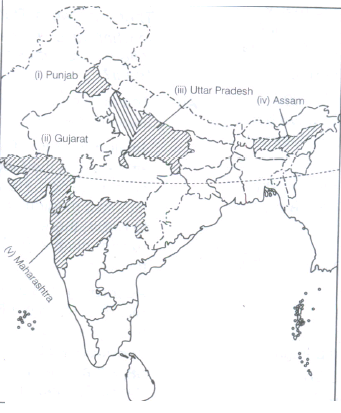
In the given below map, some states associated with great saints are marked. Name the saint that belong to each of the following states.
26.
Who was Shankaracharya and where was he born?
27.
Who were Sufis?
28.
What are Namghars?
29.
Guru Gobind Singh was associated with which institution?
30.
Who was Surdas?
31.
Discuss the ideas about the social order express in these compositions
32.
Try and find out more about the ideas of Shankara or Ramanuja.
33.
You can observe this process of local myths and legends receiving wider acceptance even today. Can you find some examples around you?
1.
Khanqahs were houses of rest for travellers especially the one kept by a religious order. Sufi masters usually held their assemblies here. Devotees of various descriptions including members of the royalty, nobility and ordinary people flocked to these Khanqahs.
2.
Ramanuja was a Bhakti saint. He was born in Tamil Nadu in the 11th century. He was deeply influenced by the Alvars. The main points of his preachings are
(i) He taught people to get salvation by showing devotion to Vishnu.
(ii) He propounded the doctrine of Vishishtadvaita or qualified oneness.
3.
India is a land of huge population, illiteracy is still rampant in India. Many local myths and legends have been receiving wider acceptance even today. Some notable amongst them are:
1. India is a place of snake charmers and Black Magic. India have been facing this myth even before there was any temple. But this myth does not dominate or define the identity of India.
2. Indian people are believed ro have bad luck, if any cat crosses their way. This myth is gaining ground even among the literate classes of society.
3. Indian people think of not having milk while leaving for a journey. They instead can take curd. This myth is still much prevalent.
4.
()
Disciples in sufi system
5.
()
Surasaravali
6.
()
Set of compilation of Alvar's songs
7.
()
Noble family
8.
()
Questioned social differences
9.
()
Advaita
10.
()
Virashaivas
11.
()
Alvars
12.
()
Basavanna, Allama Prabhu, Akkamahadevi
13.
()
advaita
14.
(d)
Mira Bai
15.
(b)
Krishna
16.
(b)
Muslim
17.
(c)
shariat
18.
(c)
noble family
19.
A New wave of Bhakti movement erupted during the 13th century. This was an age when Islam, Brahmanical Hinduism, Sufism, various strands of Bhakti, the Nath panthis, Siddhas and yogis influenced one another.
The main reason was that the ordinary strata of the society such as craftspersons, peasants, traders, etc showed their interest in listening to these new saints. The notable saints like Kabir and Baba Guru Nanak did not approve the orthodox religions. Tulsidas and Surdas accepted existing beliefs and practices but wanted to make these accessible to all. Tulsidas conceived of God in theform of Rama who wrote Ramacharitmanas in praise of him.
Surdas was an ordent devotee of Krishna. His compositions compiled in the Sursagara, Sursarawali and Sahitya Lahari, express his devotion. Shankaradeva of Assam emphasised devotion to Vishnu and composed poems and plays in Assamese. Besides, Surdas, Dadu Dayal, Ravidas and Mirabai are worth mentioning about their role in Bhakti movement.
20.
(a)
21.
(a)
22.
(a)
23.
(b)
24.
(a)
25.
(i) Guru Nanak, (ii) Mirabai, Narsi Mehta (iii) Surdas (iv) Shankaradeva (v) Eknath, Tukaram, Namdev
26.
()
Shankaracharya was a philosopher and he was born in Kerala in the eighth century.
27.
()
Sufis were Muslim mystics who see the world in a different way than that of others.
28.
()
Namghars are houses of recitation and prayer, a practice that continues even today.
29.
()
Guru Gobind Singh was associated with the institution of Khalsa.
30.
()
Surdas was an ardent devotee of Krishna.
31.
In these compositions, the poet tries to express his pity on the position of low caste. He is singing in these lines that his struggle of life lifts over food to eat and he and nothing else to do.
32.
Shankara considered the world around to be an illusion or maya and preached renunciation of the world and adoption of the path of knowledge to understand the true nature of Brahman and attain salvation while according to Ramanuja salvation can be attained through intense devotion to Vishnu, who in his grace helps the devotees to attain the bliss of union with him.
33.
Yes, the local myths and legends are receiving wider acceptance today. In last few years, we have heard a rumour that Lord Ganesha is drinking milk or a part of sea water become unsalty due to the blessings of a peer.

7th Standard CBSE Syllabus & Materials
7th Standard CBSE
CBSE 7th Social Science Theme B - New Beginnings : Cities and States - New Sample Question Papers Study Material - QB365 Set A
NEW7th Standard CBSE
CBSE 7th Social Science Theme A - Climates of India - New Sample Question Papers Study Material - QB365 Set A
NEW7th Standard CBSE
CBSE 7th Social Science Theme A - Geographical Diversity of India - New Sample Question Papers Study Material - QB365 Set A
NEW7th Standard CBSE
CBSE 7th Science Earth, Moon and the Sun - New Sample Question Papers Study Material - QB365 Set A



CBSE 7th Standard CBSE Subjects
CBSE Standards




