
 100% FREE ACCESS
7th Standard CBSE Syllabus & Materials
7th Standard CBSE
CBSE 7th Social Science Theme E - Understanding Market - New Sample Question Papers Study Material - QB365 Set A
NEW7th Standard CBSE
CBSE 7th Social Science Theme E - From Barter to Money - New Sample Question Papers Study Material - QB365 Set A
NEW7th Standard CBSE
CBSE 7th Social Science Theme D - The Constitution of India- An Introduction - New Sample Question Papers Study Material - QB365 Set A
NEW7th Standard CBSE
CBSE 7th Social Science Theme D - From the Rulers to the Ruled : Types of Governments - New Sample Question Papers Study Material - QB365 Set A
NEW7th Standard CBSE
CBSE 7th Social Science Theme B - The Age of Reorganisation - New Sample Question Papers Study Material - QB365 Set A
NEW7th Standard CBSE
CBSE 7th Social Science Theme B - The Rise of Empires - New Sample Question Papers Study Material - QB365 Set A

Published on: 30/09/2019
Women Change The World
Download CBSE Class 7th Standard CBSE Social Science question papers, sample papers, important questions, and previous year solved papers in PDF format. Get free study materials, NCERT solutions, and exam preparation resources for Class 7th Standard CBSE Social Science
Questions + Answers key
Take MCQ Social Science Test
1.
How was campaigning used as a tool in women's movements?
2.
In our society, people associate certain professions and jobs with gender. Comment.
3.
State the new developments that took place in the nineteenth century.
4.
Why was law against dowry system passed in the 1980s?
5.
Write about women's movements?
6.
Give an account about the learning scenario in the 19th century.
7.
From the given table, convert the figure of primary class children who leave school into a bar diagram. The first two percentages have already been converted for you in the bar diagram on the left.
8.
Write about various social groups and their schooling.
9.
Rokeya Sakhawat Hossain was stopped from learning English and Bangia. Why? How did she manage to learn these languages?
10.
What do yo mean by Women's Movement?
11.
What do you know about census? Give an account of 1961 and 2001 census?
12.
List one reason why learning the alphabet was so important to women like Rashsundari Devi, Ramabai and Rokeya?
13.
How do you think stereotypes, about what women can or cannot do, affect women's right to equality?
14.
Study the given table and answer the following questions:
This table shows the percentage of girls and boys leaving schools
| School level | All boys | SC boys | ST boys | All girls | SC girls | ST girls | Total |
| Primary (Classes 1-5) | 34 | 37 | 49 | 29 | 36 | 49 | 31 |
| Elementary (Classes 6-8) | 52 | 57 | 69 | 53 | 62 | 71 | 52 |
| Secondary (Classes 9-10) | 61 | 71 | 78 | 65 | 76 | 81 | 63 |
Source: Select Education Survey, GIO 2003 - 2004
(a) What percentage of children leave school at the elementary level?
(b) At which level of education do you see the highest percentage of children leaving?
(c) Why do you think that the percentage of Adivasi girls and boys leaving school is higher than that of any other group?
15.
See what images your class drew by filling in the table below. Add up the number of male and female images separately for each occupation.
| Category | Male image | Female image |
| Teacher | ||
| Farmer | ||
| Factory worker | ||
| Nurse | ||
| Scientist | ||
| Pilot |
(i) Are there more images of men than women?
(ii) In what kinds of jobs were there more images of men than women?
(iii) Have all the nurses been drawn as females? Why?
(iv) Are there fewer images of female farmers? If so, why?
1.
Campaigns are an important part of women's movement. These led to passing of certain laws. Women's movement have been able to achieve success in this way.
(i)A law was passed in 2006 to give protection to women against domestic violence.
(ii) In 1997 Supreme court promulgated guidelines to protect women against sexual harassment.
(iii) In the 1980's due to campaigns and media support dowry laws were changed to punish families who sought dowry.
(iv) 8th March is celebrated as International Women's Day.
2.
In our society we associate certain professions and jobs with gender. For example, the profession of teaching, nursing, care giving, household work is associated with women.
(i)Women are associated with jobs which are gentle, require patience, that are less physical and technical. It is linked to women's role within the family.
(ii) It is believed that women do not have a technical or scientific mind. They are considered physically weak.
(iii) Whereas armed forces, agriculture, mechanical and technical jobs are associated with men.
3.
Many new ideas about education and learning emerged in the 19th century. Many schools opened and many communities sent their children to school. But, even now there was opposition to girl education. Many men and women made efforts to open schools for girls and struggle for girls continued.
4.
Women groups across the country campaigned against 'dowry deaths' -young brides being burned by in-laws or husbands for more dowry. Satyarani was an active member who fought a long legal battle to get justice for her daughter.
Women groups took out street marches and approached courts. They reached public through newspapers etc. Finally a law was passed making dowry a legal offence.
5.
Women, individually and collectively, have struggled to bring about changes in their status and get equality in the society, this is known as women's movements. It awakened women for their rights. Individual women and women's organisations from different parts of the county are part of these movements, along with some men.
6.
In the 19th century, many new ideas about education and learning emerged.
(i) Schools became more common and communities that had never learnt reading and writing started sending their children to school.
(ii) There was a lot of opposition to educating girls even then, many women and men made efforts to open schools for girls.
(iii) Women struggled to learn to read and write.
7.
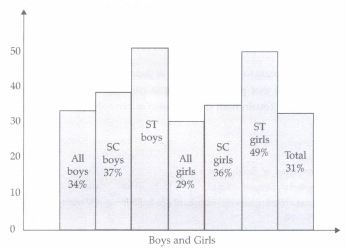
8.
There are several social groups such as Scheduled Castes (SCs) (official term for Dalits) Schedule Tribes (STs) official term for Adivasis, Muslim Communities, etc. It has been observed that girls belonging to SC and ST communities are less likely to remain in school and girls from Muslim community drop out without even completing their primary school. Girls from SC and ST communities remain in school for around four years where as Muslim girls spend just three years.
9.
Rokeya Sakhawat Hossain was stopped from learning English and Bangla because in those days English was seen as a language that would expose girls to new ideas and people thought these ideas were not correct for them the support of her elder brother and sister. She managed to learn these languages with the support of her elder brother and sister.
10.
Women's Movement means struggle by women to bring changes in spheres like education, legal reforms, violence, health, etc.
There are spheres where situation of women has improved but a lot has to be done in order to Change and improve the situation. Women individually and collectively come together to bring these changes. Various women organisations also contribute to overcome the negative situations.
11.
Census is the process of counting the number of people in a country and collecting information about them such as their age, schooling, job, etc. This information is also used to calculate the like number of literate people, ratio of men and women etc.
The 1961 census recorded 40% literacy rate of males and 15% of females whereas the 2001 figures show 76% of males and 54% of females are literate.
12.
Learning the alphabet was important to these women because by learning they could share their thoughts and views with the society through stories, writings and autobiography.
13.
The stereotypes affect the right to equality for women. Due to this, women are regarded inferior to men. Many girls do not get the same support that the boys get. Women are considered weak and incapable of doing men's work and hence are paid low salaries.
14.
(a) 52% of children leave school at the elementary level.
(b) The highest percentage of children leave school at the secondary level i.e. 63%.
(c) The percentage of Adivasi girls and boys leaving school is higher than that of other groups because of the following reasons
(i) Lack of proper schools and teachers.
(ii) Remoteness of schools from homes.
(iii) Lack of proper transportation.
15.
| Category | Male image | Female image |
| Teacher | 10 | 40 |
| Farmer | 25 | 01 |
| Factory worker | 20 | 03 |
| Nurse | 0 | 35 |
| Scientist | 30 | 03 |
| Pilot | 10 | 01 |
(i) Yes, there are more images of men than women.
(ii) In the following jobs:
(a) Manual works
(b) Military and Defence
(c) Office jobs
(d) Industries and Factories
(e) Farmers
(f) Factory Workers
(g) Scientists
(h) Pilots
(iii) Mostly nurses have been drawn as females because male nurses are very few and far between. Females are generous, kind, compassionate, considerate and enduring. Hence, they are preferred as nurses and not males.
(iv) Yes, because the work of a farmer is very strenuous and arduous. Women cannot do such physical work though there are a few females who are engaged in farming.

7th Standard CBSE Syllabus & Materials
7th Standard CBSE
CBSE 7th Social Science Theme B - New Beginnings : Cities and States - New Sample Question Papers Study Material - QB365 Set A
NEW7th Standard CBSE
CBSE 7th Social Science Theme A - Climates of India - New Sample Question Papers Study Material - QB365 Set A
NEW7th Standard CBSE
CBSE 7th Social Science Theme A - Geographical Diversity of India - New Sample Question Papers Study Material - QB365 Set A
NEW7th Standard CBSE
CBSE 7th Science Earth, Moon and the Sun - New Sample Question Papers Study Material - QB365 Set A



CBSE 7th Standard CBSE Subjects
CBSE Standards




