
 100% FREE ACCESS
7th Standard CBSE Syllabus & Materials
7th Standard CBSE
CBSE 7th Social Science Theme E - Understanding Market - New Sample Question Papers Study Material - QB365 Set A
NEW7th Standard CBSE
CBSE 7th Social Science Theme E - From Barter to Money - New Sample Question Papers Study Material - QB365 Set A
NEW7th Standard CBSE
CBSE 7th Social Science Theme D - The Constitution of India- An Introduction - New Sample Question Papers Study Material - QB365 Set A
NEW7th Standard CBSE
CBSE 7th Social Science Theme D - From the Rulers to the Ruled : Types of Governments - New Sample Question Papers Study Material - QB365 Set A
NEW7th Standard CBSE
CBSE 7th Social Science Theme B - The Age of Reorganisation - New Sample Question Papers Study Material - QB365 Set A
NEW7th Standard CBSE
CBSE 7th Social Science Theme B - The Rise of Empires - New Sample Question Papers Study Material - QB365 Set A

Published on: 06/03/2020
7th Standard Mathematics Board Exam Model Question 2019-2020
Download CBSE Class 7th Standard CBSE Mathematics question papers, sample papers, important questions, and previous year solved papers in PDF format. Get free study materials, NCERT solutions, and exam preparation resources for Class 7th Standard CBSE Mathematics
Questions + Answers key
Take MCQ Mathematics Test
1.
What happens to F, V and E if some parts are sliced off from a solid? (To start with, you may take a plasticine cube, cut a corner off and investigate).
2.
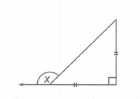
Find the value of x in the adjoining figure.
3.
Suval finished colouring a picture in \(\frac { 7 }{ 12 } \) hours.Pramod finished colouring the same picture in \(\frac { 3 }{ 4 } \) hours. Who worked longer? By what fraction was it longer?
4.
Express each of the following numbers using exponential notations.
1029
5.
Draw a \(\triangle ABC\) with sides 15 cm, 8 cm and 17 cm and find the measure of the angle opposite to the longest side, what type of triangle is it?
6.
Fill in the boxes.
\(\\ -\frac { 3 }{ 7 } =\frac { \boxed { } }{ 14 } =\frac { 9 }{ \boxed { } } \frac { -6 }{ \boxed { } } \)
7.
The largest triangle is inscribed in a semi-circle of radius 7cm. Find the area inside the semi-circle, which is not occupied by triangle.
8.
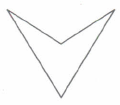
Does the following figure have rotational symmetry?
9.
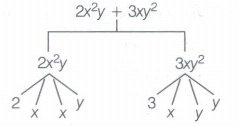
Identify the terms and represent in the form of tree diagram 2x2y + 3xy2
10.
An article was sold for Rs 250 with a profit of 5%. What was its cost price?
11.
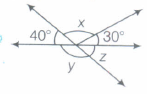
In the following figure, find the value of x, y and z.
12.
If ΔABC ≅ ΔDEF in which, AB = (3x + 7) un DE = (5x - 9) unit and BC = 4x unit.then find the value of x.
13.
Solve the following equation 4l = 44.
14.
Number of children in six different classes are given below:
| Class | Number of children |
|---|---|
| VI | 100 |
| VII | 120 |
| VIII | 130 |
| IX | 90 |
| X | 125 |
| XI | 110 |
In which class, is the number of children maximum?
15.
A number line representing integers is given below:

-3 and -2 are marked by E and F, respectively. Which integers are marked by B, D, H, J, M and O?
16.
Can you write the appropriate number in the box
c3 x c4 = C◻️ (c is any number)
17.
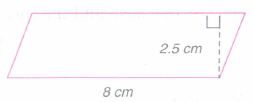
Find the area of parallelogram
18.
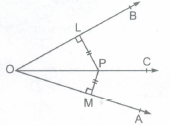
In the figure, PL \(\bot \)OB and PM \(\bot \)OA such that PL=PM. prove that \(\triangle \)PLO\(\cong \)\(\triangle \)PMO.
19.
Selling price of a toy car is Rs.540, if the profit made by shopkeeper is 20%, what is the cost price of this item?
20.
The Measures of certain sides and angles ot triangles. Identity those which cannot be constructed and say why you cannot construct them? Construct rest ot the triangles.
| Triangle | Given Measurements | ||
| ΔLMN | mㄥL=600 | mㄥN=1200 | LM=5 cm |
21.
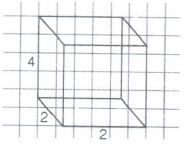
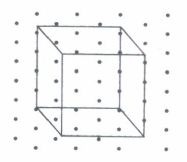
Here is an oblique sketch of a cuboid in the following figure. Draw an isometric sketch that matches this drawing
22.
Determine the order of rotation of the following figure:

23.
Identify terms which contain x and give the coefficient of x. 7x +xy2
24.
Multiply the following fractions.\(\frac{5}{6}\times 2\frac{3}{7}\)
25.
Is the sum of any two angles of a triangle always greater than the third angle?
26.
Which is the greater rational number \(\frac { 4 }{ 5 } \) or \( \frac { 6 }{ 7 } \)?
27.
If 2k - 6 = 0, then find the value of 3k + 4.
28.
Find the complement of each of the following angles. 30°
29.
Find the product of the following integers: (-25) \(\times\) (-72)
30.
The marks obtained by 10 students in Mathematics are given below: ; :10,20,13,49, 50, 10, 29, 37, 0,5 - Find the mean marks
31.
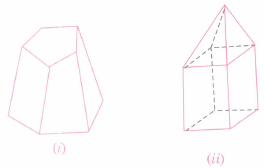
Verify Euler's formula for these solids.
32.
Express the following numbers in normal form:
5.8 x 10⁵
33.
The sides of a rectangle are 6 cm and 8 cm respectively. Find the length of the diagonal
34.
Identify the like terms in the following algebraic expressions
xyz + xy2 Z + 2xy2 Z + 3z2 xy + y2 XZ - 2X2 yz + 3xzy2
35.
Architects design many types of buildings. They draw plans for houses, such as the plan is shown in the following figure:
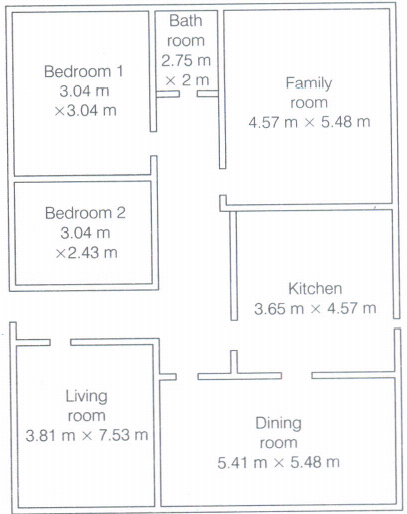
An architect wants to install a decorative moulding around the ceilings in all the rooms. The decorative moulding costs Rs 500 per m.
(a) Find how much moulding will be needed for each room.
(i) family room
(ii) living room
(iii) dining room
(iv) bedroom 1
(v) bedroom 2
(b) The carpet costs Rs 200 per m2. Find the cost of carpeting each room.
(c) What is the total cost of moulding for all the five rooms?
36.
Draw an isosceles triangle with each of equal sides of length 3 cm and the angle between them as 45°.
37.
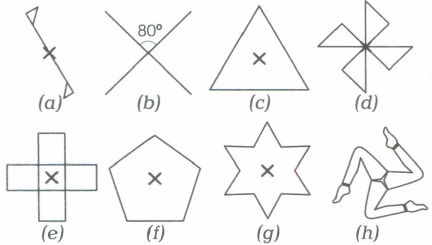
Give the order of rotational symmetry for each figure.
38.
Evaluate \(\frac{2.82\div 2.1}{4.262\times 0.5}\div \frac{11.26\times 0.54}{2.482\div 1.2}\)
39.
Taking x \(=\frac { -4 }{ 9 } \), y\(=\frac { 5 }{ 12 } \), and z\(=\frac { 7 }{ 18 } \), Find
The sum of reciprocals of x and y.
40.
Anil is a student of class VII. His teacher explain the concept of line and angles. At the end of the chapter, his teacher conduct a 10 min test. The question was asked in the test is given below
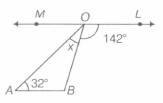
If AB || ML and \(\angle\)A = 32°, find the value of x. The answer given by Anil was 46°.
Find the value of x.
What type of value depicted by Anil's answer?
41.
(i) Out of 32 students, 8 are absent. What per cent of the students are absent?
(ii) There are 25 radios, 16 of them are out of order. What per cent of radios are out of order?
(iii) A shop has 500 parts, out of which 5 are defective. What per cent are defective?
(iv) There are 120 voters, 90 of them voted yes. What per cent voted yes?
42.
The temperature at 12 noon was 10°C above zero. 1f it decreases at the rate of 2°C/h until midnight, at what time would the temperature be 8°C below zero. What would be the temperature at midnight?
43.
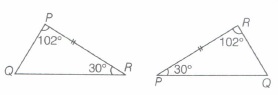
Which of the following pair of figures are congruent?
44.
The age of Sohan Lal is four times that of his son Amit. If the difference of their ages is 27 yr, find the age of Amit.
45.
Think of some situations, at least 3 examples of each, that are certain to happen, some that are impossible and some that may or may not happen i.e. situations that have some chance of happening.
46.
What is the coefficient of x2 in the expression ax + b?
a
b
a + b
0
47.
The cost of 4 m of cloth is Rs 40. Find the cost of 9 m of cloth.
Rs 90
Rs 60
Rs 50
Rs 40
48.
10 \(\times\) (- 20) is equal to
200
-200
30
10
49.
Area of a rectangle of length land breadth b is
l\(\times\)b
l+b
2\(\times\)(l+b)
6\(\times\)(l+b)
50.
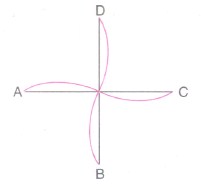
What is the order of the rotational symmetry of the following figure?
4
3
2
1
51.
Which of the following is an improper fraction?
\(\frac{1}{12}\)
\(\frac{5}{9}\)
\(\frac{4}{13}\)
\(\frac{7}{2}\)
52.
pxXpy is:
px+y
px-y
py-x
pxy
53.
Which of the following rules of congruency says that ΔABC≅ΔPQR?
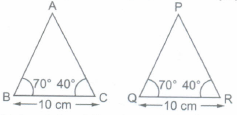
ASA
SAS
SSS
RHS
54.
Which of the following is true?
Each angle of a right triangle is 90°.
Each angle of an equilateral triangle is 90°.
Sum of all the three interior angles of a triangle is 180°.
In a right triangle the length of hypotenuse is equal to sum of the lengths of the other two sides.
55.
If 2x - 8 = 0, then 4x =
4
2
8
16
56.
Value of \(\frac { { 10 }^{ 22 }+{ 10 }^{ 20 } }{ { 10 }^{ 20 } } \) is
10
1042
101
1022
57.
The value of -\(\frac{4}{3}\)-\(\frac{-1}{3}\) is
-2
-3
2
-1
58.
In the given figure, lines PQ and ST intersect at O. If \(\angle\)POR = 90° and x : y = 3 : 2, then z is equal to
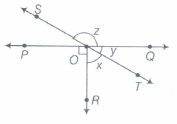
126°
144°
136°
154°
59.
The runs scored in a cricket match by 11 players are as follows: 6, 15, 120, 50, 100, 80, 10, 15, 8, 10, 10. Find the median of scores.
46
8
15
120
60.
A triangle can be constructed by taking two of its angles as
110°, 40°
70°,115°
135°, 45°
90°,90°
61.
Find angles x and y in each figure.
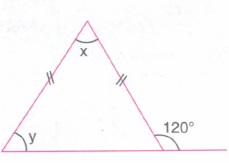
62.
A sum of money becomes Rs.30,000 in 2 years and Rs.32,500 in 3 years. Find the principal and rate of interest per cent per year.
63.
Consider the following parallelograms with sides 7 cm and 5 cm each
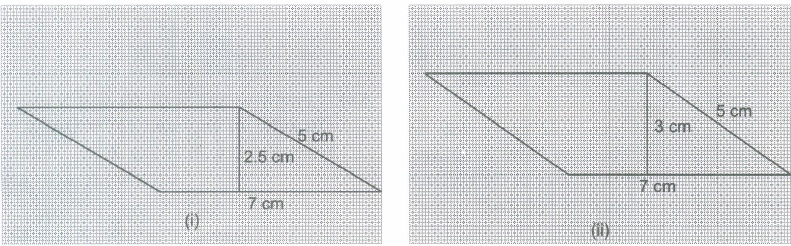
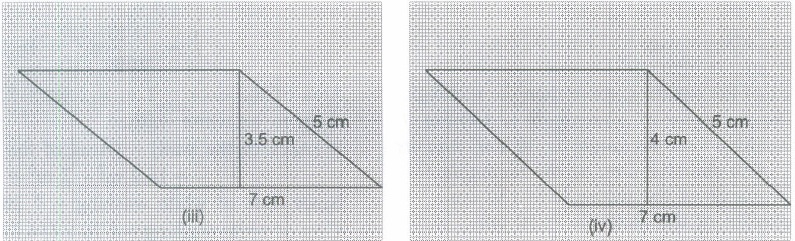
Find the perimeter and area of each of these parallelograms.
64.
The mean marks (out of 100) of a group of students is 60. If their marks are 85, 62, 36, 48, 72, x, 75 and 39, then find the value of x.
65.
Find the value of the following expressions, for a = 3,b = 2:
(a) a + b
(b) 7a-4b
(c) a2 + 2ab + b2
(d) a3 - b3
66.
By what number should (-15)-1 be divided so that the quotient is (-5)-1.
67.
Divide 184 into two parts such that one third of one part may exceed one seventh of other part by 8.
68.
Arrange the rational numbers \(\frac { -3 }{ 5 } ,\frac { 7 }{ -10 } ,\frac { -5 }{ 6 } \\ \) ascending order.
69.
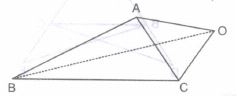
If O is a point in the exterior of ΔABC. Show that:
2(OA + OB + oq > (AB + BC + CA).
1.
Let ABCDHEFG be plasticine cube. Let a part xyz be sliced off from it. Let x, y, z lie on edge FG, FE and FB respectively.Case I. In cube ABCDHEFG,
F = 6
V = 8
E = 12
Clearly, F + V = E + 2 (= 14)
Thus, Euler's Formula is true.
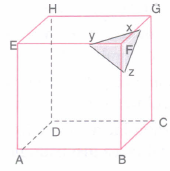
Case II. When a part XYZ is sliced
Then, F = 7
V = 10
E = 15
Clearly, F + V = E + 2 (- 17)
Thus, Euler's Formula is again true
2.
35°
3.
In order to know who worked longer, we will compare fractions \(\frac { 7 }{ 12 }\)and\(\frac { 3 }{ 4 } \)
We have,
(LCM of 12 and 4) = 12
Converting each fraction into an equivalent fraction with 12 as denominator, we have
\(\frac { 7 }{ 12 } =\frac { 7\times 1 }{ 12\times 1 } =\frac { 7 }{ 12 }
\) and \(\frac { 3 }{ 4 } =\frac { 3\times 3 }{ 4\times 3 } =\frac { 9 }{ 12 } \)
∵ 7 < 9
∵ \(\frac { 7 }{ 12 } <\frac { 9 }{ 12 }\) or \(
\frac { 7 }{ 12 } <\frac { 3 }{ 4 } \)
Thus, Vaibhav finished colouring in longer time
Now, \(\frac { 3 }{ 4 } -\frac { 7 }{ 12 } =\frac { 9 }{ 12 } -\frac { 7 }{ 12 } =\frac { 9-7 }{ 12 } =\frac { 2 }{ 12 } =\frac { 1 }{ 6 } \)
Hence, Pramod finished colouring in\(\frac { 1 }{ 6 } \)hour more time than Suval.
4.
Given, 1029
∵ 1029 = 3 x 7 x 7 x 7 = 3 x 73
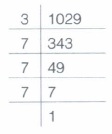
The exponent form of 1029 is 3 x 73.
5.
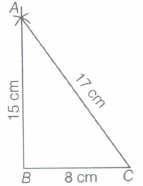
∠ABC = 90°
So, ΔABC is a right angled triangle.
6.
We have, \(\frac { -3 }{ 7 } =\frac { \boxed { } }{ 14 } =\frac { 9 }{ \boxed { } }= \frac { -6 }{ \boxed { } } \)
Here, the rational numbers equivalent to rational number \(\frac { -3 }{ 7 } \) are as follow:
\(-\frac { 3 }{ 7 } \) \(=\frac { -3\times 2 }{ 7\times 2 } =\frac { -6 }{ 14 } \Rightarrow \frac { -3 }{ 7 } =\frac { -3\times (-3) }{ 7\times (-3) } =\frac { 9 }{ -21 } \)
Also, \(\frac { -3 }{ 7 } =\frac { -3\times 2 }{ 7\times 2 } =\frac { -6 }{ 14 } \)
So, the missing integers in the boxes are filled as
\(\\ \frac { -3 }{ 7 } =\frac { \boxed { -6 } }{ 14 } =\frac { 9 }{ \boxed { -21 } } =\frac { 6 }{ \boxed { 14 } } \)
7.
Given, radius = 7 cm, diameter = 14 cm
According to the question,
Area of the triangle = \(\frac{1}{2}\) x Base x Height
= \(\frac{1}{2}\) 14 x 7 = 7 x 7 = 49 cm2
Area of a semi-circle = \(\frac{\pi r^2}{2}=\frac{\frac{22}{7}\times (7)^2}{2}\)
= 11 x 7 = 77 cm2
\(\therefore\) Required area = Area of the semi-circle - Area of the largest triangle
= 77 - 49 = 28 cm2.
8.
No, it doesn't have a rotational symmetry.
9.
Given, 2x2y + 3xy2
Total terms = 2, i.e. 2x2y and 3xy2
Tree diagram
10.
Given, SP of an article = Rs 250 ; Profit % = 5%
Let CP of an article be Rs x.
Then, profit = 5% of CP of an article = \({5\over100}\times x={5x\over100}\)
Now, SP of an article = CP + Profit
\(\therefore\) \(250=x+{5x\over 100}\Rightarrow {250 \over 1}\)
\(\Rightarrow\) \(1065x=250\times 100\)
\(\Rightarrow\) \(x={250\times100\over105}\Rightarrow x={5000\over 21}\)= Rs 238.10
Hence, CP of an article is Rs. 238.10.
11.
Since, 40° + 30° + x =180° [linear pair]
\(\Rightarrow \) 70° + x =180° \(\Rightarrow\) x =180° -70° \(\Rightarrow\) x =110°
\(\Rightarrow \) \(\angle\)z = 40° [vertically opposite angles]
\(\therefore\) \(\angle\)y + \(\angle\)z =180° [linear pair]
\(\Rightarrow\) \(\angle\)y + 40° =180°
\(\Rightarrow\) \(\angle\)y =180 - 40°\(\Rightarrow\) \(\angle\)y =140°
So, \(\angle\)x =110°, \(\angle\)y =140° and \(\angle\)z = 40°
12.
a = 5
13.
Given, 41 = 44
Taking LHS, \(4l=\frac{4l}{4}=l\)
Taking RHS, \(44=\frac{44}{4}=11\)
\(\therefore\) l = 11,which is the required solution.
14.
ClassVIII
15.
We have,
Now, completing the given number line is as follows:

Hence, the position of required letters is shown in the following table:
| Letter | Position of integer |
| B | -6 |
| D | -4 |
| H | 0 |
| J | 2 |
| M | 5 |
| O | 7 |
16.
C3 X C4 = (C X C X C) X (C X C X C X C)
=\({ C }^{ \boxed { 7 } }\)
17.
Base = 8 cm
Height = 2.5 cm
∴ Area of the parallelogram
=base \(\times\)height
=8\(\times\)2.5 = 20 cm'2
18.
In \(\triangle \)PLO and \(\triangle \)PMO, we have
\(\angle PLO=\angle PMO=\)90°[Given]
\(\overline { OP } =\overline { OP } \) [Hypotenuse]
PL=PM [Given]
\(\therefore \)Using RHS congruency, we get
\(\triangle \)PLO \(\cong \)\(\triangle \)PMO
19.
S.P. =Rs. 540
P% = Rs.20%
Let C.P be Rs.100.
Profit is Rs.20.
S.P = 100 + 20 = 120
Now, when S.P' is Rs.120, the C.P. is Rs.100
. . When S.P. is Rs.540
C.P =\(\frac { 100 }{ 120 } \times 540\)
= Rs.450.
20.
In ΔLMN, we have, mㄥL = 60°, mㄥN = 120° and LM= 5 cm
Here, mㄥL + mㄥN = 60° + 120° = 180°
But the sum of two angles of a triangle should be less than 180°. So, the triangle with the given measures can not be constructed.
21.
The isometric sketch of the given cuboid will be
22.
It has an order of 1.
23.
In the expression 7x +xy2, the terms which contains x are 7x and xy2 , so the coefficient of x are 7 and y2 respectively
24.
We have, \(\frac{5}{6}\times 2\frac{3}{7}=\frac{5}{6}\times (\frac{2\times7+3}{7})=\frac{5}{6}\times (\frac{14+3}{7})\)
=\(\frac{5}{6}\times \frac{17}{7}=\frac{5\times 17}{6\times 7}=\frac{85}{42}=2\frac{1}{42}\)
25.
No, the sum of any two angles of a triangle is not always greater than the third angle.
26.
Given rational number are \(\frac { 4 }{ 5 } \) and \(\frac { 6 }{ 7 } \)
LCM of 5 and 7 is 35.
\(\therefore \frac { 4\times 7 }{ 5\times 7 } =\frac { 28 }{ 35 } \) and \(\frac { 6\times 5 }{ 7\times 5 } =\frac { 30 }{ 35 } \)
\(\because\)30 > 28 so \(\frac { 6 }{ 7 } >\frac { 4 }{ 5 } \)
27.
13
28.
Given, angle 30°
Complement of 30° = 90° - 30° = 60°
29.
We have, (-25) \(\times\) (-72)
First integer (x) = - 25 [given]
Second integer (y) = - 72 [given]
\(\therefore\) Product (xy) = (-25) \(\times\) (-72) = 1800 [\(\because\) (-a) \(\times\)(-b) = ab]
30.
25.3
31.
(i) F = 7
V = 10
E = 15
F + V = 7 + 10 = 17
E + 2 = 15 + 2 = 17
So, F + V = E + 2
Hence, Euler's Formula is verified.
(ii) F = 9
V = 9
E = 16
F + V = 9 + 9 = 18
E + 2 = 16 + 2 = 18
So, F +V = E + 2
Hence, Euler's Formula is verified.
32.
580000
33.
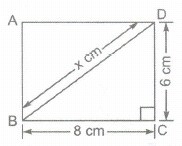
Let us draw a rectangle ABCD, such that BD is a diagonal
\(\therefore\)Each angle of ABCD is a right angle.
\(\therefore\) \(\angle C\)= 90°
\(\Rightarrow\) \(\triangle\)BCD is a right triangle
Since the side opposite to 90° is hypotenuse and (Hypotenuse)2 = [Sum of the squares of the legs of the triangle]
\(\therefore\) BD2 = BC2 + CD2
\(\Rightarrow\) (x)2 = (8)2 + (6)2
\(\Rightarrow\) x2 = 64 + 36
\(\Rightarrow\) x2 = 100
x2 = 102\(\Rightarrow\)X = 10
Thus, the required length of the diagonal is 10 cm.
34.
xy2 Z, 2xy2 Z, y2 xz, 3xzy2
35.
(a) (i) Given, breadth of the family room = 5.48 m and length of the family room = 4.57 m
\(\therefore\) Perimeter of the family room
= 2 (Length + Breadth)
= 2(5.48 + 4.57) = 2 x 10.05 = 20.10 m
(ii) Given, length of the living room = 7.53 m and breadth of the living room = 3.81 m
\(\therefore\) Perimeter of the living room
= 2 (Length + Breadth)
= 2(7.53 + 3.81) = 2 x 11.34 = 22.68 m
(iii) Given, breadth of the dining room = 5.41 m and length of the dining room = 5.48 m
\(\therefore\) Perimeter of the dining room
= 2 (Length + Breadth)
= 2(5.41 + 5.48) = 2 x 10.89 = 21.78 m
(iv) Given, length of bedroom 1= 3.04 m and breadth of bedroom 1= 3.04m
\(\therefore\) Perimeter of the bedroom 1
= 2 (Length + Breadth)
= 2(3.04+ 3.04) = 2 x 6.08 = 12.16 m
(v) Given, breadth of bedroom 2= 3.04 m and length of bedroom 2= 2.43 m
\(\therefore\) Perimeter of the bedroom 2
= 2 (Length + Breadth)
= 2(3.04 + 2.43) = 2 x 5.47 = 10.94 m.
(b) For bedroom 1,
Given, length of bedroom 1= 3.04 m and breadth of bedroom 1 = 3.04 m
We know that, area of bedroom 1 = Length x Breadth
\(\therefore\) Area of bedroom 1= 3.04 x 3.04 = 9.2416 sq m
\(\therefore\) Cost of carpeting 1 sq m = Rs 200
\(\therefore\) Cost of carpeting 9.2416 m2
= 9.2416x 200=~1848
For bedroom 2,
Given, length of bedroom 2= 3.04 m breadth of bed rom = 2.43 m
\(\therefore\) Area of bedroom 2 = Length x Breadth
= 3.04 x 2.43 = 7.3872 m2
\(\therefore\) Cost of carpeting 1 m2 = Rs 200
\(\therefore\) Cost of carpeting 7.3872 m2
= 7.3872 x 200 = Rs 1477
For living room,
Given, length of living room = 7.53 m and breadth of living room = 3.81 m
\(\therefore\) Area of living room = 3.87 x 7.53 = 28.6893 m2
Cost of carpeting of living room 1 m2 = Rs 200
\(\therefore\) Cost of carpeting 28.6893 m2
= Rs 200 x 28.6893 = Rs 5737.86
For dining room,
Given, length of dining room = 5.48 m and breadth of dining room = 5.41 m
\(\therefore\) Area of dining room = 5.41 x 5.48
= 29.6468 m2
\(\therefore\) Cost of carpeting 1 m2 = Rs 200
\(\therefore\) Cost of carpeting 29.6468 m2
= 29.6468 x 200 = Rs 5929.36
For family room,
Given, length of family room = 5.48 m and breadth of family room = 4.57 m
\(\therefore\) Area of family room = 5.48 x 4.57 = 25.0436 m2
so, Cost of carpeting family room
= 25.0436 x 200 = Rs 5008.72
(c) Total perimeter of all the five rooms
= 20.10 rn + 22.68 m + 21.78 m + 12.16 m+ 10.94 mm
= 87.66
\(\therefore\) Given, cost of moulding each room = Rs 500 per m
\(\therefore\) Total cost of moulding all five rooms
= 87.66 x 500 = Rs 43830.
36.
Steps of construction
Step I Firstly, we draw a rough sketch of triangle with given measures marked on it.
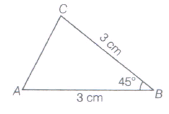
Step II Draw a line segment AB of length 3 cm.
Step III Draw an angle of 45° on point B and produce it to ray Y.
Step IV With B as centre, draw an arc of 3 cm which intersects ray BYat C.
Step V Join AC.
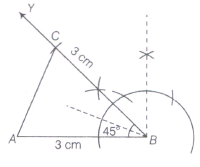
Thus, \(\triangle ABC\) is the required isosceles triangle.
37.
Let mark a point A on each figure and also, indicate the angle through which is to be rotated as shown below:
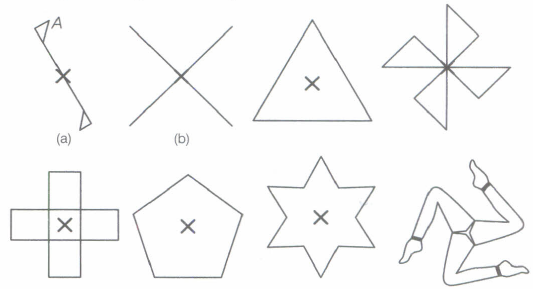
Now, to find the rotational symmetry,we proceed as follows:
For figure (a), it requires two rotations, each through an angle of 180°, about the marked point (X) to come back to its original position. So, it has a rotational symmetry of order 2.
For figure (b), it requires two rotations, each through an angle of 180°, about the marked point (X) to come back to its original position. So, it has a rotational symmetry of order 2.
For figure (c), it requires three rotations, each through an angle of 120° about the marked point (X) to come back to its original position. So, it has a rotational symmetry of order 3.
For figure (d), it requires four rotations, each through an angle of 90°, about the marked point (X) to come back to its original position. So, it has a rotational symmetry of order 4.
For figure (e), it requires four rotations, each through an angle of 90° about the marked point (X) to come back to its original position. So, it has a rotational symmetry of order 4.
For figure (f), it requires five rotations, each through an angle of 72°, about the marked point (X) to come back its original position. So, it has rotational symmetry of order 5.
For figure (g), it requires six rotations, each through an angle of 60° about the marked point (X) to come back its original position. So, it has rotational symmetry of order 6.
For figure (h), it requires three rotations, each through an angle of 120°, about the marked point to come back to its original position. So, it has rotational symmetry of order 3.
38.
0.21
39.
Reciprocal of x and y is \(\\ \frac { 1 }{ x } \)and \(\frac { 1 }{ y } \)
\(\therefore \) sum of reciprocal = \(\\ \frac { 1 }{ x } +\frac { 1 }{ y } =\frac { 1 }{ \frac { -4 }{ 9 } } +\frac { 1 }{ \frac { 5 }{ 12 } } \)
\(\\ =\frac { -9 }{ 4 } +\frac { 12 }{ 5 } =\frac { -45+48 }{ 20 } =\frac { 3 }{ 20 } \\ \)
40.
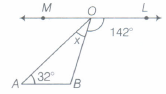
Given, AB II ML, \(\angle \)LOB =142°
\(\angle \)A = 32°
\(\angle \)MOA and \(\angle \)A are alternate angles.
So, \(\angle \)MOA = 32°
Also, (\(\angle \)MOA + x) and \(\angle \)142° form a linear pair. So,
\(\angle \)MOA + x + 142° =180°
32° + x + 142° = 180°
x =180° -142° - 32°
x = 180° -174°
x = 6°
Anil's answer in the test was not correct. The value of x was 6°.
Hence, Anil does not understand the concept of alternate angles and linear pair. So, he was still confused about the lines and angles chapter.
41.
(i) Given, total number of students = 32
Number of absent students = 8
\(\therefore\) Percentage of absent students
\(({Number \ of \ absent \ students \over Total \ number \ of \ students}\times 100)\%
\\ ({8\over32}\times 100)\%=25\%\)
Hence, 25% of the students are absent.
(ii) Total number of radios = 25
Number of radios which are out of order = 16
\(\therefore\) Percentage of radios which are out of order
\(=({Number \ of \ radios \ which \ are \ out \ of \ order\over Total \ number \ of \ ratios}\times 100)\%
\\=({16\over25}\times 100)\%=(16\times4)\%=64\%\)
Hence, 64% of radios are out of order.
(iii)Total number of parts = 500
Number of defective parts = 5
\(\therefore\) Percentage of defective parts
\(=({Number \ of \ defective\ parts\over Total \ number \ of \ parts}\times 100)\%
\\=({5\over500}\times 100)\%=1\%\)
Hence, 1% parts are defective.
(iv) Total number of voters = 120
Number of voters voted yes = 90
\(\therefore\) Percentage of voters voted yes
\(=({Number \ of \ voters \ voted \ yes \over Total \ number \ of \ votes }\times 100)\%
\\=({90\over120}\times 100)\%=(3\times 25)\%=1\%\)
Hence, 75% of voters voted yes.
42.
Given, temperature at 12 noon = + 10°C
Rate of change in temperature = - 2°C/h
Total time from 12 noon to mid-night = 12 h
Change in temperature in 12 h = 12°C \(\times\) (- 2) = - 24°C
Temperature at mid-night = 10 + (- 24) = 10 - 24= -14° C
Now, temperature difference between 10°C and - 8°C
= 10 - (- 8) = 10 + 8 = 18° C = 18/2 = 9
So, temperature change of 18° C will take place in 9 h from 12 noon
Thus, the temperature 8° C below 0° (- 8° C) would be at 9 pm.
43.
Congruent
44.
Let x be the age of Amit.
So, age of Sohan Lal, the father of Amit = 4x yr
If the difference of their ages is 27 yr.
Then, 4x- x = 27 \(\Rightarrow\) 3x = 27 \(\Rightarrow x=\frac{27}{3}=9\)
Hence, age of Amit is 9 yr.
45.
(a) Possible situations to happen are as follows:
(i) On tossing a coin, getting either a head or a tail
(ii) On drawing one card from a pack of 52 cards one side will appear.
(iii) Getting a number from 1 to 6 by throwing a die.
(b) Impossible to happen are as follows:
(i) A girl in the boy's school.
(ii) Getting a number 8 by throwing a die.
(iii) A person of height 3 m.
(c) Mayor may not happen situations are as follows:
(i) To toss a coin and get tail.
(ii) Probably it may rain.
(iii) An ant rising to 4 m height
46.
(d)
0
47.
4: 9 = 40: x
\(\Rightarrow {4\over9}={40\over x}\Rightarrow x=90\).
48.
(b)
-200
49.
(a)
l\(\times\)b
50.
(a)
4
51.
7>2
52.
(a)
px+y
53.
(a)
ASA
54.
(c)
Sum of all the three interior angles of a triangle is 180°.
55.
(d)
16
56.
(c)
101
57.
(d)
-1
58.
(b)
144°
59.
(c)
15
60.
(a)
110°, 40°
61.
(i) x + y = 1200 ...(1)
The exterior angle of a triangle is equal to the sum of its two interior opposite angles
x + y + y = 1800
Base angles opposite to the equal sides of an isosceles triangle are equal and the sum of the measures of the three angles of a triangle is 1800
\(\Rightarrow\)x + 2y = 1800 ... (2)
Subtracting equation (1) from equation (2),
y = 60°
Put y = 60° in equation (1),
x + 60° = 120°
\(\Rightarrow\)x = 120° - 60°
\(\Rightarrow\)x = 60°
62.
∵ The sum becomes Rs.32,500 in 3 years.
∴ Amount after 3 years = Rs.32,500
Amount after 2 years = Rs.30,000
∴ Interest for 1 year = Rs.32,500 - Rs.30,000
= Rs.2,500
⇒ Interest for 2 years= Rs.2,500 x 2 = Rs.5,000
∴ Principal = [Amount after 2 years] - [Interest for 2 years]
= Rs.30,000 - Rs.5,000 = Rs.25,000
Now, let rate of interest be x% p.a.
∴ Principal (P) = Rs.25,000
Time (T) = 2 years
Interest (S.l.) = Rs.5,000
Rate (R%) = x% p.a.
S.I = \({P\times R\times T\over100}⇒5000={25,000\times x \times2\over100}\)
\(⇒\ x={5,000\times100\over25,000\times2}={1\times10\over1\times1}=10\)
Thus, the required rate = 10% p.a.
63.
| Parallelogram | Perimeter | Area |
| (i) (ii) (iii) (iv) |
2(7 + 5) cm = 24 cm 2(7 + 5) cm = 24 cm 2(7 + 5) cm = 24 cm 2(7 + 5) cm = 24 cm |
7 x 2.5 sq. cm = 17.5 sq. cm 7 x 3 sq. cm = 21 sq. cm 7 x 3.5 sq. cm = 24.5 sq. cm 7 x 4 sq. em = 28 sq. cm |
Here, we observe that the parallelogram having same perimeters ean have different areas.
64.
Total number of students = 8
Sum of the marks obtained =85 + 62 + 36 + 48 + x + 75 + 39 + 72=417+x
\(\therefore \)Mean marks =\(\frac { (417\quad +x) }{ 8 } \)
\(\Rightarrow \)\(\frac { (417\quad +x) }{ 8 } \)=60
\(\Rightarrow \)417 + x = 60 x 8 = 480
\(\Rightarrow \)x = 480 - 417 = 63
Thus, the required value of x = 63
65.
Substituting a = 3 and b = 2 in
(a) a + b, we get
a + b = 3 + 2 = 5
(b) 7a - 4b, we get
7a - 4b = 7 x 3 - 4 x 2
= 21 - 8 = 13
(c) a2 + 2ab + b2, we get
a2 + 2ab + b2 = 32 + 2 x 3 x 2 + 22
= 9 + 2 x 6 + 4
= 9 + 12 + 4 = 25.
(d) a3 - b3, we get
a3 - b3 = 33 - 23 = 3 x 3 x 3 - 2 x 2 x 2
= 27 -8 = 19.
66.
Let the number (- 15)-1 should be divided by x to get the quotient (-5)-1.
\(\therefore (-15)^{-1}\div x=(-5)^{-1}\)
\(\Rightarrow \frac{1}{-15}\div x=\frac{1}{-5}\)
\(\Rightarrow \frac{1}{-15}\times \frac{1}{x}=\frac{1}{-5}\)
\(\Rightarrow \frac{1}{-15x}=\frac{1}{-5}\)
\(\Rightarrow -15x\times 1=-5\times 1\)
\(\Rightarrow -15x = -5\)
\(\Rightarrow x=-\frac{5}{-15}\)
\(\Rightarrow x=-\frac{1}{-3}\)
\(\Rightarrow x=\frac{1}{3}\)
67.
Let one part of 184 be x.
\(\therefore\) Other part be (184 - x)
Now, according to question,
\(\Rightarrow \quad \frac { 1 }{ 3 } x-\frac { 1 }{ 7 } (184-x)=8\)
\(\Rightarrow \quad \frac { x }{ 3 } +\frac { x }{ 7 } -\frac { 184 }{ 7 } =8\)
\(\Rightarrow \quad \frac { 7x+3x }{ 21 } =8+\frac { 184 }{ 7 } \)
\(\Rightarrow \quad \frac { 10x }{ 21 } =\frac { 56+184 }{ 7 } \)
\(\Rightarrow \quad \frac { 10x }{ 21 } =\frac { 240 }{ 7 } \)
\(\Rightarrow \quad x=\frac { 21\times 240 }{ 7\times 10 } \)
= 72
Hence, parts are 72 and 184 - 72 = 112.
68.
Sequence is \(\frac { -3 }{ 5 } ,\frac { 7 }{ -10 } ,\frac { -5 }{ 6 } \\ \)
L.C.M.of 5, 10 and 6=30
\(\Rightarrow \frac { -3 }{ 5 } ,\frac { 7 }{ -10 } ,\frac { -5 }{ 6 } \)
\(\Rightarrow -\frac { 3\times 6 }{ 5\times 6 } ,\frac { 7\times 3 }{ -10\times 3 } ,-\frac { 5\times 5 }{ 6\times 5 } \)
\(\Rightarrow -\frac { 18 }{ 30 } ,\frac { 21 }{ 30 } ,\frac { 25 }{ 30 } \)
Since \(-\frac { 25 }{ 30 } <\frac { 7 }{ -10 } <\frac { -3 }{ 5 } \)
Hence sequence in ascending order is
\(\frac { -5 }{ 6 } <\frac { 7 }{ -10 } <\frac { -3 }{ 5 } \).
69.
In ΔAOB,
OA + OB > AB ....(i)
Similarly, in ΔBOC,
OB + OC > BC ....(ii)
and in ΔAOC,
OA + OC > AC ....(iii)
By adding (i), (ii) and (iii),we get
OA + OB + OB + OC + OA + OC > AB + BC + CA
\(\Rightarrow\) 2O A + 2OB + 2OC > AB + BC + CA
\(\Rightarrow\) 2(OA + OB + OC) > AB + BC + CA

7th Standard CBSE Syllabus & Materials
7th Standard CBSE
CBSE 7th Social Science Theme B - New Beginnings : Cities and States - New Sample Question Papers Study Material - QB365 Set A
NEW7th Standard CBSE
CBSE 7th Social Science Theme A - Climates of India - New Sample Question Papers Study Material - QB365 Set A
NEW7th Standard CBSE
CBSE 7th Social Science Theme A - Geographical Diversity of India - New Sample Question Papers Study Material - QB365 Set A
NEW7th Standard CBSE
CBSE 7th Science Earth, Moon and the Sun - New Sample Question Papers Study Material - QB365 Set A



CBSE 7th Standard CBSE Subjects
CBSE Standards




