
 100% FREE ACCESS
7th Standard CBSE Syllabus & Materials
7th Standard CBSE
CBSE 7th Social Science Theme E - Understanding Market - New Sample Question Papers Study Material - QB365 Set A
NEW7th Standard CBSE
CBSE 7th Social Science Theme E - From Barter to Money - New Sample Question Papers Study Material - QB365 Set A
NEW7th Standard CBSE
CBSE 7th Social Science Theme D - The Constitution of India- An Introduction - New Sample Question Papers Study Material - QB365 Set A
NEW7th Standard CBSE
CBSE 7th Social Science Theme D - From the Rulers to the Ruled : Types of Governments - New Sample Question Papers Study Material - QB365 Set A
NEW7th Standard CBSE
CBSE 7th Social Science Theme B - The Age of Reorganisation - New Sample Question Papers Study Material - QB365 Set A
NEW7th Standard CBSE
CBSE 7th Social Science Theme B - The Rise of Empires - New Sample Question Papers Study Material - QB365 Set A

Published on: 06/03/2020
7th Standard Mathematics Board Exam Sample Question 2020
Download CBSE Class 7th Standard CBSE Mathematics question papers, sample papers, important questions, and previous year solved papers in PDF format. Get free study materials, NCERT solutions, and exam preparation resources for Class 7th Standard CBSE Mathematics
Questions + Answers key
Take MCQ Mathematics Test
1.
Express 256 as a power of 2.
2.
Construct a triangle ABC when AB = 5.5 cm, BC = 4.5 cm and \(\angle\)B = 60°.
3.
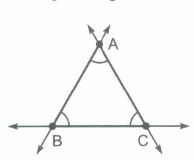
Find the measure of the angles made by the intersecting lines at the vertices of an equilateral triangle.
4.
The heights of 5 girls in a group are: 142 em, 150 em, 146 em, 154 em and 148 em. Find the mean height
5.
Find the values of the following polynomials at a = - 2 and b = 3.
a2 +2ab + b2
6.
Write the number of faces, edges and vertices in the solids given below:
Prism
7.
Find the area and perimeter of a triangle, whose base is 6 cm and each equal sides are 5 cm and height 4 cm.
8.
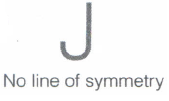
Draw all lines of symmetry for each of the following figures as given below.

9.
Measurement made in Science lab must be as accurate as possible. Ravi measured the length of an iron rod and said it was 19.34 cm long. Kamal said 19.25 cm and Tabish said 19.27 cm. The correct length was 19.33 cm. How much of error was made by each of the boys?
10.
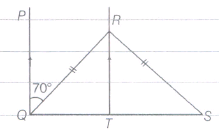
In the above figure, \(\triangle QRS\) is an isosceles triangle, wherePQ || RT. Find the value of \(\angle QRS\).
11.
Arun bought a car for Rs 350000. The next year, the price went upto Rs 370000. What was the percentage of price increase?
12.
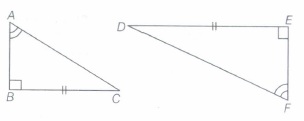
Explain, why ΔABC ≅ ΔFED.
13.
Write a negative integer and a positive integer whose difference is +2.
14.
Find the next two rational numbers to complete the following pattern.
\(\frac { -1 }{ 3 } ,\frac { -2 }{ 3 } ,\frac { -3 }{ 9 } \)
15.
Set up equation and solve them to find the unknown numbers in the following cases. If I take three-fourths of a number and add 3 to it, I get 21.
16.
Express the following numbers in expanded forms
12345
17.
Find the height of the wall whose length is 4 m and which can be covered by 2400 tiles of size 25 cm by 20cm.
18.
Simplify the following expression and find its value, when p = 4 and q = - 3 2(p2 + pq) + 3 - pq
19.
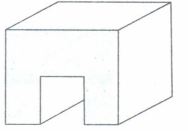
Draw the top, side and front views of the solids given below in figures
20.
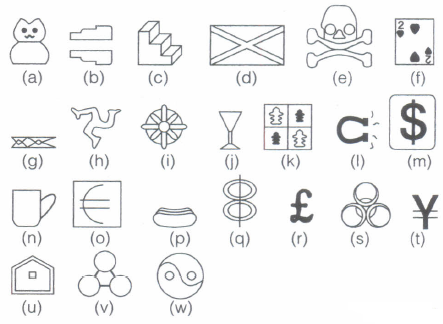
In each of the following figures, write the number of lines of symmetry and order of rotational symmetry.
21.
The Measures of certain sides and angles ot triangles. Identity those which cannot be constructed and say why you cannot construct them? Construct rest ot the triangles.
| Triangle | Given Measurements | ||
| ΔPQR | mㄥQ=300 | mㄥB=600 | QR=4.7 cm |
22.
A man sold two radios for Rs 5000each. On one he gets a gain of 10% and on other a loss of 10%. Find his total gain or loss per cent in the whole transactions.
23.
Taking x \(=\frac { -4 }{ 9 } \),y\(=\frac { 5 }{ 12 } \)and z\(=\frac { 7 }{ 18 } \), Find
The rational number, which when added to x gives y.
24.
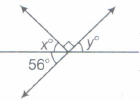
Determine the values of x and y and state reason for your answer.
25.
The highest point measured above sea level is the summit of Mt. Everest, which is 8848 m above sea level and the lowest point is challenger deep at the bottom of Mariana Trench, which is 10911 m below sea level. What is the vertical distance between these two points?
26.
A rectangular field is 10\(\frac{2}{5}\) m long and 16\(\frac{1}{3}\) m wide. Then, find the area of the field.
27.
Study the double bar graph shown below and answer the questions that follow:
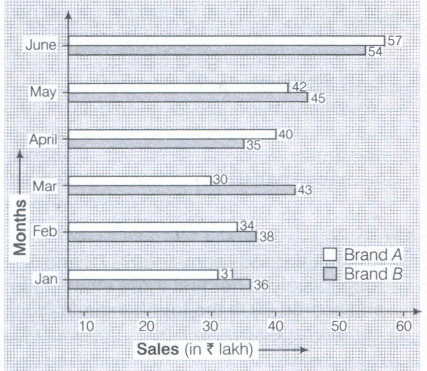
(a) What information is represented by the above double bar graph?
(b) In which month, sales of brand A decreased as compared to the previous month?
(c) What is the difference in sales of both the brands for the month of June?
(d) Find the average sales of brand 8 for the six months,
(e) List all months for which the sales of brand 8 was less than that of brand A.
(f) Find the ratio of sales of brand A as compared to brand 8 for the month of January.
28.
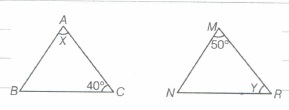
If ΔABC ≅ ΔMNR, then find the value of (2x+3y), where x and y shown in the following figures.
29.
In a class of 60 students, the number of girls is one-third the number of boys. Find the number of girls and boys in the class.
30.
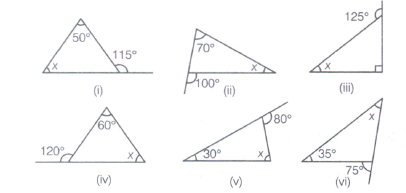
Find the value of the unknown interior angle x in the following figures.
31.
In \(\angle\)ABC if AB = 3 cm, AC = 5 cm and m\(\angle\)C = 30°. Can we draw this triangle?
32.
Solve: 6s + 24 = 0
33.
Find the value of 44875 \(\times\) 99 - (- 44875) using the property.
34.
Find the number of cubes in each of the following figures.

35.
Using laws of exponents, simplify and write the answer in exponential form: (220 \(\div\) 215) x 23
36.
Find the circumference of the circle with the following radius 7 cm.
37.
Classify the following as binomials and trinomials.4x3 + 3x2 + 6
38.
Find five rational numbers between \(\frac { -5 }{ 7 } \)and \(\frac { -3 }{ 8 } \).
39.
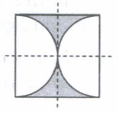
The following figures have more than one line of symmetry. Such figures are said to have multiple lines of symmetry.
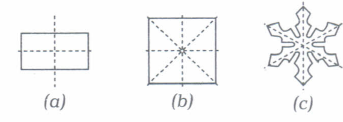
Identify multiple lines of symmetry, if any, in each of the following figures.

40.
75% of what number is 15?
41.
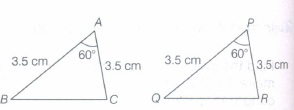
In the following figures, measures of some parts of the triangles are indicated. By applying SAS congruence rule, state the pair of congruent triangles .
42.
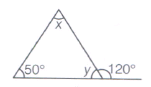
Find the values of the unknown x and y in the following diagrams.
43.
Find the complement of each of the following angles. 48°
44.
Find the mean of first five even numbers
45.
Multiply and reduce to lowest form (if possible).\(\frac{4}{5}\times \frac{12}{7}\)
46.
The rational number \(\frac{-6}{-25}\) in standard form is
\(\frac{6}{25}\)
\(\frac{-6}{25}\)
\(\frac{6}{-25}\)
\(\frac{-6}{-25}\)
47.
We want to show that Δ ART ≅ Δ PEN. We have to use SAS criterion. We have AT = PN, ㄥA = ㄥP. What more we need to show?
ㄥT = ㄥN
ㄥT = ㄥE
ㄥT = ㄥP
None of these.
48.
\(3\frac{1}{3}\div 10\) is equal to
\(\frac{1}{2}\)
\(\frac{1}{3}\)
\(\frac{1}{4}\)
\(\frac{1}{5}\)
49.
1027000000 in Standard Form is:
10.27 x 10⁸
1.027 x 10⁹
102.7 x 10⁷
0.1027 X 10¹⁰
50.
The coefficient of a constant term is:
0
1
5
does not exist
51.
The order of rotational symmetry of a square is:
1
2
3
4
52.
The simplest ratio of 15 weeks and 10 days is:
1 : 21
21 : 1
2 : 21
21 : 2
53.
The angle. which is its own supplement:
0°
45°
90°
does not exist
54.
The line segment joining a vertex of a triangle to the mid-point of the opposite side is called its______________
median
altitude
55.
When (-1) and 1 are multiplied, we get:
0
1
-1
2
56.
Cube of \(\left( \frac { -1 }{ 4 } \right) \) is
\(\frac { -1 }{ 12 } \)
\(\frac { 1 }{ 16 } \)
\(\frac { -1 }{ 64 } \)
\(\frac { 1 }{ 64 } \)
57.
Area of a right-angled triangle is 30 cm2. If its smallest side is 5 cm, then its hypotenuse is
14 cm
13 cm
12 cm
11 cm
58.
The value of x is :
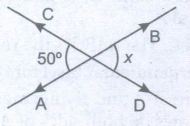
40°
50°
60°
130°
59.
Khilona earned scores of 97,73 and 88, respectively in her first three examinations. If she scored 80 in the fourth examination, then her average score will be
increased by 1
increased by 1.5
decreased by 1
decreased by 1.5
60.
Which of the following numbers satisfies the equation -6 + x = -18?
10
-13
-12
-16
61.
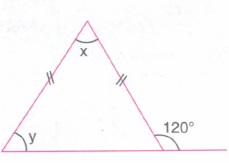
Find angles x and y in each figure.
62.
A rectangular park is 40 m long and 25 m wide. A path 2.5 m wide is constructed outside the park. Find the area of the path.
63.
The mean marks (out of 100) of a group of students is 60. If their marks are 85, 62, 36, 48, 72, x, 75 and 39, then find the value of x.
64.
Find the value of the following expressions, for a = 3,b = 2:
(a) a + b
(b) 7a-4b
(c) a2 + 2ab + b2
(d) a3 - b3
65.
Find x, such that \(\left(1\over5\right)^5\times\left(1\over 5\right)^{19}=\left(1\over 5\right)^{8x}\)
66.
How much pure alcohol must be added to 400 ml of a 15% solution to make its strength 32%.
67.
3% commission on the sale of a property amounts to is Rs.42,660. What is the total value of the property?
68.
Write four numbers in the following pattern :
\(\frac { -1 }{ 3 } ,\frac { -2 }{ 6 } ,\frac { -3 }{ 9 } '\frac { -4 }{ 12 } ,...\)
69.
Two poles of height 9 m and 14m stand upright on a plane ground. If the distance between their tops is 13 m, find the distance between their feets.
1.
28
2.
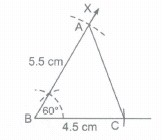
Steps of construction:
I. Draw a line segment BC = 4.5 cm.
II. Construct \(\angle\)CBX = 60° at B.
III. From BX, cut off line segment BA = 5.5 cm,
IV. Join AC
Thus, ABC is the required triangle.
3.
Points of intersection are A, B and C.
Measure of LA = 60°
Measure of LB = 60°
Measure of LC = 60°
4.
Sum of the observations (heights)
= [142 + 150 + 146 + 154 + 148] cm =740 cm
Number of observations = 5
\(\therefore \)Mean height = \(\frac { Sum\ of\ observations }{ Number\ of\ observations } \)
\(\frac { 140 }{ 5 } \) cm = 148 cm
Thus, the required mean height = 148 cm
5.
1
6.
Faces = 5, edges = 9, vertices = 6
7.
Given, base (b)= 6 cm and height (h)= 4 cm
\(\therefore\) Area of a triangle = \(\frac{1}{2}\) x b x h = \(\frac{1}{2}\) x 6 x 4 = 12 cm2
and perimeter of a triangle = Sum of the length of all three sides
= Base + 2 x Equal sides
= 6 + 2 x 5 [.: two sides are equal]
= 6 + 10 = 16 cm.
8.
9.
The actual length of an iron rod = 19.33 cm
measured length = 19.34 cm
Error = Measured value - Actual value
= (19.34 -19.33) cm + .01cm
Kamal measured = 19.25 cm
Error = (19.25 -19.33) cm - 0.08 cm
Tabish measured = 19.27 cm
Error = (19.27 -19.33) cm = - 0.06 cm
10.
\(\angle QRS=140^0\)
11.
Original price of the car = Rs 350000
Increased price of the car = Rs 370000
Then. increase in price = Rs (370000 - 350000) =Rs 20000
\(\therefore\) Percentage of price increase \(=\left( { Increase\ in\ price\over Original\ price\times100 } \right)\%\)
\(=\left( {20000\over350000} \times100 \right)\%\)
\(={40\over7}\%=5{5\over7}\%\)
Hence, the percentage of price increase was\(5{5\over 7}\%\)
12.
In ΔABC and ΔFED,
ㄥB = ㄥE [each 90° given]
\(ㄥ\)A = ㄥF [given]
∴ ㄥC = ㄥD
[if two corresponding angles of two triangles are equal than their third corresponding angles are equal)
Also, BC = ED [given]
It implies that ΔABC and ΔFED are congruent by ASA congruent criterion.
[∵ ㄥB = ㄥE, ㄥC = ㄥD and BC = ED)
13.
For a negative integer and a positive integer whose difference is +2,
First integer = 1,
and second integer = -1
\(\therefore\) 1 - (-1) = 1 + 1 = 2
14.
By observing the above pattern, we find that denominators are multiples of 3, so we will progress in this way
\(\frac { -2 }{ 6 } =\frac { -1\times 2 }{ 3\times 2 } ,\frac { -3 }{ 9 } =\frac { -1\times 3 }{ 3\times 3 } \)
so,\(\\ \frac { -1\times 4 }{ 3\times 4 } =\frac { -4 }{ 12 } ,\frac { -1\times 5 }{ 3\times 5 } =\frac { -5 }{ 15 } \)
15.
Let the number be x.
Three-fourths of the number = \(\frac{3}{4}x\)
According to the question,
On adding 3 to it, we get 2l.
i.e. \(\frac{3}{4}x+3=21\)
which is the required equation.
Now, to solve this equation, transposing (+3) from LHS to RHS, we get
\(\frac{3}{4}x=21-3\quad \Rightarrow \frac{3}{4}x=18\)
On multiplying both sides by 4, we get
\(\frac{3}{4}x\times 4=18\times 4\Rightarrow 3x=72\)
Again, dividing both sides by 3, we get
\(\frac{3x}{3}=\frac{72}{3}\quad \Rightarrow x=24\)
Hence, the required number is 24.
16.
1x10⁴+2x10³+3x10²+4x101+5x100
17.
Area of a tile = 25 x 20 cm2 = 500 cm2
Area of 2400 tiles = 2400 x 500 cm2
= 1200000 cm2
= \(\frac { 1200000 }{ 10000 } \)m2
[\(\therefore\) 10000 cm2 = 1 m2]
= 120 m2
Let the height of the wall be h metres then,
Area of the wall = 4h m2
Since 2400 tiles completely cover the wall.
\(\therefore\) Area of the wall = Area of 2400 tiles
\(\Rightarrow\) 4h = 120
\(\Rightarrow\) \(\frac { 4h }{ 4 } \)= \(\frac { 120 }{ 4 } \)
\(\Rightarrow\) h = 30
[Dividing both sides by 4]
Hence the height of the wall is 30 metre.
18.
23
19.
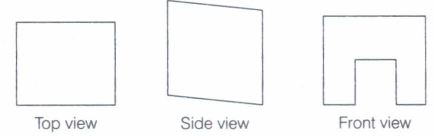
20.
| Figure | Number of lines of symmetry | Order of rotational symmetry |
|---|---|---|
| a | 1 | 1 |
| b | 1 | 1 |
| c | 1 | 1 |
| d | 2 | 2 |
| e | 1 | 1 |
| f | 0 | 1 |
| g | 1 | 1 |
| h | 0 | 3 |
| i | 4 | 4 |
| j | 1 | 1 |
| k | 0 | 1 |
| l | 1 | 1 |
| m | 0 | 2 |
| n | 0 | 1 |
| o | 1 | 1 |
| p | 1 | 1 |
| q | 2 | 2 |
| r | 0 | 1 |
| s | 3 | 3 |
| t | 1 | 1 |
| u | 1 | 1 |
| v | 3 | 3 |
| w | 0 | 2 |
21.
In ΔPQR we have mㄥQ = 30°, mㄥR = 60° and QR = 4.7 cm.
Here, two angles and included side are given, so ΔPQR can be constructed.
Step V Rays QX and RY intersect at P.
Step I Firstly, draw a rough sketch of triangle with given measures marked on it.
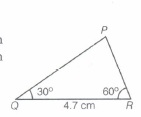
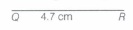
Step II Draw a line segment QR = 4.7 cm.
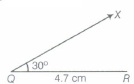
Step III At point Q, draw a ray QX making an angle of 30° with QR.
Step IV At point R, draw a ray RY making an angle of 600 with QR
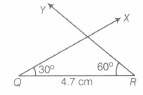
Step V Rays QX and RY intersect at P.
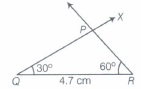
Thus, ΔPQR is the required triangle.
22.
Selling price of each radio = Rs 5000
Let the cost price of each radio be Rs x.
10% profit on one radio
i.e.\({110\over 100}\times x=5000\)
\(x={5000\over 110}\times100={50000\over11}=Rs4545.45\\ 10\%
\)
23.
Let we add A to x to find y,
A+x=y\(\Rightarrow \) \(A+\left( \frac { -4 }{ 9 } \right) =\left( \frac { 5 }{ 12 } \right) \)
\(A=\frac { 5 }{ 12 } -\left( \frac { -4 }{ 9 } \right) =\frac { 5 }{ 12 } +\frac { 4 }{ 9 } \)
\(=\frac { 5\times 3+4\times 4 }{ 36 } =\frac { 15+16 }{ 36 } =\frac { 31 }{ 36 } \)
24.
x = 34°, y=56°
25.
As per the given information, we can draw the given diagram.
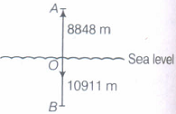
Let A be the point above the sea level and B be the point below the sea level.
\(\therefore\) Vertical distance between points A and B = Distance between point A and sea level + Distance between point B and sea level.
= AO + OB = 8848 + 10911 = 19759 m
26.
169.86 m2
27.
(a) The above double bar graph compares the sale of brands A and 8during the months of January to June.
(b) We can clearly see from the double bar graph that sales for brand A reduced in the month of March compared to that of February.
(c) Sales of brand A in June = Rs. 57 lakh
and sales of brand 8 in June = Rs. 54 lakh
Difference in sales = 57 - 54 = Rs. 3 lakh
(d) Average sales of brand 8
=\(\frac { total\ sales\ of\ brand\ b\ in\ sin\ months\ from\ january\ to\ june }{ 6 } \)
= \(\frac { 36+38+43+35+45+54 }{ 6 } \)
= \(\frac { 251 }{ 6 } \) Rs.41.83 lakh
(e) We can clearly see from the double bar graph that sales of brand 8is less than sales of brand A in the month of April and June
(f) Sales of brand A in January = 31
and sales of brand 8 in January = 36
Required ratio = \(\frac { 31 }{ 36 } \)or 31:36
28.
2x+3y=220°
29.
As per the given information in the question, the total number of students in the class = 60
Let x be the number of boys in the class.
So, the number of girls in the class = \(\frac{x}{3}\)
\(\therefore x+\frac{x}{3}=60\Rightarrow \frac{3x+x}{3}=60\Rightarrow \frac{4x}{3}=60\)
4x = 60 x 3 \(\Rightarrow\) 4x = 180 \(\Rightarrow x=\frac{180}{4}=45\)
Hence, the number of boys in the class is 45 and number of girls in the class is \(\frac{45}{3}=15\)
30.
We know that in a triangle, an exterior angle is equal to the sum of two interior opposite angles. Therefore,
(i) Sum of interior opposite angles = Exterior angle
=> x+50°=115°=>x=115°-50°=65°
Hence, the value of the unknown interior angle x is 65°.
(ii) The value of the unknown interior angle x is 30°.
(iii) The value of the unknown interior angle x is 35°.
(iv) The value of the unknown interior angle x is 60°.
(v) The value of the unknown interior angle x is 50°.
(vi) The value of the unknown interior angle x is 40°.
31.
We may draw AC = 5 cm and \(\angle\)C = 30°. CA is one arm of \(\angle\)C. Point B should be lying on the other arm of \(\angle\)C. But we observe that point B cannot be located uniquely. So, the given data is not sufficient for construction of \(\triangle\)ABC.
32.
6s + 24 = 0
\(\Rightarrow\) 6s = - 24
Thus, s = -4
33.
44875 \(\times\) 99- (- 44875) = 44875 \(\times\) 99- 44875 \(\times\) - 1
= 44875 \(\times\) [99- (-1)]
[using distributively over addition]
= 44875 \(\times\) (99 + 1)
= 44875 \(\times\) 100
= 4487500.
34.
8
35.
(220 \(\div\) 215) x 23 = (220-15)x23
=25 x23 =25+3 =28
36.
Given, radius (r) = 7 cm
\(\therefore\) Circumference of a circle = 2\(\pi\)r
= 2 x \(\frac{22}{7}\) x 7 = 44 cm.
37.
Given 4x3 + 3x2 + 6
The expression 4x3 + 3x2 + 6 is having three terms, i.e. 4x3, 3x2 and + 6.
So, it is a trinomial.
38.
For more rational numbers, firstly we make both denominators same. Since LCM of 7 and 8 is 56.
Now , \(\frac { -5\times 8 }{ 7\times 8 } =\frac { -40 }{ 56 } ,\frac { -3 }{ 8 } \times \frac { 7 }{ 7 } =\frac { -21 }{ 56 } \Rightarrow \) -40<-39<-38<....<-21
\(\therefore \) \(\frac { -40 }{ 56 } <\frac { -39 }{ 56 } <\frac { -38 }{ 56 } <\frac { -37 }{ 56 } <\frac { -36 }{ 56 } <\frac { -35 }{ 56 } <.....<\frac { -21 }{ 56 } \)
Hence, Five rational numbers between \(\frac { - 5 }{ 7 } \) and \(\)\(\frac { - 3 }{ 8 } \) are \(
\frac { - 39 }{ 56 } ,\frac { - 38 }{ 56 } ,\frac { - 37 }{ 56 } ,\frac { - 36 }{ 56 } ,\frac { - 35 }{ 56 }\).
39.
The multiple lines of symmetry of each figure are shown below:
This figure has 2 lines of symmetry which are shown by dotted lines.
40.
Let the number be x.
\(\therefore\) 75% of \( x =15 \Rightarrow {75\over100}\times x =15\)
\(\Rightarrow x=15\times {100\over75} \Rightarrow x=20\)
Hence, the number is 20.
41.
In ΔABC and ΔPQR, we have
AB = 3.5 cm and PQ = 3.5 cm, so AB = PQ
AC = 3.5 cm and PR = 3.5 cm, so AC = PR
LA=60° and LP=60°, so ㄥA = ㄥP
Hence, two sides and an angle in ΔABC and ΔPOR are equal. Therefore, the two triangles are congruent.
∴ ΔABC ≅ ΔPOR
42.
We know that in a triai.gle, the exterior angle is equal to the sum of two interior opposite angles.
By exterior angle property of a triangle,
Sum of interior opposite angles = Exterior angle
\(\Rightarrow\) x + 50° = 120° \(\Rightarrow\) = 120° - 50° = 70°
Since, the sum of all the angles of triangle is 1800.
Now, by angle sum property of a triangle,
\(\Rightarrow\) x+ y+500=180° \(\Rightarrow\) 70°+ y+500=180°
\(\Rightarrow\) y +120° = 180° \(\Rightarrow\) Y = 180° -120° = 60°
Hence, the value of the unknown x and yare 70° and 60°, respectively.
43.
Given, angle 48°
Complement of 48° = 90° - 48° = 42°
44.
First five even numbers = 2, 4, 6, 8,10
Sum of first five even numbers
=2+4+6+8+10=3
\(Mean=\frac { sum\ of\ the\ numbers }{ number\ of\ observations } =\frac { 30 }{ 5 } =6\)
Hence, mean of first five even numbers is 6.
45.
We have, \(\frac{4}{5}\times \frac{12}{7}\times \frac{4\times12 }{5\times 7}=\frac{48}{35}=1\frac{13}{35}\)
46.
\(\frac{-6}{-25}=\frac{-6\times-1}{-25\times-1}=\frac{6}{25}\)
47.
(a)
ㄥT = ㄥN
48.
\(3\frac{1}{3}\div10=\frac{10}{3}\div10=\frac{10}{3}\times\frac{1}{10}=\frac{10\times1}{3\times10}=\frac{1}{3}\)
49.
(b)
1.027 x 10⁹
50.
(b)
1
51.
(d)
4
52.
(d)
21 : 2
53.
(c)
90°
54.
(a)
median
55.
(c)
-1
56.
(c)
\(\frac { -1 }{ 64 } \)
57.
(b)
13 cm
58.
(b)
50°
59.
(d)
decreased by 1.5
60.
(c)
-12
61.
(i) x + y = 1200 ...(1)
The exterior angle of a triangle is equal to the sum of its two interior opposite angles
x + y + y = 1800
Base angles opposite to the equal sides of an isosceles triangle are equal and the sum of the measures of the three angles of a triangle is 1800
\(\Rightarrow\)x + 2y = 1800 ... (2)
Subtracting equation (1) from equation (2),
y = 60°
Put y = 60° in equation (1),
x + 60° = 120°
\(\Rightarrow\)x = 120° - 60°
\(\Rightarrow\)x = 60°
62.
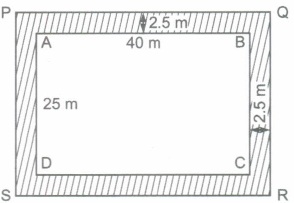
Let ABCD be the rectangular park of sides 40 m and 25 m, and the shaded region represents the path 2.5 m wide.
Now, PQ = (40 + 2.5 + 2.5) m = 45 m
PS = (25 + 2.5 + 2.5) m = 30 m
\(\therefore\)Area of rectangle ABCD = I x b = 40 m x 25 m
= 1000 m2
Area of rectangle PQRS = 45 m x 30 m = 1350 m2
So, Area of the path = [Area of rectangle PQRS] - [Area of rectangle ABCD]
= 1350 m2 - 1000 m2 = 350 m2
63.
Total number of students = 8
Sum of the marks obtained =85 + 62 + 36 + 48 + x + 75 + 39 + 72=417+x
\(\therefore \)Mean marks =\(\frac { (417\quad +x) }{ 8 } \)
\(\Rightarrow \)\(\frac { (417\quad +x) }{ 8 } \)=60
\(\Rightarrow \)417 + x = 60 x 8 = 480
\(\Rightarrow \)x = 480 - 417 = 63
Thus, the required value of x = 63
64.
Substituting a = 3 and b = 2 in
(a) a + b, we get
a + b = 3 + 2 = 5
(b) 7a - 4b, we get
7a - 4b = 7 x 3 - 4 x 2
= 21 - 8 = 13
(c) a2 + 2ab + b2, we get
a2 + 2ab + b2 = 32 + 2 x 3 x 2 + 22
= 9 + 2 x 6 + 4
= 9 + 12 + 4 = 25.
(d) a3 - b3, we get
a3 - b3 = 33 - 23 = 3 x 3 x 3 - 2 x 2 x 2
= 27 -8 = 19.
65.
\(⇒\ \left(1\over 5\right)^{5+19}=\left(1\over 5\right)^{8x}\)
[∵ am x an = am+n]
\(⇒\ \left(1\over 5\right)^{24}=\left(1\over 5\right)^{8x}\)
When bases are equal, then by equating their exponents, we get
8x = 24
\(∴\ x={24\over 8}=3\)
66.
Quantity of pure alcohol in 400 ml. of 15% = 400 \(\times \frac { 15 }{ 100 } \)
= 60 ml
Now, we add x ml of pure alcohol to the sample.
So, total pure alcohol = (60 + x) ml.
But volume of new sample = (400 + x) ml.
\(\therefore\) Percentage of pure alcohol in new sample \(=\frac { (60+x) }{ (400+x) } \times 100\)
which is equal to 32%
\(\Rightarrow \quad \frac { 60+x }{ 400+x } \times 100=32\)
\(\Rightarrow \quad \frac { 60+x }{ 400+x } =\frac { 32 }{ 100 } \)
\(\Rightarrow\) 100(60 + x) = 32 (400 + x)
\(\Rightarrow\) 100x + 6000 = 32x + 12800
\(\Rightarrow\) 100x-32x = 12800 - 6000
\(\Rightarrow\) 68x = 6800
\(\Rightarrow \ x=\frac { 6800 }{ 68 } =100\ ml\)
67.
Let the cost of property be Rs. 100.
\(\Rightarrow \) Commission is Rs.3
\(\Rightarrow \) When commission is Rs.3, then cost of property
= Rs.100
\(\therefore \) When commission is Rs.42,660, then cost of property
=\(\frac { 100 }{ 3 } \times \)42660
=100 x 14220
=Rs.1422000
Hence, the cost of property is Rs.14,22,000.
68.
Given pattern is
\(-\frac { 1 }{ 3 } ,\frac { 2 }{ 6 } ,\frac { 3 }{ 9 },-\frac { 4 }{ 12 } ...\)
Here, \(-\frac { 1 }{ 3 } =\frac { (-1)\times 1 }{ 3\times 1 } \)
\(-\frac { 2 }{ 6 } =\frac { (-1)\times 2 }{ 3\times 2 } \)
\(-\frac { 3 }{ 9 } =\frac { (-1)\times 3 }{ 3\times 3 } \)
and \(-\frac { 4 }{ 12 } =\frac { (-1)\times 4 }{ 3\times 4 } \)
Hence, next four numbers are
\(\frac { (-1)\times 5 }{ 3\times 5 } =-\frac { 5 }{ 15 } \)
\(\frac { (-1)\times 6 }{ 3\times 6 } =-\frac { 6 }{ 18 } \)
\(\frac { (-1)\times 7 }{ 3\times 7 } =-\frac { 7 }{ 21 } \)
\(\frac { (-1)\times 8 }{ 3\times 8 } =-\frac { 8 }{ 24 } \).
69.
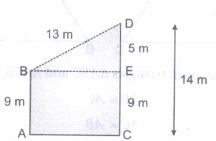
In the above figure, AB and CD are two poles whose heights are 9 m and 14m respectively.
\(\Rightarrow\) AB = EC = 9m
and BD = 13m
DE = 14 - 9
= 5m
Now in right ΔBDE, by Pythagoras
BD2 = BE2 + DE2
132 = BE2 + 52
\(\Rightarrow\) BE2 = (13)2 - (5)2
= 169-25
BE2 = 144
\(\Rightarrow\) BE = \(\sqrt { 144 } \)
\(\Rightarrow\) BE = 12m.
Hence, distance between their feet = 12 m.

7th Standard CBSE Syllabus & Materials
7th Standard CBSE
CBSE 7th Social Science Theme B - New Beginnings : Cities and States - New Sample Question Papers Study Material - QB365 Set A
NEW7th Standard CBSE
CBSE 7th Social Science Theme A - Climates of India - New Sample Question Papers Study Material - QB365 Set A
NEW7th Standard CBSE
CBSE 7th Social Science Theme A - Geographical Diversity of India - New Sample Question Papers Study Material - QB365 Set A
NEW7th Standard CBSE
CBSE 7th Science Earth, Moon and the Sun - New Sample Question Papers Study Material - QB365 Set A



CBSE 7th Standard CBSE Subjects
CBSE Standards




