
 100% FREE ACCESS
7th Standard CBSE Syllabus & Materials
7th Standard CBSE
CBSE 7th Social Science Theme E - Understanding Market - New Sample Question Papers Study Material - QB365 Set A
NEW7th Standard CBSE
CBSE 7th Social Science Theme E - From Barter to Money - New Sample Question Papers Study Material - QB365 Set A
NEW7th Standard CBSE
CBSE 7th Social Science Theme D - The Constitution of India- An Introduction - New Sample Question Papers Study Material - QB365 Set A
NEW7th Standard CBSE
CBSE 7th Social Science Theme D - From the Rulers to the Ruled : Types of Governments - New Sample Question Papers Study Material - QB365 Set A
NEW7th Standard CBSE
CBSE 7th Social Science Theme B - The Age of Reorganisation - New Sample Question Papers Study Material - QB365 Set A
NEW7th Standard CBSE
CBSE 7th Social Science Theme B - The Rise of Empires - New Sample Question Papers Study Material - QB365 Set A

Published on: 06/03/2020
7th Standard Science Board Exam Model Question 2019-2020
Download CBSE Class 7th Standard CBSE Science question papers, sample papers, important questions, and previous year solved papers in PDF format. Get free study materials, NCERT solutions, and exam preparation resources for Class 7th Standard CBSE Science
Questions + Answers key
Take MCQ Science Test
1.
The full form of WWTP is:
Water trickling from a damaged tap
Water coming out of a shower
Water flowing in a river
Water coming out of a laundry
2.
Heat is a form of:
Energy
Light
Electricity
Work
3.
Who discovered magnetic effect of current?
HC Oersted
Michael Faraday
Ohm
Fleming
4.
Blood platelets help in:
Clotting of blood
Killing germs
Transport of CO2
Transport of O2
5.
One millionth second is
Microsecond
Nanosecond
Picosecond
None of these
6.
The power of lens is measured in:
Dioptre
Watt
Dyne
cm
7.
Silkworm is called:
Adult silk moth
Female silk moth
Caterpillar
Pupa
8.
Stomach secretes:
HCl
H2SO4
CH3COOH
NaOH
9.
Choose the correct order of terms that describes the process of nutrition in ruminants.
swallowing \(\rightarrow \) partial digestion \(\rightarrow \) chewing of cud \(\rightarrow \) complete digestion
chewing of cud \(\rightarrow\) swallowing \(\rightarrow\) partial digestion \(\rightarrow\) complete digestion
chewing of cud \(\rightarrow\) swallowing \(\rightarrow\) mixing with digestive juices \(\rightarrow\) digestion
swallowing \(\rightarrow\) chewing and mixing \(\rightarrow\) partial digestion \(\rightarrow\) complete digestion
10.
Which of the following does not show water shortage?
Taps running dry
Long queues for getting water
Marches and protests for demand of water
A family gets three buckets of water per person per day
11.
Seeds of drumstick and maple are carried to long distances by wind because they possess.
winged seeds
large and hairy seeds
long and ridged fruits
spiny seeds
12.
Which of the following is not a correct statement?
Forest trees are cut down to obtain timber
Forest trees are cut down to obtain paper
Forest trees are cut down to obtain natural rubber
Forest trees are cut down to obtain firewood
13.
Paheli's mother made a concentrated sugar syrup by dissolving sugar in hot water. On cooling, crystals of sugar got separated. This indicates a
physical change that can be reversed
chemical change that can be reversed
physical change that cannot be reversed
chemical change that cannot be reversed
14.
During exhalation, the ribs
move outwards
move downwards
move upwards
do not move at all
15.
Which of the statements given below is correct?
In winter, the winds blow from the land to the ocean.
In summer, the winds blow from the land towards the ocean.
A cyclone is formed at a very high pressure system with very high speed winds revolving around it.
The coastline of India is not vulnerable to cyclones.
16.
The microorganisms present in the soil require moisture (water) and nutrients for growth and survival. Choose from the options below, the habitat (place) where the soil has plenty of water and nutrients.
Desert
Forest
Open field
Cricket ground
17.
The maximum and minimum temperatures displayed daily in the weather bulletin refer to the
highest day temperature and lowest night temperature of the day
highest day temperature and highest night temperature of the month
temperature recorded at 12 noon and at mid night (00.00 h)
average highest temperature of day and average lowest temperature of night
18.
The plant which traps and feeds on insects is
Cuscuta
China rose
pitcher plant
rose
19.
Why mercury is used as an indicator in thermometers?
20.
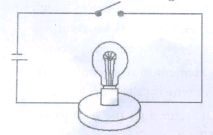
What do you mean by open circuit?
21.
Explain how lightning take place.
22.
How clouds are formed? What is this change called? Explain.
23.
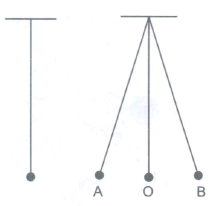
What is a simple pendulum ? What is the timeperiod of a pendulum?
24.
Give eight English alphabet letters which do not show lateral inversion while placed before a plane mirror?
25.
Ruminants such as cows and buffaloes swallow their food hurriedly and then sit restfully and chew their food. Can you reason why?
26.
The excessive use of water leads to a severe problem. Write the problem.
27.
Bryophyllum leaves reproduce using which mode of reproduction?
28.
Name the respiratory organs in frogs.
29.
Sanitation can be improved. Explain, what step should be taken to improve it.
30.
Name some wool yielding animals
31.
While going inside a forest, it becomes darker. Why?
32.
Sponges and Hydra do not possess any circulatory system then how do they carry out distribution of food and other substances?
33.
How can a farmer convert acidic soil into neutral soil?
34.
Fungus can be harmful and useful. Give an example showing both of these traits of fungus.
35.
Name the reaction when an acid is mixed with base.
36.
Mention two adaptive features of penguin that help it in swimming.
37.
After coming from football match Ravi had cramping in his leg muscles. His father Mr. Sharma who is a physical trainer in his school advised him to take hot water bath
On this situation answer the following questions:
(i) Why do we get muscle cramps after heavy exercise?
(ii) How far the advice given by Ravi's father is effective?
(iii) Which value is shown by Mr. Sharma?
38.
Show that water is a bad conductor of heat.
39.
What are CFLs ? Why are CFLs preferred over electric bulbs ?
40.
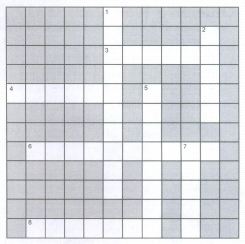
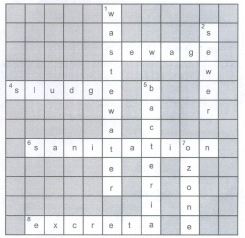
Here us a crossword puzzle: Good luck!
Across
3. Liquid waste products
4. Solid waste extracted in sewage treatment
6.A word related to hygiene
8. Waste matter discharged from human body
Down
1. Used water
2. A pipe carrying sewage
3. Micro-organisms which cause cholera
7.A chemical to disinfect water
41.
In which way forests are helpful in controlling flood and soil erosion?
42.
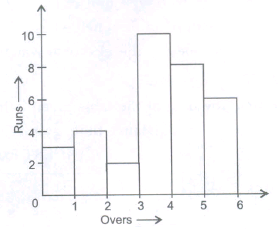
In a cricket match a team scored 3, 4, 2, 10, 8, 6 runs in first 6 overs. Show these runs by a bar graph (supply graph paper).
43.
Vivek went to visit his grandfather in village where he saw that his grandfather's field of wheat is infected with fungus but no one is aware of this. Vivek told him that he should use an antifungal agent in his fields to stop this infection?
(a) What is fungus?
(b) Can fungus only cause disease or can it be helpful also?
(c) What values are shown by Vivek?
44.
Deforestation can be considered as a reason for depletion of the water table. Comment.
45.
State the main differences between asexual and sexual reproduction.
46.
How ozone layer acts as a protective shield?
47.
Due to uneven heating of land and ocean water what happens in the following season?
In summer season
48.
The internal structure of heart has four chambers.
(a) Name the upper chambers of heart.
(b) Name the lower chambers of heart.
49.
You must be familiar with the following nursery rhymes.
(i) 'Baa Baa! Baa Baa! Black sheep, have you any wool.'
(ii) 'Mary had a little lamb, whose fleece was white as snow.'
Which parts of the black sheep have wool?
50.
Find out the letters of English alphabet or any other language known to you in which the image formed in a plane mirror appears exactly like the letter itself. Discuss your findings.
51.
Name three types of salts. Give one example of each type of salt.
52.
Write the difference between milk teeth and permanent teeth.
53.
Explain how soil is formed.
54.
Name two animals each that live in polar regions and tropical rainforests.
55.
Tanay came to know about drastic loss of human lives, property, agriculture etc. in the cyclone affected area of Odisha. His mother gave him Rs. 500to purchase a dress for his birthday which was just after seven days to happen. But in his school, teacher said about a circular in which students are supposed to donate in the rescue fund of disaster affected people. Tanay donated the money to the fund.
On this situation answer the following questions:
(i) What is cyclone?
(ii) Which area of Indian coast are prone to cyclone?
(iii) State some effective safety measures of cyclone.
(iv) Which value of Tanay is shown here?
56.
A jug placed facing a plane mirror. Draw the position or image of jug.
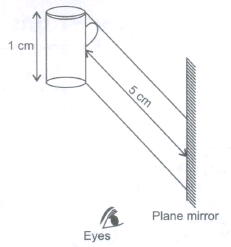
Answer the following questions:
(i) What is the size of the image of the jug?
(ii) What is the distance between image of jug and mirror?
57.
(a) Draw a schematic diagram showing photosynthesis.
(b) What are the products of photosynthesis?
(c) Name the gases utilized and liberated in photosynthesis.
(d) Can all plants do photosynthesis?
58.
Water is very precious for all the living beings. What will happen in future, if we do not save water now?
59.
One day, Pinki was ironing the clothes in her room. After half an iron of ironing, the light went off and Pinki went outside to the lobby of her house to check it there was any problem in the household circuit. At the same time, she listened the voice of her 4 years old daughter from the same room where she was ironing the clothes. Her daughter was about to touch the hot electric iron but at the same moment, Pinki entered in the room and pushed her daughter back from that place.
(a) On which effect of electric current, does the electric iron works?
(b) Mention the values showed by Pinki here.
60.
Prove with the help of an experiment that heat radiation can travel through vacuum.
61.
Explain the process of reproduction in plants, involving the fusion of cells from male and female parts of a flower.
62.
Think and suggest some ways to minimise waste and pollutants at their source, taking your home as an example.
63.
(a) Respiratory process occurs in two phases, what are those two major steps of respiration? Describe each one.
(b) Define the term breathing rate.
64.
Boojho goes to the football ground to play football. The distance-time graph of his journey from his home to the ground is given as figure.
(a) What does the graph between points B and C indicate about the motion of Boojho?
(b) Is the motion between 0 to 4 min uniform or non-uniform?
(c) What is his speed between 8 to 12 min of his journey.
65.
Neha went to the market with her mother to buy a silk saree for her grandmother. The shopkeeper was showing sarees of different varieties of silk but her mother wanted to take only a pure silk saree and not an artificial one. Neha was confused that how to distinguish between a pure silk and an artificial silk saree. But her mother helped her in selecting a pure silk saree for her grandmother and she was quite elated about that.
Now, answer the following questions:
(a) How her mother distinguished between pure silk saree and an artificial silk saree?
(b) Is the pure silk saree more costly than an artificial one?
(c) What values are shown by Neha's mother?
66.
Sachin lives in a village, this village is surrounded by a forest. One day he noticed that in nearby pond sedimentation is increased so much that water has become muddy, streams are drying up. There is scarcity of fuel wood. He soon realised that he has to raise the issue of forest protection from cutting down trees, etc. Soon he involved the nearby village people and made an organisation to take an initiative.
Now, answer the following questions
(a) What changes might have Sachin noticed in his area?
(b) Give the porbable reason for such changes mentioned above.
(c) What are the values shown by Sachin?
67.
In the summer holidays, Karan went to Rann of Kutch in Gujarat with his parents. Karan was aware that in the coastal regions of India especially in the Rann of Kutch common salt is obtained from seawater. Karan was very excited to see that place. He requested his father that he wants to see the process of obtaining salt from the sea. His father helped him and they went to see the place where common salt was collecting. And he also explained the whole process. Karan was very happy to see the process. Now, answer the following questions.
(a) How is common salt obtained from sea water?
(b) Name the process by which salt is collected from seawater
(c) What values are shown by Karan?
68.
Priya's grandfather was taken to the hospital as he was unable to perform excretory processes. Priya heard a nurse talking to her father that her grandfathers has kidney failure and needs to undergo dialysis. Priya later asked her father as to what is dialysis process and why does grandpa needs it. Her father smiles and tells her all the facts associated with this process.
(a) What do you mean by dialysis?
(b) Why is there a need for dialysis in some people?
(c) Excretion is an important life process. How?
(d) Which is the major excretory organ in humans?
(e) What values do you observe in Priya?
69.
During a field trip, some students visited an agricultural farm and saw a few birds eating earthworms. They enjoyed the scene and then they also started picking and killing the earthworms for pleasure. Seeing the crowd of students in a corner, the teacher rushed to them to see the matter and objected to their action. Anshul, one of the student asked the reason.
Teacher smiled and explained him that an earthworm living in the soil is very beneficial for farmers. Anshul wondered whether there were other organisms also in the soil. The teacher appreciated him and explained.
(a) Mention the importance of earthworm.
(b) List some organisms living in soil.
(c) What are the values shown by Anshul?
70.
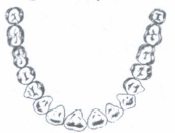
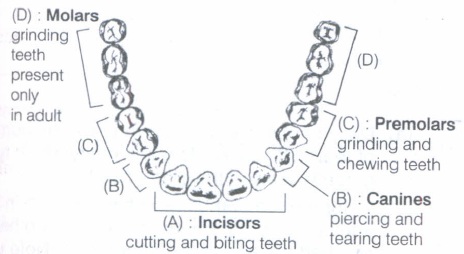
Label the given figure as directed below in A to D and give the name of each type of teeth.
(a) The cutting and biting teeth as A
(b) The piercing and tearing teeth as B
(c) The grinding and chewing teeth as C
(d) The grinding teeth present only in adult as D.
71.
Boojho, Paheli and their friend Golu were provided with a test, each containing China rose solution which was pink in colour. Boojho added 2 drops of solution 'A' in his test tube and got dark pink colour. Paheli added 2 drops of solution '8'to her test tube and got green colour. Golu added 2 drops of solution 'C' but could not get any change in colour. Suggest the possible cause for the variation in their results.
72.
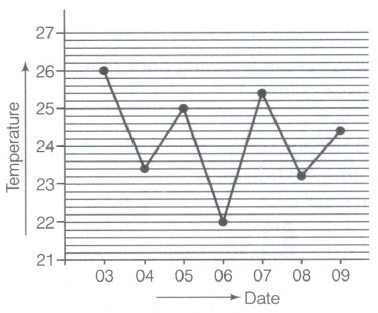
The following graph shows the change in temperature. Answer according to the reading of graph.
(a) Draw a table and fill the temperature change of each day.
(b) Which day show the highest temperature?
(c) Which day shows the minimum temperature?
1.
(d)
Water coming out of a laundry
2.
(a)
Energy
3.
(a)
HC Oersted
4.
(a)
Clotting of blood
5.
(a)
Microsecond
6.
(a)
Dioptre
7.
(c)
Caterpillar
8.
(a)
HCl
9.
(a)
swallowing \(\rightarrow \) partial digestion \(\rightarrow \) chewing of cud \(\rightarrow \) complete digestion
10.
(d)
A family gets three buckets of water per person per day
11.
(a)
winged seeds
12.
(c)
Forest trees are cut down to obtain natural rubber
13.
(a)
physical change that can be reversed
14.
Move downwards During exhalation the ribs moves downwards causing a decrease in area of chest cavity forcing the air out.
15.
(a)
In winter, the winds blow from the land to the ocean.
16.
(b)
Forest
17.
(a)
highest day temperature and lowest night temperature of the day
18.
(c)
pitcher plant
19.
Mercury is used as thermometric fluid because:
(i)It expands easily and uniformly on heating.
(ii)It can be used over a wide range of temperature.
(iii)It is easily visible, being opaque and shining.
(iv) It does not stick to the sides of a glass tube.
20.
When the switch is in off position then the circuit from the positive terminal of battery to the negative terminal is not complete. The circuit is then said to be opened and current does not flow throughout the circuit and bulb does not glow.
21.
During the condensation of water vapour and freezing of droplets, a large amount of heat is released which further pushes the air at a high speed. The water droplets and ice particles rub against each other in rapidly rising air. This builds up an electric charge which is released by a stroke of lightning.
22.
Clouds are formed by the condensation of water vapours present in the atmosphere. It comes back to the atmosphere/earth as rain water. No new product is formed. So it is a physical change.
23.
A simple pendulum has a small metallic ball called bob suspended from a rigid stand by a thread. The time taken by the pendulum to complete one oscillation is called time period. One oscillation of a pendulum is completed when the bob moves from position O to A and then from A to B and then back to A or from A to B to A.
24.
Eight English alphabet letters which do not show lateral inversion are:
A, H, I, M, O, T, U, X.
25.
To digest their food completely.
26.
The excessive use of water leads to water scarcity in an area.
27.
Asexually by vegetative propagation.
28.
Frogs respire through their moist skin as well as through a pair of lungs
29.
Low cost onsite sewage disposal system must be encouraged to improve sanitation.
30.
Wool yielding animals are sheep, yak, llama, alpaca, angora goat, angora rabbit and camel.
31.
In a forest, big trees, shrubs and other plants are found. They trap solar radiation for photosynthesis. So, the sunlight does not reach at the forest floor, thus making it dark.
32.
The water in which these organisms live brings them food and oxygen as it enters their bodies.
33.
The farmer can convert acidic soil into neutral soil by adding a small quantity of quicklime or slaked lime solution to the soil
34.
Fungus produces antibiotics like penicillin used to treat diseases and fungus can also harm us by causing fungal infections on skin and hair.
35.
Neutralisation reaction.
36.
Adaptive features of penguin that help it in swimming are as follows
(i) It has streamlined body.
(ii) It has webbed feet.
37.
(i) The cramps occur when muscle cells respire anaerobically. The partial break down of glucose produces lactic acid, accumulation of which causes muscle cramps.
(ii) Hot water bath improves circulation of blood. As a result, the supply of oxygen to the muscle cells increases and complete breakdown of lactic acid occurs to form carbon dioxide and water.
(iii) Apart from his profession Mr. Sharma is caring and conscious about his son, so he gave the perfect advice to him to get relief from fatigue.
38.
Take a test-tube. Half fill it with cold water. Now drop in it a cube of ice wrapped in a wire gauze. It sinks to the bottom. Hold the top end of the test-tube with a test-tube holder. Heat it over a flame. It will be noticed that water starts boiling but ice is not fully melted. It means that heat has been transferred through the molecules of water. This shows that water is a bad conductor of heat.
39.
An electric bulb is used for light but it also gives heat. This is not desirable. This results in the wastage of electricity. This wastage can be reduced by using fluorescent tube lights (CFLs)in place of the bulbs. CFLs are also used to reduce wastage of electricity. There are compact fluorescent lamps. These can be fixed in ordinary bulbs holders.
40.
41.
Due to spoilage of forest trees, the rainwater drops fall slowly on the ground. The forest also slows down the speed of rainwater and allowed it to seep. In absence of tress the rainwater hits the ground directly and may flood the area around it. Roots of forest trees bind the soil together and thus prevents soil erosion also.
42.
43.
(a) Fungus are non-green plants that grow on dead and decaying matter for their food.
(b) Fungus are also useful as it can cure different type of infections.
(c) Vivek is sincere, curious and knowledge with a keen sense of applying it where necessary.
44.
Large scale deforestation has occurred to accommodate the growing population, to grow food for them and to provide space for industries. Vegetation slows down the flow of rainwater on land and increases the absorption of water by the soil.
Cutting down of trees and destroying vegetation, therefore interferes with the natural process by which seeping takes place and the groundwater is recharged.
It finally results in the depletion of the water table.
45.
The main differences between asexual and sexual reproduction are
| Asexual reproduction | Sexual reproduction |
| Only one parent is needed | Two parents a male and a female are required. |
| Offsprings are genetically identical to their parents. | Offsprings exhibit variation with respect to their parents. |
| No seed is formed. Fragmentation, budding, spore formation, vegetative propagation are its different types | Seeds are formed due to fusion of male and female gametes. |
| Spirogyra, yeast, moulds and potato exhibit asexual reproduction | Fruit-bearing plants like mango and China rose, reproduce sexually. |
46.
The ozone layer protects us from the harmful ultraviolet radiations which come from the sun. Ozone absorbs ultraviolet radiations coming from the sun and breaks down to form oxygen.
In this way, ozone layer absorbs harmful ultraviolet radiations.
47.
Due to uneven heating of land and ocean water
In summer season The uneven heating of land and ocean water generates wind from the South-West direction. These winds carry lot of water from the Indian ocean.
48.
The vertical section of heart shows that heart is divided into four compartments called as chambers.
(a) The upper two chambers of heart are called atria or atrium.
(b) The lower two chambers of heart are called ventricles.
49.
The black sheep in the poem seems to have wool on almost all the parts as it in the poem, it offers wool enough to fill three bags full.
50.
Image formed by the plane mirror shows lateral inversion, i.e. left seems to be right and vice-versa. In case of alphabetic letters A, H, I, M, 0, T, U, V, W, X, Y show same image in the plane mirror.
51.
Type of salts
(i) Neutral salts e.g. sodium chloride (NaCI)
(ii) Acidic salts e.g. Ammonium chloride (NH4CI)
(iii) Basic salts e.g. sodium hydrogen carbonate (NaHCO3)
52.
The difference between milk teeth and permanent teeth are
| Milk teeth | Permanent teeth |
| They grow during infancy i.e. when one is small baby. |
They grow at the age of 6-8 years. |
| They are also called as temporary teeth because these are lost at the age of 6-8 years |
They do not fall till the old age. |
| They can be replaced by permanent teeth. |
If these teeth fall down no new teeth arises on its place. |
53.
Soil formation is a slow process which occurs in following two steps
(i) Weathering of rocks is the breakdown of rocks into small particles by the action of air, wind and water.
(ii) These small particles mix with humus (organic matter) and form soil.
54.
Polar regions Polar bear/penguin/ reindeer/musk oxen.
Tropical rainforests Red-eyed frog /elephants lion-tailed macaque/ lion and tiger.
55.
(i) Water takes up heat from atmosphere to change into vapour. Next water vapour changes back to liquid raindrops and release heat in the atmosphere. This heat warms the air around and rises up causing a drop in pressure. This cycle is repeated that leads to very low pressure system with very high speed winds revolving around it. It is known as cyclone.
(ii) Particularly the East coastline of India is vulnerable to cyclones.
(iii) (a) Forecast and warning service.
(b) Construction of cyclone centres in cyclone prone areas.
(c) Rapid communication of warnings to the Government agencies, fisherman, ships and general public.
(iv) Tanay is an aware student and concerned about the incidents happening around him. He is a responsible future citizen of our country.
56.
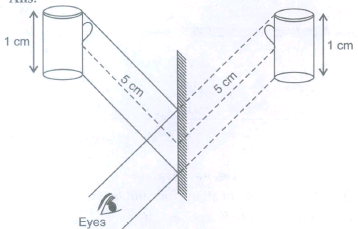
(i) Size of image of jug is 1cm.
(ii) Distance between image of jug and mirror is 5 cm.
57.
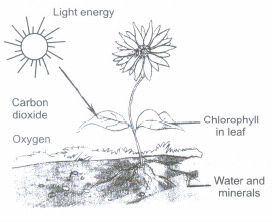
(b) Carbohydrates and oxygen.
(c) Liberated-oxygen, Utilised-carbon dioxide.
(d) All plants cannot do photosynthesis, only green plants can do photosynthesis.
58.
Water is needed for various life activities. If we continue the misuse of water and do not conserve it, the groundwater level will be depleted. This may result into various consequences like
(i) Lowering of the water table Excessive pumping can lower the groundwater table.
(ii) Reduced surface water supply Groundwater and surface water are connected. When groundwater is overused, the lakes, streams and rivers connected to groundwater, can also have little supply.
(iii) Loss of plants from land We fully depend on the plants for food directly or indirectly. Plants need water to prepare their food. If there will be scarcity of water on earth, the plants will be unable to prepare their food. This inturn will lead to the end of the life because world without plants means no food, no oxygen, not enough rain and other innumerable problems. Therefore, it is true that water is a precious resource
59.
(a) The electric iron works on the basis of heating effect of electric current.
(b) The values showed by Pinki here is a great concern and love towards her own 4 years old daughter.
60.
First of all, take a flat bottom flask and fix a rubber stopper having two holes in the mouth of the flask. Shift a thermometer through one hole and a glass tube with stopper through the other hole. Now, with the help of a vacuum pump, remove the air from the flask and try to record the temperature from the thermometer. Put a flask in the bright sunlight and we will observe that the thermometer records a rise in temperature. So, on this basis, we can say that this experiment proves that the heat radiation can travel through vacuum.
61.
When the reproduction in an organism includes two types of gametes, i.e male and female from two different parents, it is called sexual reproduction, The sexual reproduction takes place by the fusion of male and female gametes by the process called fertilisation to form zygote.
.png)
Sexual reproduction (fertilisation) in plants The different steps that take place during sexual reproduction in plants are
(i) The pollens are deposited on stigma and begin to germinate.
(ii) Pollen tube containing male gametes reaches to the ovary of flower.
(iii) The tip of the pollen tubes gets dissolved and male gametes comes out of the pollen tube.
(iv) Inside the ovary male gametes fuse with the female gamete or egg present in the ovule.
(v) The fusion of both the gametes will result into a fertilised egg cell which is also called as zygote.
62.
We can minimise waste and pollutants entering the water and create less wastewater by taking following few steps at home:
(i) By not throwing used tea leaves, solid food remains, etc., in the drain. We should throw it in the dustbin.
(ii) By not throwing chemicals like medicines, paints, insecticides, etc., in the drain as they increase the pollution load of the sewage
63.
(a) Respiration is the process of breakdown of food to produce energy for performing various functions. It involves two major steps:
(i) Inhalation is the process of taking in of air which is rich in oxygen, inside our body.
(ii) Exhalation is the process of giving out of air which is rich in carbon dioxide from our body to the external environment.
(b) The number of times a person breathes, in a minute is called as breathing rate. An adult human being can inhale or exhale 15-18 times in a minute. It is the average breathing rate of an adult human being. Breathing rate is not constant always.
64.
(a) Since, the graph between B and C is parallel to time-axis, so it indicates that Boojho is at rest.
(b) Since, the graph is not straight line, so it is a non-uniform motion.
\(Speed=\frac{Distance}{Time}=\frac{225-150}{12-8}=\frac{75}{4}=18.75\ m/min\)
65.
(a) Neha's mother took a thread of natural silk fabric and another thread of artificial silk fabric and burn them separately. The thread which burns giving a smell of burning hair will be natural silk (or pure silk). The thread which burns giving a smell a burning paper will be an artificial silk.
(b) Yes, pure silk saree is more costly than an artificial one.
(c) Neha's mother is intelligent and knowledgeable.
66.
(a) Sachin noticed the disturbance in the water cycle in his area like stream drying up. Pond water getting muddy, less availability of fuel wood, etc.
(b) Deforestation.
(c) Love for nature and environmental consciousness.
67.
(a) Seawater is collected in shallow pits. It is then allowed to evaporate in the sun. As the water evaporates, the salt solution becomes supersaturated (concentrated). This supersaturated solution cannot hold the excess salt. Thus, it separates out in the form of salt crystals. These salt crystals are collected and are redissolved in water and filtered to remove insoluble impurities. The clear solution is again evaporated to obtain the crystals of pure salt.
(b) Salt is obtained from sea water by the process of evaporation.
(c) The values shown by Karan are curious, aware and intelligence
68.
(a) Dialysis is the process used for cleaning of the blood by separating the waste products in an artificial medium.
(b) Dialysis is needed when the excretory organ of humans, i.e. kidney becomes damaged on unfunctional due to some injury or infection.
(c) Excretion process removes the waste products released in body after the utilisation of food and other components. These products are toxic and may harm us if not removed from our body.
(d) Kidney
(e) Priya is curious, sincere and aware eager to acquire new knowledge.
69.
(a) An earthworm helps in making the rich humus in soil.
(b) Ant, earthworm, termites, milipede, centipede, etc.
(c) Curiosity to learn and scientific attitude
70.
71.
China rose (gudhal) is an acid-base indicator.
China rose solution in different medium shows following changes:
China rose + acid \(\longrightarrow\) Give dark pink colour, hence A is an acidic solution.
China rose + base \(\longrightarrow\) give green colour, hence B is a basic solution.
China rose + neutral \(\longrightarrow\) No change in colour, hence C is a neutral solution.
72.
(a) Table showing the reading of temperature from the graph:
| Date | Maximum temperature |
|---|---|
| 03/11/14 | 26.0oC |
| 04/11/14 | 23.5oC |
| 05/11/11 | 25.0oC |
| 06/11/14 | 22.0oC |
| 07/11/14 | 25.5oC |
| 08/11/14 | 23.3oC |
| 09/11/14 | 24.4oC |
(b) The highest temperature is seen on 3rd November, 2014.
(c) The lowest temperature or minimum temperature was seen on 06th November, 2014.

7th Standard CBSE Syllabus & Materials
7th Standard CBSE
CBSE 7th Social Science Theme B - New Beginnings : Cities and States - New Sample Question Papers Study Material - QB365 Set A
NEW7th Standard CBSE
CBSE 7th Social Science Theme A - Climates of India - New Sample Question Papers Study Material - QB365 Set A
NEW7th Standard CBSE
CBSE 7th Social Science Theme A - Geographical Diversity of India - New Sample Question Papers Study Material - QB365 Set A
NEW7th Standard CBSE
CBSE 7th Science Earth, Moon and the Sun - New Sample Question Papers Study Material - QB365 Set A



CBSE 7th Standard CBSE Subjects
CBSE Standards




