
 100% FREE ACCESS
7th Standard CBSE Syllabus & Materials
7th Standard CBSE
CBSE 7th Social Science Theme E - Understanding Market - New Sample Question Papers Study Material - QB365 Set A
NEW7th Standard CBSE
CBSE 7th Social Science Theme E - From Barter to Money - New Sample Question Papers Study Material - QB365 Set A
NEW7th Standard CBSE
CBSE 7th Social Science Theme D - The Constitution of India- An Introduction - New Sample Question Papers Study Material - QB365 Set A
NEW7th Standard CBSE
CBSE 7th Social Science Theme D - From the Rulers to the Ruled : Types of Governments - New Sample Question Papers Study Material - QB365 Set A
NEW7th Standard CBSE
CBSE 7th Social Science Theme B - The Age of Reorganisation - New Sample Question Papers Study Material - QB365 Set A
NEW7th Standard CBSE
CBSE 7th Social Science Theme B - The Rise of Empires - New Sample Question Papers Study Material - QB365 Set A

Published on: 06/03/2020
7th Standard Science Board Exam Sample Question 2020
Download CBSE Class 7th Standard CBSE Science question papers, sample papers, important questions, and previous year solved papers in PDF format. Get free study materials, NCERT solutions, and exam preparation resources for Class 7th Standard CBSE Science
Questions + Answers key
Take MCQ Science Test
1.
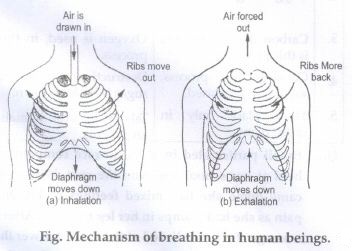
Explain breathing mechanism.
2.
Seema's family is shifted from Masouri to Mumbai, She saw the outer walls of their house were painted white. Moreover, she noticed that it is better when she is out of the house in comparison to inside of the house. Her mother gave her some light cotton clothes to wear.
On the basis of the situation answer the following:
(i) How does the heat reach us from the Sun?
(ii) Why is the wall painted white but not with any other colour?
(iii) Why did her mother prefer cotton clothes?
3.
What is thunderstorm? How does it develop?
4.
Why sheared skin with hair is thoroughly washed in tanks? What is this process called?
5.
Consider the following ray diagram.
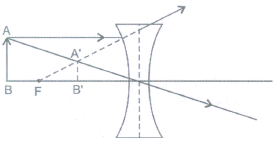
Answer the following question:
(i) Which lens is used?
(ii) What is the characteristics of the image formed?
(iii) How will the position of image change if position of image is changed?
6.
Solve the crossword given as Figure:
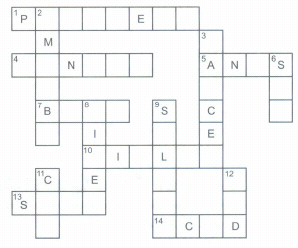
Across
1. Cream-coloured digestive gland
3. Undigested excretory solid residues
4. Organ that mixes saliva with the food
5. Point of defecation
7. Stored in gall bladder.
10. Finger-like outgrowth in the small intestine
13. Kind of taste buds
14. Kills bacteria in the stomach
Down
2. Feeds with the help of pseudopodia
6. Total number of molars in one jaw of an adult
8. largest gland
9. Watery secretion in the mouth
11. A ruminant
12. Form of food chewed by ruminants.
7.
Certain pattern of the rainfall in our country leads to scarcity of water. Explain that pattern. Which part of the country gets rainfall twice a year?
8.
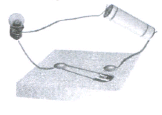
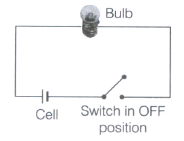
Draw the circuit diagram to represent the circuit shown in figure.
9.
A sewage treatment plant involves few steps in its working.
Aeration tank, grit and sand removal tank, second sedimentation tank, bar screen, first sedimentation tank.
Which step gives most of the sludge?
10.
How does the process of fertilisation take place in flowers?
11.
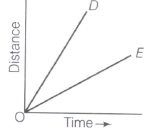
The following figure shows the distance-time graph for the motion of two objects 0 and E. Which one of them is moving slower?
12.
Plants help in maintaining O2-CO2 cycle. Explain it in the light of photosynthesis and respiration.
13.
What is the special feature present in a human heart which does not allow mixing of blood when oxygen-rich and carbon dioxide-rich blood reach the heart?
14.
Explain why burning of wood and cutting it into small pieces are considered as two different types of changes.
15.
Why is soil erosion relatively less in dense forests as compared to barren, open fields?
16.
Plants are considered an essential part of earth as they keep a check on lot of process occurring all over. What would happen if all the green plants are wiped from earth?
17.
The polar bear are white in colour. Explain why.
18.
State differences between acids and bases.
19.
Why are handles of most utensils made up of plastic and wood?
20.
If you keep a moist bread in open mould starts growing on it within few days. From where does this mould come from?
21.
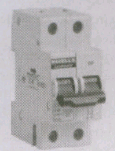
What are MCBs ?How do they work?
22.
Find out how many times you breathe in and breathe out in a minute
23.
What is meant by the understoreys?
24.
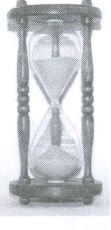
What is a sand clock?
25.
How do you prepare turmeric paper?
26.
Mention the usage of silk fibre.
27.
The earth looks blue from space. Explain why?
28.
Animal waste, oil and urea are some of the organic impurities present in sewage. Name two more organic impurities present in sewage.
29.
In the wind flow pattern, it can be found that the wind shown is not in the exact North-South direction. Explain why.
30.
Explain why concave mirror is known as a converging mirror?
31.
How can you say that ripening of a fruit is a chemical change?
32.
Arteries have a very thick and elastic wall. Why?
33.
Give the formula to calculate the absorption percentage.
34.
Explain the role of mucus secreted by stomach.
35.
Which parts of the plant are called food factories of the plant?
36.
Give one example of an animal that can live both in water and on land.
37.
Describe various steps of cleaning wastewater in a wastewater treatment plant.
38.
Describe various reasons for depletion of water table. Explain how does increasing population affect the water table.
39.
Write a short note on the disaster management in case of cyclones.
40.
What is rusting? How do we prevent it ?
41.
Explain the phrase - "Unity is Strength" on the basis of the making of fabric from fibre.
42.
What is the role of sun for controlling the weather?
43.
How do ruminants digest the cellulose?
44.
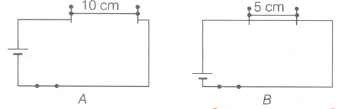
Paheli took a wire of length 10 cm. Boojho took a wire of 5 cm of the same material and thickness both of them connected with wires as shown in the circuit given in figure. The current flowing in both the circuits is the same.
(a) Will the heat produced in both the cases be equal? Explain.
(b) Will the heat produced be the same, if the wires taken by them are of equal lengths but of different thickness? Explain.
45.
On last Monday, Pankaj was dealing immense cough and cold. Besides this, he was suffering from a great headache. So, he decided to take a leave on that day so that he could take some rest at his home. After one hour he thought to check his fever through a clinical thermometer, so before using it, he washed it and started shaking it very fastly in his hand, so that the mercury level of thermometer gets reduced. At the same time, his elder brother Vishwas scold him and suggested him to shake thet hermometer slowly.
(a) State some precautionary measures while checking the fever through a clinical thermometer.
(b) Mention the values showed by the elder brother of Pankaj ( i.e. Vishwas).
46.
Ria went to a plant nursery with her mother. The gardner approached them and asked about their choice of plant. Ria's mother wanted a flowering plant with fragrance. Gardner showed them a plant and told them that this variety has been prepared by a method of vegetative propagation of stems.
Ria grew curious and asked some questions to Gardner.
(a) What is vegetative propagation?
(b) What are methods of producing new plants using stem?
(c) Name any two plants where this method of reproduction is used. Is this a asexual or sexual method?
(d) What values do you observe in Ria?
47.
A person put some warm water in an aquarium having fish during winter season. He thought that fish will be more comfortable in luke warm water than cold water. But he observed that fishes in the aquarium died. Why the fishes died in warm water?
48.
Namit was driving a car and suddenly became aware of a loud sound coming from behind. He looked through his rear view mirror and saw an ambulance. He recalled reading that such emergency vehicles often have their name written in the mirror (AMBULANCE) or writing,
i.e. 3 J VI A J U 8 M A.
He quickly made way for the ambulance, murmuring a quick prayer for the speedy recovery of the patient inside the ambulance.
(a) Name the type of mirror which is used as a rear view mirror and why?
(b) Mention values did Namit exhibit.
49.
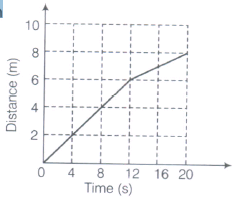
Given below as a figure is the distance-time graph of the motion of an
(a) What will be the position of the object at 20 s?
(b) What will be the distance travelled by the object in 12 s?
(c) What is the average speed ofthe object?
50.
Write the major steps by which we can conserve the forest.
51.
While learning to ride a bicycle, Boojho lost his balance and fell. He got bruises on his knees and it started bleeding. However, the bleeding stopped after sometime.
(a) Why did the bleeding stop?
(b) What would be the colour of the wounded area and why?
(c) Which type of blood cells are responsible for clotting of blood?
52.
During a field trip, some students visited an agricultural farm and saw a few birds eating earthworms. They enjoyed the scene and then they also started picking and killing the earthworms for pleasure. Seeing the crowd of students in a corner, the teacher rushed to them to see the matter and objected to their action. Anshul, one of the student asked the reason.
Teacher smiled and explained him that an earthworm living in the soil is very beneficial for farmers. Anshul wondered whether there were other organisms also in the soil. The teacher appreciated him and explained.
(a) Mention the importance of earthworm.
(b) List some organisms living in soil.
(c) What are the values shown by Anshul?
53.
Describe the process by which plants prepare their food using different raw materials.
54.
Nitesh was playing with his friends in the garden. Suddenly, Nitesh was stung by a honeybee and was in great pain. Immediately, his friends call his mother. She applied baking soda solution on the affected area and then took him to the doctor.
Read the above passage and answer the following questions:
(a) What could be the reason for this burning pain?
(b) Why did his mother applied baking soda solution on the affected area?
(c) What values are shown by Nitesh's friends?
55.
Plants needs water for:
Transport of nutrients
Transpiration
Respiration
Colouration
56.
Which one does not cause erosion of soil?
Fragmentation of rocks
Deforestation
Floods
Overgazing
57.
When the object is placed very dose to the lens, the image formed is virtual, erect and magnified, the lens is:
Convex lens
Concave mirror
Biconcave lens
All of these
58.
Which one is animal fibre?
Cotton
Silk
Polyester
Jute
59.
Lichens are the association of :
An autotroph and a saprotroph
An autotroph and a heterotroph
A green plant and non-green plant
All of the above
60.
If the number of turns in the coil of an electromagnet is more, the strength of the electromagnet will be
lesser
greater
double
same
61.
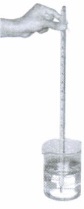
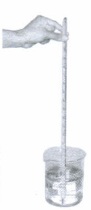
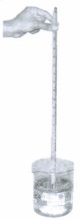
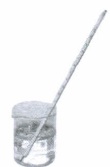
Four arrangements to measure temperature of ice in beaker with laboratory thermometer are shown in figure (a, b, c, d). Which one of them shows the correct arrangement for accurate measurement of temperature?
62.
Which of the following statements is/are true for sexual reproduction in plants?
(i) Plants are obtained from seeds
(ii) Two plants are always essential
(iii) Fertilisation can occur only after pollination
(iv) Only insects are agents of pollination
Choose from the options given below.
(i) and (iii)
only (i)
(ii) and (iii)
(i) and (iv)
63.
Which of the following is/are products of wastewater treatment?
Biogas
Sludge
Both biogas and sludge
Aerator
64.
On which axis is dependent variable represented?
x-axis
y-axis
On any axis
Depends on the data
65.
Minimum loss of energy takes place while we are
walking
swimming
running
Sleeping
66.
Which of the following does a forest prevent?
Floods
Soil erosion
Water table from going down
All of the above
67.
A man painted his main gate made up of iron, to
(i) and (ii)
(ii) and (iii)
Only (ii)
(i) and (iii)
68.
Formation of thunderstorm requires
moisture
rapidly rising warm air
sea breeze
All of the above
69.
Aquatic animals like fish excrete their wastes in gaseous form as
oxygen
hydrogen
ammonia
nitrogen
70.
Which of the following pair of teeth differ in structure but are similar in function?
Canines and incisors
Molars and premolars
Incisors and molars
Premolars and canines
71.
Which of the following briefly describes the desert climate?
Hot and humid
Dry and humid
Hot and dry
Hot and wet
72.
When the soil is too basic, plants do not grow well in it. To improve its quality, what must be added to the soil?
Organic matter
Quicklime
Slaked lime
Calamine solution
1.
The chest cavity is separated from the abdomen by a muscular wall called diaphragm. When diaphragm moves downwards and ribs move up and outward, the space in chest cavity increases. As a result, air from atmosphere rushes through nose, trachea to lung (inhalation or inspiration). When the diaphragm moves upwards to its original position, ribs move down and inward, the space in the chest cavity decreases. As a result, air from lung is forced out of the body through air passage (exhalation or expiration).
2.
(i) The radiation of the Sun gives us heat which do not require any medium.
(ii) White colour absorbs less heat coming from Sun and more it reflects. The temperature of any object increases due to absorbed part of the heat, in case of white colour it is least.
(iii) Her mother preferred cotton clothes as they are light and porous through which air can pass easily and make our body cool, as the climate of Mumbai is temperate.
3.
Thunderstorm develops in hot humid tropical areas. The rising temperatures produce strong upward rising winds. These winds carry water droplets upwards where they freeze and fall down again.
The swift movement of the falling water droplets along with the rising air crete lightning and sound. This event is called thunderstorm.
4.
The wool obtained after shearing contains a substance called yalk which consists of complex chemical lanolin. In addition to it, the same wool contains suint, which is dried perspiration of sheep. These are removed by washing with soap-alkali preparation or some suitable detergent in tanks. This process is called scouring.
5.
(i) Concave lens.
(ii) The image formed is erect, virtual and diminished.
(iii) The characteristics of the image will not change on changing the position of object.
6.
7.
We face shortage of water mainly because water is not evenly distributed by the nature on the earth. Some places such as North East India get so much rains, so that it gets flooded almost every year.
On the other hand, Thar desert in Rajasthan may get rains rarely in the monsoon season. This uneven pattern of rains causes water scarcity in India at some places.
8.
9.
First sedimentation tank.
10.
The steps involved in the process of fertilisation are
(i) After pollination, pollen grains start growing into a pollen tube on the stigma passing through pistil.
(ii) The tube extends through the style and reaches to the ovules.
(iii) The pollen tube carries the male gametes called pollen grains.
(iv) Male gametes fuse with the egg (female gamete) present inside ovule and forms a zygote. This process is called fertilisation.
(v) Later zygote develops into an embryo and ovules develop into a seed.
(vi) Thus, seed carries an embryo with stored food and is covered by a hard protective covering called seed coat.
11.
After studying the figure given alongside, 0 or E is moving slower as the slope of distance-time graph of E is less than that of graph D.
12.
Photosynthesis is the process during which CO2 is used by the plants and O2 is released as a products. This O2 is used by the animals for their respiration and CO2 is released during it which is again used for photosynthesis by plants. In this way, O2 - CO2 cycle is balanced by plants.
13.
In human, the heart has four chambers. The two upper chambers are called the atria and the two lower chambers are called the ventricles. The partition between the chambers helps to avoid mixing up of blood rich in oxygen with the blood rich in carbon dioxide.
14.
Burning of wood is a chemical change while cutting of wood is a physical change because, during burning, new substances are formed. After burning, we cannot get original substance (i.e. wood) back. Cutting of wood into small pieces is a physical change because no new substance is formed.
15.
In dense forests, the tree cover (canopy) prevents rainwater from directly falling on the ground/soil. Also roots of the vegetation bind the soil particles and hold them together. As a result, soil erosion is minimised. But in barren, open fields, the soil is exposed to the falling rain. The soil particles become loose due to the impact of raindrops and the flow of water carries them away. The flowing water further erodes the soil surface aggravating erosion.
16.
Green plants are the source of energy for all the living organisms so that they can perform their normal functions. If all green plants and trees disappear, all the organism depending on them for food and shelter will also die.
The lack of gaseous exchange will lead to increase in amount of CO2, causing death in humans and other animals also. The cycle of life will gradually disappear.
17.
Polar bear have white fur. This is an adaptation of polar bear to blend it with the white background of ice or snow. This helps them to protect from their predators and also to catch their prey.
18.
Differences between acids and bases are as follows:
| Acids | Bases |
| They are sour in taste | They are bitter in taste |
| They turn blue litmus to red | They turn red litmus to blue |
| They are not soapy to touch | They are soapy to touch |
| They are soluble in water | They may or may not be soluble in water |
| They are corrosive in nature | They are not corrosive in nature. |
19.
The handles of most utensils are made of plastic and wood because plastic and wood are poor conductors of heat. We can easily hold the handle with bare hands even if the utensils are hot. This helps us to remove hot utensils from the flame.
20.
The air contains spores of bread mould which can survive in air for long time due to presence of a thick wall. When they fall on a piece of moist bread they germinate on it.
21.
MCBs (Miniature circuit breakers) are switches which automatically turn off when current in a circuit exceeds the safe limit. We turn them on and the circuit is once again complete
22.
15-18 times.
23.
The trees have crowns of different sized and types. These create different horizontal layers in the forest. These are known as understoreys. Giant and tall trees constitute the top layer followed by shrubs and tall grasses and herbs form the lowest layer.
24.
Sand clock is a clock used by Romans to measure a constant time called hour. It consists two chambers fitted over one another filled with an amount of sand and it takes exactly one hour to empty a chamber. Once the upper chamber is completely emptied, the chamber is turned upside down to record the time again. It is also called hour glass
25.
Take some turmeric and mix it in some water to make a paste. Deposit it on blotting paper of filter paper and dry it. Cut thin strips of the yellow paper so obtained. These thin strips are turmeric paper
26.
Basically it is used in making silk fibres
27.
The major surface area (71%) of the earth is covered with water. This imparts blue colour to the earth.
28.
Fruits and vegetable wastes, pesticides and herbicides are organic impurities present in sewage other than animal wastes, oil and urea.
29.
It is because the winds would have blown in the North-South direction either from North to South or from South to North. A change in direction is however caused by the rotation of the earth.
30.
Concave mirror is known as a converging mirror because it converges a beam of parallel rays of light (reflecting from it) at one point.
31.
Ripening of a fruit is a chemical change because after ripening, a new product with different properties is formed.
32.
Arteries carry blood at a very high pressure due to pumping action of heart hence, the need of thicker walls.
33.
The absorption percentage of water can be calculated by the formula given below
Percentage of water absorb
\(\frac { amount\quad of\quad water\quad absorted(in\quad ml) }{ amount\quad of\quad soil(in\quad gm) } x100\)
34.
The function of mucus is to protect the lining of stomach from the action of hydrochloric acid secreted by stomach lining.
35.
Leaves are referred to as food factories of plants. This is because, leaves synthesise food by the process of photosynthesies.
36.
Those animals that can live both in water and on land are called amphibian, e.g. frog.
37.
(a) Wastewater is passed through bar screens. Large objects like rags, sticks, cans, plastic packets, napkins are removed.
(b) Water then goes to a grit and sand removal tank. The speed of the incoming wastewater is decreased to allow sand, grit and pebbles to settle down.
(c)The water is then allow to settle in a large tank which is sloped towards the middle. Solids like faeces settle at the bottom and are removed with a scraper. This is the sludge. A skimmer removes the floatable solids like oil and grease. Water so cleared is called clarified water. The sludge is transferred to a separate tank where it is decomposed by the anaerobic bacteria. The biogas produced in the process can be used as fuel or can be used to produce electricity.
(d) Airis pumped into the clarified water to help aerobic bacteria to grow. Bacteria consume human waste, food waste, soaps and other unwanted matter still remaining in clarified water.
(e) After several hours, the suspended microbes settle at the bottom of the tank as activated sludge. The water is then removed from the top.
38.
The reasons of depletion of water table:
(1) Increase in population.
(2) Industrialisation.
(3) Agricultural activities.
(4) Scanty rainfall.
(5) Deforestation.
(6 Decrease in the effective area for seepage of water.
Effect of increasing population:
As the population increases, demand for construction of houses, shops, offices, roads and pavements is increased. This decreases the open areas like parks and playgrounds. This in turn decreases the seepage of rainwater into the ground. More over a huge amount of water is required for construction work. Often groundwater is used for this purpose.
So, on the one hand we are consuming more groundwater and on the other hand we are allowing less water to seep into the ground. This results in the depletion of water table.
39.
The disaster management of a cyclone involves:
(A) Effective Safety Measures:
(i) A cyclone forecast and warning service.
(ii) Rapid communication of warning to the government agencies, the ports, fisherman, ships and to the general public.
(iii) Construction of cyclone shelters in the cyclone prone areas and administrative arrangements for moving people fast to safer places.
(B) Action on the Part of the People:
(i) We should not ignore the warnings issued by the meteorological department through media like TV, radio or newspapers.
(ii) We should:
(a) make necessary arrangements to shift the essential household goods, domestic animals and vehicle etc., to safer places.
(b) avoid driving on roads through standing water, as floods may have damaged the roads and
(c) keep ready the phone numbers of all emergency services; like police, fire brigade and medical centre. Some other precautions if you are staying in a
cyclone prone area:
(1) Do not drink water that could be contaminated. Always store drinking water for emergencies.
(2) Do not touch wet electric switches and fallen powerlines.
(3) Do not pressurise the rescue force by making undue demands.
40.
If we leave a piece of iron in the open for some time, it acquires a coating of brownish substances. This substance is called rust and the process of its formation is called rusting. This is the change that effects iron articles and slowly destroys them. Since iron is used in making bridges, ships, cars, truck bodies and many other articles. The monetary loss due to rusting is huge. For rusting the presence of both oxygen and water (or water vapour) is essential. Infact, if the moisture content in air is high which means if it is more humid, rusting becomes faster.
Methods of preventing rust formation: Rusting of an iron object can be prevented or reduced by not allowing air and moisture to come in contact with the surface of iron objects. Following are the methods of prevention form rusting.
(i) Putting oil or paint over the surface of iron implements.
(ii) Galvanization: In this method, surface of iron is covered with a layer of more active metal like zinc. Zinc metal looses electrons in preference to iron and hence, prevents the rusting of iron.
(iii) By tin-plating
(iv) Use of anti-rust solutions: Alkaline chromate and alkaline phosphate solution act as anti-rust solutions. When iron objects are dipped into a boiling and strongly alkaline solution of sodium phosphate, a protective insoluble film of iron phosphate is formed on them. This film protects the article form rusting.
41.
Fibres and fabric play a large role in everyday application. A fibre is a hair-like strand of material. They are the smallest visible unit of a fabric and denoted by being extremely long in relation to their width. Fabric can be spun into yarn and made into fabric.A single fibre is too week to break but when it one made a fabric it is difficult to tear. Fabric needs more energy to tear apart as compared to single fibre.
42.
All changes in the weather are caused by the sun. The energy sent out by the sun is so huge that it is the source of all heat and light on the earth. Energy absorbed and reflected by the earth surface, oceans and the atmosphere play an important role in determining weather of any particular place.
43.
The food of ruminants like grass is rich in cellulose (a type of carbohydrate). Ruminants have a large sac-like structure between the small intestine and large intestine. The cellulose of the food is digested here by the action of certain bacteria which are not present in humans. In this way ruminants can digest the cellulose but many animals including human can not digest cellulose.
44.
(a) No, the amount of heat produced in both the wires will be different because amount of heat produced in a wire on passing electric current depends on the length of wire and here length is different for both the wires.
(b) No, the amount of heat produced in the wire of same length but different thickness cannot be same because amount of heat produced in a wire also depends on the thickness of the wire.
45.
(a) The following precautionary measures while checking the fever through a clinical thermometer are
(i) While reading the clinical thermometer, it should never be held by the bulb.
(ii) The clinical thermometer should be washed properly (before and after use).
(b) The values showed by the elder brother of Pankaj, Vishwas, are concern towards the way of using the clinical thermometer and the importance of money as well.
46.
(a) Vegetative propagation is the process of reproduction in which new plants are produced from different parts of old plants like stem, roots or leaves.
(b) Cutting and grafting method are two methods where stem is used for vegetative propagation.
(c) Mango and rose are two plants cultivated using vegetative propagation.
This is an asexual method of reproduction.
(d) Ria is curious, inquiring who wants to gain knowledge about process occurring around here.
47.
The fishes have special type of organs for respiration called gills. These gills absorbs oxygen dissolved in water and through blood vessels, this oxygen is passed to all the parts of the body. The amount of dissolved oxygen is comparatively less in water than the amount of oxygen in air. Therefore, the rate of breathing is also high in aquatic animals.
If we add warm water, to the aquarium the dissolved oxygen will dissociate and move into the atmosphere again, leaving the least percentage of oxygen into the water (as it is known that the solubility of gases in water goes down as the temperature rises). Therefore, fishes will have difficulty in breathing in the absence of oxygen and will die.
48.
(a) Convex mirror is a mirror which is used as a rearview mirror. It is used to get a wide view of traffic behind.
(b) The values exhibit by Namit here is courtesy concerned for other, sympathy, knowledgeable.
49.
(a) From the graph, it is clear that the distance at 20 s is 8 m.
(b) Distance travelled by the body object in 12 s is 6 m.
(c) \(Average\ speed=\frac{Total\ distance}{Total\ time}=\frac{8}{20}=0.4m/s\)
50.
Forests maintain balance in nature. There conservation is the need of the hour. We should take the following steps to conserve the forests.
(i) Planned harvesting An efficient way to get wood from forests for our requirements is to cut only some of the trees in an area. The uncut trees prevent erosion. Fruits of these trees produce seeds so that new trees can grow. This way the forest cover is maintained.
(ii) Afforestation This is the practice of renewing a forest by planting seedlings or small trees. These days, in our country, planned afforestation is being done not only by the government but also by private organisations for commercial purposes. Selective cutting of trees in these plantations provides wood for construction and also keeps the forest cover intact.
(iii)Protection from fire Huge forest areas are destroyed by fire every year. Fire may occur due to the carelessness of people or due to lightning during a storm or by friction between dry stems and dry branches of trees.Forest fires are controlled by spraying fire extinguishing solutions from aircrafts or by changing the direction of wind by using strong blowers.
51.
(a) When a cut or wound starts bleeding after some time, a clot is formed which plugs the cut and bleeding stops.
(b) Wounded area becomes dark red in colour due to clotting of blood.
(c) The blood clot is formed due to the presence of the cells called platelets in the blood.
52.
(a) An earthworm helps in making the rich humus in soil.
(b) Ant, earthworm, termites, milipede, centipede, etc.
(c) Curiosity to learn and scientific attitude
53.
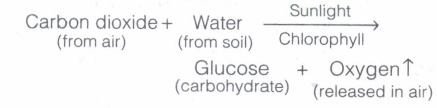
The process by which green plants can prepare their own food is called photosynthesis. Green plants possess chlorophyll in their leaf and utilises carbon dioxide (from air) water, minerals (from soil, through root) as raw material and sunlight as source of energy and convert light energy into chemical energy. The food thus synthesied is in the form of starch (carbohydrate). The overall reaction for photosynthesis can be given as follows:
54.
(a) The reason for this burning pain is honeybee sting which causes pain and irritation. This is due to the acidic liquid (formic acid) injected into the skin by the honeybee.
(b) The effect of acid can be neutralised by rubbing the affected area by baking soda solution which is a mild base.
(c) Nitesh's friends are caring, supportive and helpful.
55.
(a)
Transport of nutrients
56.
(a)
Fragmentation of rocks
57.
(a)
Convex lens
58.
(b)
Silk
59.
(b)
An autotroph and a heterotroph
60.
(b)
greater
61.
(a)
62.
(a)
(i) and (iii)
63.
(c)
Both biogas and sludge
64.
(b)
y-axis
65.
(d)
Sleeping
66.
(d)
All of the above
67.
(d)
(i) and (iii)
68.
69.
(c)
ammonia
70.
(b)
Molars and premolars
71.
(c)
Hot and dry
72.
(a)
Organic matter

7th Standard CBSE Syllabus & Materials
7th Standard CBSE
CBSE 7th Social Science Theme B - New Beginnings : Cities and States - New Sample Question Papers Study Material - QB365 Set A
NEW7th Standard CBSE
CBSE 7th Social Science Theme A - Climates of India - New Sample Question Papers Study Material - QB365 Set A
NEW7th Standard CBSE
CBSE 7th Social Science Theme A - Geographical Diversity of India - New Sample Question Papers Study Material - QB365 Set A
NEW7th Standard CBSE
CBSE 7th Science Earth, Moon and the Sun - New Sample Question Papers Study Material - QB365 Set A



CBSE 7th Standard CBSE Subjects
CBSE Standards




