
 100% FREE ACCESS
10th Standard CBSE Syllabus & Materials
10th Standard CBSE
CBSE 10th Social Science ECO - Globalisation and the Indian Economy - New Model Questions Papers Study Material - QB365 Set A
NEW10th Standard CBSE
CBSE 10th Social Science ECO - Money and Credit - New Model Questions Papers Study Material - QB365 Set A
NEW10th Standard CBSE
CBSE 10th Social Science ECO - Sectors of the Indian Economy - New Model Questions Papers Study Material - QB365 Set A
NEW10th Standard CBSE
CBSE 10th Social Science ECO - Development - New Model Questions Papers Study Material - QB365 Set A
NEW10th Standard CBSE
CBSE 10th Social Science PS - Outcomes of Democracy - New Model Questions Papers Study Material - QB365 Set A
NEW10th Standard CBSE
CBSE 10th Social Science PS - Gender, Religion and Caste - New Model Questions Papers Study Material - QB365 Set A

Published on: 02/03/2019
Acids, Bases and Salts important Questions
Download CBSE Class 10th Standard CBSE Science question papers, sample papers, important questions, and previous year solved papers in PDF format. Get free study materials, NCERT solutions, and exam preparation resources for Class 10th Standard CBSE Science
Questions + Answers key
Take MCQ Science Test
1.
You might have seen lemon or tamarind juice being used to clean tarnished surface of copper vessels. Explain why these sour substances are effective in cleaning the vessels?
2.
What is the change in pH values of milk when it changes into curd? Explain
3.
Write one word/term for the following:
(i) Water soluble base
(ii) A substance which dissociates on dissolving in water to produce hydrogen ions. [H+ (aq) ions]
(iii) A reaction between an acid and a base to form salt and water.
(iv) A substance which dissociates on dissolving in water to produce hydroxide ions [OH- ions]
4.
Two solutions A and B have pH values of 5 and 8 respectively. Which solution will be basic in nature?
5.
Given below are the pH values of four different liquids : 7.0, 14.0, 4.0, 2.0
Which of these could be that of
(i) lemon juice,
(ii) distilled water,
(iii) 1 M sodium hydroxide solution,
(iv) tomato juice
6.
Give the uses of bleaching powder.
7.
Write the chemical formula for washing soda. How may it be obtained from baking soda? Name an industrial use of washing soda other than washing clothes.
8.
How would you distinguish between baking powder and washing soda by heating?
9.
Equal lengths of magnesium ribbons are taken in test tubes A and B. Hydrochloric acid (HCl) is added to test tube A, while acetic acid \((CH_3COOH)\) is added to test tube B. Amount and concentration taken for both the acids are same. In which test tube, will the fizzing occur more vigorously and why?
10.
What will happen if a solution of sodium hydrocarbonate is heated? Give the equation of the reaction involved.
11.
Why do HCI, HNO3, etc., show acidic characters in aqueous solutions while solutions of compounds like alcohol and glucose do not show acidic characters?
12.
In an attempt to demonstrate electrical conductivity through an electrolyte, the following apparatus shown below was set up.
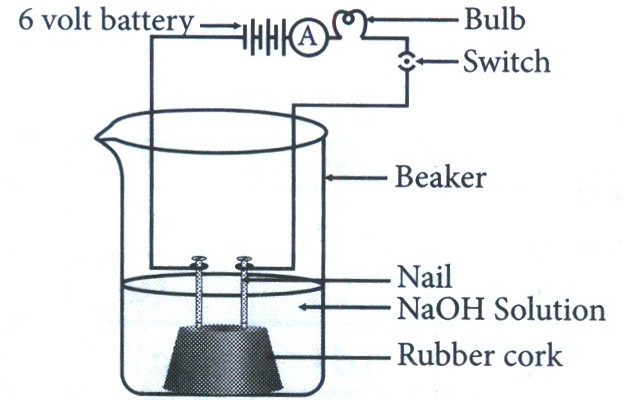
which among the following statement(s) is (are) correct?
(i) Bulb will not glow because electrolyte is not acidic
(ii) Bulb will glow because NaOH is a strong base and furnishes ions for conduction.
(iii) Bulb will not glow because circuit is incomplete.
(iv) Bulb will not glow because it depends upon the type of electrolytic solution.
(i) and (iii)
(ii) and (iv)
(ii) only
(iv) only
13.
Which of the following is (are) true when HCl (g) is passed through water?
(i) It does not ionise in the solution as it is a covalent compound.
(ii) It ionises in the solution
(iii) It gives both hydrogen and hydroxyl ion in the solution
(iv) It forms hydronium ion in the solution due to the combination of hydrogen ion with water molecule
(i) only
(iii) only
(ii) and (iv)
(iii) and (iv)
14.
Which of the following statement is not correct?
All metal carbonates react with acid to give a salt, water and carbon dioxide
All metal oxides react with water to give salt and acid
Some metals react with acids to give salt and hydrogen
Some non-metal oxides react with water to form an acid
15.
Which of the following phenomena occur, when a small amount of acid is added to water?
(i) Ionisation (ii) Neutralisation (iii) Dilution (iv) Salt formation
(i) and (ii)
(i) and (iii)
(ii) and (iii)
(ii) and (iv)
16.
One of the constituents of baking powder is sodium hydrogen carbonate, the other constituent is
hydrochloric acid
tartaric acid
acetic acid
sulphuric acid
17.
Sodium carbonate is a basic salt because it is a salt of
Strong acid and strong base
weak acid and weak base
strong acid and weak base
weak acid and strong base
18.
A solution turns red litmus blue; its pH is likely to be?
1
4
5
10
19.
Account for the following:
(i) State the relation between hydrogen ion concentration of an aqueous solution and its pH.
(ii) An aqueous solution has a pH value of 7.0. Is this solution acidic, basic or neutral?
(iii) Which has a higher pH value, 1MHCl or 1MNaOH solution?
(iv) Tooth enamel is one of the hardest substances in our body. How does it undergo damage due to eating chocolates and sweets? What should we do to prevent it?
(v)How do [H+] ions exist in water?
20.
(i) Define universal indicator. For what purpose it is used?
(ii) Two solutions A and B have pH values of 3.0 and 9.5 respectively. Which of these will turn litmus solution from blue to red and which will turn phenolphthalein from colourless to pink?
(iii) Water is a neutral substance. What colour will you get when you add a few drops of the universal indicator to a test tube containing distilled water?
21.
(a) Why is sulphuric acid called 'King of Chemicals'?
(b) Describe the three chemical reactions that take place during the conversion of sulphur dioxide to sulphuric acid in the 'Contact Process'.
(c) Why should water be never added drop wise to concentrated sulphuric acid?
22.
A dry pellet of a common base B, when kept in open absorbs moisture and turns sticky. The compound is also a by-product of chlor-alkali process. Identify B. What type of reaction occurs when B is treated with an acidic oxide? Write a balanced chemical equation for one such solution.
23.
For making cake, baking powder is taken. If at home your mother uses baking soda instead of baking powder in cake,
(a) How will it affect the taste of the cake and why?
(b) How can baking soda be converted into baking powder?
(c) What is the role of tartaric acid added to baking soda?
24.
A student takes three beakers A, B and C filled with aqueous solution of glucose, alcohol and hydrochloric acid respectively as shown in the following figure:
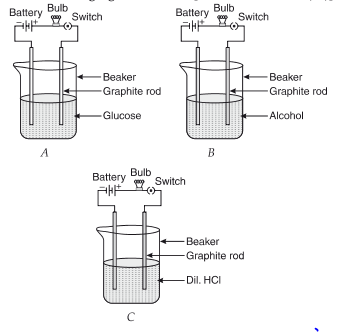
(i) State your observation in terms of glowing of the bulb when the switch is on.
(ii) Justify your observations by giving a reason in each case.
(iii) Mention the change noticed with appropriate reason if the content of beaker B is replaced by sodium hydroxide solution.
25.
15 mL of water and 10 mL of sulphuric acid are to be mixed in a beaker
(i) State the method that should be followed with reason.
(ii) What is this process called?
26.
(i) Giving a reason for each, state which of the following will conduct electricity and which will not:
(a) A solution of glucose
(b) Dil. Hydrochloric acid?
(ii) If acetic acid and hydrochloric acid of same concentration are taken, which of the two is,1 stronger acid and why?
(iii) How is the strength of an acid affected when some water is added to it?
27.
A liquid has a pH less than 7 which represent all acidic solution:
(i) State the nature of the solution, if its pH increases from 7 to 14.
(ii) Mention the ion whose concentration increases with the increase in pH value.
(iii) Suggest a method that is generally used for measuring the pH value.
28.
(i) Write the name given to bases that are highly soluble in water. Give an example.
(ii) How is tooth decay related to pH? How can it be prevented?
(iii) Why does bee-sting cause pain and irritation? Rubbing of baking soda on the sting area gives relief. How?
1.
Lemon juice contains citric acid and tamarind contains tartaric acid. These acids react with a basic layer of copper carbonate on the surface to form soluble salts which are easily removed and surface shines.
2.
pH decreases.
It is due to the formation of lactic acid in the curd. Since, acids generally have a low pH value, when milk changes to curd its pH will decrease.
3.
(i) Alkali
(ii) Acid
(iii) Neutralization reaction
(iv) Base
4.
B will be basic nature, with pH = 8.
5.
| pH | Liquid |
| 7.0 | Distilled Water |
| 14.0 | 1 M sodium hydroxide solution |
| 4.0 | Tomato juice |
| 2.0 | Lemon juice |
6.
(i) Used in bleaching cotton, Wood pulp, clothes.
(ii) Used as oxidising agent in chemical industries.
(iii) Used as disinfectant to kill germs in drinking water.
7.
The chemical formula of washing soda is \(Na_2CO_3.10H_2O.\)
Washing soda. On heating, baking soda gives sodium carbonate, carbon dioxide and water. Consequently, the recrystallisation of sodium carbonate gives washing soda. The chemical equations involved in the process are:
\(\underset{Baking\ soda}{2NaHCO_3}\rightarrow \underset{Sodium\ carbonate}{Na_2CO_3}+\underset{Carbon\ dioxide}{CO_2}+\underset{Water}{H_2O}\)
\(Na_2CO_3\rightarrow10H_2O\xrightarrow {Recrystallization}\underset{Washing\ soda}{Na_2CO_3.10H_2O}\)
Washing soda is used in glass, soap and paper industries.
8.
The chemical formula of baking powder is sodium hydrogen carbonate \((NaHCO_3).\) while, that of washing soda is sodium carbonate carbonate on heating gives \(CO_2\) gas which will turn lime water milky whereas no such gas is obtained from sodium carbonate.
\(2NaHCO_3\xrightarrow {Heat}Na_2CO_3+H_2O+CO_2\)
\(NA_2CO_3.10H_2O\xrightarrow {Heat}Na_2CO_3+10H_2O\)
9.
(i) Reaction occurs in test tube A
2HCl(aq) + Mg(s) \(\rightarrow\) MgCl2(aq) + H2(g)
(ii) Reaction occurs in test tube B
2CH3COOH (aq) + Mg(s) \(\rightarrow\) (CH3COO)2Mg(aq) + H2(g)
Fizzing occurs in both the test tubes due to the evolution of H2 gas but it is faster in test tube A because of the greater extent of dissociation of HCI (strong acid) as compared to B as CH3COOH is not completely dissociated (weak acid).
10.
When sodium hydrogen carbonate is heated, carbon dioxide gas is produced alongwith sodium carbonate.
2NaHCO3 (s) \(\xrightarrow[]{Heat}\) Na2CO3(s) + H2O(l) + CO2(g) \(\uparrow\)
Sodium hydrogen carbonate Sodium carbonate Water Carbon dioxide
11.
Acidic character of a compound is due to the presence of replaceable H+ ions, which are released in aqueous solution and are responsible for acidic properties. As HCI, HNO3 etc have replaceable H+ ions, they show acidic character while glucose and alcohol do not have replaceable H+ ions, hence, no acidic character is shown by them.
12.
(c)
(ii) only
13.
(c)
(ii) and (iv)
14.
(b)
All metal oxides react with water to give salt and acid
15.
(b)
(i) and (iii)
16.
(b)
tartaric acid
17.
(d)
weak acid and strong base
18.
(d)
10
19.
(i) If H+ ion concentration is more, pH will be less and vice versa or pH of a solution is inversely proportional to H+ ion concentration or pH 52 log (H+).
(ii) This solution is neutral.
(iii) 1MNaOH solution.
(iv) When the pH in the mouth is below 5.5, bacteria present in the mouth produce acids by degradation of sugar and corrode the tooth enamel. It can be prevented by using tooth pastes which are generally basic.
(v) As hydronium [H3O]+ ion.
20.
(i) Universal indicator is a mixture of many different indications (or dyes) which give different colours at different pH values of the entire pH scale. The colour produced by the universal indicator is used to find the pH value of acid or base by matching the colour with the colours on pH colour chart.
(ii) Solution A is acidic and will turn litmus solution from blue to red.
Solution B is basic and will turn phenolphthalein from colourless to pink.
(iii) Green colour will be obtained.
21.
(a) Concentrated sulphuric acid is called the king of chemicals as it is a very strong acid and is highly corrosive.
(b) The three chemical reactions that take place during the conversion of sulfur dioxide to sulphuric acid in the 'Contact Process' are given below.
Step I: Sulphur dioxide is mixed with air and passed over vanadiumpent (V) oxide catalyst heated to \(450^oC\) to form sulphur trioxide.
\(\underset{Sulphur\ dioxide}{2SO_{2(g)}}+\underset{Oxygen}{O_{2(g)}}\underset{\rightleftharpoons }{V_2O_5}\underset{Sulphur\ trioxide}{2SO_{3(g)}}+Heat\)
Step II : Sulphur trioxide is dissolved in concentrated sulphuric acid to form a thick fuming liquid called oleum.
\(\underset{Sulphuric\ acid}{H_2SO_4(l)}+\underset{Sulphur\ trioxide}{SO_{3(g)}}\begin{matrix} V_2O_5 \\ \rightleftharpoons \\ \end{matrix}\underset{Oleum}{H_2S_2O_{7(l)}}\)
Step III: Oleum is diluted with a calculated quantity of water to obtain sulphuric acid.
\(H_2S_2O_{7(l)}+\underset{Water}{H_2O_{(l)}}\rightarrow\underset{Sulphuric\ acid}{2H_2SO_{4(aq)}}\)
(c) If water is added to sulphuric acid then a large amount of heat is evolved. This changes water to steam, which can splash the acid. Hence, it is dangerous.
22.
Sodium hydroxide (NaOH) is a commonly used base and is hygroscopic, that is, it absorbs moisture from the atmosphere and becomes sticky. The acidic oxides react with base to give salt and water. The reaction between NaOH and \(CO_2\) can be given as \(2NaOH+CO_2\rightarrow Na_2CO_3+H_2O\)
23.
(a) Baking soda is sodium hydrogen carbonate. On heating, it is converted carbonate. On heating, it is converted into sodium carbonate which is bitter to taste.
\(2NaHCO_3\xrightarrow{Heat}Na_2CO_3+H_2O+CO_2\)
(b) Baking soda can be converted into baking powder by the addition of appropriate acid to it.
(c) The role of tartaric acid is to neutralise sodium carbonate and cake will not taste bitter.
24.
(i) Bulb A and B do not glow but bulb C glows.
(ii) Glucose and alcohol solutions do not conduct electricity as they do not have ions. Dil. HCI contains ions so the flow of ions is responsible for the flow of current
(iii) After replacement, bulb glows in B as NaOH solution contains ions (Na+ and OH- ions).
25.
(i) The acid is to be added slowly in water to prevent the mixture to be splashed. The reaction is highly exothermic, therefore, constant cooling should be done.
(ii) The process is called dilution.
26.
(i) (a) A solution of glucose will not conduct electricity because it does not have ions.
(b) Oil. HCl will conduct electricity because it produces H+ ions in water.
(ii) HCI is stronger because it gives rise to more H+ ions than acetic acid.
(iii) The strength of the acid decreases.
27.
(i) Increase in the strength of alkali. So the nature of solution will be basic.
(ii) Hydroxide ion or hydroxyl ion or OH- ion.
(iii) A paper impregnated with the universal indicator is generally used to measure the pH of a solution.
28.
(i) Alkali. e.g., NaOH (Sodium hydroxide).
(ii) Tooth decay starts when the pH of the mouth is lower than 5·5.It can be prevented by using tooth pastes which are generally basic.
(iii) Bee-sting has acid that causes pain and irritation. Baking soda is alkaline, neutralises the acid and gives relief.

10th Standard CBSE Syllabus & Materials
10th Standard CBSE
CBSE 10th Social Science PS - Federalism - New Model Questions Papers Study Material - QB365 Set A
NEW10th Standard CBSE
CBSE 10th Social Science PS - Power Sharing - New Model Questions Papers Study Material - QB365 Set A
NEW10th Standard CBSE
CBSE 10th Social Science GEO - Manufacturing Industries - New Model Questions Papers Study Material - QB365 Set A
NEW10th Standard CBSE
CBSE 10th Social Science GEO - Minerals and Energy Resources - New Model Questions Papers Study Material - QB365 Set A



CBSE 10th Standard CBSE Subjects
CBSE Standards





