
 100% FREE ACCESS
7th Standard CBSE Syllabus & Materials
7th Standard CBSE
CBSE 7th Social Science Theme E - Understanding Market - New Sample Question Papers Study Material - QB365 Set A
NEW7th Standard CBSE
CBSE 7th Social Science Theme E - From Barter to Money - New Sample Question Papers Study Material - QB365 Set A
NEW7th Standard CBSE
CBSE 7th Social Science Theme D - The Constitution of India- An Introduction - New Sample Question Papers Study Material - QB365 Set A
NEW7th Standard CBSE
CBSE 7th Social Science Theme D - From the Rulers to the Ruled : Types of Governments - New Sample Question Papers Study Material - QB365 Set A
NEW7th Standard CBSE
CBSE 7th Social Science Theme B - The Age of Reorganisation - New Sample Question Papers Study Material - QB365 Set A
NEW7th Standard CBSE
CBSE 7th Social Science Theme B - The Rise of Empires - New Sample Question Papers Study Material - QB365 Set A

Published on: 30/07/2018
In Acids, Bases and Salts contains important questions in CBSE 7th Standard Science. It also covered with the most important questions in Acids, Bases and Salts.
Teachers please subscribe Now and Create Unlimited 7th Standard Science question papers with answer keys. For subscription, please Click Here.
Download CBSE Class 7th Standard CBSE Science question papers, sample papers, important questions, and previous year solved papers in PDF format. Get free study materials, NCERT solutions, and exam preparation resources for Class 7th Standard CBSE Science
Questions + Answers key
Take MCQ Science Test
1.
Name three bases used in the laboratory with their formulae.
2.
Write the effect of China rose petals on acidic and basic solutions.
3.
Explain why
(a) an antacid tablet is taken when you suffer from acidity?
(b) calamine solution is applied on the skin when an ant bites?
(c) Is factory waste neutralised before disposing it into the water bodies?
4.
Describe the process of neutralisation with the help of an example.
5.
State differences between acids and bases.
6.
Calamine can be used to treat ant's sting.
7.
Lime water turns red litmus blue.
8.
All substances are either acidic or basic.
9.
Indicator is a substance which shows different colours in acidic and basic solutions.
10.
Sodium hydroxide turns blue litmus to red.
11.
Form a sentence using the following words: baking soda, ant bite, moist, effect, neutralised, rubbing.
12.
Write two basic substances which we use in our daily life.
13.
Why does a turmeric stain on white shirt is turned to red when it is washed with soap?
14.
Write the name of two indicators which occur naturally.
15.
What is the test for acids and bases using litmus paper?
16.
One day Rahul's mother after taking meal felt pain and irritation in her stomach. His father was out of station. Rahul was an intelligent boy. He remembered his teacher's statement and gave his mother some baking soda solution which gave her a relief from pain and irritation of the stomach.
Read the above passage and answer the following questions.
(a) Which information given by Rahul's teacher that helped him to select the baking soda as a remedy?
(b) Why he selects baking soda as a cure?
(c) What values are shown by Rahul?
17.
You are provided with three test tubes A, B and C as shown in the figure with different liquids.
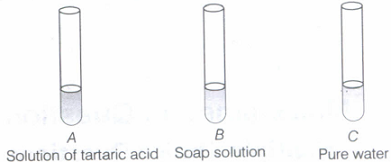
What will you observe when you put
(a) a piece of blue litmus paper in each test tube?
(b) a piece of red litmus paper in each test tube?
(c) a few drops of phenolphthalein solution to each test tube?
18.
Which of the following sets of substances contains acids?
Grapes, lime water
Vinegar, soap
Curd, milk of magnesia
Curd, vinegar
19.
Neutralisation reaction is a
physical and reversible change
physical change that cannot be reversed
chemical and reversible change
chemical change that cannot be reversed
20.
When the soil is too basic, plants do not grow well in it. To improve its quality, what must be added to the soil?
Organic matter
Quicklime
Slaked lime
Calamine solution
21.
Turmeric is a natural indicator. On adding its paste to acid and base separately, which colours would be observed?
Yellow in both acid and base
Yellow in acid and red in base
Pink in acid and yellow in base
Red in acid and blue in base
22.
The correct way of making a solution of acid in water is to
add water to acid
add acid to water
mix acid and water simultaneously
add water to acid in a shallow container
23.
Acids turn blue litmus ________
24.
Acetic acid is present in __________ while __________ is present in lemon.
25.
The substances which show different colours in acidic, basic and neutral solutions are called __________
26.
Phenolphthalein gives ___________ colour with lime water.
27.
Lemon juice and vinegar taste _________ because they contain __________
1.
Bases which are mostly used in the laboratory as below
(i) Sodium hydroxide (NaOH)
(ii) Calcium hydroxide [Ca(OH2)]
(iii) Ammonium hydroxide (NH4OH)
2.
China rose petals when added to warm water, form a light pink coloured solution which may be used as an indicator. This indicator turns acidic solution to magenta (deep pink) and basic solution to green.
3.
(a) We take an antacid tablet such as milk of magnesia to neutralises the excessive acid released in the stomach.
(b) When an ant bites, it injects the formic acid into the skin. The effect of acid can be neutralised by applying calamine solution that contains zinc carbonate.
(c) The factory wastes contain acids if they are allowed to flow into the water bodies, the acid will kill fishes and other organisms. The factory wastes are thus neutralised by adding basic substances.
4.
The reaction between an acid and a base is known as neutralisation reaction. In this reaction, both acid and base cancel each other's effect. Neutralisation reaction results in the formation of salt and water. During this reaction, energy in the form of heat is evolved.
Acid + Base \(\longrightarrow\) Salt + Water + Heat \(\uparrow\)
e.g. when sodium hydroxide (NaOH) is added to hydrochloric acid (HCI), sodium chloride (NaCl) and water (H2O) are obtained.
NaOH + HCI \(\longrightarrow\) NaCI + H2O + Heat \(\uparrow\)
Sodium Hydrochloric Sodium Water
hydroxide Acid Chloride
5.
Differences between acids and bases are as follows:
| Acids | Bases |
| They are sour in taste | They are bitter in taste |
| They turn blue litmus to red | They turn red litmus to blue |
| They are not soapy to touch | They are soapy to touch |
| They are soluble in water | They may or may not be soluble in water |
| They are corrosive in nature | They are not corrosive in nature. |
6.
(a)
7.
(a)
8.
(b)
9.
(a)
10.
(b)
11.
The effect of an ant bite can be neutralised by rubbing moist baking soda.
12.
(i) Baking soda
(ii) Soap or detergent
13.
Turmeric stain on white shirt is turned to red when it is washed with soap because the soap solution is basic in nature.
14.
(i) Turmeric
(ii) China rose
15.
Acids turn blue litmus paper red while bases turn red litmus paper blue.
16.
(a) Rahul knows that our stomach contains hydrochloric acid. It helps us to digest food. But, too much acid in the stomach causes indigestion. Sometimes, indigestion is painful and some mild base should be taken to relief from this pain. So, this information given by his teacher helped him.
(b) He gave her mother baking soda solution which was available in the kitchen easily. He selects baking soda because it is a mild base and neutralises the excess acid in the stomach and it will give relief from pain.
(c) Rahul is very intelligent and caring boy.
17.
| Test tube | Effect on blue litmus paper | Effect on red litmus paper | Effect on phenolphthalein solution |
| A | Turns red | Remains red | Colourless |
| B | Remains blue | Turns blue | Pink colour |
| C | Remains blue | Remains red | Colourless |
18.
(d)
Curd, vinegar
19.
(d)
chemical change that cannot be reversed
20.
(a)
Organic matter
21.
(b)
Yellow in acid and red in base
22.
(b)
add acid to water
23.
()
red
24.
()
vinegar, citric acid
25.
()
indicators
26.
()
Pink
27.
()
sour, acids

7th Standard CBSE Syllabus & Materials
7th Standard CBSE
CBSE 7th Social Science Theme B - New Beginnings : Cities and States - New Sample Question Papers Study Material - QB365 Set A
NEW7th Standard CBSE
CBSE 7th Social Science Theme A - Climates of India - New Sample Question Papers Study Material - QB365 Set A
NEW7th Standard CBSE
CBSE 7th Social Science Theme A - Geographical Diversity of India - New Sample Question Papers Study Material - QB365 Set A
NEW7th Standard CBSE
CBSE 7th Science Earth, Moon and the Sun - New Sample Question Papers Study Material - QB365 Set A



CBSE 7th Standard CBSE Subjects
CBSE Standards




